
Arabica–Robusta Blend Ratios Compared: A Blind Tasting for Espresso and Milk Drinks
Arabica–Robusta blend ratios can change an espresso’s aroma, bitterness, body and perceived sweetness, but the result depends on the green coffees, roast development, dose, extraction and milk recipe. This research-only guide compares blend ratios through published evidence and a repeatable tasting plan. Caffeine Brothers did not conduct the blind tasting described in the original brief, so the ratio table below is a set of testable starting hypotheses, not reported Caffeine Brothers results.
Quick answer
For a controlled espresso comparison, start with the same roast level, dose, basket, water and target yield. Compare 100% Arabica, 80:20 Arabica–Robusta, 70:30, 50:50 and 20:80 by weight. Treat the ratios as a ladder: more Robusta may increase perceived body, bitterness and crema potential in some coffees, while the cup’s actual balance still depends on quality, processing and roast. Published chemistry and sensory research supports comparing proportions, but it cannot predict the result of an untested Caffeine Brothers blend.
Freshly roasted Philippine coffee
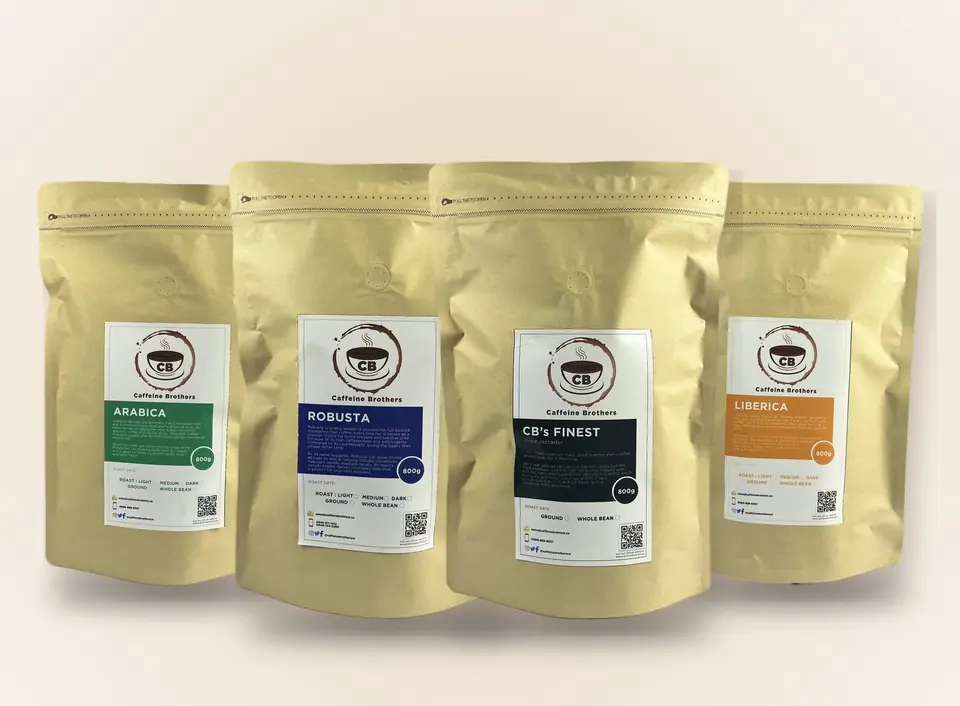
Shop our coffee beans: Arabica, Robusta, Kapeng Barako and signature blends, roasted daily in Manila, whole bean or ground. Not sure which? Take the Coffee Match Quiz.
Shop Coffee Beans →Contents
- What changes as Robusta increases?
- What published research supports
- Ratio comparison table
- Espresso recipe starting points
- How to compare milk drinks
- A blind-tasting protocol you can run
- Cost and menu implications
- Frequently asked questions
What changes as Robusta increases?
Arabica and Robusta are commercial species groups: Coffea arabica and Coffea canephora. World Coffee Research explains that they are distinct species groups with different genetic histories and variety pools. Species labels alone do not determine cup quality; variety, farm conditions, processing, storage and roast all matter.
- Aroma and flavor: proportion changes can alter volatile-compound profiles. A peer-reviewed study by Sanz and colleagues found that moving from an 80:20 Arabica–Robusta blend toward 20:80 changed the amounts of multiple volatile-compound families and changed sensory results.
- Body and bitterness: these are useful attributes to score, not guaranteed outcomes. Record intensity and quality separately; “more bitter” does not automatically mean “better body.”
- Milk performance: milk and sugar reduce perceived acidity and bitterness and add their own aroma and texture. A milk-drink result cannot be inferred from a black espresso score alone.
What published research supports
The World Coffee Research Sensory Lexicon provides a shared vocabulary for flavor, aroma and texture. Use descriptors such as bitter, brown spice, roasted, earthy, cocoa, nutty, astringent and creamy only when they match what a taster perceives; do not turn the lexicon into a claim about an untested blend.
Sanz et al. (2002) compared Arabica–Robusta proportions and reported changes in volatile families and sensory analysis. That study supports testing ratios under controlled conditions; it is not a result for Caffeine Brothers’ current products.
A recent milk-beverage study compared 100% Arabica with a 70:30 Arabica–Robusta blend in chilled sweetened coffee and found that the milk alternative had a stronger effect on acceptance than the coffee type in that specific design. See the open-access Food study. Its formulation and consumer sample are different from a Philippine café latte, so use it as context rather than a local preference claim.
For espresso control, the primary research paper Systematically Improving Espresso shows why dose, beverage mass and extraction conditions must be held steady when comparing coffees. A ratio comparison without recipe control is not a fair comparison.
Arabica–Robusta ratio comparison table
These are research-planning hypotheses, not tasting findings. Use the same beans and roast development where possible, then replace the “watch for” column with your recorded notes.
| Blend by weight | What to watch for in black espresso | What to watch for with milk | Best use of the test |
|---|---|---|---|
| 100:0 | Acidity, aroma clarity, sweetness and finish | Whether flavor remains distinct after dilution | Arabica reference cup |
| 80:20 | Whether added body supports, or masks, sweetness | Balance in a flat white or cappuccino | Moderate blend step |
| 70:30 | Body, bitterness, aftertaste and crema appearance | Whether coffee remains present in a latte | Common test point for milk drinks |
| 50:50 | Intensity, roast notes, bitterness and tactile weight | Whether the cup becomes heavy or muddy | Midpoint stress test |
| 20:80 | Robusta character, bitterness, astringency and finish | Whether milk rounds the cup without erasing defects | High-Robusta boundary test |
Espresso recipe starting points
Use one recipe for every ratio before making a second pass. A practical starting point is 18 g dose, 36 g beverage mass and a 25–32 second contact-time window. This is a recipe recommendation, not a universal standard or a Caffeine Brothers test result. If a blend runs differently, change only grind size first, then record the change.
- Weigh the same dose into the same basket.
- Use the same water, temperature, distribution and tamp.
- Stop each shot at the same beverage mass.
- Record dose, yield, time, grinder setting and tasting temperature.
- Score each cup before seeing the ratio label.
For café consistency, connect the recipe card to a portion-control and waste-reduction training guide. Include dial-in losses separately from the tasting score.
How to compare milk drinks
Choose one milk drink and keep its build constant. For example, use one espresso dose and beverage mass, 150–180 ml of the same milk, and the same final beverage temperature. Score coffee presence, bitterness, sweetness, texture and aftertaste. A latte can hide acidity and bitterness more than a short milk drink, so do not use one format as a proxy for every menu item.
If you sell several formats, compare the winning ratio in a flat white, cappuccino and latte as separate decisions. Then review the result alongside your coffee menu pricing guide and coffee-shop margin analysis; sensory preference and financial fit are different measurements.
A blind-tasting protocol you can run
- Prepare five coded samples: 100:0, 80:20, 70:30, 50:50 and 20:80.
- Randomize serving order for each taster so the ratio sequence does not bias the result.
- Use the same roast date range, grind workflow, dose, yield, water and milk.
- Have tasters score aroma, acidity, sweetness, bitterness, body, aftertaste, coffee presence in milk and overall preference on a 1–5 scale.
- Collect comments before revealing the codes. Report the number of tasters, preparation details, score scale and any exclusions.
- Repeat on another day if one shot or milk pitcher was clearly defective. Do not average away a preparation error without recording it.
This protocol creates your own result. Until someone runs it and records the data, no ratio in this article should be described as the best blend or the preferred Caffeine Brothers formula.
Cost and menu implications
Calculate blend cost by weight: (Arabica share × Arabica price/kg) + (Robusta share × Robusta price/kg). For a 70:30 blend, multiply Arabica price by 0.70 and Robusta price by 0.30, then add the two results. This is an illustrative formula; use current supplier quotations and account for roast loss, packaging and waste.
For purchasing, include test doses and dial-in waste in your order plan with the beans-per-month calculator. If you change the blend, update the recipe cost before changing a menu price.
Frequently asked questions
Is 70:30 automatically the best Arabica–Robusta blend?
No. It is a useful test point, and published studies cannot establish the best result for a different roast, origin, machine, milk or customer group.
Does more Robusta always mean more crema?
No universal rule should be used for a purchasing decision. Crema depends on coffee composition, roast, freshness, grind, dose, pressure and extraction. Record what your own recipe produces.
Should I taste the blends as espresso or with milk?
Both, if the blend will be used in both formats. Score black espresso and milk drinks separately because milk changes perception.
Can I call this a blind tasting?
Only after a real blind tasting has been performed and its method and results are reported. This article is a research-only guide and does not report a Caffeine Brothers tasting.
References
- World Coffee Research Sensory Lexicon.
- World Coffee Research: understanding Arabica and Robusta species groups.
- Sanz et al. (2002), volatile compounds and sensory analysis of Arabica–Robusta blends.
- Food (MDPI) study comparing Arabica and a 70:30 Arabica–Robusta blend in chilled sweetened coffee.
- Systematically Improving Espresso: Insights from Mathematical Modeling and Experiment.
Sources accessed October 1, 2026. This is a research-only reframe. Caffeine Brothers did not perform or report the blind tasting described in the original brief.
 Previous Post