How Much Coffee Is Lost During Espresso Dial-In? How to Measure It
Espresso dial-in waste is the coffee a café uses while adjusting a grinder and recipe before service. This guide shows how to measure it, separate avoidable loss from quality-control use, and estimate the peso cost. The scenarios below are illustrative planning examples, not measured results from a specific café.
Quick answer
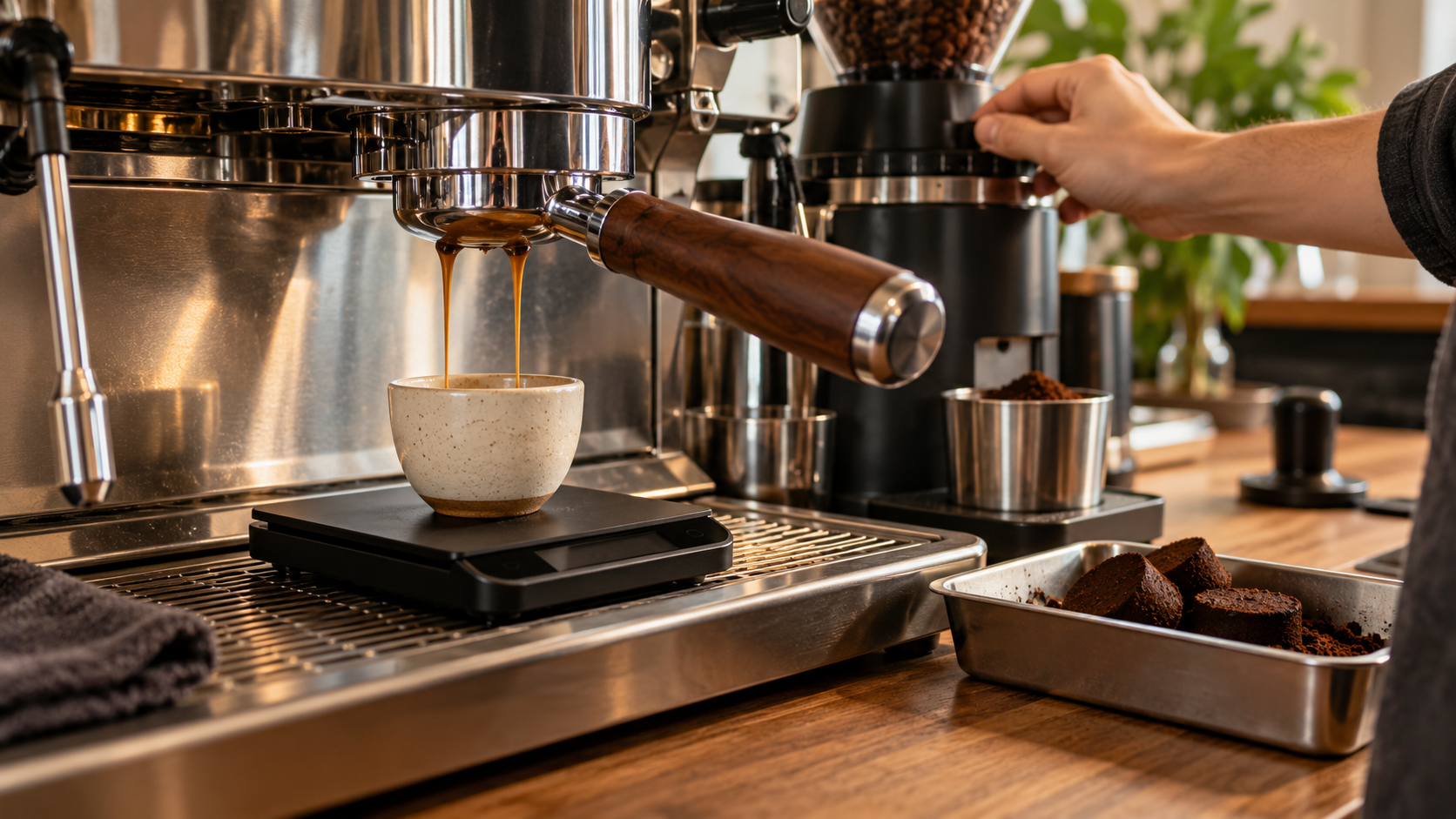
This espresso dial-in waste framework tracks every test-shot dose, grinder purge, measured retention or exchange loss, spill, and rejected remake. Weigh coffee in grams, then apply waste grams ÷ 1,000 × bean price per kilogram. A café using a 140-gram illustrative dial-in allowance at PHP950/kg would account for PHP133.00 of beans for that session. Your own scale log—not a generic benchmark—should set the operating allowance.
Beans made for espresso and milk drinks
For lattes, cappuccinos and iced coffee, try our Arabica-Robusta Blend or bold Robusta, roasted daily and ground to order for espresso or moka pot.
Shop the Blend →Contents
- What Counts as Espresso Dial-In Waste?
- What the published research supports
- How to Measure Espresso Dial-In Waste
- The waste and cost formulas
- Illustrative Espresso Dial-In Waste Scenarios
- How to reduce waste without hiding quality problems
- Frequently asked questions
What Counts as Espresso Dial-In Waste?
Use separate categories so a manager can see what can be reduced:
- Evaluation shots: doses ground and brewed to assess flow, taste, or yield after a grind, dose, or distribution change.
- Grinder purge: beans deliberately run through to clear retained coffee after a setting change. Weigh it rather than estimating it.
- Retention or exchange loss: coffee left in the grinder and displaced when the next coffee or setting is introduced.
- Spills and dropped doses: beans or grounds that cannot be used safely.
- Rejected remakes: shots remade because the recipe or service standard was missed.
Spent espresso pucks are used coffee, but they are not automatically avoidable dial-in waste. Record them separately. A tasting shot that is approved for a staff drink under your food-safety policy is a different operational category from a shot that is discarded; both still need a transparent log.
What the published research supports
Espresso recipes are best described with measurable dose, beverage mass, and time rather than crema volume. A common starting point is a 1:2 brew ratio—for example, 18 g of coffee in and 36 g out—then the barista changes one variable at a time. That is a recipe convention, not a universal result. A practical workflow is described by this espresso dial-in guide.
Published research has shown that espresso extraction can be modelled and optimized to reduce shot variation and coffee use. Read the primary study, Systematically Improving Espresso: Insights from Mathematical Modeling and Experiment, or its OSTI copy. The study does not provide a Caffeine Brothers café baseline.
The Specialty Coffee Association discusses how brewing temperature changes extraction and sensory results in its brewing-temperature research summary. For machine controls, the La Marzocco GB5 manual documents programming by time, pulses, mass, or brew ratio. These sources support careful measurement; they do not replace your café’s own log.
How to Measure Espresso Dial-In Waste
- Define the session. Record the coffee, grinder, basket, target dose, target yield, and the person responsible for the adjustment.
- Start with a weighed batch. Weigh beans before grinding. At close, weigh remaining beans. Keep the two readings and any refill separate.
- Label containers. Use separate containers for purge, accepted evaluation shots, rejected shots, spills, and retention or exchange loss.
- Log one variable per attempt. Write the grind setting, dose, beverage mass, time, and reason the shot was accepted or rejected. A scale reading is more useful than “looked fast.”
- Record grinder purge. Weigh purge coffee after each meaningful setting change. If the grinder has a measured retention test, log that amount separately.
- Repeat across normal openings. Use the same form for five to ten service openings before setting a local allowance. That range is a data-collection protocol, not a reported result.
For an espresso dial-in waste log, use a simple sheet with these columns: date, coffee, grind change, dose in (g), shot yield (g), time (s), purge (g), retention (g), rejected/remade (g), reason, and disposition. Keep quality-control use visible instead of declaring it “zero waste.”
The waste and cost formulas
For a session, calculate:
Dial-in waste (g) = rejected test-shot doses + purge grams + spills/dropped doses + measured retention or exchange loss.
Keep accepted evaluation shots in a separate column when they are consumed under an approved staff-drink policy. Then calculate:
Waste cost = waste grams ÷ 1,000 × bean cost per kilogram.
If the price changes by lot, use the lot’s documented price. For current purchasing decisions, compare the number with a Philippine coffee-bean price tracker and retain the supplier quotation that supports your input.
Illustrative Espresso Dial-In Waste Scenarios
The following espresso dial-in waste table is a worksheet example, not a Caffeine Brothers measurement. Each scenario assumes PHP950/kg and shows the arithmetic so a café can replace the assumptions with its own records.
| Scenario | Test shots | Test-shot dose | Purge | Retention | Total logged waste | Illustrative cost |
|---|---|---|---|---|---|---|
| Lean opening | 3 × 18 g | 54 g | 6 g | 1 g | 61 g | 61 ÷ 1,000 × PHP950 = PHP57.95 |
| Mid-range opening | 7 × 18 g | 126 g | 12 g | 2 g | 140 g | 140 ÷ 1,000 × PHP950 = PHP133.00 |
| High-adjustment opening | 12 × 20 g | 240 g | 24 g | 4 g | 268 g | 268 ÷ 1,000 × PHP950 = PHP254.60 |
To show the planning effect, the mid-range example repeated over 26 opening days is 140 g × 26 = 3,640 g, or 3.64 kg. At PHP950/kg, that is PHP3,458. This is an illustrative budget calculation, not a prediction. Compare your measured result with the beans-per-month calculator so dial-in coffee is included in purchasing rather than disappearing from the order plan.
How to reduce waste without hiding quality problems
- Use a recipe card. Set a target dose, yield, and time before the first shot. Change one variable at a time.
- Standardize the handoff. A short portion-control and waste-reduction training guide can make the log consistent across shifts.
- Measure purge. A small, verified purge may protect the next shot; an unmeasured purge becomes invisible loss.
- Review grinder choice and workflow. Low-retention or single-dose workflows may help some cafés, but equipment changes should be evaluated against speed, consistency, and total cost.
- Use accepted shots responsibly. If local food-safety policy permits a staff drink, mark it as “consumed quality control,” not as zero waste.
When the log shows a persistent cost problem, connect it to the café’s wider coffee-shop margin analysis and menu pricing decisions. The point is to make quality and cost visible together.
Frequently asked questions
Is every dial-in shot waste?
No. Separate shots that are consumed under an approved policy from shots discarded because the recipe failed. Both use beans, but they have different operational causes.
What should I weigh?
Weigh beans before grinding, purge, measured retention, spills, rejected grounds, and remakes. Weigh beverage output for recipe control, but do not count the beverage liquid as bean waste.
How many days should we log?
Five to ten normal openings is a practical starting protocol for a local baseline. It is a recommendation for data collection, not a universal study result.
Can old dial-in shots be served?
Only if your café’s food-safety and quality policies allow it and the shot is logged accurately. Never relabel an out-of-spec shot as waste-free simply because someone drank it.
References
- Systematically Improving Espresso: Insights from Mathematical Modeling and Experiment (primary research).
- OSTI full-text copy of the espresso modelling study.
- Specialty Coffee Association: brewing temperature and sensory profile.
- La Marzocco GB5 manual.
- Espresso dial-in workflow guide (secondary practical reference).
Sources accessed September 28, 2026.
 Previous Post
 Next Post