
Coffee Capital of the Philippines: Amadeo, Cavite in Numbers
By Robin Salvador, co-founder, Caffeine Brothers
Last updated: October 19, 2026
Quick answer: Amadeo, a hill town in Cavite, is the place Philippine news reports call the coffee capital of the Philippines. It hosts the yearly Pahimis coffee festival, and published figures for its coffee area range from 3,600 to 4,790 hectares, mostly Robusta. Across the whole province, Philippine Statistics Authority (PSA) data show Cavite produced 1,229.74 metric tons of green coffee beans in 2025 on 8,027 hectares. That is about 3.4% of national output and roughly five times what Batangas produced. Lipa, Batangas was the country’s main coffee town in the 1800s, before coffee rust struck in 1889.
Key takeaways
- Cavite had 8,027 hectares planted to coffee in 2025, and 7,350 of them (91.6%) were Robusta, according to PSA OpenSTAT.
- Cavite produced 1,229.74 t of green coffee beans in 2025, up from 457.88 t in 2024 but far below the 3,542.98 t recorded in 2012.
- Reported figures for Amadeo’s own coffee area range from 3,600 ha (Inquirer, 2012) to 4,790 ha (Inquirer, 2019). PhilAtlas gives the town’s total land area as 36.92 km², or 3,692 ha.
- Pahimis, Amadeo’s coffee thanksgiving festival, started in 2002. “Pahimis” is the old Amadeo word for thanksgiving.
- Coffee reached Amadeo in 1876, and Cavite took in Batangas seedlings after coffee rust hit Lipa in 1889.
Why is Amadeo called the coffee capital of the Philippines?
Amadeo is a landlocked town in upland Cavite, about 442 meters above sea level, with 26 barangays and 41,901 residents in the 2020 census, according to PhilAtlas. The “coffee capital” label comes from news coverage and local promotion. We found no national law or proclamation that gives any town the title.
The Philippine News Agency, in a January 2019 story carried by PTV News, captioned Amadeo as the “Coffee Capital of the Philippines.” The Inquirer used the same phrase in a 2012 headline, and in February 2019 it wrote that the town wanted to “reestablish itself as the undisputed coffee capital of the Philippines.” The Cavite provincial government describes Amadeo as the biggest coffee producer in the province, with the largest land area devoted to coffee in upland Cavite.
The title has an older owner. In the 1880s Lipa, Batangas was the country’s main coffee producer, and Batangas barako sold for five times the price of Java beans, according to Wikipedia’s summary of Philippine coffee history. Coffee rust arrived in 1889. By 1891 national output was one sixth of what it had been two years earlier, and surviving seedlings were moved to Cavite as Batangas farmers switched crops. The same account says coffee was introduced to Amadeo in 1876. Wikipedia is a secondary source, so treat these dates as a summary of older records. Our guide to kapeng barako covers the Batangas side of the story.
How much coffee does Cavite produce?
The PSA publishes coffee output and area by province on OpenSTAT. We read the tables on October 19, 2026; the production table was last updated on August 28, 2026 and the area table on September 1, 2026. PSA does not publish town-level figures, so the numbers below cover all of Cavite, not only Amadeo.
| Measure (2025) | Cavite | Batangas | Philippines |
|---|---|---|---|
| Area planted to coffee | 8,027 ha | 3,650.34 ha | 124,982.58 ha |
| Robusta area (share) | 7,350 ha (91.6%) | 2,200 ha (60.3%) | 101,098.49 ha (80.9%) |
| Excelsa area | 552 ha | 1,400.34 ha | 7,454 ha |
| Liberica area | 75 ha | 50 ha | 1,327.11 ha |
| Bearing coffee trees | 7,120,900 | 1,987,481 | 84,839,827 |
| Green coffee beans produced | 1,229.74 t | 236.48 t | 35,645.64 t |
| Green beans per hectare planted | 0.15 t | 0.06 t | 0.29 t |
Cavite produced 77.9% of CALABARZON’s 1,578.26 t of green coffee in 2025 and 3.4% of the national total. Its output per hectare planted was about half the national figure, which reflects old trees and partly tended farms as much as the local climate.
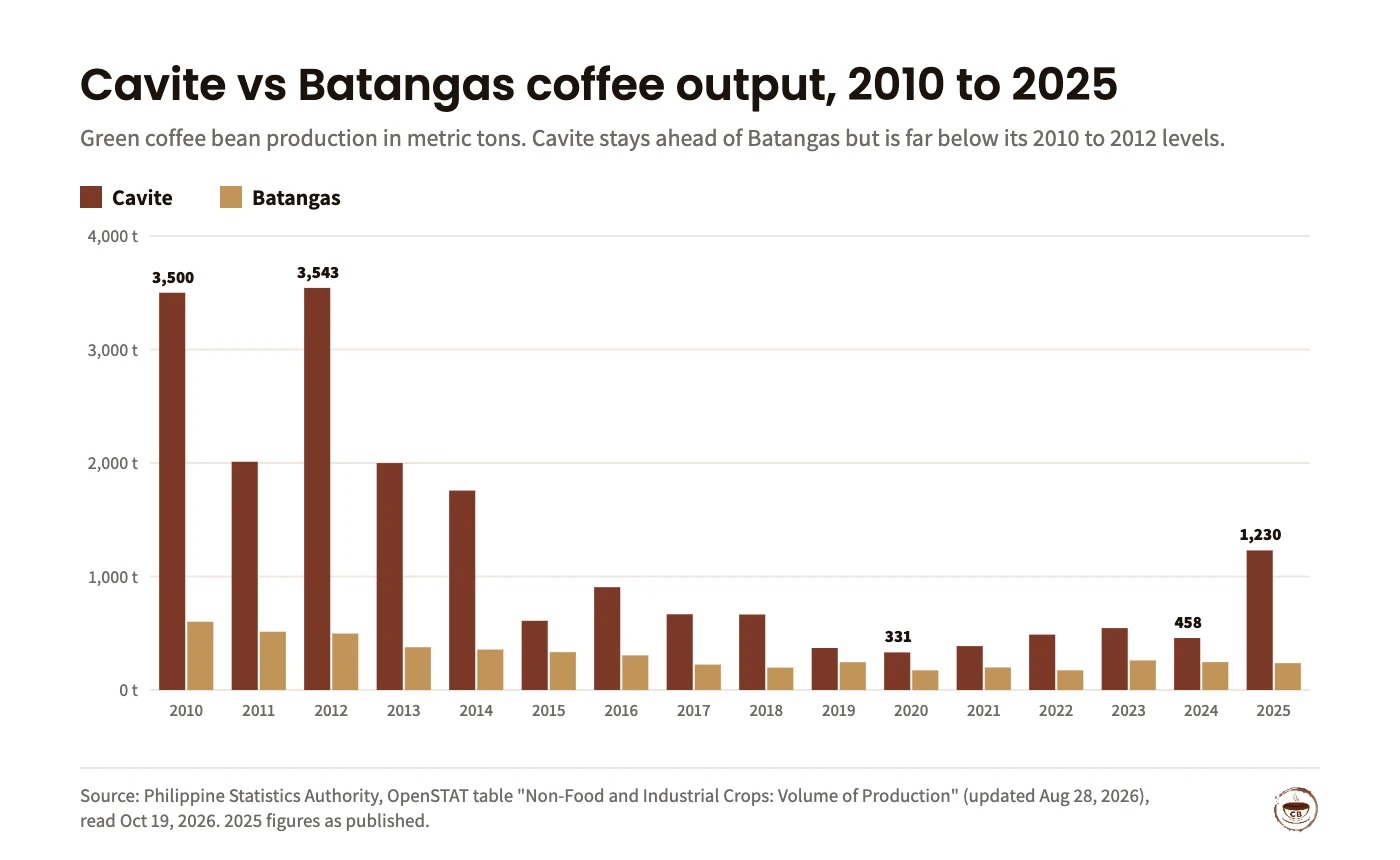
The long trend is down. Cavite produced 3,500.11 t in 2010 and 3,542.98 t in 2012, then fell to 331.20 t in 2020. Output climbed back to 1,229.74 t in 2025, about 2.7 times the 2024 figure, while the area planted barely moved (8,190 ha in 2024, 8,027 ha in 2025). A jump that size with a flat planted area is worth watching: PSA figures for recent years can be revised, so treat 2025 as the latest published number, not a settled one.
How big is Amadeo’s coffee area? The sources disagree
There is no single official figure for Amadeo alone. News stories and the provincial government give different numbers, and some are larger than the town itself.
| Source and date | Figure reported | What it covers |
|---|---|---|
| Inquirer, Feb 19, 2012 | As many as 15,000 ha in the past; 3,600 ha now, 90% Robusta | Amadeo; about 4,000 coffee farmers |
| Cavite provincial government, Pahimis page (undated) | 4,508 ha | Amadeo, largest coffee area in upland Cavite |
| PNA via PTV News, Jan 12, 2019 | 4,508 ha | Amadeo coffee farmland |
| Inquirer, Feb 10, 2019 | 4,790 ha | Amadeo, largest coffee area in Cavite’s uplands |
| Philippine Coffee Board via PTV News, Jan 17, 2019 | 24,000 ha down to 8,000 ha as of 2018 | “The coffee area” around the new Amadeo field office |
| PSA OpenSTAT, 2018 and 2025 | 8,249 ha (2018); 8,027 ha (2025) | All of Cavite province |
| PhilAtlas (2013 area) | 3,692 ha total land area | All land in Amadeo |
Two things stand out. The 4,508 ha and 4,790 ha figures are larger than the 3,692 ha of land PhilAtlas gives for the whole town, so they cannot all sit inside Amadeo’s mapped boundary. They may count farms run by Amadeo growers in neighboring towns or use older boundaries; the sources do not say. Second, the Philippine Coffee Board’s “8,000 hectares as of 2018” matches PSA’s Cavite-wide total of 8,249 ha for that year, which suggests the board was describing the wider Cavite coffee area. If you quote a size for Amadeo, name the source and year.
What kind of coffee grows in Amadeo?
Robusta dominates. The Inquirer reported in 2012 that 90% of Amadeo’s planted area was Robusta and that Nescafé bought almost all of the farmers’ green beans for instant coffee. Buyers were offering ₱96 per kilo at the time, a price one farmer called too low. Province-wide, PSA counts 7,350 ha of Robusta, 552 ha of Excelsa and 75 ha of Liberica in 2025. Our Robusta guide and Excelsa guide explain how these species differ.
Local groups have tried to move up the value chain. The Café Amadeo Development Cooperative received a DTI-funded roasting machine worth ₱560,000 in December 2013, according to the Department of Agriculture’s coffee roadmap, which lists the cooperative’s products as brewed coffee from Liberica, Robusta, Arabica and Excelsa. The January 2019 farmers’ symposium that opened the Pahimis season had the theme “Pick Red ‘Specialty Robusta’,” a push for farmers to harvest only ripe cherries.
What is the Pahimis festival?
“Pahimis” is the old Amadeo word for thanksgiving. The Cavite provincial government explains that farmers used to give away the last can of their harvest, believing it would bring luck and a good crop the next season. The modern festival began in 2002, after a fall in coffee prices led some farmers to cut down their trees, and it included a coffee trade fair, street dancing, contests and farm-management talks.
The festival is held at harvest time. In 2019 it ran from February 22 to 24, and about 350 farmers from Amadeo and nearby towns were expected at the kickoff symposium, according to PNA. The Inquirer described dancers in jute sacks and hats and garlands decorated with coffee beans. The same 2002 push produced an Adopt-a-Farm program covering about 140 hectares, which assured landowners ₱10,000 a year for five years.
Amadeo coffee timeline
| Year | Event | Source |
|---|---|---|
| 1876 | Coffee introduced in Amadeo | Wikipedia |
| 1889 to 1891 | Coffee rust cuts national output to one sixth; seedlings move from Batangas to Cavite | Wikipedia |
| 2002 | First Pahimis festival; Adopt-a-Farm and Café Amadeo start | Cavite provincial government; Inquirer 2019 |
| 2012 | ₱5 million granted for a 10 kg roasting machine under Sagip Saka | Inquirer, Feb 19, 2012 |
| 2013 | DTI-funded ₱560,000 roaster for the Café Amadeo cooperative | DA Coffee Roadmap 2021 to 2025 |
| 2016 | UPLB study of 92 Amadeo farmers rates economic and environmental sustainability as low | UPLB thesis, 2016 |
| 2019 | Philippine Coffee Board opens an Amadeo field office with ₱10 million initial investment | PTV News, Jan 17, 2019 |
| 2025 | Cavite produces 1,229.74 t of green coffee beans | PSA OpenSTAT |
Why did Cavite’s coffee output fall?
The sources point to income. The Cavite provincial government says some farmers cut down their trees when bean prices fell. In 2019 the Philippine Coffee Board’s chairperson said farmers had “lost their interest due to low income.” A 2016 UPLB study of 92 Amadeo farmers found that those with less than one hectare commonly earned ₱5,000 to ₱20,000 a year in gross income from coffee.
Land use is the other pressure. The Department of Agriculture’s coffee roadmap notes that in Cavite some coffee farms have been developed into subdivisions or converted to vegetables, guyabano and banana. For a wider view of where Philippine coffee grows today, see our map of Philippine coffee regions.
How to compare Cavite and Batangas coffee at home
- Buy beans labelled by origin. Look for the province or town on the bag, plus the species, so you know you are comparing Robusta with Robusta.
- Match the roast level. A dark roast and a medium roast of the same bean taste further apart than two origins at the same roast.
- Use the same recipe for both. Same grind, same water and the same dose. Our drip bags use 10 g per cup, which is an easy reference.
- Taste side by side. Brew both at once, let them cool a little, and note body, bitterness and sweetness before reading the labels again.
We do not sell Amadeo or Cavite coffee. Our Robusta and Kapeng Barako come from Batangas, and on October 19, 2026 a 1 kg bag of Robusta cost ₱813 and Kapeng Barako ₱858 in our shop, or ₱8.13 and ₱8.58 for 10 g of coffee.
Frequently asked questions
Which town is the coffee capital of the Philippines?
Amadeo in Cavite is the town Philippine news reports call the coffee capital of the Philippines, including the Philippine News Agency and the Philippine Daily Inquirer. We found no national law that gives any town the title. Amadeo has the largest coffee area in upland Cavite, according to the Cavite provincial government.
Was Lipa, Batangas the coffee capital of the Philippines?
Lipa was the country’s main coffee producer in the 1800s and was later labelled the coffee capital, according to Wikipedia’s history summary. Coffee rust arrived in 1889, and by 1891 national output had fallen to one sixth of its level two years earlier. Surviving seedlings went to Cavite, which today produces about five times as much green coffee as Batangas, based on 2025 PSA data.
What coffee is grown in Amadeo, Cavite?
Mostly Robusta. The Inquirer reported in 2012 that 90% of Amadeo’s 3,600 coffee hectares were Robusta, and PSA data for 2025 show 7,350 of Cavite’s 8,027 coffee hectares (91.6%) planted to Robusta. Smaller areas grow Excelsa (552 ha) and Liberica (75 ha).
When is the Pahimis coffee festival in Amadeo?
Pahimis is held at harvest time as a thanksgiving for the coffee crop. The 2019 festival ran from February 22 to 24, according to PNA and the Inquirer. Check with the Municipality of Amadeo for the current year’s dates.
Sources
- Non-Food and Industrial Crops: Volume of Production, by Region, Province, Quarter, and Semester, 2010 to 2026. Philippine Statistics Authority, OpenSTAT, updated August 28, 2026. Used for green coffee bean output for Cavite, Batangas, CALABARZON and the Philippines.
- Non-Food and Industrial Crops: Area Planted/Harvested, by Region, Province, Quarter, and Semester, 2010 to 2026. Philippine Statistics Authority, OpenSTAT, updated September 1, 2026. Used for coffee area by species.
- Non-Food and Industrial Crops: Number of Bearing Trees, by Region, Province, Quarter, and Semester, 2010 to 2026. Philippine Statistics Authority, OpenSTAT, updated August 28, 2026. Used for bearing coffee trees.
- Philippine Coffee Industry Roadmap 2021 to 2025. Department of Agriculture, High Value Crops Development Program. Used for land conversion in Cavite and the Café Amadeo roaster.
- Coffee capital perks up. Philippine Daily Inquirer, February 10, 2019. Used for the 4,790 ha figure, Adopt-a-Farm and festival details.
- Miracle brewing in P5-M rescue of coffee capital. Philippine Daily Inquirer, February 19, 2012. Used for 3,600 ha, 90% Robusta, 4,000 farmers, the ₱96/kg offer and the ₱5 million roaster.
- Pahimis Festival. Provincial Government of Cavite, undated. Used for the meaning of Pahimis, the 2002 origin and the 4,508 ha figure.
- “Pahimis” Coffee Festival slated Feb. 22-24. PTV News with PNA, January 12, 2019. Used for festival dates, the symposium and the 4,508 ha figure.
- 5K hectares in Cavite town eyed for coffee plantation. PTV News, January 17, 2019. Used for the Philippine Coffee Board field office, the ₱10 million investment and the 24,000 to 8,000 ha statement.
- Amadeo, Province of Cavite. PhilAtlas, read October 19, 2026. Used for land area, elevation, barangays and 2020 population.
- Coffee production in the Philippines. Wikipedia, read October 19, 2026. Used for the 1876, 1889 and 1891 history (secondary source).
- Assessing the Sustainability of Coffee Farmers in Amadeo, Cavite. A. K. V. Alvarez, University of the Philippines Los Baños, 2016. Used for farmer income and sustainability ratings.
- Caffeine Brothers shop. Prices checked October 19, 2026. Used for Robusta and Kapeng Barako prices.
Cite this article: Caffeine Brothers. “Coffee Capital of the Philippines: Amadeo, Cavite in Numbers.” Caffeine Brothers Coffee Blog, October 2026. https://caffeinebrothers.co/coffee-capital-of-the-philippines/
You are welcome to reference the charts and frameworks in this article with a link back to this page.
Want to taste Philippine Robusta and Liberica? Try our Batangas Robusta or Kapeng Barako, roasted daily and ground for free, or browse the full shop. Questions about origins or bulk orders? Contact us.
 Previous Post
 Next Post