22 Best Coffee Roasting Machines in 2026
By Robin Salvador, co-founder, Caffeine Brothers
Last updated: November 15, 2026
A coffee roasting machine is a heater, a way to keep beans moving, and a way to cool them fast. Every machine on this list does those three things. Where they differ is how much they hold, how much control they give you, what power or gas they need, and how much they cost to buy and run.
We are a Philippine coffee roaster, and we roast every day. That doesn’t make us testers of the 22 machines below. We did not use these machines for this article. What we did was read each manufacturer’s own product page, spec sheet or manual, check prices at named retailers on 15 November 2026, and note where sources disagree. Where a manufacturer doesn’t publish a figure, the table says “Not publicly disclosed” instead of a guess. The full method is at the end.
If you are just starting out, read our beginner’s guide to home roasting first. It covers pan, oven and popcorn-popper roasting before you spend money on a machine.
Quick comparison of the best coffee roasting machines
| If you want… | Look at | Max batch (green) |
|---|---|---|
| The cheapest way to start roasting at home | Fresh Roast SR540 | 120 g |
| A home drum roaster for a full pound | Behmor 2000AB Plus / 2020SR Plus | 454 g |
| Logged, repeatable home roasts on a drum | Hottop KN-8828B-2K+ | 300 g |
| 1 kg batches on household power | Aillio Bullet R2 | 1 kg |
| 220 V prosumer roasting with more output | Aillio Bullet R2 Pro | 1.2 kg |
| Hands-off sample roasting for green coffee QC | IKAWA PRO100 | 120 g |
| A sample roaster that can run 15 batches an hour | ROEST L200 Ultra | 200 g |
| An electric café roaster with no gas line | ROEST P3000 or Stronghold S7X | 3 kg / 850 g |
| A classic 3 kg gas shop roaster | Diedrich DR-3 or San Franciscan SF-6 | 3 kg |
| A 6 kg workhorse for a growing roastery | Giesen W6A or Probat P05e | 6 kg |
| Wholesale output with built-in smoke control | Loring S35 Kestrel or San Franciscan SF-25 | 35 kg / 12 kg |
Batch capacities throughout this article are the manufacturers’ published maximums for green (unroasted) coffee. A machine’s best-tasting batch is often smaller than its maximum, and roasted weight comes out lower than green weight because beans lose moisture.
Best home coffee roasting machines
Home roasters plug into a normal outlet, sit on a counter and roast between about 100 g and 450 g at a time. Most have no proper exhaust, so plan to roast near a window, under a range hood or outside.
A note for readers in the Philippines before you scroll: household power here is 220 V at 60 Hz. Several popular home roasters are built only for North America’s 120 V, which means a step-down transformer and, in some cases, no warranty.
1. Fresh Roast SR540
Overview
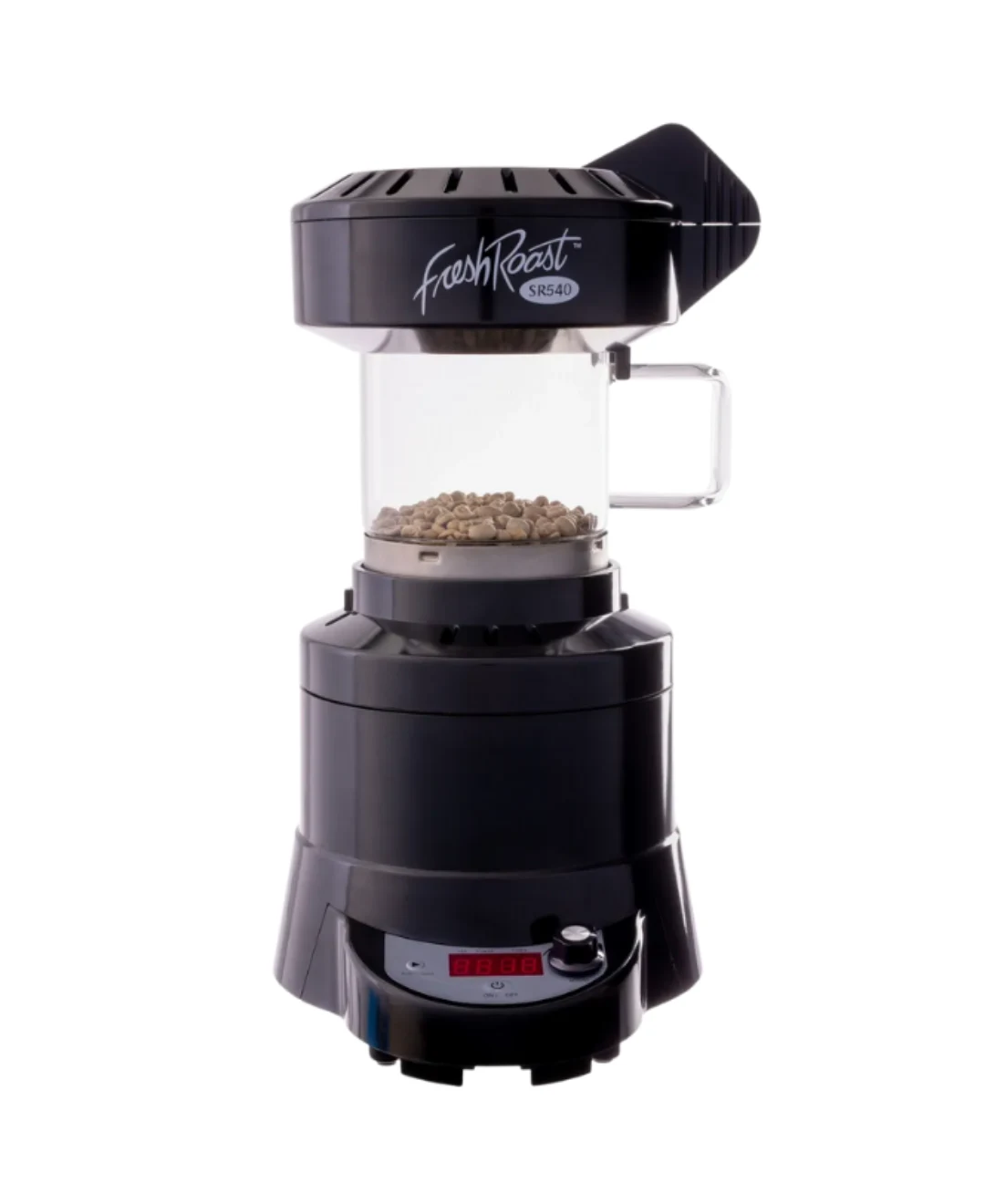
The SR540 is the entry model in the Fresh Roast range, sold by Home Roasting Supplies, the company Fresh Roast owners register their machines with. It is a small hot-air (fluid-bed) roaster. A fan blows heated air up through a glass chamber so the beans float and tumble while you watch them change colour.
Main specifications
| Spec | Manufacturer figure |
|---|---|
| Roasting technology | Fluid bed (hot air) |
| Batch size | 85 g (3 oz) minimum, 120 g (4 oz) maximum |
| Heat control | 9 levels |
| Fan control | Variable (levels not stated) |
| Power | 120 V, North America only |
| Wattage, dimensions, weight | Not publicly disclosed |
| Warranty | 1 year on the base; 6 months on glass chamber, top cap and chaff basket |
Source: Home Roasting Supplies SR540 product page.
Key features
You set heat and fan speed by hand during the roast. The glass chamber shows every colour stage, which is the fastest way to learn what first crack looks and sounds like. A chaff collector sits on top.
Performance and practical applications
At 120 g, one batch makes roughly a few days of coffee for one person. Hot-air roasters run fast and loud, so first crack is harder to hear than on a drum. That is a general trait of the design, not a measured result for this unit.
Advantages
- Lowest price on this list.
- You can see the beans the whole time.
- Simple manual controls.
Disadvantages
- 120 V only. The manufacturer says the warranty is void if the roaster is used outside North America.
- Small batches mean many roasts for a household that drinks a lot of coffee.
- No logging or software.
Who should buy it
Someone in the US or Canada who wants to find out whether home roasting is for them before spending more.
Who should avoid it
Buyers in the Philippines and other 220 V countries, and anyone who needs more than about 120 g per batch.
Price and availability
USD 239 for the bundle with 2 lb of green coffee and no extension tube, on homeroastingsupplies.com (US, checked 15 November 2026).
Our verdict
A sensible first roaster in North America. Outside it, the voltage and warranty terms push it down the list.
2. Fresh Roast SR800
Overview
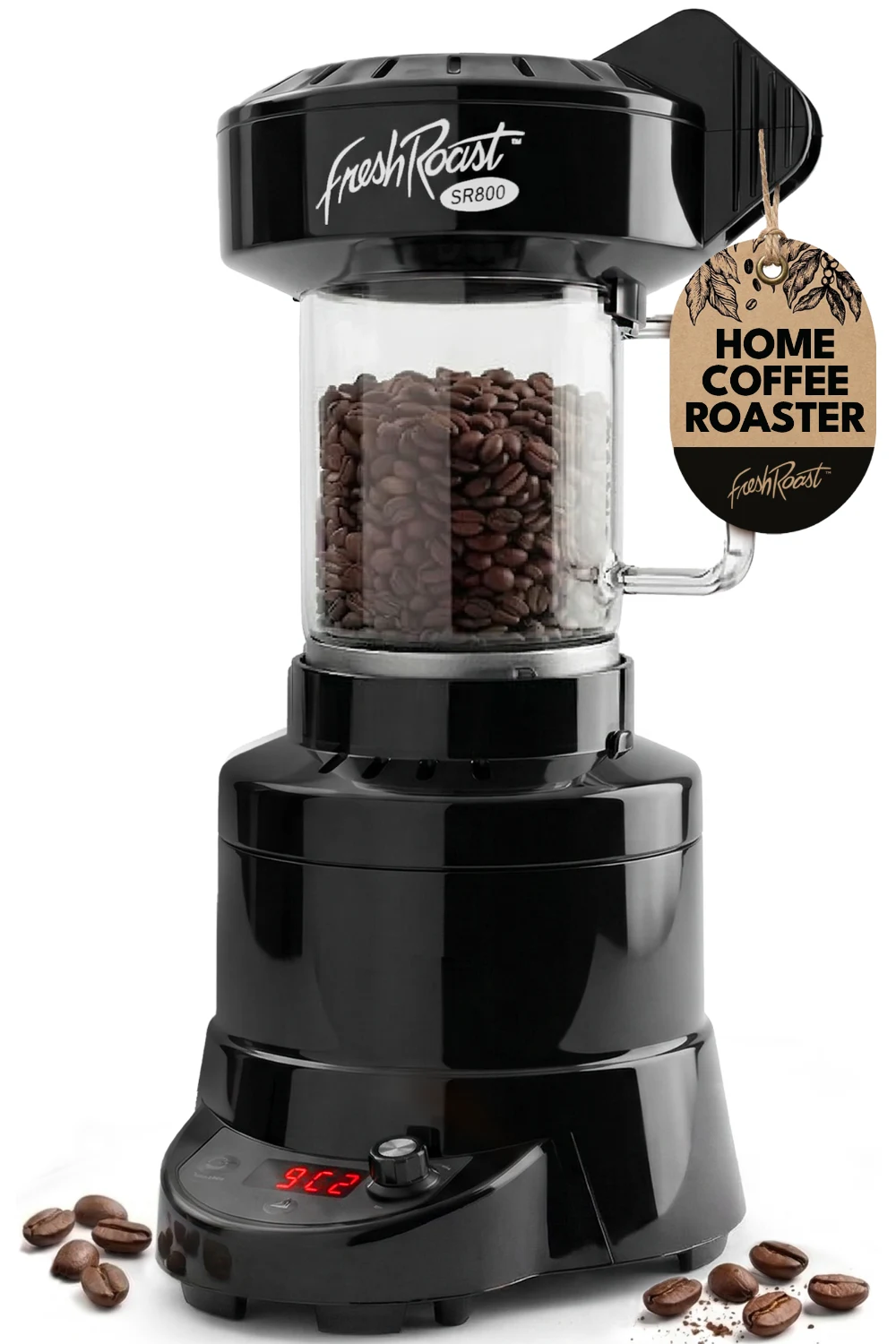
The SR800 is the larger Fresh Roast. Its wider chamber and stronger fan roughly double the batch of the SR540.
Main specifications
| Spec | Manufacturer figure |
|---|---|
| Roasting technology | Fluid bed (hot air) |
| Batch size | 4 oz (113 g) minimum; 8 oz (226 g) wet-processed or 6 oz (170 g) dry-processed maximum |
| Heater | 1,600 W |
| Heat control | 9 levels; expanded fan range |
| Power | 120 V, North America only |
| Chaff / cooling | Chaff basket sold separately (USD 16.95); bean cooler sold separately |
| Warranty | 1 year base; 6 months on glass, cap and chaff basket |
Source: Home Roasting Supplies SR800 product page. The same page also gives a 3 oz (85 g) minimum in its troubleshooting section. We used the 4 oz figure from the spec list.
Key features
Manual heat and fan control, like the SR540, with a larger chamber. The manufacturer caps dry-processed (natural) coffee at a lower weight because those beans shed more chaff.
Performance and practical applications
Up to 226 g per batch suits a household of two. Natural-processed coffees need the smaller 170 g load, which is worth knowing if you like fruity naturals.
Advantages
- Twice the batch of the SR540 for under USD 350.
- Clear chamber and simple controls.
Disadvantages
- 120 V and North America only.
- The chaff basket is an extra purchase.
- Retailer reviews describe it as top-heavy (MoreBeer).
Who should buy it
North American home roasters who outgrew a popcorn popper or an SR540.
Who should avoid it
220 V markets, and anyone who wants software logging.
Price and availability
USD 334 on homeroastingsupplies.com (US, checked 15 November 2026). The same price appears at Sweet Maria’s.
Our verdict
The better of the two Fresh Roasts for most households in its home market.
3. Behmor 2000AB Plus (120 V) / 2020SR Plus (220 V)
Overview
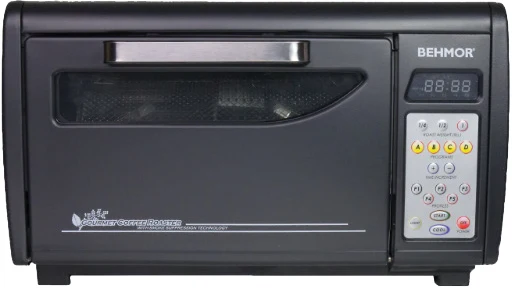
Behmor makes a countertop drum roaster that looks like a small toaster oven. Quartz elements heat a rotating mesh drum, and the machine has a smoke-suppression system. The 120 V model is the 2000AB Plus. The 220 V model is sold as the 2020SR Plus (Coffee Bean Corral).
Main specifications
| Spec | Figure | Source type |
|---|---|---|
| Roasting technology | Drum, quartz heating elements | Manual |
| Maximum batch | 1 lb (454 g) | Retailer |
| Minimum batch | About 1/4 lb (113 g) | Retailer |
| Power | 120 V (2000AB Plus); 220 V (2020SR Plus) | Retailer |
| Wattage, dimensions, weight | Not publicly disclosed in the sources checked | |
| Clearance | At least 18 in (46 cm) on all sides | Manual |
Sources: Behmor 2000AB operation manual, Sweet Maria’s.
Key features
Pre-programmed profiles plus manual control, an automatic cooling cycle and a removable drum and chaff tray. The manual says to allow an hour between roasts and never to leave the roaster unattended.
Performance and practical applications
Sweet Maria’s, which sells it, says the Behmor works best in the medium range and is not ideal for very light or very dark roasts. They also say smaller batches give more control than a full pound. That is a retailer observation, not ours.
Advantages
- The largest batch of any home machine here.
- A 220 V version exists.
- Low price for a drum roaster.
Disadvantages
- Limited range at the extremes of roast level, per Sweet Maria’s.
- Needs an hour of rest between roasts, per the manual.
- Stock has been patchy. Sweet Maria’s listed a restock with a refreshed design for late August or early September 2026.
Who should buy it
Home roasters who want to roast a pound at a time for medium roasts.
Who should avoid it
Light-roast or very dark-roast fans, and anyone who needs back-to-back batches.
Price and availability
USD 479 at Sweet Maria’s (US, checked 15 November 2026). Check current stock before you plan around it.
Our verdict
Still the cheapest route to a 1 lb drum batch, with clear limits on roast range.
4. Gene Cafe CBR-101
Overview
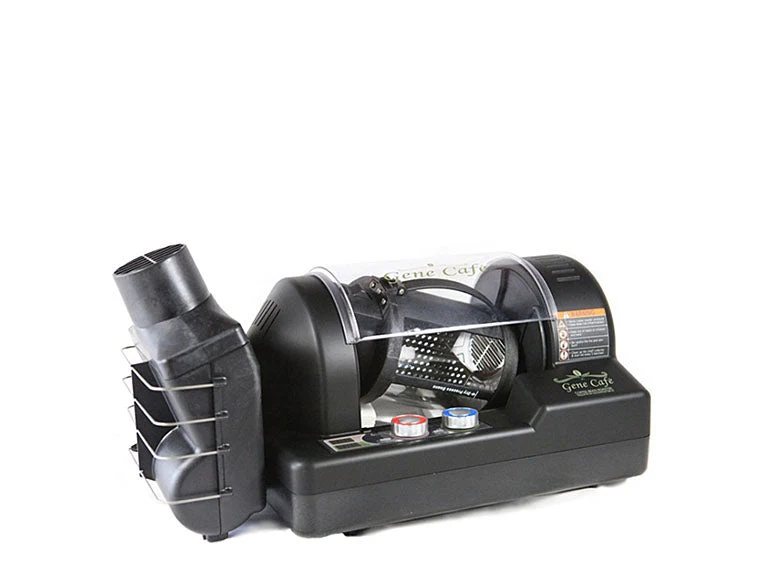
The CBR-101 is made by Genesis Co., Ltd., according to its owner’s manual. It uses hot air like a fluid-bed roaster but turns the glass chamber on an off-axis rotation, so the beans tumble without needing a strong fan to lift them.
Main specifications
| Spec | Figure | Source type |
|---|---|---|
| Roasting technology | Rotating glass chamber, indirect hot air | Manual |
| Maximum batch | 250 g | Manual / US retailers |
| Heater | 1,300 W | Distributor |
| Temperature range | 60 to 250 °C | Distributor |
| Power | 220-240 V or 120 V versions | Distributors |
| Noise | 65 dB | Distributor |
| Warranty | 1 year (US, serviced by Gene Cafe USA) | Retailer |
Sources: Brewing Gadgets, Majesty Coffee, Coffee Parts Australia. Some European retailers list 300 g. We used the 250 g figure because it matches the manual and the US distributor.
Key features
You set time and temperature on the panel and can change them mid-roast. The machine cools the beans automatically when the roast ends. The chamber detaches for loading and cleaning.
Performance and practical applications
It is quiet next to most hot-air roasters, which makes cracks easier to hear. One retailer review notes that the temperature display reads exhaust air rather than the beans, so the number is a guide, not a bean temperature.
Advantages
- Available in 220-240 V.
- Quiet, with a clear chamber.
- 250 g batches.
Disadvantages
- No saved profiles or software.
- The temperature display is not a bean probe.
- We found no official manufacturer product page, so support depends on your local distributor.
Who should buy it
A home roaster in a 220 V country who wants a simple, quiet machine.
Who should avoid it
Anyone who wants to log roast curves.
Price and availability
USD 690 at Sweet Maria’s (US, checked 15 November 2026).
Our verdict
One of the few home roasters sold in 220 V, which makes it a realistic option in the Philippines.
Best advanced and prosumer coffee roasters
These machines add bean temperature probes, saved profiles and software logging. They suit serious hobbyists and very small businesses that sell to friends, an office or a farmers’ market.
5. Hottop KN-8828B-2K+
Overview
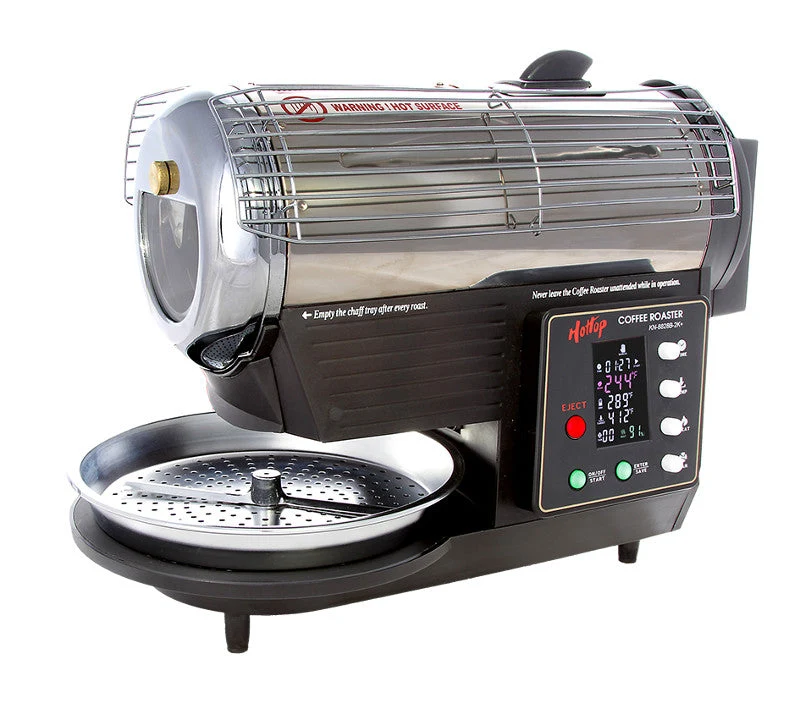
Hottop’s top home model is a small electric drum roaster with two thermocouples: one for the beans and one for the air around them.
Main specifications
| Spec | Manufacturer figure |
|---|---|
| Roasting technology | Drum, electric |
| Batch size | 225 to 300 g (250 g optimal) |
| Sensors | Dual K-thermocouples (bean and environment) |
| Power | 110, 120, 220, 230 and 240 V versions |
| Dimensions | 14 in H x 10 in W x 19 in D |
| Weight | 19 lb |
| Cooling | External tray with stirring arm and fan; 4 to 5 minutes |
| Warranty | 1 year |
| Wattage | Not publicly disclosed |
Source: Hottop Americas product page.
Key features
You can change temperature, time, fan speed and heater power during the roast, or run it on auto. There is a manual emergency eject and a smoke reduction system.
Performance and practical applications
Two probes let you watch bean temperature and the rate it rises, which is how most roasters compare one batch to the next. Retail reviewers mention using the free Artisan logging software with it. Hottop’s own page does not mention Artisan, so treat compatibility as user-reported.
Advantages
- Real bean temperature data in a home-sized drum.
- Voltage versions for most countries, including 220 V.
- External cooling tray.
Disadvantages
- 300 g maximum.
- Reviewers say cleaning is the main chore (Rancher Wholesale reviews).
Who should buy it
Home roasters who want to learn profiling on a drum without the price of a 1 kg machine.
Who should avoid it
Anyone roasting for sale in any volume.
Price and availability
USD 1,800 at Rancher Wholesale (US, checked 15 November 2026).
Our verdict
A good training machine for drum profiling. Its batch size keeps it a hobby tool.
6. Aillio Bullet R2
Overview
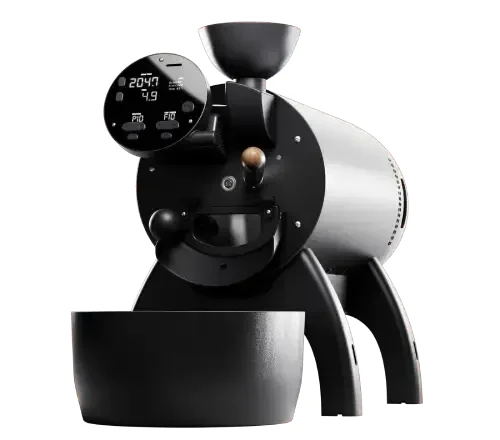
Aillio designs the Bullet in Denmark and builds it in Taiwan. It heats the drum by induction, the same principle as an induction cooktop, which means a 1 kg drum roaster can run on household power.
Main specifications
| Spec | Manufacturer figure |
|---|---|
| Roasting technology | Drum, induction heated |
| Maximum batch | 1 kg |
| Minimum batch | Not stated by Aillio (retailers list 150 g) |
| Power | 1,700 W; 10 power stages |
| Voltage | 110-120 V or 200-240 V; 15 A at 120 V, 8 A at 230 V |
| Drum speed | 30 to 90 rpm in 9 steps |
| Exhaust fan | 12 steps; 80 to 100 mm port |
| Dimensions | 603 x 325 x 446 mm base; 750 mm long with cooling tray |
| Weight | 16 kg net |
| Software | RoasTime 4 (Mac, Windows, Linux) and Roast.World |
| Warranty | 2 years |
Sources: aillio.com/r2, aillio.com/r2-specs.
Key features
An infrared bean temperature sensor (IBTS), FlowSense airflow control, a barometric pressure sensor and a cooling tray with a built-in chaff filter.
Performance and practical applications
One kilogram of green coffee per batch moves the Bullet out of hobby territory. Aillio quotes 7 to 9 minutes for a 1 kg batch to reach first crack. Sweet Maria’s notes that a full R2 Pro batch yields about 2 lb of roasted coffee after weight loss (Sweet Maria’s), which gives a sense of real output.
Advantages
- 1 kg batches without gas or three-phase power.
- Full software logging and replay.
- 2-year warranty.
Disadvantages
- You still need to duct the smoke out, as forum users point out (Home-Barista).
- USD 4,099 before shipping.
Who should buy it
Serious home roasters, coffee trainers and micro-businesses roasting a few kilograms a week.
Who should avoid it
Cafés that need more than a few kilograms a day.
Price and availability
USD 4,099 on aillio.com (US, checked 15 November 2026).
Our verdict
The most capable machine here that runs on a normal outlet.
7. Aillio Bullet R2 Pro
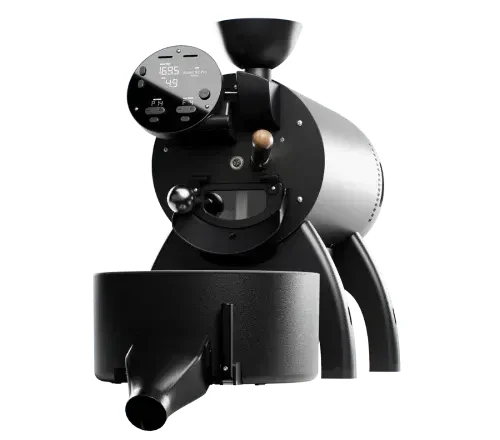
Overview
The R2 Pro is the 220-240 V version of the Bullet with more power and a larger batch.
Main specifications
| Spec | Manufacturer figure |
|---|---|
| Maximum batch | 1.2 kg |
| Power | 2,300 W; 14 power stages |
| Voltage | 200-240 V only; 12 A at 230 V; needs a dedicated 240 V / 20 A circuit |
| Time to first crack (1 kg) | About 6 minutes |
| Dimensions | 603 x 325 x 458 mm base; 873 mm long with Pro cooling tray |
| Weight | 16 kg net |
| Warranty | 2 years |
Sources: aillio.com/r2-pro, aillio.com/r2-specs.
Key features
Everything on the R2, plus a Pro cooling tray with silicone stirrers.
Performance and practical applications
The extra 200 g per batch and faster heat-up mean more coffee per hour than the standard R2. It needs its own circuit, so budget for an electrician.
Advantages
- Built for 220-240 V, which matches Philippine power.
- Larger batch and more power than the R2.
Disadvantages
- Needs a dedicated circuit.
- USD 1,200 more than the R2.
Who should buy it
Micro-roasteries and cafés in 220 V countries that want an electric roaster smaller than a 3 kg shop machine.
Who should avoid it
Homes without a spare 20 A circuit.
Price and availability
USD 5,299 on aillio.com (US, checked 15 November 2026).
Our verdict
For Philippine buyers, this is the Bullet to look at first because it is designed for 220-240 V.
8. Kaleido Sniper M10 / M10S
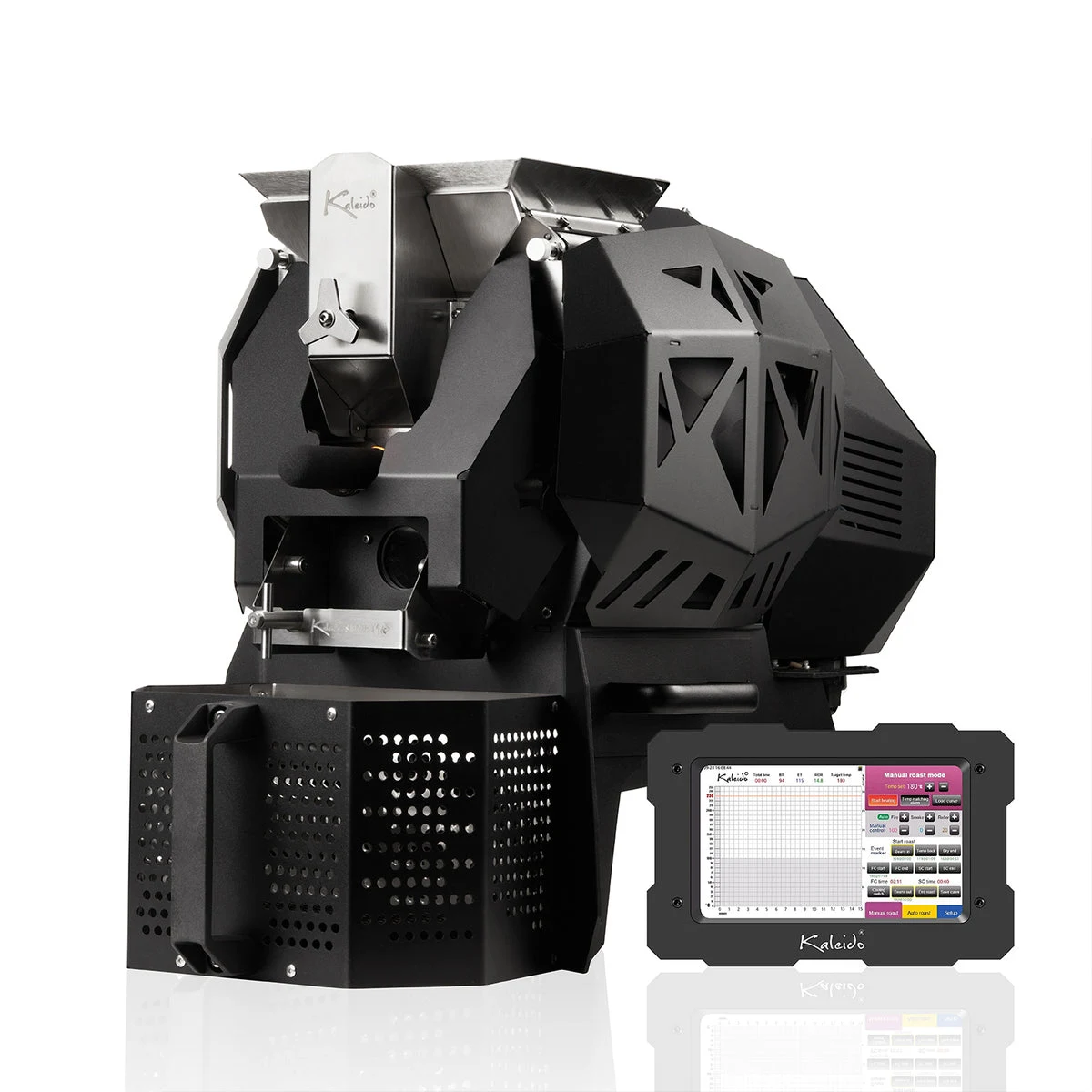
Overview
Kaleido’s largest Sniper is an electric drum roaster sold in Kaleido-system and Artisan-compatible (“Dual”) versions.
Main specifications
| Spec | Figure | Source type |
|---|---|---|
| Batch size | 300 to 1,200 g (M10); 500 to 1,200 g (M10S) | Distributor |
| Heating | Electric; seller describes carbon-fibre infrared plus hot air | Distributor |
| Voltage | 120 V and 220 V versions | Retailer |
| Electrical note | 120 V model needs a dedicated 20 A circuit | Retailer |
| Wattage, dimensions, weight, warranty | Not publicly disclosed in the sources checked |
Sources: kaleido-sniper.com (an authorized distributor in Japan), Coffee Bean Corral, Cliff & Pebble.
Key features
Adjustable heat, fan and drum speed, with a tablet controller or Artisan. Retailers note the heating elements ship uninstalled and must be fitted by the buyer.
Performance and practical applications
On paper it matches the Bullet’s 1.2 kg batch for well under its price. A Home-Barista user who owns one said support was responsive but software connection could be fiddly compared with Aillio (forum thread). That is one owner’s experience.
Advantages
- 1.2 kg capacity at about USD 2,900.
- Artisan support.
Disadvantages
- Thin official documentation. We could not find a manufacturer power rating.
- Buyer installs the heating elements.
Who should buy it
Budget-minded hobbyists and small sellers who are comfortable with some setup.
Who should avoid it
Businesses that need clear local service and spare-parts support.
Price and availability
USD 2,879 for the 120 V Dual at Coffee Bean Corral; M10S from USD 3,099 on kaleido-sniper.com (both checked 15 November 2026).
Our verdict
Strong value per kilogram of capacity, with a documentation gap you should close with the seller before buying.
Best sample coffee roasting machines
Sample roasters roast 50 to 200 g so you can cup a green coffee before buying a full bag, or test a profile before running it on a big machine. Importers, QC labs and roasteries use them daily.
9. IKAWA PRO100 / PRO100X
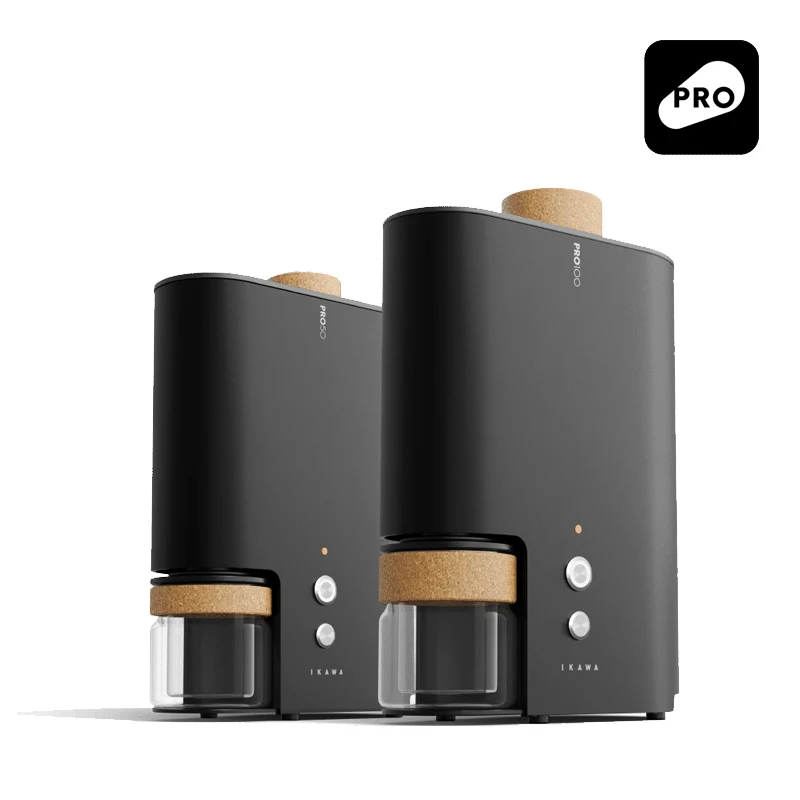
Overview
IKAWA, based in London, makes app-controlled hot-air sample roasters. The PRO100 is the 100 g model. The PRO100X adds a humidity sensor that IKAWA uses for automatic first-crack detection.
Main specifications
| Spec | Figure | Source type |
|---|---|---|
| Roasting technology | Hot air, app controlled | Manufacturer |
| Batch | 120 g maximum, 100 g recommended | Manufacturer brochure |
| Voltage | 100 V, 110-130 V or 220-240 V | Manufacturer |
| Power | Up to 1.7 kW at 120 V; 1.35 kW at 220-240 V | Distributors |
| Dimensions | 240 x 130 x 345 mm | Manufacturer brochure |
| Weight | 4.35 kg | Manufacturer brochure |
| Warranty | 1 year | Distributor |
Sources: ikawacoffee.com, IKAWA Pro Series brochure, Cafune, Di Pacci. The power figure differs between regions because draw depends on supply voltage.
Key features
You load a profile from the app, add beans and press start. Profiles can be shared between IKAWA machines, so a lab in Manila and a buyer abroad can roast a sample the same way.
Performance and practical applications
For green coffee buyers, repeatability matters more than flexibility, and that is what this machine is built for. It is portable enough to take to a farm or a cupping event.
Advantages
- Very small and portable.
- Same profile gives the same roast across machines.
- Available in 220-240 V.
Disadvantages
- 100 g per batch, so one sample at a time.
- Needs a phone or tablet.
Who should buy it
Green coffee buyers, importers and roasteries that cup many samples.
Who should avoid it
Anyone who wants to roast coffee to drink every week.
Price and availability
EUR 3,570 net excluding VAT for the PRO100 and EUR 5,339 for the PRO100X at CMS (EU, checked 15 November 2026).
Our verdict
The default choice for portable, repeatable sample roasting.
10. Kaffelogic Nano 7
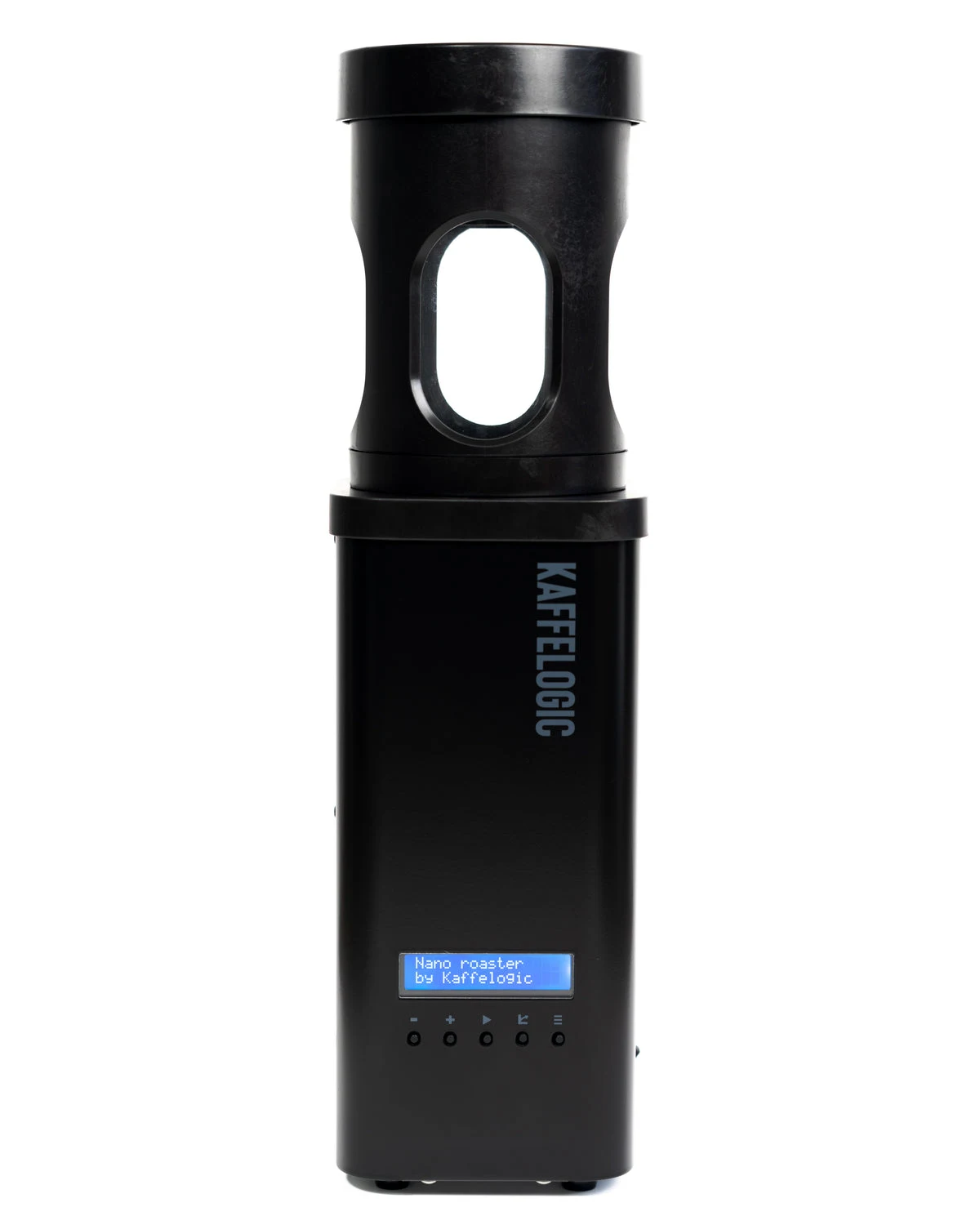
Overview
Kaffelogic hand-assembles the Nano 7 in Dunedin, New Zealand (Coffee Beanery). It is a countertop hot-air roaster with profile automation, sold to both home users and professionals.
Main specifications
| Spec | Figure | Source type |
|---|---|---|
| Batch | 90 to 120 g; 50 to 200 g with the Boost Kit | Manufacturer / distributor |
| Heater | 1,400 W | Distributor |
| Fan motor | 60 W brushless DC | Distributor |
| Voltage | 230-240 V; 120 V version in North America | Distributors |
| Software | Kaffelogic Studio (free); 15 built-in profiles | Distributor |
| Dimensions, weight, warranty | Not publicly disclosed in the sources checked |
Sources: kaffelogic.com/products/nano-7e, Coffee Parts Australia, CMS.
Key features
The roaster follows a temperature and airspeed curve on its own. You can run it with no computer or log and edit profiles in Studio.
Performance and practical applications
It covers the industry-standard 100 g sample batch (Eight Ounce Coffee), and the Boost Kit stretches it to 200 g for home use.
Advantages
- Much cheaper than other automated sample roasters.
- 230-240 V version.
- Works without software.
Disadvantages
- Small batches even with the Boost Kit.
- Kaffelogic’s own product page publishes very few specs.
Who should buy it
Home roasters who want automation, and small labs on a budget.
Who should avoid it
Anyone who needs more than 200 g per roast.
Price and availability
USD 1,300.99 for the 120 V version at Eight Ounce Coffee (US, checked 15 November 2026).
Our verdict
The most affordable automated sample roaster we checked.
11. ROEST L200 Ultra
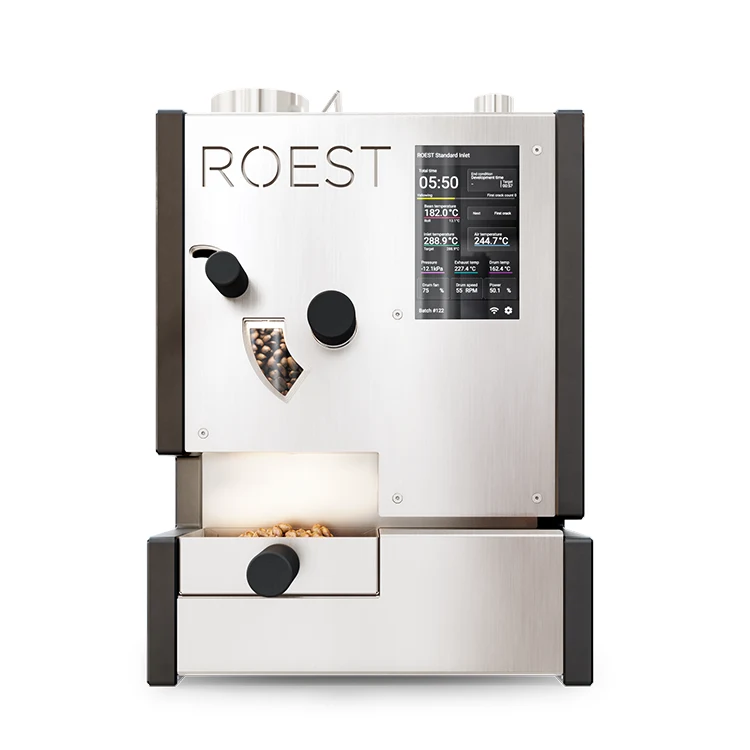
Overview
ROEST’s top sample roaster uses a convection drum and a “Counterflow” mode that reverses airflow through the drum.
Main specifications
| Spec | Manufacturer figure |
|---|---|
| Batch | 50 to 200 g |
| Throughput | Up to 3 kg/h in Counterflow mode (about 15 full batches per hour) |
| Power | 1.65 kW, 50-60 Hz |
| Voltage | 230 V, 115 V or 100 V |
| Dimensions | 266 x 375 x 410 mm (H x W x D) |
| Weight | 14 kg (wood) or 16 kg (black aluminium) |
| Sensors | Air, inlet, dual bean, drum, exhaust and pressure |
| Software | ROEST Connect (included) |
| Warranty | 1 year |
Source: ROEST L200 Ultra page.
Key features
Automatic first-crack detection, a separate cooling fan so the next batch can start right away, a 2 kg chaff collector and Wi-Fi.
Performance and practical applications
Fifteen 200 g batches an hour is enough to cup a whole shipment’s worth of offer samples in a morning. It also works as a profiling tool for a larger production roaster.
Advantages
- Highest sample throughput here.
- Full sensor set and software included.
- 230 V option.
Disadvantages
- Price on request beyond a lineup starting price.
Who should buy it
Busy QC labs and roasteries that cup dozens of samples a week.
Who should avoid it
Home users. It is far more machine than a household needs.
Price and availability
ROEST lists sample roasters from EUR 5,290. It does not publish a separate L200 Ultra price (checked 15 November 2026).
Our verdict
The sample roaster to choose when volume matters as much as repeatability.
12. Stronghold S7X
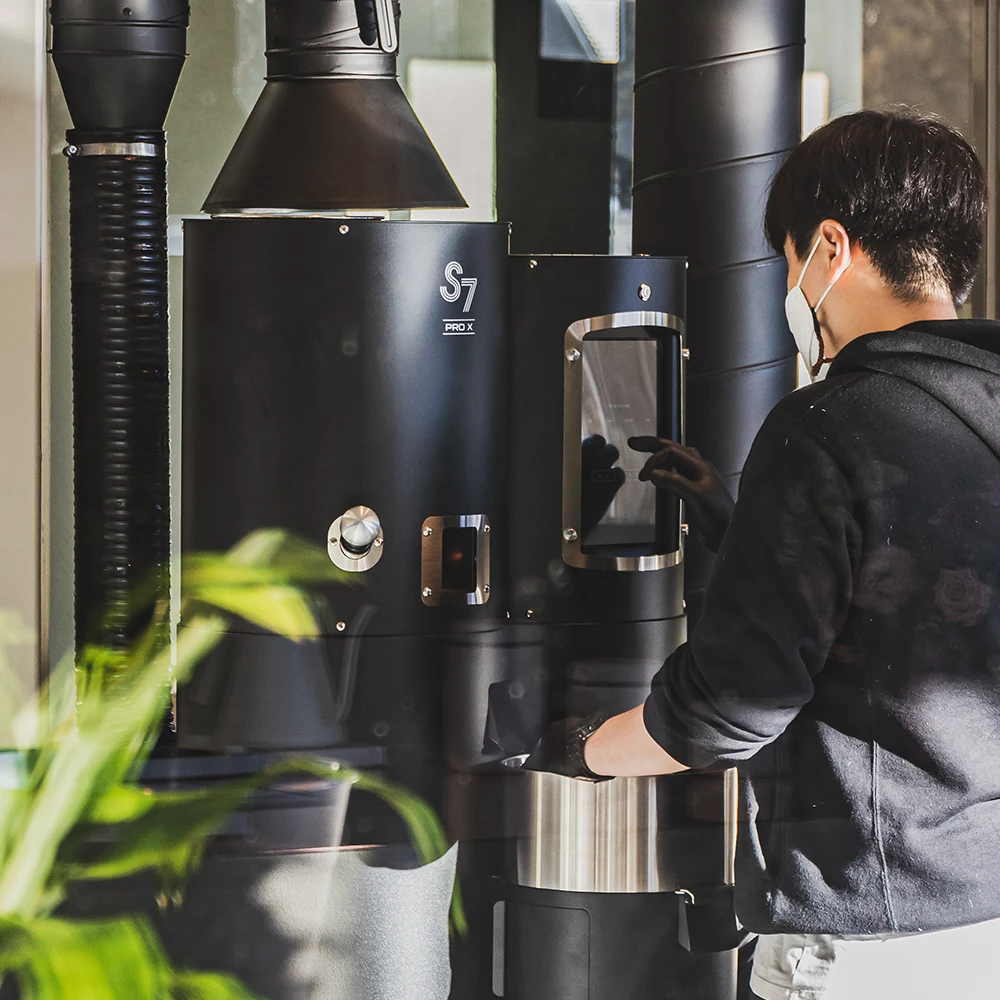
Overview
The S7X is an all-electric roaster with a vertical drum and three separate heat sources: a heated drum, halogen lamps and hot air. Stronghold pitches it for sample roasting, competition prep and small cafés.
Main specifications
| Spec | Figure | Source type |
|---|---|---|
| Batch | 150 to 850 g | Authorized distributor |
| Power | 5.8 kW | Authorized distributor |
| Voltage | 220 V | Authorized distributor |
| Dimensions | 650 x 620 x 886 mm | Authorized distributor |
| Weight | 75 kg | Authorized distributor |
| Cooling | To room temperature in 90 seconds | Authorized distributor |
| Warranty | Not publicly disclosed in the sources checked |
Source: Eight Ounce Coffee S7X page. Stronghold’s service guidance asks for single-phase 220 V with at least 3.5 kW capacity (Stronghold service page via CMS).
Key features
Program and manual roasting, automatic profile saving and replication, a 10.1-inch display and a built-in chaff collector.
Performance and practical applications
Up to 850 g makes it a bridge machine: big enough to supply a small café, small enough to dial in samples. Distributors say competition baristas have used Stronghold machines, which we have not verified independently.
Advantages
- Single-phase 220 V, so no three-phase upgrade.
- Three heat sources controlled separately.
Disadvantages
- Expensive for its batch size.
- Needs a 220 V circuit with real capacity.
Who should buy it
Specialty cafés that want to roast in-house without gas, and competitors.
Who should avoid it
Anyone who needs kilograms per batch for wholesale.
Price and availability
EUR 18,000 net excluding VAT at CMS (EU, checked 15 November 2026). Other distributors quote on request.
Our verdict
Precise and gas-free, priced for specialty cafés more than volume roasters.
Best small commercial coffee roasting machines
These 1 to 7 kg machines are where most cafés and new roasteries land. They need proper exhaust ducting, and most need gas or three-phase power.
13. ROEST P3000
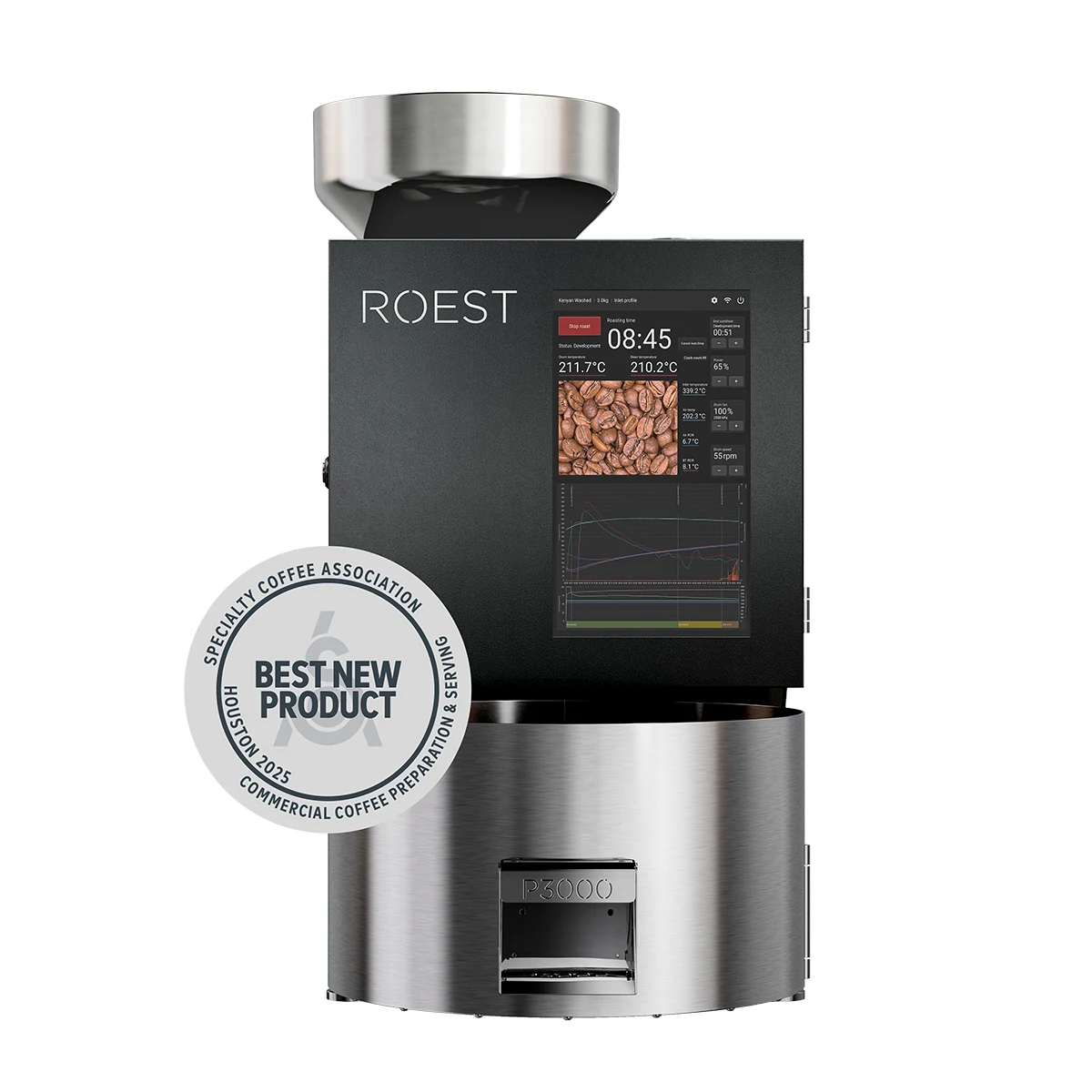
Overview
ROEST’s production roaster brings its sample-roaster software and sensors to 3 kg batches, fully electric.
Main specifications
| Spec | Manufacturer figure |
|---|---|
| Batch | 1 to 3 kg |
| Throughput | Up to 25 kg/h |
| Power | 10.24 kW max, 16 A |
| Voltage | 380-400 V three-phase, 50-60 Hz |
| Dimensions | 816 x 410 x 850 mm (H x W x D) |
| Weight | About 80 kg |
| Cooling | Cools 3 kg from second crack to 30 °C in under 2.5 minutes |
| Exhaust | Two 100 mm outlets, can merge into one 150 mm line; built-in cyclone and mesh filters |
| Noise | 69 dB |
Source: ROEST P3000 page.
Key features
ROEST Connect software and an independent cooling fan, in a footprint smaller than most 3 kg gas roasters.
Performance and practical applications
Up to 25 kg an hour is a strong figure for a 3 kg roaster, because batches can overlap with cooling. You will need three-phase power.
Advantages
- No gas line.
- Very compact and light for its output.
- Same software as ROEST sample roasters.
Disadvantages
- Needs three-phase 380-400 V.
- Price on request.
Who should buy it
Cafés and roasteries with three-phase power that want an electric 3 kg machine.
Who should avoid it
Sites with only single-phase supply.
Price and availability
Quotation only (checked 15 November 2026).
Our verdict
The strongest electric option at 3 kg if your building has three-phase power.
14. Diedrich DR-3 / DR3-E
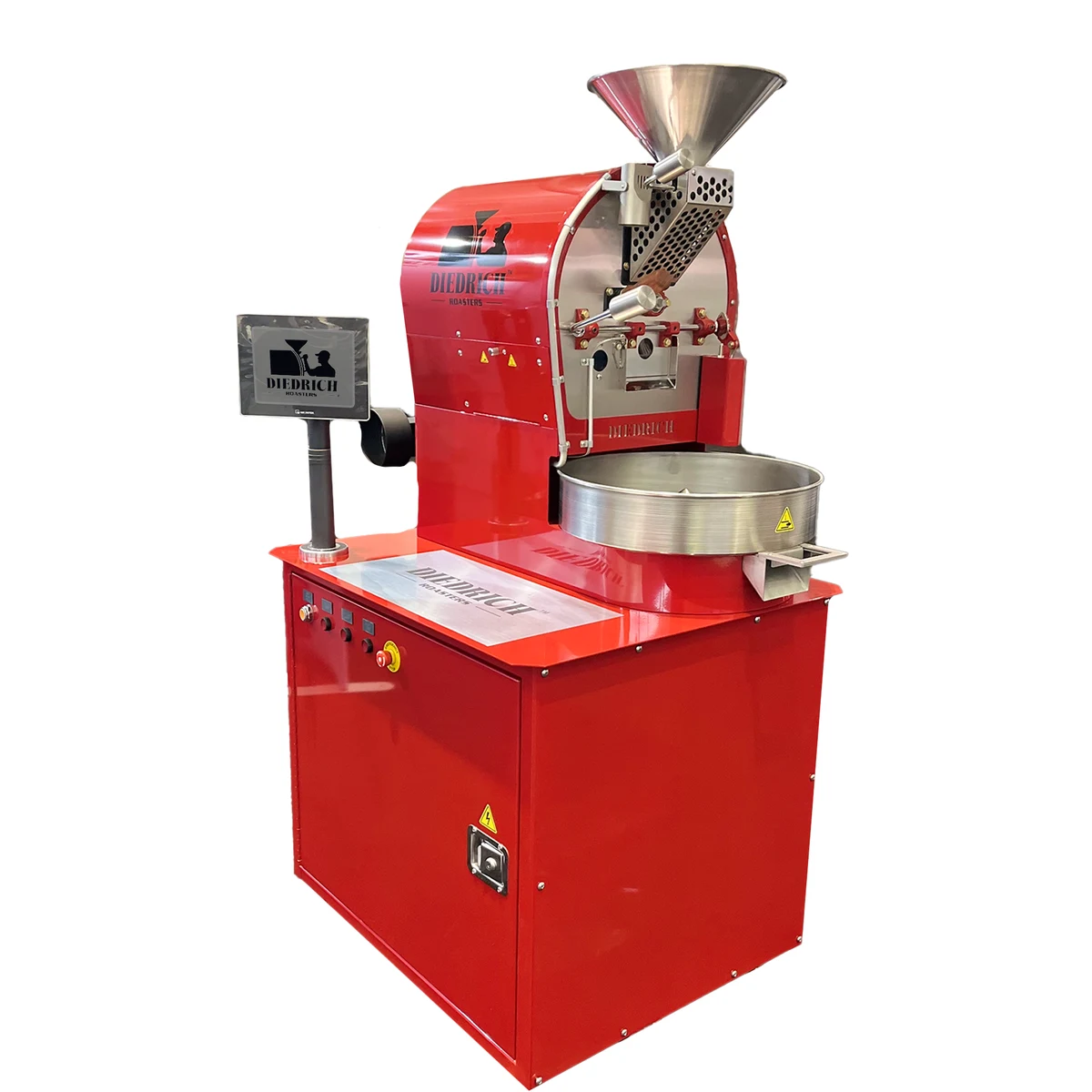
Overview
Diedrich, based in Ponderay, Idaho, launched the DR-3 in 2022 to replace its long-running IR-1 and IR-2.5 (Daily Coffee News). There is a gas DR-3 and an electric DR3-E. If you see a “new” IR-2.5 for sale, it is old stock or used.
Main specifications
| Spec | Manufacturer figure |
|---|---|
| Batch | 1 to 3 kg |
| Hourly output | About 12 kg (26.4 lb) |
| Heat | Gas (DR-3) or electric (DR3-E) |
| Voltage | 115 V or 230 V single-phase on the product page; 240 V single-phase in Diedrich’s comparison table |
| Software | Burner integration with Cropster and Artisan |
| Warranty | 12 months, but no later than 18 months after delivery; wear items excluded |
Sources: Diedrich DR-3 page, Diedrich roaster comparison, DR3-E page. Diedrich’s pages disagree on voltage, so confirm the configuration with the factory.
Key features
Variable roast air, cooling air and drum speed across Diedrich’s range (Diedrich), and an external chaff cyclone.
Performance and practical applications
Diedrich says the DR-3 handles three batch sizes, from a 1 kg sample to a full 3 kg production run. That flexibility suits a café that wants one machine for both profiling and production.
Advantages
- Gas or electric versions.
- US-built with US-based support.
- Works with Cropster and Artisan.
Disadvantages
- Short warranty window compared with San Franciscan’s lifetime cover.
- Conflicting voltage information across Diedrich’s own pages.
Who should buy it
Cafés starting in-house roasting at a few kilograms a day.
Who should avoid it
Buyers who need more than about 12 kg an hour.
Price and availability
Quotation only (checked 15 November 2026).
Our verdict
A flexible 3 kg roaster from an established maker. Pin down the electrical spec in writing.
15. San Franciscan SF-6
Overview
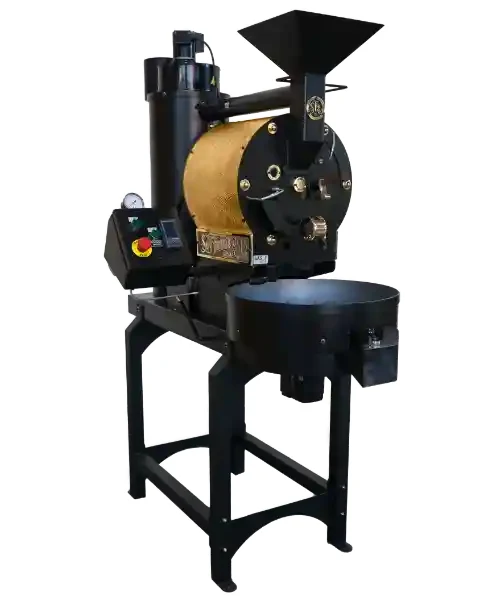
The SF-6 is a traditional cast-look 3 kg drum roaster, handmade in Carson City, Nevada. San Franciscan pitches it at cafés and farmers’ markets.
Main specifications
| Spec | Manufacturer figure |
|---|---|
| Batch | 1 to 3 kg |
| Hourly output | 3 to 4 roasts, about 8.2 kg (18 lb) |
| Fuel | Natural gas or propane |
| Cooling | Removable cooling tray |
| Chaff | Cyclone in a cylinder behind the roaster |
| Warranty | Lifetime on materials and fabrication; 1 year on third-party parts such as motors and bearings |
| Electrical, dimensions, weight | Not publicly disclosed in text (spec sheet is an image) |
Source: San Franciscan SF-6 page.
Key features
Manual control with a gas pressure gauge, and compatibility with most data loggers.
Performance and practical applications
At 8.2 kg an hour it is slower than the DR-3 or P3000 on paper. Many buyers choose it for the look of the machine in a café as much as the output.
Advantages
- Lifetime warranty on the build.
- Runs on propane, which is easy to source as LPG in the Philippines.
Disadvantages
- Lowest hourly output among the 3 kg machines here.
- Key installation specs sit in an image spec sheet, so ask for them in writing.
Who should buy it
Cafés that want a visible, traditional roaster as part of the shop.
Who should avoid it
Roasteries that need maximum output per hour.
Price and availability
Quotation only (checked 15 November 2026).
Our verdict
Built to last, and slower than its rivals.
16. Giesen W6A
Overview
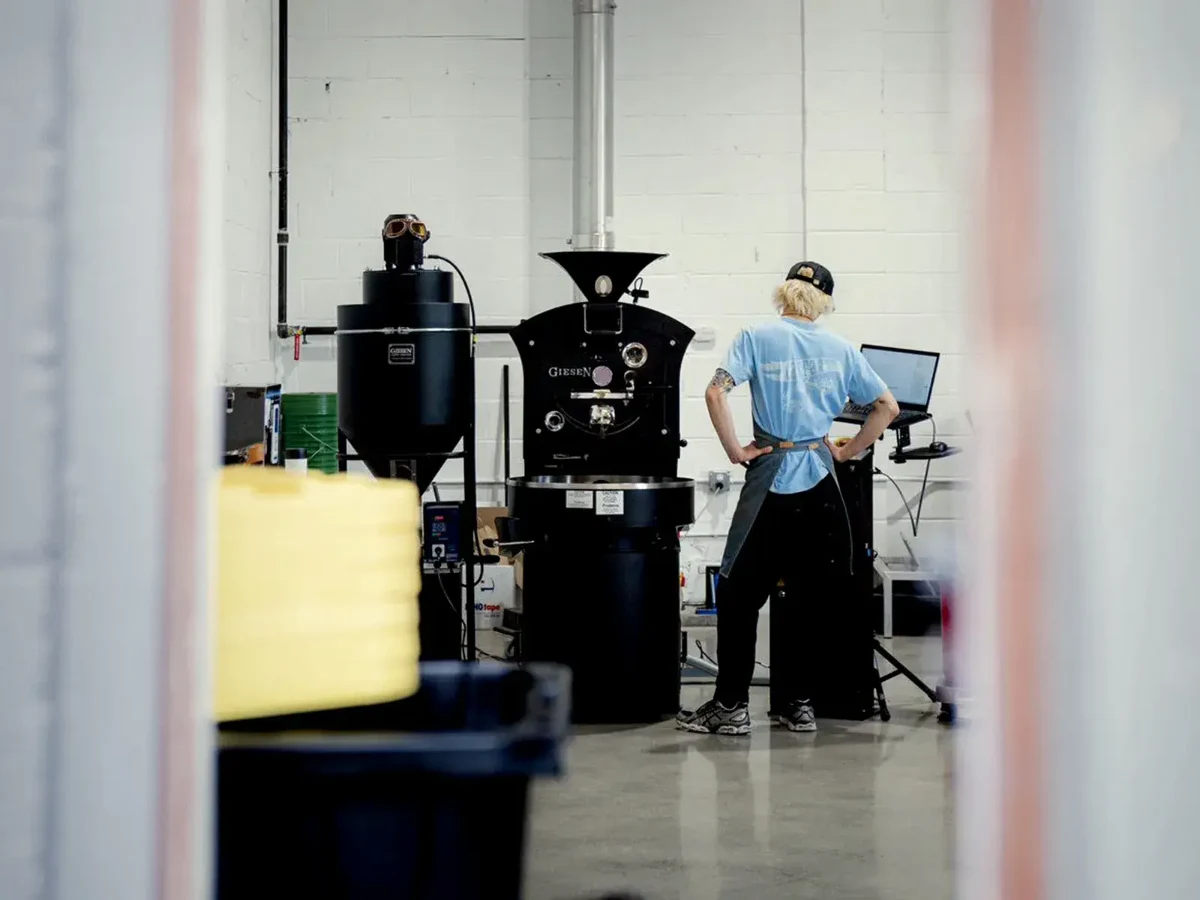
Giesen handcrafts its roasters in Ulft, the Netherlands. The W6A is its 6 kg gas roaster. An electric W6E is also available.
Main specifications
| Spec | Manufacturer figure |
|---|---|
| Batch | 3 to 6 kg |
| Hourly output | Up to 24 kg (the same page also says 30 kg) |
| Fuel | Natural gas, propane or butane |
| Electrical | 1.7 kW max (W6E: 17 kW) |
| Dimensions | 1427 x 723 x 1705 mm |
| Weight | 485 kg (roaster only) |
| Chimney | 150 mm |
| Software | Giesen Profiler (optional) |
Sources: giesen.com/w6-series, W6 technical datasheet, October 2024. An older Giesen brochure lists a 0.5 to 6 kg range (brochure). We used the 3 kg minimum from the current page and 2024 datasheet.
Key features
Separate roasting and cooling fans, so you can roast the next batch while the last one cools. Drum speed, airflow and burner power are all adjustable.
Performance and practical applications
A W6A is a common first “real” roaster for a wholesale business. In the Philippines, the Philippine Coffee Board has shown a Giesen W15A in use at a San Juan City business, so Giesen machines are already installed locally.
Advantages
- Proven 6 kg design used worldwide.
- Gas or electric versions.
- Roast and cool at the same time.
Disadvantages
- 485 kg needs a solid floor and forklift access.
- Minimum batch is now 3 kg, so it is not a sample roaster.
Who should buy it
Roasteries supplying several cafés or offices.
Who should avoid it
A single café roasting under 10 kg a week.
Price and availability
USD 34,999 for the UL-certified model at WebstaurantStore (US, checked 15 November 2026). Elsewhere, request a quote.
Our verdict
The safe choice for a business ready for 6 kg batches.
17. Probat P05e
Overview
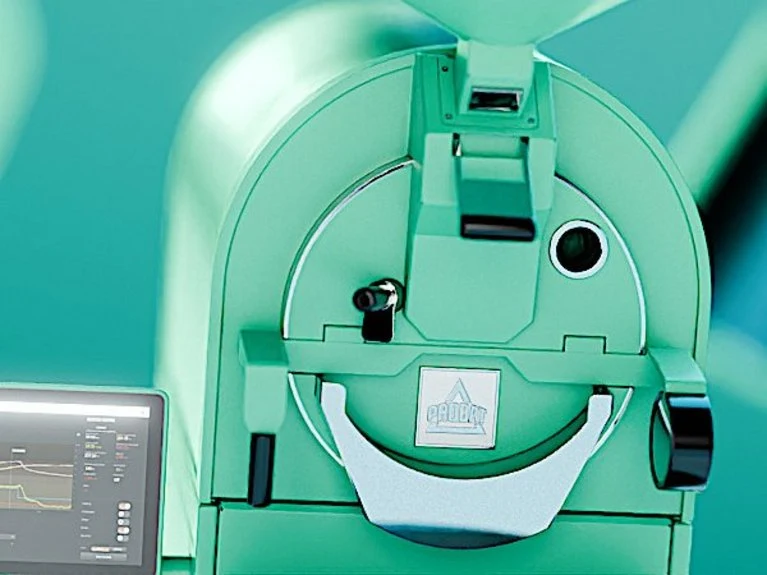
Probat, from Emmerich am Rhein in Germany, is one of the oldest names in roasting. The P05e is the electric version of its 6 kg P05 shop roaster.
Main specifications
| Spec | Manufacturer figure |
|---|---|
| Batch | 1 to 6 kg |
| Roasting capacity | 17 kg/h of roasted coffee |
| Roast time | 10 to 20 minutes |
| Heat | Electric (P05 also offered for natural gas, propane and hydrogen) |
| Space | 5 to 10 m²; height 2.5 m |
| Electrical, weight | Not publicly disclosed in the sources checked |
Sources: Probat P series page, P05 brochure.
Key features
Probat says the P05e’s electric hot-air blower reacts as quickly as a gas burner. At the 2023 German Roasting Championships, second and third place both roasted on the electric version (Probat newsroom).
Performance and practical applications
A 1 kg minimum on a 6 kg machine means you can run small single-origin lots and full blends on the same roaster.
Advantages
- Wide 1 to 6 kg range.
- Electric option with no gas line.
Disadvantages
- Needs a lot of floor space (5 to 10 m²).
- No public price.
Who should buy it
Roasteries that want Probat build quality and plan to grow into it.
Who should avoid it
Small shops short on space.
Price and availability
Quotation only (checked 15 November 2026). Probat opened a regional office in Cebu in 2012 for Southeast Asian service (Global Coffee Report). Confirm it is still active before relying on it.
Our verdict
The most flexible batch range in the 6 kg class.
18. Loring S7 Nighthawk
Overview
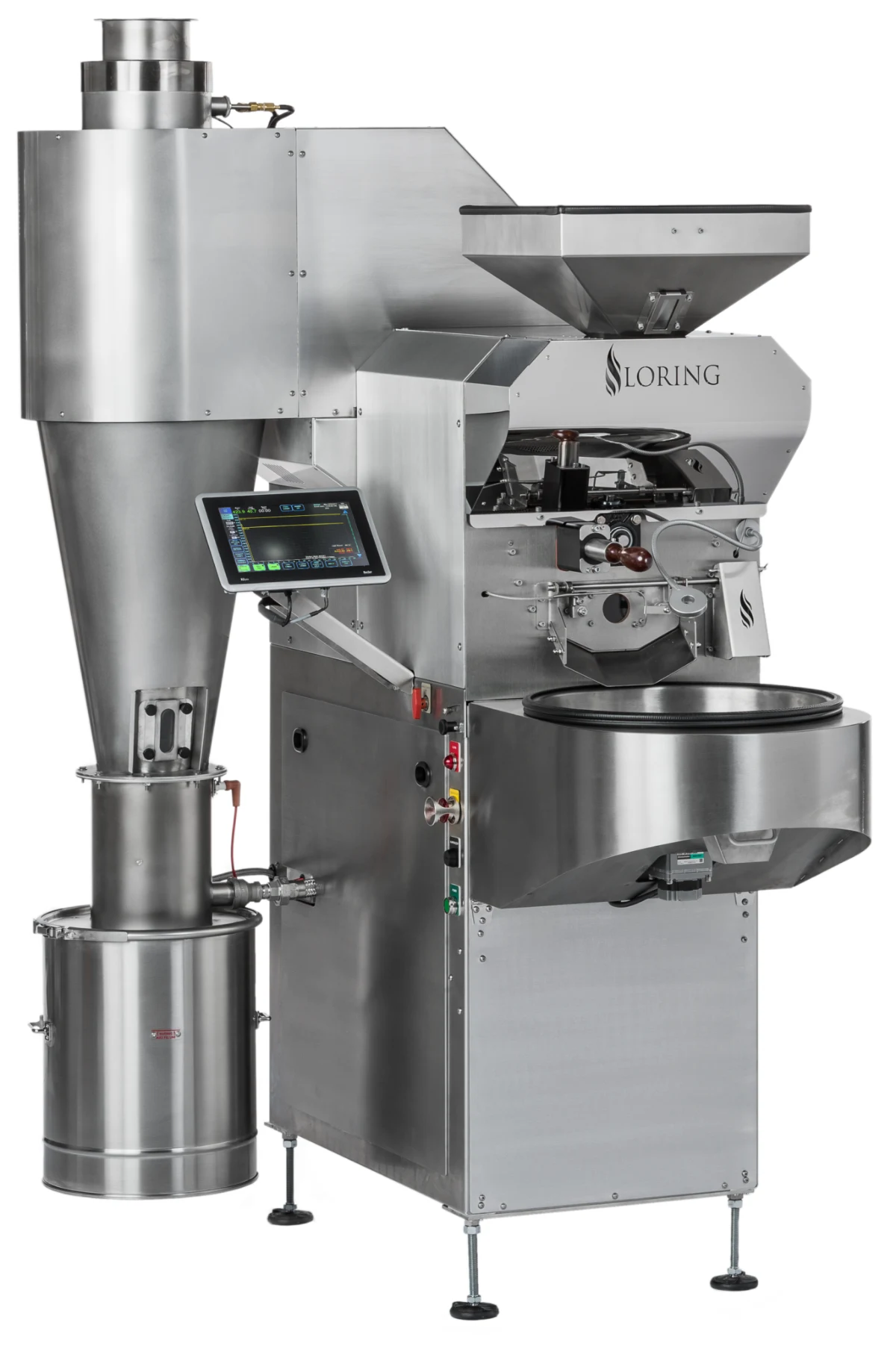
Loring’s smallest roaster uses one burner to heat the roast air and burn the smoke, so it needs no separate afterburner.
Main specifications
| Spec | Manufacturer figure |
|---|---|
| Batch | 1.4 to 7 kg |
| Fuel | Natural gas or propane |
| Heat input | 72,000 BTU/h sustained; 82,000 BTU/h instantaneous |
| Electrical | 0.6 kW nominal; 2.9 kW peak |
| Dimensions | 208 x 106 x 184 cm (H x W x L) |
| Weight | 397 kg uncrated |
| Exhaust | Minimum 6 in (152 mm) stack |
| Controls | Touch screen, PID control of burner and fan, saved profiles |
Sources: Loring S7 page, S7 tech spec PDF.
Key features
Built-in smoke incineration and full automation.
Performance and practical applications
Smoke is one of the hardest problems for a café in a mall or a mixed-use building. A roaster that burns its own smoke can make approval easier, though local rules still decide.
Advantages
- No external afterburner.
- Low electrical draw for a gas roaster.
- Wide 1.4 to 7 kg range.
Disadvantages
- Price on request, and widely known as a premium brand.
- Tall machine at over 2 m.
Who should buy it
Urban roasteries where smoke control is the main constraint.
Who should avoid it
Buyers on a tight first-roaster budget.
Price and availability
Quotation only (checked 15 November 2026).
Our verdict
Pay for the Loring when emissions are the problem you most need to solve.
Best medium and industrial coffee roasting machines
From 12 kg upward you are planning a production room: gas lines, three-phase power, afterburners, destoners and forklifts.
19. Giesen W15A
Overview
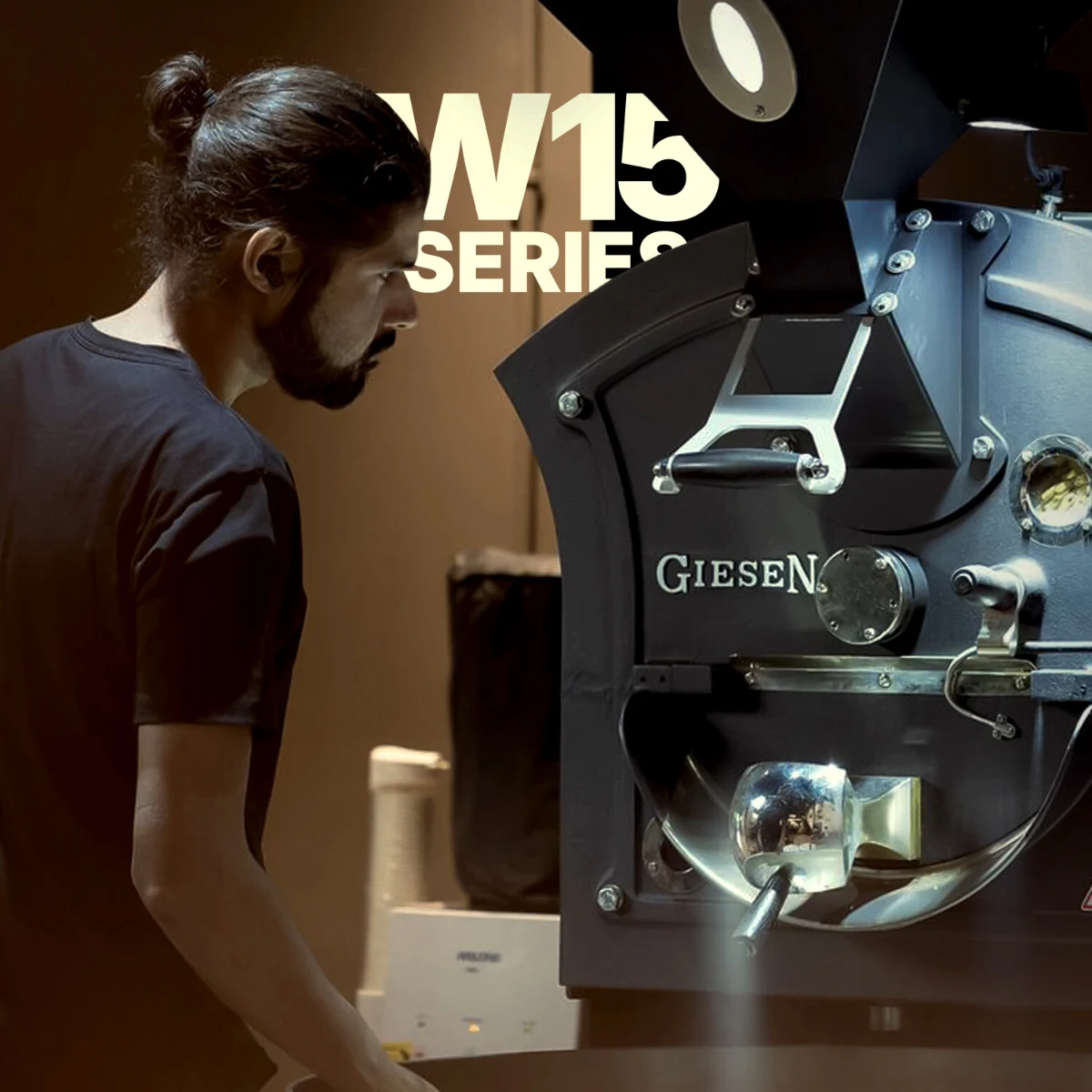
The W15A is Giesen’s 15 kg gas roaster and the usual step up from a W6A.
Main specifications
| Spec | Manufacturer figure |
|---|---|
| Batch | 7.5 to 15 kg |
| Hourly output | Up to 60 kg |
| Fuel | Natural gas or propane |
| Dimensions | 1899 x 962 x 1983 mm |
| Weight | 650 kg (roaster only) |
| Chimney | 200 mm |
| Software | Giesen Profiler |
Sources: W15 technical datasheet, Giesen DirectIndustry listing. Older Giesen material lists a 0.5 kg minimum. The newer datasheet says 7.5 kg, which we used.
Performance and practical applications
Sixty kilograms an hour is roughly one full sack of green coffee, which Giesen itself uses as the comparison.
Advantages
- Already installed in the Philippines, per the Philippine Coffee Board.
- Roast and cool at the same time.
Disadvantages
- 7.5 kg minimum makes small lots impractical.
- 650 kg machine with a 200 mm chimney.
Who should buy it
Wholesale roasters supplying many accounts.
Who should avoid it
Single-site cafés.
Price and availability
Quotation only. An older US listing at USD 39,999 is marked no longer available, so it should not be read as a current price (checked 15 November 2026).
Our verdict
A natural second roaster for a business that has outgrown 6 kg.
20. San Franciscan SF-25
Overview
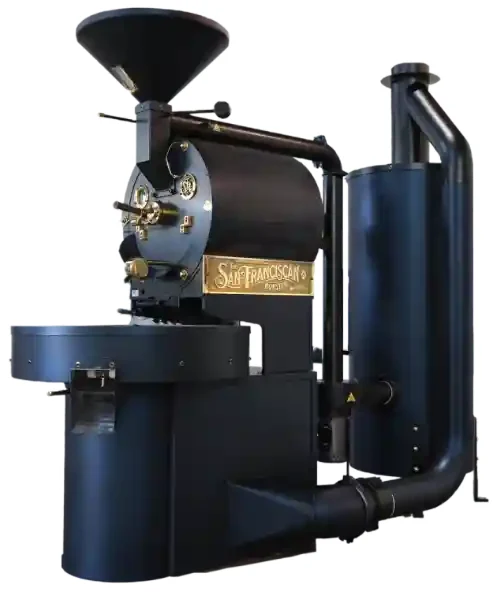
A 12 kg drum roaster with a built-in afterburner, handcrafted in Carson City, Nevada.
Main specifications
| Spec | Manufacturer figure |
|---|---|
| Batch | 3 to 12 kg |
| Hourly output | Up to 48 kg (the same page’s callout says 56 kg) |
| Fuel | Natural gas or propane |
| Heat input | 100,000 BTU roaster + 250,000 BTU afterburner |
| Electrical | 220 V; 30 A supply recommended |
| Clearance | At least 18 in on all sides |
| Warranty | Lifetime on materials and fabrication; 1 year third-party parts |
Source: San Franciscan SF-25 page. We used the lower hourly figure.
Performance and practical applications
The afterburner adds 250,000 BTU of gas use, which matters for running costs. A cyclone is offered as an alternative where rules allow.
Advantages
- Afterburner included.
- Wide 3 to 12 kg range.
- Lifetime build warranty.
Disadvantages
- High combined gas demand.
- Conflicting hourly figures on the product page.
Who should buy it
Growing roasteries that need smoke control without stepping to a Loring.
Who should avoid it
Sites with limited gas supply.
Price and availability
Price on application, with financing offered (checked 15 November 2026).
Our verdict
A 12 kg roaster with emissions handled from day one.
21. Probat P25
Overview
The largest of Probat’s P series shop roasters.
Main specifications
| Spec | Manufacturer figure |
|---|---|
| Batch | 1 to 30 kg (as published) |
| Roasting capacity | 85 kg/h of roasted coffee |
| Roast time | 10 to 20 minutes |
| Heat | Natural gas, propane, electric or hydrogen (current product page) |
| Electrical, dimensions, weight | Not publicly disclosed in the sources checked |
Source: Probat P series page. Probat’s 2023 P series brochure lists only propane and natural gas for the P25 (brochure). The product page is newer, so we used it.
Performance and practical applications
Eighty-five kilograms of roasted coffee an hour puts it in wholesale and private-label territory.
Advantages
- Large output from a shop-roaster footprint.
- Four heating options.
Disadvantages
- Few public installation specs.
- No public price.
Who should buy it
Established wholesale roasters.
Who should avoid it
Anyone still proving demand.
Price and availability
Quotation only (checked 15 November 2026).
Our verdict
Probat build quality at wholesale scale. Ask for the full technical sheet early.
22. Loring S35 Kestrel
Overview
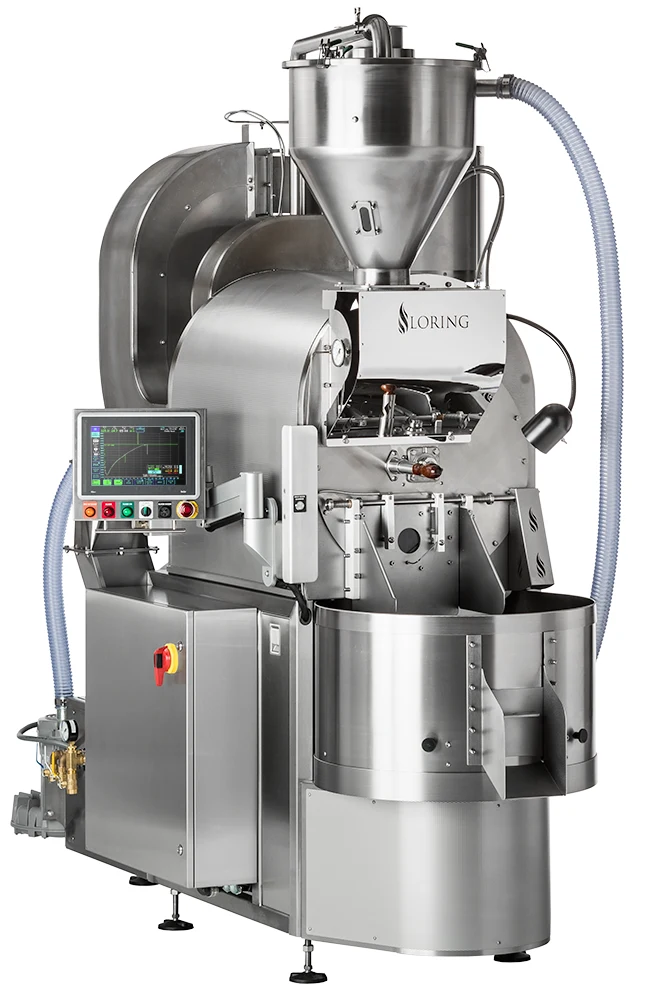
Loring’s 35 kg roaster uses the same single-burner, smoke-incinerating design as the S7.
Main specifications
| Spec | Manufacturer figure |
|---|---|
| Batch | 7 to 35 kg |
| Dimensions | 270 x 173 x 241 cm (H x W x L) |
| Afterburner | Integrated |
| Controls | Touch screen, PID, saved profiles, full automation |
| Fuel, electrical, weight, hourly output | In Loring’s S35 tech PDF; not inspected for this article |
Source: Loring S35 page.
Performance and practical applications
A 7 kg minimum on a 35 kg machine is a wide range, so one roaster can handle both small accounts and large orders.
Advantages
- Integrated afterburner.
- Wide batch range.
Disadvantages
- Premium price on quotation.
- Needs a 2.7 m tall space.
Who should buy it
High-volume roasters in buildings with strict smoke rules.
Who should avoid it
Most businesses under a few tonnes a month.
Price and availability
Quotation only (checked 15 November 2026).
Our verdict
The top of this list for output and emissions control.
Complete coffee roasting machine comparison
| Machine | Manufacturer | Category | Technology | Batch (green) | Heat source | Power | Main distinguishing feature | Price / status | Ideal application | Official link |
|---|---|---|---|---|---|---|---|---|---|---|
| SR540 | Fresh Roast | Home | Fluid bed | 85-120 g | Electric | 120 V | Lowest price | USD 239 (US) | First home roaster (N. America) | Link |
| SR800 | Fresh Roast | Home | Fluid bed | 113-226 g | Electric | 120 V, 1.6 kW | Double SR540 batch | USD 334 (US) | Home, two people | Link |
| 2000AB / 2020SR Plus | Behmor | Home | Drum | Up to 454 g | Electric | 120 V or 220 V | 1 lb home batch | USD 479 (US) | Medium roasts at home | Link |
| CBR-101 | Gene Cafe | Home | Rotating hot air | Up to 250 g | Electric | 120 V or 220-240 V, 1.3 kW | Quiet, 220 V option | USD 690 (US) | Home in 220 V countries | None found |
| KN-8828B-2K+ | Hottop | Prosumer | Drum | 225-300 g | Electric | 110-240 V versions | Dual probes | USD 1,800 (US) | Learning drum profiling | Link |
| Bullet R2 | Aillio | Prosumer | Induction drum | Up to 1 kg | Electric | 1.7 kW, 120 or 230 V | 1 kg on household power | USD 4,099 | Serious home, micro-business | Link |
| Bullet R2 Pro | Aillio | Prosumer | Induction drum | Up to 1.2 kg | Electric | 2.3 kW, 200-240 V | 220 V, more output | USD 5,299 | Micro-roastery | Link |
| Sniper M10/M10S | Kaleido | Prosumer | Drum | 300-1,200 g | Electric | 120 V or 220 V | Low cost per kg | From USD 2,879 | Budget small batch | Distributor |
| PRO100 / 100X | IKAWA | Sample | Hot air | Up to 120 g | Electric | Up to 1.7 kW | App-shared profiles | EUR 3,570+ net (EU) | Green coffee QC | Link |
| Nano 7 | Kaffelogic | Sample / home | Hot air | 90-120 g (50-200 g Boost) | Electric | 1.4 kW | Cheapest automation | USD 1,300.99 (US) | Budget lab, home | Link |
| L200 Ultra | ROEST | Sample | Convection drum | 50-200 g | Electric | 1.65 kW | 3 kg/h of samples | From EUR 5,290 | High-volume QC | Link |
| S7X | Stronghold | Sample / café | Vertical drum, triple heat | 150-850 g | Electric | 5.8 kW, 220 V | Three heat sources | EUR 18,000 net (EU) | Specialty café | Distributor |
| P3000 | ROEST | Small commercial | Convection drum | 1-3 kg | Electric | 10.24 kW, 3-phase | 25 kg/h electric | Quote | Café / roastery with 3-phase | Link |
| DR-3 / DR3-E | Diedrich | Small commercial | Drum | 1-3 kg | Gas or electric | 115/230 V 1-ph | Replaced IR-2.5 | Quote | Café roasting | Link |
| SF-6 | San Franciscan | Small commercial | Drum | 1-3 kg | Gas / propane | Not disclosed | Lifetime warranty | Quote | Show roaster in café | Link |
| W6A | Giesen | Small commercial | Drum | 3-6 kg | Gas | 1.7 kW electrical | Roast and cool at once | USD 34,999 (US) | Growing wholesale | Link |
| P05e | Probat | Small commercial | Drum | 1-6 kg | Electric | Not disclosed | Widest 6 kg range | Quote | Flexible roastery | Link |
| S7 Nighthawk | Loring | Small commercial | Drum, smoke incineration | 1.4-7 kg | Gas / propane | 0.6 kW nominal | No afterburner needed | Quote | Urban roastery | Link |
| W15A | Giesen | Medium | Drum | 7.5-15 kg | Gas | Not disclosed | 60 kg/h | Quote | Wholesale | Link |
| SF-25 | San Franciscan | Medium | Drum + afterburner | 3-12 kg | Gas / propane | 220 V, 30 A | Afterburner included | Quote | Growing roastery | Link |
| P25 | Probat | Medium / industrial | Drum | 1-30 kg | Gas, electric, hydrogen | Not disclosed | 85 kg/h | Quote | Wholesale, private label | Link |
| S35 Kestrel | Loring | Industrial | Drum, smoke incineration | 7-35 kg | Gas (see tech PDF) | See tech PDF | Integrated afterburner | Quote | High volume | Link |
Specifications and capacities are manufacturer-published figures (or distributor figures where noted above). A maximum batch is not the same as recommended daily output, and real output depends on roast level, preheat, cooling and cleaning time.
How to choose the right coffee roasting machine
Start with how much roasted coffee you need each week, then work backwards.
- Work out weekly roasted coffee. A café serving 100 drinks a day at about 18 g per shot uses around 12.6 kg a week. That figure is an illustration, not a benchmark. Use your own sales.
- Add weight loss. Beans lose weight during roasting. Sweet Maria’s figure for the Bullet R2 Pro (1.2 kg green giving about 2 lb, or 0.9 kg, roasted) shows the scale.
- Decide how many roasting hours you have. A 1 kg machine doing four batches an hour covers a lot more than its batch size suggests.
- Check your site: voltage, phase, gas, floor strength and where the exhaust can go.
- Then pick the category. Under 2 kg a week is a home roaster. A few kilograms a week is prosumer. One busy café is usually a 1 to 3 kg machine. Several accounts usually means 6 kg and up.
If you haven’t run a café before, our café startup cost breakdown and break-even calculator help you test whether a roaster pays for itself.
Types of coffee roasting machines explained
Drum roasters vs fluid-bed roasters
A drum roaster turns beans in a heated metal drum. Heat reaches the beans through the drum wall (conduction), the hot air passing through (convection) and radiant heat. Most commercial roasters in this list are drums.
A fluid-bed roaster blows hot air up through the beans so they float. Heat comes almost entirely from the air. Fresh Roast, IKAWA and Kaffelogic work this way. Hot-air roasters respond fast and are easy to automate at small sizes. We explain why some people prefer the cup they produce in why air-roasted coffee is changing the coffee experience.
The Gene Cafe sits in between: hot air, but in a rotating chamber.
Gas vs electric coffee roasters
Gas roasters (natural gas or propane/LPG) dominate above 6 kg. Electric roasters avoid gas lines and permits for gas, and are now available up to 6 kg and beyond (Probat P05e, Giesen W6E, ROEST P3000). Electric machines above a few kilowatts usually need three-phase supply. Induction (Aillio) is a type of electric heating.
Understanding batch capacity, heat and airflow
Batch capacity is the most misread spec. A “6 kg” roaster is rated for 6 kg of green coffee at its maximum, and Giesen’s current W6A minimum is 3 kg. Running far below the minimum gives poor heat transfer and inaccurate probe readings.
Heat transfer controls how fast beans dry, brown and crack. You change it with burner or heater power. Airflow controls how much heat moves by convection and how fast smoke and chaff leave the drum. Most commercial machines here let you adjust both, and many add drum speed.
Temperature monitoring and roast profiling
A bean temperature probe and logging software let you repeat a roast. Machines with probes (Hottop, Aillio, ROEST, Stronghold, Diedrich, Giesen, Probat, Loring) can be logged. Many commercial roasters work with Cropster or Artisan. If you’re new to roast levels, see our guide to understanding coffee roast levels.
Sample roasting vs production roasting
Sample roasting answers “is this coffee worth buying, and how should we roast it?” Production roasting answers “how do we roast 30 kg the same way every day?” Many roasteries keep a sample roaster next to a production machine.
How much does a coffee roasting machine cost?
From the prices we checked on 15 November 2026:
| Category | Published price range we found | Examples |
|---|---|---|
| Home | USD 239 to 690 | Fresh Roast SR540, Gene Cafe CBR-101 |
| Prosumer | USD 1,800 to 5,299 | Hottop, Kaleido M10, Aillio R2 Pro |
| Sample | USD 1,300 to EUR 18,000 net | Kaffelogic Nano 7, IKAWA, Stronghold S7X |
| Small commercial | USD 34,999 (W6A, US) where published; most on quotation | Giesen, Probat, Diedrich, Loring |
| Medium / industrial | Quotation only | Giesen W15A, Probat P25, Loring S35 |
We have not converted these to pesos because exchange rates move and the landed cost in the Philippines also includes freight, insurance, duties, VAT and installation. Ask any seller for a landed quote in pesos.
Cost of operating a coffee roasting machine
Running cost has four parts: energy, maintenance parts, labour and green coffee. Green coffee is by far the largest.
For electric machines, energy per hour is roughly the rated power in kW multiplied by the share of the time the heater runs, multiplied by your rate per kWh. As a worked example only: if a ROEST L200 Ultra drew its full 1.65 kW for an hour and your rate were ₱12 per kWh, the electricity would cost about ₱20. Heaters cycle, so the real figure is usually lower. Use the rate on your own Meralco or cooperative bill.
For gas machines, ask the manufacturer for gas consumption per hour at your batch size, and include the afterburner if there is one. The SF-25’s afterburner alone is rated at 250,000 BTU.
Essential maintenance considerations
Chaff and roast oils build up in drums, fans, cyclones and ducts, and this build-up is a fire risk. Manufacturers list daily, weekly and yearly cleaning. Aillio adds a filter-clean alert. Mill City’s manuals ask for clearance around the chaff collector for frequent removal (MCR-15 manual). Budget for cleaning time every day, not just service visits.
What to consider before buying a commercial coffee roaster
Ventilation and exhaust requirements
Every machine here needs smoke to go somewhere. Small commercial machines list exhaust sizes: ROEST P3000 merges into a 150 mm line, the Giesen W6A uses a 150 mm chimney, the W15A a 200 mm chimney and the Loring S7 at least a 6 in (152 mm) stack. Malls and mixed-use buildings may also require smoke treatment, which is where an afterburner (SF-25, Loring) or a filter system comes in.
Electrical and installation requirements in the Philippines
Philippine supply is 220 V, 60 Hz. Practical points:
- Avoid 120 V-only machines. The Fresh Roast warranty is void outside North America.
- 220-240 V single-phase works for the Aillio R2 Pro, Stronghold S7X, IKAWA (220-240 V model) and Kaffelogic 230-240 V.
- Check the frequency. Most machines listed say 50-60 Hz, but confirm motors and fans are rated for 60 Hz.
- Three-phase machines like the ROEST P3000 need a three-phase connection, which many small commercial units don’t have. Ask your building admin and a licensed electrician before ordering.
- Propane is sold here as LPG, which suits gas roasters that list propane. Confirm the burner is set up for your gas.
Shipping, spare parts and after-sales support
A 485 kg roaster arrives crated and needs a forklift. Before you buy, ask the seller who installs and commissions the machine in the Philippines, which parts they stock locally and how fast they can ship a failed motor or thermocouple. Probat opened a Cebu service office in 2012, and Giesen and Probat machines are already roasting in the Philippines, per the Philippine Coffee Board and local roasters. That doesn’t guarantee support for every brand, so get it in writing.
How to choose a machine for a new coffee roasting business
- Prove demand before you buy big. Many new brands start by buying roasted coffee wholesale or under a private label and only buy a roaster once volume is steady.
- Size the machine to 12 to 18 months of expected volume, not today’s.
- Keep a small sample roaster in the plan if you will buy green coffee by the sack.
- Budget for ducting, electrical work, a scale, storage, packaging and training on top of the machine.
If you’d rather sell coffee under your own name before investing in a roaster, Caffeine Brothers offers wholesale coffee for cafés and offices and private-label orders. You can also request a free coffee sample to compare against your own roasts.
Common mistakes when purchasing a commercial coffee roaster
- Buying on maximum batch without checking the minimum.
- Ordering before confirming voltage, phase and gas.
- Forgetting the exhaust route and building permission.
- Assuming a foreign warranty applies in the Philippines.
- Not budgeting daily cleaning time.
- Buying a discontinued model (like a “new” Diedrich IR-2.5) without checking parts support.
Frequently asked questions
What is the best coffee roasting machine for beginners?
For North American buyers, the Fresh Roast SR540 is the cheapest manufacturer-supported starting point at USD 239. For buyers in 220 V countries like the Philippines, the Gene Cafe CBR-101 (USD 690 in the US) and the Kaffelogic Nano 7 are sold in 220-240 V versions.
What is the best coffee roaster for a small café?
Most single cafés fit a 1 to 3 kg machine. Gas options include the Diedrich DR-3 and San Franciscan SF-6. Electric options include the Aillio Bullet R2 Pro (1.2 kg, 220-240 V), Stronghold S7X (850 g, 220 V) and ROEST P3000 (3 kg, three-phase).
How much does a commercial coffee roaster cost?
Among published prices, a Giesen W6A listed at USD 34,999 in the US in November 2026. Most commercial makers, including Probat, Loring, Diedrich and San Franciscan, quote on request. Add freight, duties, installation and ducting to the machine price.
Is a drum or fluid-bed roaster better?
Neither is better in general. Fluid-bed roasters are quicker and easy to automate at small sizes, which is why most sample roasters use hot air. Drum roasters dominate commercial production. Choose by batch size and the control you need.
Can I use a 120 V coffee roaster in the Philippines?
Only through a correctly sized step-down transformer, and you may lose the warranty. Fresh Roast states its warranty is void outside North America. Buying a 220-240 V model avoids the problem.
Do coffee roasters need ventilation?
Yes. All roasters produce smoke and chaff. Home machines need a window, hood or outdoor space. Commercial machines need ducting to the outside, and some sites need an afterburner or filter.
How long does a roast take?
Probat lists 10 to 20 minutes per batch for its P series. Aillio quotes 7 to 9 minutes to first crack for a 1 kg batch on the Bullet R2. Hot-air sample roasters are usually faster.
Does Caffeine Brothers sell coffee roasting machines or green coffee?
No. Caffeine Brothers roasts and sells roasted coffee and drip bags in the Philippines. We don’t sell roasting machines or green beans.
Research methodology and sources
How we selected machines: we started from the brands in our brief (Aillio, Fresh Roast, Behmor, Gene Cafe, Hottop, Kaleido, IKAWA, ROEST, Kaffelogic, Stronghold, Mill City Roasters, Diedrich, Giesen, Probat, Loring and San Franciscan), kept models we could match to a current manufacturer or authorized-distributor page, and dropped or replaced discontinued models.
How we verified specs: manufacturer pages, spec sheets and manuals came first. Where a maker publishes nothing, we used authorized distributors and named retailers and labelled them. Where sources disagreed (Giesen batch minimums, Diedrich voltage, SF-25 output, Gene Cafe capacity, Probat P25 fuel), we used the newest manufacturer source and noted the conflict in the review.
How we checked prices: on 15 November 2026, at the named seller, in the seller’s currency. Prices change, and we have not converted currencies.
Hands-on testing: none. Caffeine Brothers has not tested these 22 machines for this article. Performance comments come from manufacturer data or named third-party sources.
How we formed verdicts: by comparing published capacity, control, power needs, support and price against the buyer each machine suits. We do not use star ratings or scores.
Machines considered but left out: Mill City Roasters, which moved production to a new M-Series in 6, 10 and 20 kg sizes during 2026 (Sprudge) without full public specs yet; the Aillio Bullet R1, which Aillio lists as no longer available (aillio.com); and the Diedrich IR-1 and IR-2.5, replaced by the DR-3.
Conclusion
For home roasting, decide first whether your power is 120 V or 220 V, because that rules out half the home machines. For a café, a 1 to 3 kg roaster usually covers one shop, and the real decision is gas or electric, which comes down to what your building can supply. For wholesale, size for the next 12 to 18 months and plan the exhaust before the machine.
Whatever you roast on, it helps to taste well-roasted coffee for reference. Caffeine Brothers roasts Philippine Arabica, Robusta and Barako daily. Browse the shop or ask for a free sample.
 Previous Post