
How Long Do Coffee Beans Stay Fresh in Philippine Conditions? A Storage Guide
How long do coffee beans stay fresh in Philippine conditions? The answer depends on packaging, humidity, heat, light and how quickly an opened bag is used. This research-based guide gives homes and cafés a practical storage plan without claiming a local storage experiment.
The ranges below summarize published guidance and laboratory research. Caffeine Brothers did not conduct a Philippine storage trial for this article, so these are planning references rather than guaranteed local shelf lives. The storage steps below help coffee beans stay fresh longer in ordinary Philippine kitchens and café stockrooms.
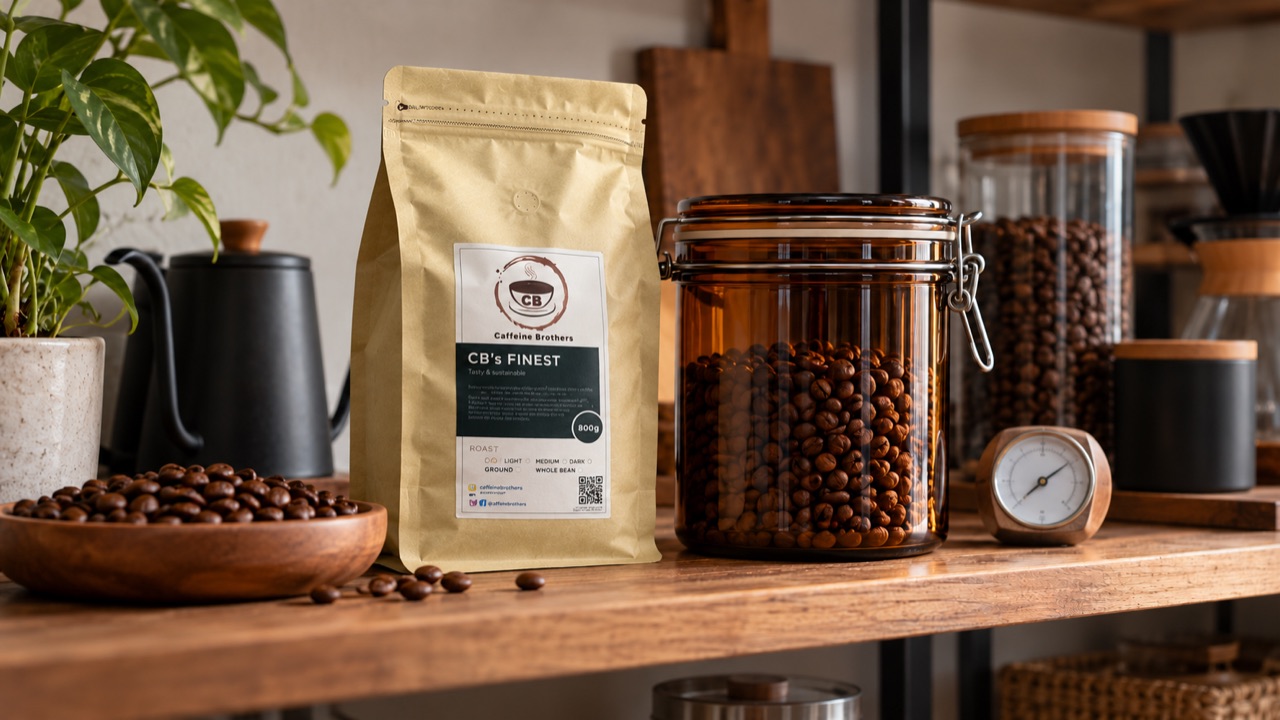
Freshly roasted Philippine coffee
Shop our coffee beans: Arabica, Robusta, Kapeng Barako and signature blends, roasted daily in Manila, whole bean or ground. Not sure which? Take the Coffee Match Quiz.
Shop Coffee Beans →Quick answer: freshness planning ranges
The National Coffee Association (NCA) lists the following general freshness ranges after opening when coffee is transferred to airtight storage. They are useful for purchase planning, not a promise that every coffee will taste identical throughout the range.
| Coffee form | NCA planning range | Practical implication |
|---|---|---|
| Roasted whole beans at room temperature | 1–3 weeks | Buy a quantity you can finish steadily. |
| Ground coffee at room temperature | 1–2 weeks | Grind close to brewing and keep the package tightly closed. |
| Roasted whole beans refrigerated | About 2 weeks | Moisture and odors make handling critical. |
| Roasted whole beans frozen | 3–4 months | Use genuinely airtight portions and avoid condensation. |
Read the NCA storage and shelf-life guidance for its assumptions and cautions. A best-by date applies to the packaged product; it is not a guaranteed flavor date after opening.
Why Philippine conditions matter
PAGASA describes the Philippines as tropical and maritime, with high temperature and humidity. Its climate overview reports average monthly relative humidity from 71% in March to 85% in September. Those are national climate summaries, not measurements of a particular kitchen or café stockroom.
In practice, a cupboard beside an oven, a shelf near an espresso machine and an air-conditioned storeroom can expose the same coffee to different heat and moisture. Record where each bag is stored, whether it receives sunlight or steam, and whether the room is cooled overnight. These observations help you remove avoidable exposure; they cannot calculate a scientifically validated expiry date.
See PAGASA’s climate overview for the national temperature, humidity and rainfall context.
What packaging research shows
Smrke and colleagues compared four ways of storing whole roasted Arabica after opening: an airtight canister, tape, a clip and a package with an integrated screw cap. The tested screw-cap package performed best on chemical freshness indices. The study used one roast batch and a defined sampling procedure; it did not establish a universal consumer acceptance deadline. Its results do not prove that every screw-cap product beats every canister.
Read the 2022 Food Packaging and Shelf Life study. The study also explains why packaging must allow carbon dioxide to leave while limiting oxygen entry.
Earlier research by Glöss and colleagues linked packaging barrier properties with changes in chemical freshness indices in whole beans and capsules. Materials containing an aluminium layer offered better protection within that tested set. This supports checking a package’s oxygen and moisture barrier, but it does not create a universal taste ranking for every retail bag.
Read the PubMed record for the 2014 freshness-index research.
Coffee beans stay fresh: a practical storage routine
NCA recommends an opaque, airtight container in a cool, dark location away from heat sources and sunlight. Grind only what you need immediately before brewing. If you freeze beans, use an airtight container or sealed portions and return the unused coffee before condensation forms. This routine gives coffee beans their best chance to stay fresh in a humid kitchen.
| Checkpoint | Record or action |
|---|---|
| Incoming coffee | Supplier, batch, roast date and quantity |
| Opening a bag | Write the opening date on the label and identify the storage location |
| Closing the package | Check the valve, zipper or lid and remove excess air where the design allows |
| Daily use | Record consumption instead of estimating from bag appearance |
| Brew comparison | Keep dose, water and method consistent when noting flavor changes |
| Reordering | Compare remaining stock with expected use and delivery time |
This checklist makes a storage routine repeatable; it is not a completed experiment or a tested ranking of containers.
Match bag size to your consumption
Calculate how long a bag will remain open:
Days to use a bag = bag weight in grams ÷ daily bean use in grams.
Illustrative home example: two brews per day at 18 g each use 36 g daily. A 250 g bag lasts about 6.9 days; a 1 kg bag lasts about 27.8 days. These are consumption estimates that exclude waste, not freshness predictions.
Illustrative café example: 60 drinks at an 18 g dose require 1,080 g before waste, so a 1 kg bag would last less than a day at that sales level. A slower-selling second coffee may remain open much longer. Track each coffee separately so you can see whether coffee beans stay fresh through the full sales cycle.
Use the beans-per-month calculator to connect order quantities with demand. For consistent dosing and waste records, use the portion-control and waste-reduction training guide.
Frequently asked questions
Does a new container help coffee beans stay fresh?
No. Storage slows further change; it does not reverse staling. Packaging research measures how freshness indicators develop over time, so a new container is not a reason to buy more than you can use.
Can every Philippine customer be promised the same number of fresh days?
No. The reviewed studies use particular coffees, packages and conditions. A responsible guide states those limits and helps readers track their own use and storage environment.
How should a café investigate a flavor change?
Keep a dated log with the opening date, dose, water, grinder setting and tasting notes. Hold the recipe steady when comparing sessions. These notes support troubleshooting, but they are not a controlled storage trial because several factors may change together.
Editorial note: This is a research-based storage guide, not a Caffeine Brothers storage experiment. General ranges are cited to the NCA; Philippine climate context is cited to PAGASA; packaging findings are cited to the linked peer-reviewed studies. Internal links are provided for further reading and are not independent verification of their numerical claims.
 Previous Post
 Next Post