Coffee Shop Electricity Cost in the Philippines (Oct 2026 Rates)
By Robin Salvador, co-founder, Caffeine Brothers
Last updated: October 18, 2026
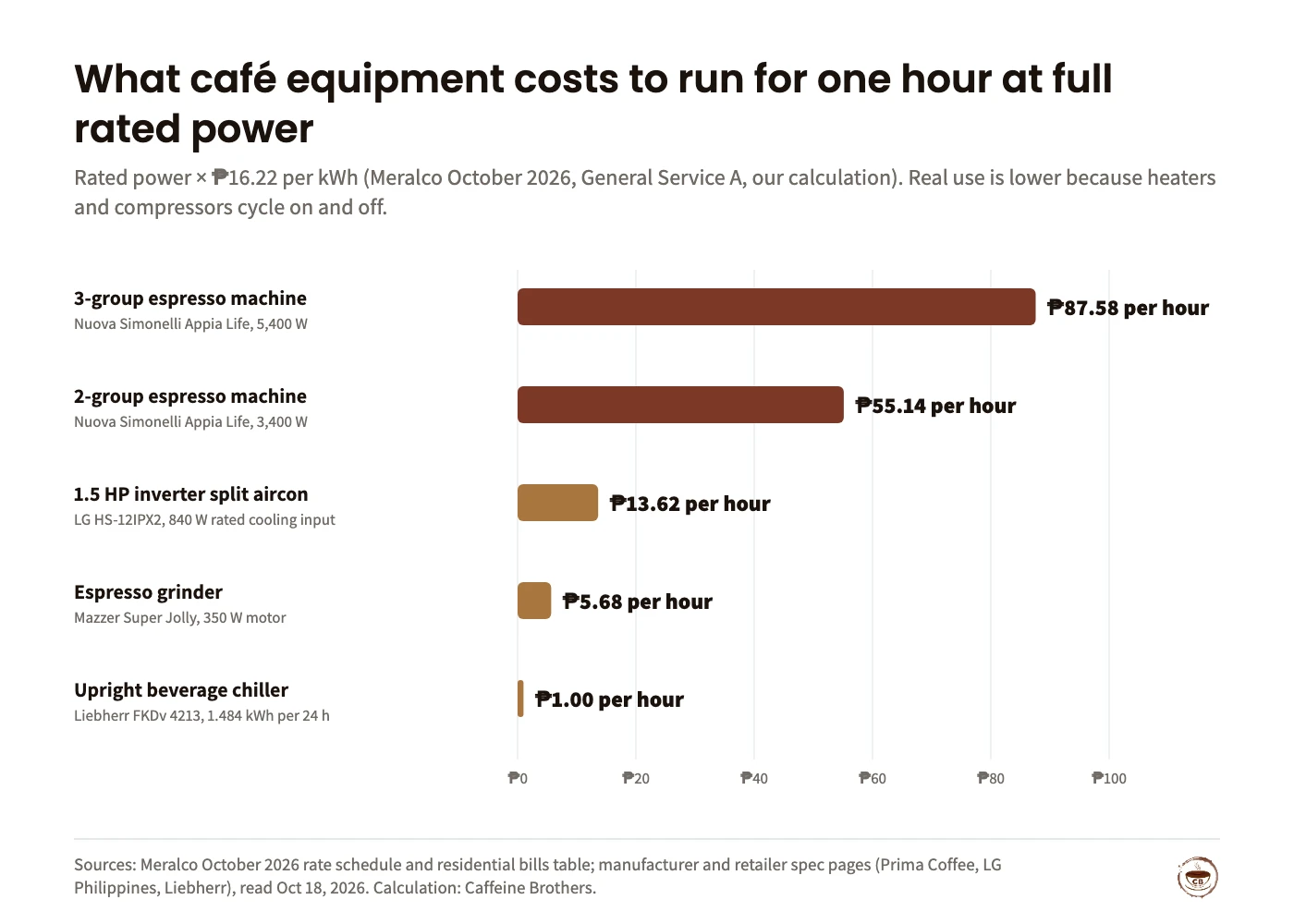
Quick answer: A Meralco General Service A account pays about ₱16.22 per kWh at October 2026 rates, based on Meralco’s published tables. At that rate a 2-group espresso machine rated 3,400 W costs ₱55.14 an hour at full power, a 1.5 HP inverter aircon (840 W rated) ₱13.62, an espresso grinder (350 W) ₱5.68 and an upright drinks chiller about ₱24 a day. In our example small café those four items use 485 to 706 kWh a month, or about ₱7,900 to ₱11,500.
Key takeaways
- Meralco’s overall rate for a typical 200 kWh household rose to ₱15.0615 per kWh in October 2026, up ₱0.3191 from September.
- At 1,000 kWh a month, the per-kWh total in Meralco’s October table is ₱16.2534. A General Service A business account pays the same charges without the ₱0.0350 residential energy tax, about ₱16.22.
- The generation charge alone is ₱10.2005 per kWh for every customer class, about 63% of the bill per kWh.
- Meralco’s General Service A class is for non-residential connected loads below 5 kW. A 3-group espresso machine rated 5,400 W is above that on its own.
- Grinding one espresso dose costs less than one centavo of electricity. Beans cost ₱14.63 to ₱19.22 for an 18 g double at our October 18, 2026 prices.
How much does Meralco charge a coffee shop per kWh?
Meralco publishes a rate schedule and a table of residential bills every month. In October 2026 the overall rate for a household using 200 kWh is ₱15.0615 per kWh. The Philippine Star and Daily Tribune both reported that this is ₱0.3191 higher than September’s ₱14.7424, driven by a ₱0.4973 rise in the generation charge that was partly offset by lower transmission charges and taxes.
A café uses more than a household, so the 1,000 kWh row is closer to reality. The October schedule lists the same per-kWh charges for General Service A (GS-A) as for residential customers at each consumption bracket. The one difference we found is the energy tax under Batas Pambansa Blg. 36, which the schedule marks as for residential customers only. Removing it from the 1,000 kWh row gives about ₱16.22 per kWh. Between 500 and 1,500 kWh the result stays between ₱16.21 and ₱16.24.
| Charge (October 2026) | ₱ per kWh at 1,000 kWh | Notes |
|---|---|---|
| Generation | 10.2005 | Same for every customer class; changes monthly |
| Transmission and ancillary service | 1.1442 | ₱0.5422 + ₱0.6020 |
| System loss | 0.9301 | |
| Distribution | 2.0941 | Rate for use above 400 kWh a month |
| Supply and metering | 0.8543 | Includes fixed ₱16.38 and ₱5.00 monthly charges spread over 1,000 kWh |
| AWAT refunds 1 and 2 | (1.0139) | Refunds ordered by the ERC, shown as credits |
| VAT | 1.2013 | |
| Universal charge and FIT-All | 0.7209 | ₱0.3850 + ₱0.3359 |
| Other small charges | 0.0869 | Lifeline subsidy, local franchise tax, RPT and others |
| Residential energy tax | 0.0350 | Not charged to GS-A business accounts |
| Total, residential | 16.2534 | |
| Total, GS-A business (our calculation) | 16.2184 | Residential total minus energy tax |
Coffee beans for your café
Caffeine Brothers supplies cafés, offices and restaurants with freshly roasted Philippine coffee in 10 kg wholesale boxes from ₱773/kg, with free Metro Manila delivery and a free sample before you commit.
See Wholesale Prices →Which Meralco rate class is a coffee shop on?
The October 2026 schedule defines General Service A as non-residential customers with a connected load of less than 5 kW. General Service B covers demand from 5 kW to below 40 kW. GS-B bills are built differently: part of the charge is per kW of peak demand, and the supply and metering charges are fixed amounts per month. The generation charge per kWh is the same ₱10.2005.
Connected load adds up fast in a café. The equipment in our example below has a combined rated power of about 4.65 kW, just under the GS-A limit, before lights, a freezer or a second aircon. The 3-group version of the same espresso machine is rated at 5,400 W by itself. Check the rate class printed on your Meralco bill, and ask Meralco when you apply for a new connection. Our coffee shop permits guide covers the other paperwork for opening.
How much power does café equipment use?
Equipment is sold with a rated power in watts. That is the most it draws when everything is running. Espresso machines and refrigerators draw full power only while the heater or compressor is on. The table uses published specs for common models. We picked them because their specs are public, and we do not sell or endorse them.
| Equipment | Example model and spec | Rated power | Cost per hour at full power |
|---|---|---|---|
| 3-group espresso machine | Nuova Simonelli Appia Life, 220 V, 15 L boiler | 5,400 W | ₱87.58 |
| 2-group espresso machine | Nuova Simonelli Appia Life, 220 V, 11 L boiler | 3,400 W | ₱55.14 |
| 1.5 HP inverter split aircon | LG HS-12IPX2, 230 V 60 Hz; minimum cooling input 305 W | 840 W rated | ₱13.62 (₱4.95 at minimum) |
| Espresso grinder | Mazzer Super Jolly Electronic, 64 mm burrs, 3 to 4 g per second | 350 W | ₱5.68 |
| Upright beverage chiller | Liebherr FKDv 4213, 403 L gross | 1.484 kWh per 24 h | ₱1.00 average (₱24.07 a day) |
What could a small café pay in a month?
No public source we found measures how many hours a commercial espresso machine’s heater runs in a working day, so we show two scenarios rather than one number. Treat the table as a way to plan, and replace our assumptions with your own meter readings.
Assumptions: open 10 hours a day, 26 days a month. The aircon runs at its 840 W rated input whenever the café is open. The chiller runs every day at its rated 1.484 kWh per 24 hours. The grinder makes 100 doses a day at 6 seconds each. The 2-group machine’s heater is on for 25% or 50% of opening hours.
| Item | kWh a month | Cost at ₱16.22 |
|---|---|---|
| 1.5 HP inverter aircon | 218.4 | ₱3,542 |
| Upright chiller (30 days) | 44.5 | ₱722 |
| Espresso grinder | 1.5 | ₱25 |
| 2-group espresso machine, heater on 25% of open hours | 221.0 | ₱3,584 |
| 2-group espresso machine, heater on 50% of open hours | 442.0 | ₱7,169 |
| Total, 25% scenario | 485.4 | ₱7,873 |
| Total, 50% scenario | 706.4 | ₱11,457 |
How much electricity goes into one cup?
Grinding is the cheapest step. At 3 to 4 g per second, an 18 g dose takes about 5 to 6 seconds. A 350 W motor running 6 seconds uses 0.00058 kWh, which costs less than one centavo.
The espresso machine matters more. In the scenarios above it uses 8.5 or 17 kWh a day. Spread over 100 drinks a day, that is about ₱1.38 or ₱2.76 per drink. Beans cost far more: an 18 g double dose costs ₱14.63 with our Robusta, ₱15.59 with CB’s Finest and ₱19.22 with our Benguet Arabica, using 1 kg bag prices on October 18, 2026 (₱813, ₱866 and ₱1,068). Our café cost per cup breakdown puts these numbers next to milk, cups and labor.
Are Meralco rates going down soon?
Two changes were announced but not yet in the October bill. The Philippine Star reported on October 14, 2026 that the Energy Regulatory Commission approved a distribution rate rising from ₱1.35 to ₱1.48 per kWh for July 2026 to June 2030, and ordered a ₱2.64 billion refund equal to ₱0.1733 per kWh for residential customers over six months. Daily Tribune reported that the refund is expected to start in November. Meralco said it would apply both once it receives the decisions. Check the next schedule before you update your budget.
How can a café cut its electricity bill?
- Read your rate class and kWh on each Meralco bill and record the meter weekly so you can see which days and hours cost the most.
- Size the espresso machine to your volume. A 3-group Appia Life is rated 2,000 W higher than the 2-group, worth ₱32.44 an hour at full power.
- Compare rated and minimum input on aircons. The LG unit above is rated at 840 W but can run at 305 W once the room is cool, which is the reason inverter units cost less to run.
- Check the chiller’s kWh per 24 hours before you buy. It runs all night, so a small daily figure adds up over 30 days.
- Price your menu with energy included. The Coffee Lab calculators help you add bean, milk and overhead costs per cup.
Staff costs usually outweigh power. See our barista salary guide for the October 2026 minimum wage and contributions.
Frequently asked questions
How much is Meralco per kWh for a small business in October 2026?
Meralco’s October 2026 table gives ₱15.0615 per kWh for a household using 200 kWh and ₱16.2534 at 1,000 kWh. General Service A business accounts pay the same per-kWh charges without the residential energy tax, which works out to about ₱16.22 per kWh at 1,000 kWh in our calculation.
How much electricity does an espresso machine use?
A commercial machine is rated by its heating power. The Nuova Simonelli Appia Life is listed at 3,400 W for 2 groups and 5,400 W for 3 groups. At ₱16.22 per kWh that is ₱55.14 and ₱87.58 per hour at full power, but the heaters cycle off once the boiler is hot, so real use is lower.
Is a coffee shop on General Service A or General Service B?
Meralco puts non-residential customers with a connected load below 5 kW on General Service A, and customers with a demand from 5 kW to below 40 kW on General Service B. A 2-group espresso machine, an aircon and a grinder already come close to 5 kW, so many cafés end up on GS-B. Your bill shows the rate class.
How much electricity cost goes into one cup of coffee?
Very little at the grinder: a 350 W grinder running 6 seconds for one dose costs less than one centavo. In our scenario, the espresso machine adds about ₱1.38 to ₱2.76 per drink at 100 drinks a day, compared with ₱14.63 to ₱19.22 of beans in an 18 g double dose.
Sources
- Summary schedule of rates, effective October 2026 billing. Meralco, October 2026. Used for rate classes, GS-A charges and the residential-only energy tax.
- Residential bills at typical consumption levels, October 2026. Meralco, October 2026. Used for the per-kWh breakdown at 200, 500, 1,000 and 1,500 kWh.
- Meralco rates up this month. The Philippine Star, October 14, 2026. Used for the ₱0.3191 increase, its drivers and the pending distribution rate and refund.
- Meralco rate hike eats into October bill relief. Daily Tribune, October 13, 2026. Used for the September rate and the November refund timing.
- Nuova Simonelli Appia Life. Prima Coffee, read October 18, 2026. Used for 2-group and 3-group power and boiler size.
- Mazzer Super Jolly Electronic. Prima Coffee, read October 18, 2026. Used for motor power and grind speed.
- 1.5 HP Split Type Dual Inverter Aircon HS-12IPX2. LG Philippines, read October 18, 2026. Used for rated and minimum cooling power input.
- FKDv 4213 beverage cooler. Liebherr, read October 18, 2026. Used for volume and energy use per 24 hours.
- Caffeine Brothers shop. Prices checked October 18, 2026. Used for bean cost per double shot.
Cite this article: Caffeine Brothers. “Coffee Shop Electricity Cost in the Philippines (Oct 2026 Rates).” Caffeine Brothers Coffee Blog, October 2026. https://caffeinebrothers.co/coffee-shop-electricity-cost/
You are welcome to reference the charts and frameworks in this article with a link back to this page.
Running a café? Beans are the biggest cost per cup. Our wholesale coffee comes in 10 kg boxes with free Metro Manila delivery. Model your costs in the Coffee Lab, or contact us for a quote.
 Previous Post