Coffee Shop Permits in the Philippines: Steps and Fees for 2026
By Robin Salvador, co-founder, Caffeine Brothers
Last updated: October 14, 2026
Quick answer: To open a coffee shop in the Philippines you need a DTI business name (or SEC registration for a corporation), a barangay clearance, a mayor’s or business permit, a sanitary permit and health certificates for your staff, a Fire Safety Inspection Certificate, and BIR registration, plus SSS, PhilHealth and Pag-IBIG registration once you hire. The fixed fees we could confirm for a small Quezon City kiosk with 4 staff come to about ₱1,830, before business tax, barangay and fire fees, which depend on your capital and city.
Key takeaways
- DTI business name registration costs ₱200 to ₱2,000 depending on scope, plus ₱30 documentary stamp tax, and lasts five years.
- The BIR’s ₱500 annual registration fee was removed by the Ease of Paying Taxes Act and has not been collected since January 22, 2024.
- In Quezon City, the business tax on a new permit is computed from your declared capitalization, and the permit is valid for one year from the date of issue.
- Quezon City charges a ₱100 sanitary permit inspection fee and ₱75 per health certificate, plus a ₱50 HIV seminar and lab tests for each staff member.
- Republic Act No. 11032 caps processing at 3, 7 or 20 working days, depending on how complex the application is.
This guide covers the registrations most small cafés, kiosks and coffee carts go through. Requirements differ between cities, so we use Quezon City’s published rules as a worked example and point out where your own city may differ. It is general information, not legal or tax advice. If you are still planning the business itself, start with our guide on how to start an independent coffee shop.
What permits does a coffee shop need in the Philippines?
| Registration or permit | Issued by | When you need it | Fee we could confirm |
|---|---|---|---|
| Business name (sole proprietor) | DTI | Before the mayor’s permit | ₱200 to ₱2,000 + ₱30 DST |
| SEC registration (corporation or partnership) | SEC | Instead of DTI if you incorporate | Not covered here |
| Barangay business clearance | Your barangay | Usually before the mayor’s permit | Set by each barangay |
| Mayor’s or business permit | City or municipal BPLO | Before you open, renewed yearly | Business tax based on declared capital (QC) |
| Sanitary permit | City health office | With or after the business permit | ₱100 inspection fee (QC) |
| Health certificates for food handlers | City health office | For every staff member | ₱75 each + ₱50 HIV seminar + lab tests (QC) |
| Fire Safety Inspection Certificate (FSIC) | Bureau of Fire Protection | As part of the business permit process | Assessed by the BFP |
| BIR registration | BIR Revenue District Office | Before you issue your first receipt | No annual fee since January 22, 2024 |
| SSS, PhilHealth and Pag-IBIG employer numbers | Each agency | When you hire your first employee | Not covered here |
Coffee beans for your café
Caffeine Brothers supplies cafés, offices and restaurants with freshly roasted Philippine coffee in 10 kg wholesale boxes from ₱773/kg, with free Metro Manila delivery and a free sample before you commit.
See Wholesale Prices →How much does DTI business name registration cost?
A sole proprietor who trades under a name other than their own must register that name with the Department of Trade and Industry (DTI). The fee depends on the territorial scope you choose. The DTI Business Name Registration System lists these fees, each with an extra ₱30 documentary stamp tax.
| Scope | Registration fee | With ₱30 DST |
|---|---|---|
| Barangay | ₱200 | ₱230 |
| City or municipality | ₱500 | ₱530 |
| Regional | ₱1,000 | ₱1,030 |
| National | ₱2,000 | ₱2,030 |
Registration is valid for five years. DTI accepts early renewal up to 180 days before expiry and regular renewal within 90 days after it. Renewing in the 90 days after that grace period adds a 50% surcharge on the registration fee. For one café, city or municipality scope is usually enough. Choose a wider scope only if you plan to open branches in other cities and want to protect the name there.
How does the business permit work? A Quezon City example
Your mayor’s permit, also called a business permit, is issued by the city or municipal Business Permits and Licensing Office. Quezon City’s Business Permits and Licensing Department publishes its steps in a 2025 citizen’s charter. For a new permit it asks for proof of business registration (DTI, SEC or CDA), proof of the right to use the space (a lease contract, land title or tax declaration), a valid ID of the owner, and photos of the business location.
The application is filed online through QC e-Services. The charter lists five internal steps (document evaluation, zoning approval of the location, generation of the tax bill, final review and approval), each with a processing time of 30 minutes. The time taken to pay depends on the applicant, and the business tax is system-generated from your declared capitalization under the Quezon City Revenue Code. Under City Ordinance SP-3013 of 2021, a Quezon City business permit is valid for one year from the date of issue, not until December 31.
Other cities follow a similar flow but use their own forms, fees and timelines. Republic Act No. 11032, the Ease of Doing Business Act of 2018, requires every city and municipality to use a single unified application form and to run a Business One Stop Shop. It also caps processing time at 3 working days for simple transactions, 7 for complex ones and 20 for highly technical applications, counted from the day the application is complete.
What does the sanitary permit require for a café?
A coffee shop handles food and water, so the city health office has to clear it. Quezon City’s guide, last updated June 26, 2026, asks food and water businesses for a current business permit and its official receipt, health certificates for employees, a health occupancy permit receipt for new or newly renovated establishments, a microbiological water analysis from a DOH-accredited laboratory every other month, and a monthly pest control service report from an FDA-accredited provider. The inspection fee is ₱100, and new businesses receive a digital provisional sanitary permit.
Every staff member who handles food needs a health certificate. Quezon City’s guide, last updated June 11, 2026, says a certificate is valid for one year from issue and lists these fees.
| Quezon City health certificate item | Fee |
|---|---|
| Health certificate processing | ₱75 |
| HIV seminar | ₱50 |
| Sputum exam (city in-house lab) | ₱110 |
| Stool exam (city in-house lab) | ₱65 |
| Total per person using the in-house lab | ₱300 |
What are the fixed fees for a small coffee kiosk?
To give a sense of scale, we added up the fees we could confirm from official pages for a Quezon City coffee kiosk run by a sole proprietor with 4 staff. This leaves out the biggest local items, because they depend on your situation: the business tax (based on declared capital), the barangay clearance, the Fire Safety Inspection Certificate fee, and any fees for signage, occupancy or water analysis.
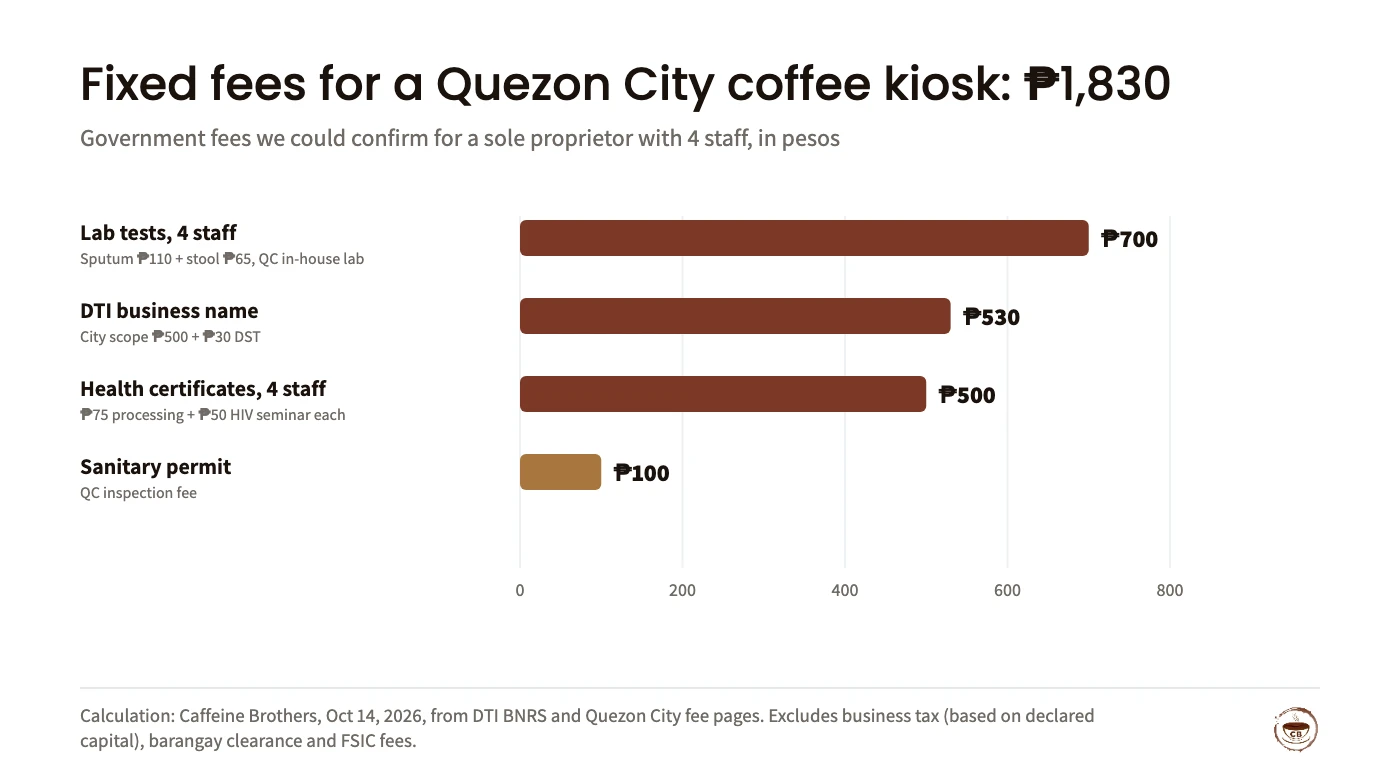
The confirmed fees total ₱1,830. That is small next to equipment, rent and coffee, which is where most of your opening budget goes. Our pop-up coffee shop cost calculator can help you model those bigger costs, and our cost per cup breakdown shows how coffee prices feed into your margins.
What changed with BIR registration?
Every business must register with the Bureau of Internal Revenue (BIR) at the Revenue District Office that covers its address before it starts issuing receipts. One cost has disappeared. The Ease of Paying Taxes Act, Republic Act No. 11976, removed the ₱500 annual registration fee, and the BIR stopped collecting it from January 22, 2024, as the Philippine Information Agency reported on January 15, 2024. Businesses no longer file BIR Form 0605 for it each January.
Small sole proprietors also have a choice of income tax regime. Under Revenue Memorandum Order No. 23-2018, which implements the TRAIN law, a self-employed individual whose gross sales do not exceed the ₱3,000,000 VAT threshold can opt for an 8% tax on gross sales in excess of ₱250,000, in place of the graduated income tax rates and the percentage tax. Whether that is better for your café depends on your margins, so run the numbers with an accountant before you register.
In what order should you get your coffee shop permits?
- Register the business name with DTI, or incorporate with the SEC if you have partners or investors.
- Sign the lease, or prepare your land title or tax declaration, since the city asks for proof that you can use the space.
- Get the barangay business clearance for the address.
- Apply for the mayor’s or business permit through your city’s Business One Stop Shop or online portal, and pay the business tax on the bill the city generates.
- Book the fire safety inspection with the Bureau of Fire Protection, and ask your city’s Business One Stop Shop how it is scheduled with the business permit.
- Send your staff for health certificates and apply for the sanitary permit, with the water analysis and pest control reports your city requires.
- Register with the BIR, choose your tax regime and set up your receipts before your first sale.
- Register as an employer with SSS, PhilHealth and Pag-IBIG before your staff start work.
Keep copies of every receipt and certificate in one folder. Most of them are needed again when you renew your business permit each year.
Frequently asked questions
How much does it cost to register a coffee shop business name with DTI?
DTI charges ₱200 for barangay scope, ₱500 for city or municipality, ₱1,000 for regional and ₱2,000 for national scope, plus ₱30 documentary stamp tax. Registration is valid for five years. A single café usually only needs city or municipality scope.
Do I still pay the ₱500 BIR annual registration fee?
No. The Ease of Paying Taxes Act (Republic Act No. 11976) removed the ₱500 annual registration fee, and the BIR stopped collecting it from January 22, 2024. You still need to register with the BIR, issue receipts and file returns.
How long does a business permit take?
Under the Ease of Doing Business Act (Republic Act No. 11032), simple transactions must be processed within 3 working days, complex ones within 7 and highly technical ones within 20, counted from a complete application. Quezon City’s 2025 citizen’s charter lists 30 minutes for each internal step of a new business permit, not counting payment and other clearances.
Which coffee shop permits do I renew every year?
In Quezon City the business permit is valid for one year from the date of issue, and health certificates are also valid for one year. Your DTI business name lasts five years. Check your own city’s rules, since renewal dates and fees are set locally.
Sources
- Business Name Registration FAQ. Department of Trade and Industry, checked October 14, 2026. Used for the fees by scope, the ₱30 DST, the five-year validity and renewal periods.
- BPLD Citizen’s Charter 2025. Quezon City Business Permits and Licensing Department, 2025. Used for the new permit requirements, steps, processing times, tax basis and one-year validity.
- How to Apply for Business Sanitary Permit. Quezon City Government, last updated June 26, 2026. Used for the sanitary permit requirements and ₱100 fee.
- How to Get a Health Certificate. Quezon City Government, last updated June 11, 2026. Used for health certificate fees and validity.
- BIR waives annual registration fee for business taxpayers. Philippine Information Agency, January 15, 2024. Used for the removal of the ₱500 fee under RA 11976.
- Revenue Memorandum Order No. 23-2018. Bureau of Internal Revenue, June 20, 2018, via the Supreme Court E-Library. Used for the 8% option, ₱250,000 and ₱3,000,000 figures.
- Republic Act No. 11032 (Ease of Doing Business Act). Approved May 28, 2018, via LawPhil. Used for processing time limits, the unified form and the Business One Stop Shop.
Cite this article: Caffeine Brothers. “Coffee Shop Permits in the Philippines: Steps and Fees for 2026.” Caffeine Brothers Coffee Blog, October 2026. https://caffeinebrothers.co/coffee-shop-permits-philippines/
You are welcome to reference the tables and charts in this article with a link back to this page.
Opening a café or kiosk? We supply roasted Philippine Arabica, Robusta, Kapeng Barako and blends in 10 kg boxes with free Metro Manila delivery. See our wholesale coffee prices, try the planning tools in the Coffee Lab, or message us for a quote.
 Previous Post