Sagada Coffee: History, Farms and Prices in 2026
By Robin Salvador, co-founder, Caffeine Brothers
Last updated: October 15, 2026
Quick answer: Sagada coffee is Arabica grown on small farms around Sagada, Mountain Province, a town whose center sits about 1,522 meters above sea level. Mountain Province holds 24% of the Cordillera’s coffee trees, according to Department of Agriculture data reported in December 2024. A Sagada farmer won Best Arabica Washed Process at the 2025 Philippine Coffee Quality Competition, and DOST figures from March 2026 put local green beans at around ₱300 per kilogram and roasted beans above ₱1,000.
Key takeaways
- Sagada’s town center is about 1,522 meters above sea level, inside the 1,000 to 1,800 meter band DOST-PCAARRD gives for Cordillera Arabica.
- Mountain Province has 24% of the Cordillera’s 1,944,947 coffee trees, but Benguet produced 61% of the region’s 1,013.62 tonnes of green coffee in 2023.
- Gareth Likigan of Sagada won Best Arabica Washed Process at the 2025 Philippine Coffee Quality Competition, one of only three Mountain Province farmers who qualified.
- Forest fires in February and March 2024 hit more than 30 Sagada coffee farmers, with losses estimated at ₱16 million.
- A ₱17.54 million Sagada coffee roastery began construction in March 2026 under the DA’s Philippine Rural Development Project.
What is Sagada coffee?
Sagada coffee is the Arabica grown in and around Sagada, a municipality of 19 barangays in Mountain Province. PhilAtlas lists the town’s land area at 109.71 square kilometers and its 2020 census population at 11,510. Most of the coffee comes from backyard and small family plots rather than plantations.
Altitude is the main reason the town grows Arabica. PhilAtlas estimates the town center at 1,522.3 meters above sea level. A 2013 DOST-PCAARRD article says Cordillera Arabica does best at 1,000 to 1,800 meters and in cool areas of 17 °C to 24 °C. A 2011 PCAARRD article describes Mountain Province as holding 15 °C to 24 °C all year.
Sagada is one of five Mountain Province towns that adopted Arabica as their “one town one product,” together with Besao, Sabangan, Tadian and Bauko, according to that 2011 PCAARRD article. The same article reports a local ordinance requiring every household to plant at least five coffee trees, and it quotes the rule that a marriage license will not be issued unless the couple plants coffee trees.
| Fact | Figure | Source and date |
|---|---|---|
| Town center elevation | About 1,522 m above sea level | PhilAtlas, read October 2026 |
| Land area and barangays | 109.71 km², 19 barangays | PhilAtlas, read October 2026 |
| Population | 11,510 | 2020 Census, via PhilAtlas |
| Best elevation for Cordillera Arabica | 1,000 to 1,800 m | DOST-PCAARRD, March 7, 2013 |
| Mountain Province temperature | 15 °C to 24 °C year round | DOST-PCAARRD, October 6, 2011 |
| Mountain Province coffee trees | 24% of 1,944,947 Cordillera trees | Inquirer citing DA Cordillera, December 9, 2024 |
| Green bean price | Around ₱300 per kg | DOST via Gurupress Cordillera, March 16, 2026 |
| Roasted bean price | More than ₱1,000 per kg | DOST via Gurupress Cordillera, March 16, 2026 |
Where did Sagada coffee come from?
Accounts differ. The Philippine Daily Inquirer, citing Cordillera coffee history in December 2024, reports that Arabica was first introduced to Galliano, now Aringay in La Union, by military governor Manuel Scheidnagel in 1875, and spread into the highlands from there.
For Sagada itself, the Wikipedia entry on Sagada coffee notes that there are “multiple conflicting accounts.” Most credit Jaime P. Masferré, a retired Spanish soldier from Catalonia, who set up a plantation at Batalao in the late 1890s. Okoi, a Japanese carpenter who worked for American missionaries, is said to have obtained seedlings from Masferré and planted them in Fidelisan. The entry cites a 2016 history by Malanes, Nakamura and Tacloy and a 2016 book chapter by Danesto Anacio, and it notes that century-old trees in Fidelisan still produce beans. Treat these details as local history rather than documented record.
How much coffee does Mountain Province grow?
There is no official production figure for Sagada alone, and the Philippine Statistics Authority does not publish a Mountain Province coffee series that we could find. The best regional numbers come from the Department of Agriculture in the Cordillera. In a December 9, 2024 report, the Inquirer cited DA data showing Cordillera green coffee output of 797.94 tonnes in 2019, 997.83 tonnes in 2022 from 5,162.11 hectares, and 1,013.62 tonnes in 2023.
The same report says the region has 1,944,947 coffee trees, 1,021,940 of them bearing fruit. Kalinga has 37% of the trees, Mountain Province 24% and Benguet 20%. Output looks different: Benguet produced 61% of 2023 green coffee, Kalinga 21% and Ifugao 11%. Mountain Province’s share of output was not reported. Arabica made up 60% of 2023 production and Robusta 38%.
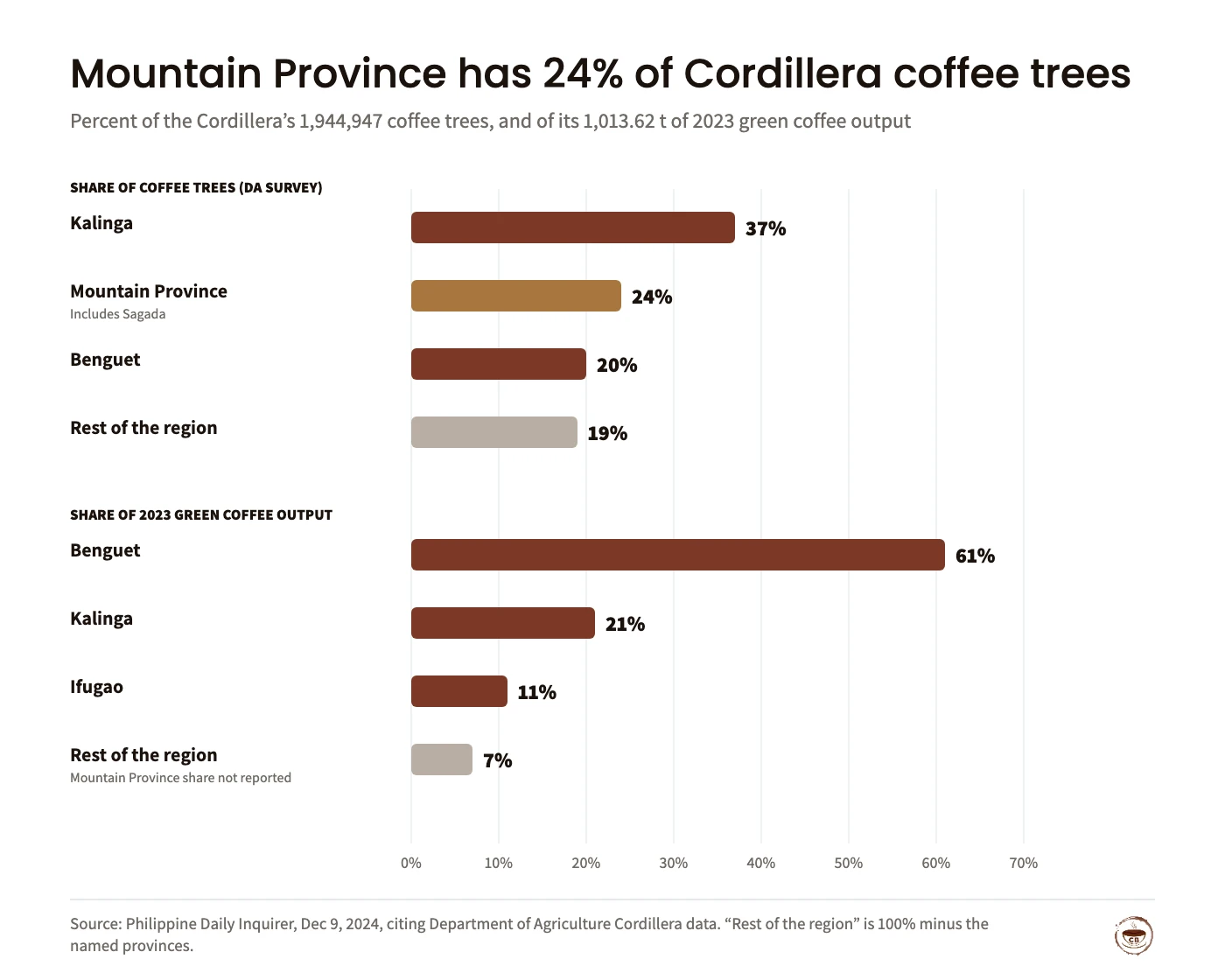
Older counts are not directly comparable. A 2013 DOST-PCAARRD article counted 1,035,600 coffee trees in Mountain Province alone, with an average yield of only 0.3 kilograms of green beans per tree. The 2024 regional survey implies about 467,000 trees for the province (24% of 1,944,947). The two counts come from different surveys and years, so read the gap as a sign of how uncertain small-farm data is, not as a measured decline.
| Year | Cordillera green coffee output | Notes |
|---|---|---|
| 2019 | 797.94 t | Lowest year from 2014 to 2023 |
| 2022 | 997.83 t | From 5,162.11 ha of upland farms |
| 2023 | 1,013.62 t | Benguet 61%, Kalinga 21%, Ifugao 11%; Arabica 60%, Robusta 38% |
For a closer look at the neighboring province that leads output, read our guide to Benguet coffee, and for the national picture see our map of Philippine coffee growing regions.
How is Sagada coffee grown and processed?
Most Sagada coffee is shade grown on small plots, picked by hand and processed at home or through local groups. Esquire Philippines profiled Sagada farmer Gareth Likigan in June 2025. He grows coffee under alnus trees, picks only very ripe cherries and uses anaerobic fermentation. His washed beans dry in the sun for about two weeks and his natural process beans for about two months. The harvest runs from November to April.
DOST-PCAARRD wrote in 2013 that Arabica green beans from Benguet and Mountain Province are comparable to quality beans from South America. That is a general assessment of the region’s beans, not a cupping score for Sagada.
Has Sagada coffee won awards?
Yes. At the 2025 Philippine Coffee Quality Competition, Gareth Likigan won Best Arabica Washed Process and placed sixth among Arabica small scale farms, according to Esquire Philippines. The article says only three coffee farmers from Mountain Province qualified for the competition that year, and that judges noted floral and peach notes with sharp acidity in his coffee. The article did not publish his score.
The same competition shows how high prices can go for top lots. Esquire reported that a naturally processed Benguet Arabica from farmer Rodiyo Tacdoy sold for ₱9,900 per kilogram at the 2025 auction. Competition lots are small and are not a guide to everyday prices.
What has happened to Sagada coffee since 2022?
- December 21, 2022: the Montañosa Coffee Center opened at Mountain Province State Polytechnic College in Bauko to showcase the province’s coffees and support small farmers, according to the Philippine Information Agency.
- February and March 2024: forest fires damaged coffee farms. The Philippine News Agency reported on April 6, 2024 that more than 30 Sagada coffee farmers lost their livelihood, with losses estimated at ₱16 million, and that each was set to receive ₱5,000 in DSWD aid.
- March 2026: the Sagada group SACGPO moved ahead with a coffee roastery under the DA’s Philippine Rural Development Project, with a ₱17.54 million construction contract awarded to Benguet Builders, according to Gurupress Cordillera.
How much does Sagada coffee cost?
Published prices are scattered, so compare them per kilogram and per cup. Gurupress Cordillera, citing DOST in March 2026, put Sagada green beans at around ₱300 per kilogram and roasted beans at more than ₱1,000 per kilogram. In April 2024, PNA reported that a local brand, Sagada Gold, sold for ₱250 per 200 grams, which works out to ₱1,250 per kilogram.
The table converts each price to the cost of one cup at 10 grams of ground coffee, the amount in one of our drip bags. Our own Benguet Arabica is included as a reference point from a neighboring Cordillera province, at the prices on our shop on October 15, 2026.
| Coffee | Price as published | Per kg | Per 10 g cup | Date |
|---|---|---|---|---|
| Sagada green beans (unroasted) | Around ₱300 per kg | ₱300 | Not brewable | March 2026 (DOST via Gurupress) |
| Sagada roasted beans | More than ₱1,000 per kg | Over ₱1,000 | Over ₱10.00 | March 2026 (DOST via Gurupress) |
| Sagada Gold, roasted | ₱250 per 200 g | ₱1,250 | ₱12.50 | April 2024 (PNA) |
| Caffeine Brothers Benguet Arabica | ₱292 per 200 g | ₱1,460 | ₱14.60 | October 15, 2026 (our shop) |
| Caffeine Brothers Benguet Arabica | ₱1,068 per 1 kg | ₱1,068 | ₱10.68 | October 15, 2026 (our shop) |
| PCQC 2025 auction lot (Benguet natural) | ₱9,900 per kg | ₱9,900 | ₱99.00 | June 2025 (Esquire) |
Roasted coffee loses weight in the roaster, so a green bean price is not comparable with a roasted price. Compare roasted with roasted.
How to buy good Sagada coffee
- Ask for the roast date. A recent roast date matters more than the town on the label. Our guide to keeping coffee beans fresh in the Philippines explains why.
- Ask where it was grown. A barangay or farm name, such as Fidelisan, tells you more than “Sagada” alone.
- Ask how it was processed. In general, washed coffee tastes cleaner and natural process coffee tastes fruitier. Sellers who know their farmers can answer this.
- Work out the price per kilogram. Divide the pack price by its weight so you can compare 200 g packs with 1 kg bags.
- Buy whole beans if you have a grinder. Ground coffee goes stale faster. If you don’t have one, ask for a grind that matches your brewer.
- Brew it gently. Pour-over or a French press shows off a light Arabica better than strong, sweet preparations. Our guide to coffee brewing methods gives the ratios for each.
If you are weighing Arabica against stronger beans, our comparison of Robusta vs Arabica caffeine shows how much less caffeine Arabica carries.
Frequently asked questions
What kind of coffee is Sagada coffee?
Sagada coffee is mostly Arabica grown on small and backyard farms in Sagada, Mountain Province, at around 1,500 meters above sea level. Local histories trace the town’s trees to Arabica planted in the late 19th century, and some century-old trees still bear fruit in Fidelisan.
How much does Sagada coffee cost?
DOST figures reported by Gurupress Cordillera in March 2026 put Sagada green beans at around ₱300 per kilogram and roasted beans at more than ₱1,000 per kilogram. In April 2024, PNA reported a local Sagada Gold brand at ₱250 per 200 grams.
Is Sagada coffee better than Benguet coffee?
Both are Cordillera Arabica grown in the same elevation band, and DOST-PCAARRD has described Benguet and Mountain Province beans as comparable to quality South American beans. Quality depends more on the farm, the processing and the roast date than on the town name.
Does Caffeine Brothers sell Sagada coffee?
No. Our Arabica comes from Benguet and is roasted to a medium roast. If you want a Cordillera Arabica for home brewing, our Benguet Arabica is the closest match in our range.
Sources
- Sagada, Mountain Province Profile. PhilAtlas, read October 14, 2026. Used for elevation, land area, barangays and 2020 population.
- Highly elevated and shade-grown coffee has better cup quality. DOST-PCAARRD, D. Magpantay, March 7, 2013. Used for the 1,000 to 1,800 m range, 17 °C to 24 °C, 1,035,600 trees, 0.3 kg per tree and the South American comparison.
- PCAARRD to implement STBF projects on coffee in Mt. Province. DOST-PCAARRD, October 6, 2011. Used for the five “one town one product” towns, the five-tree ordinance and temperature.
- Cordillera brew fuels generations. Philippine Daily Inquirer, Vincent Cabreza, December 9, 2024, citing DA Cordillera. Used for production 2019 to 2023, area, tree counts, provincial shares, species mix and the 1875 introduction.
- Sagada coffee. Wikipedia, read October 14, 2026, citing Malanes et al. (2016) and Anacio (2016). Used for the Masferré and Okoi accounts and Fidelisan trees.
- Sagada’s Pride: How One Farmer Is Cultivating a Community of Coffee Growers. Esquire Philippines, Mari-An C. Santos, June 14, 2025. Used for PCQC 2025 results, processing, harvest season and the ₱9,900 per kg auction price.
- Sagada coffee farmers affected by forest fires to get aid soon. Philippine News Agency, April 6, 2024. Used for farmers affected, ₱16 million losses, the planned ₱5,000 aid and the Sagada Gold price.
- Sagada’s P17.54M coffee roastery project begins construction; Arabica industry expects further boost. Gurupress Cordillera, March 16, 2026 (updated March 17). Used for the roastery contract and DOST green and roasted prices.
- 1st Coffee Center in Mt. Province launched. Philippine Information Agency, Valerie Jane Taguba, December 2022. Used for the Montañosa Coffee Center launch.
- Arabica Coffee Beans (Benguet, Medium Roast). Caffeine Brothers shop, prices checked October 15, 2026. Used for the reference prices.
Cite this article: Caffeine Brothers. “Sagada Coffee: History, Farms and Prices in 2026.” Caffeine Brothers Coffee Blog, October 2026. https://caffeinebrothers.co/sagada-coffee/
You are welcome to reference the tables and charts in this article with a link back to this page.
Looking for Cordillera Arabica you can order today? Our Benguet Arabica is roasted to a medium roast and ground for free if you need it. Browse every bean in the shop, or message us with questions.
 Previous Post
 Next Post