
Benguet Coffee: Arabica from the Cordillera, Explained (2026)
By Robin Salvador, co-founder, Caffeine Brothers
Last updated: October 13, 2026
Quick answer: Benguet coffee is mainly highland Arabica grown in Benguet province in the Cordillera, on farms between about 531 and 1,800 m above sea level. Benguet produced 61% of the Cordillera’s green coffee in 2023, out of a regional total of 1,013.62 metric tons. Arabica reached the Benguet plateaus in 1877, and the traditional trees are of the Typica variety.
Key takeaways
- Arabica is grown at 531–1,800 m across Benguet’s 13 municipalities (Benguet State University, 2013).
- The Cordillera produced 1,013.62 metric tons of green coffee in 2023; Benguet supplied 61%.
- By DA data, Arabica made up about 60% of Cordillera coffee in 2023, Robusta 38%.
- Arabica was planted on the Benguet plateaus in 1877, two years after it arrived in what is now Aringay, La Union.
- Atok’s cooperative coffee scored 87.06 at the 2018 Philippine Coffee Quality Competition, above the 80-point specialty mark.
What is Benguet coffee?
“Benguet coffee” usually means Arabica grown in the highlands of Benguet, the southern gateway province of the Cordillera Administrative Region (CAR). Slow Food, which lists Benguet coffee on its Ark of Taste of endangered foods, describes it as a Typica variety of Arabica that has been grown “for over 80 years mainly by Igorot people”, at around 1,600 m in Atok.
It sits in a very different place from the coffee most Filipinos drink. Nationally, the Department of Agriculture’s coffee roadmap shows that Robusta dominates and that most coffee comes from Mindanao. Benguet is one of the few provinces where Arabica, the species that needs cool, high ground, is the main crop. For the bigger picture, see our guide to Philippine coffee origins and the 4 types of coffee grown in the Philippines.
Benguet coffee at a glance
| Fact | Figure | Source |
|---|---|---|
| Main species | Arabica (traditional trees: Typica) | Slow Food Ark of Taste |
| Growing elevation | 531–1,800 m above sea level | Benguet State University, 2013 |
| Municipalities surveyed | All 13 municipalities of Benguet (106 growers interviewed) | Benguet State University, 2013 |
| Cordillera green coffee output, 2023 | 1,013.62 metric tons | DA data via Philippine Daily Inquirer, 2024 |
| Benguet’s share of Cordillera output, 2023 | 61% (about 620 metric tons, our calculation) | DA data via Philippine Daily Inquirer, 2024 |
| Arabica arrives in Benguet | 1877 | BSU’s Valentino Macanes, via Philippine Daily Inquirer, 2024 |
| Best-known cooperative | Atok Arabica Coffee Growers Marketing Cooperative (Atokape) | SunStar Baguio, 2018 |
Where is coffee grown in Benguet, and how high?
In 2013, researchers from Benguet State University (BSU) mapped Arabica farms with GPS and interviewed 106 coffee growers across all 13 municipalities of Benguet. They found Arabica growing at elevations from 531 to 1,800 m above sea level, in three agro-ecological zones:
| Zone | Elevation | Temperature range reported |
|---|---|---|
| High hills | 500–1,000 m | 28.95–32.30°C |
| Low mountain | 1,001–1,500 m | about 25.43–28.00°C |
| Mid-mountain | 1,501–2,000 m | about 18.0–24.0°C |
The same study found that growers usually plant Arabica alongside other crops and trees, raise seedlings in shaded nurseries or move wild seedlings from under old coffee trees, and rejuvenate old trees by pruning. It described production as mainly organic in practice, with no synthetic fertilizers or pesticides used by the farmers surveyed. (That describes the farms studied, not a certification. Caffeine Brothers coffee is not certified organic.)
Atok is the best-known coffee town. It lies along the Halsema Highway, and its growers’ cooperative began as a project in 1995 with 30 members, became a cooperative in 2009 and had 280 members by 2018, according to SunStar Baguio. The cooperative told SunStar that a hectare of farmland can produce 700 to 800 kg of coffee a year.
How much coffee does Benguet produce?
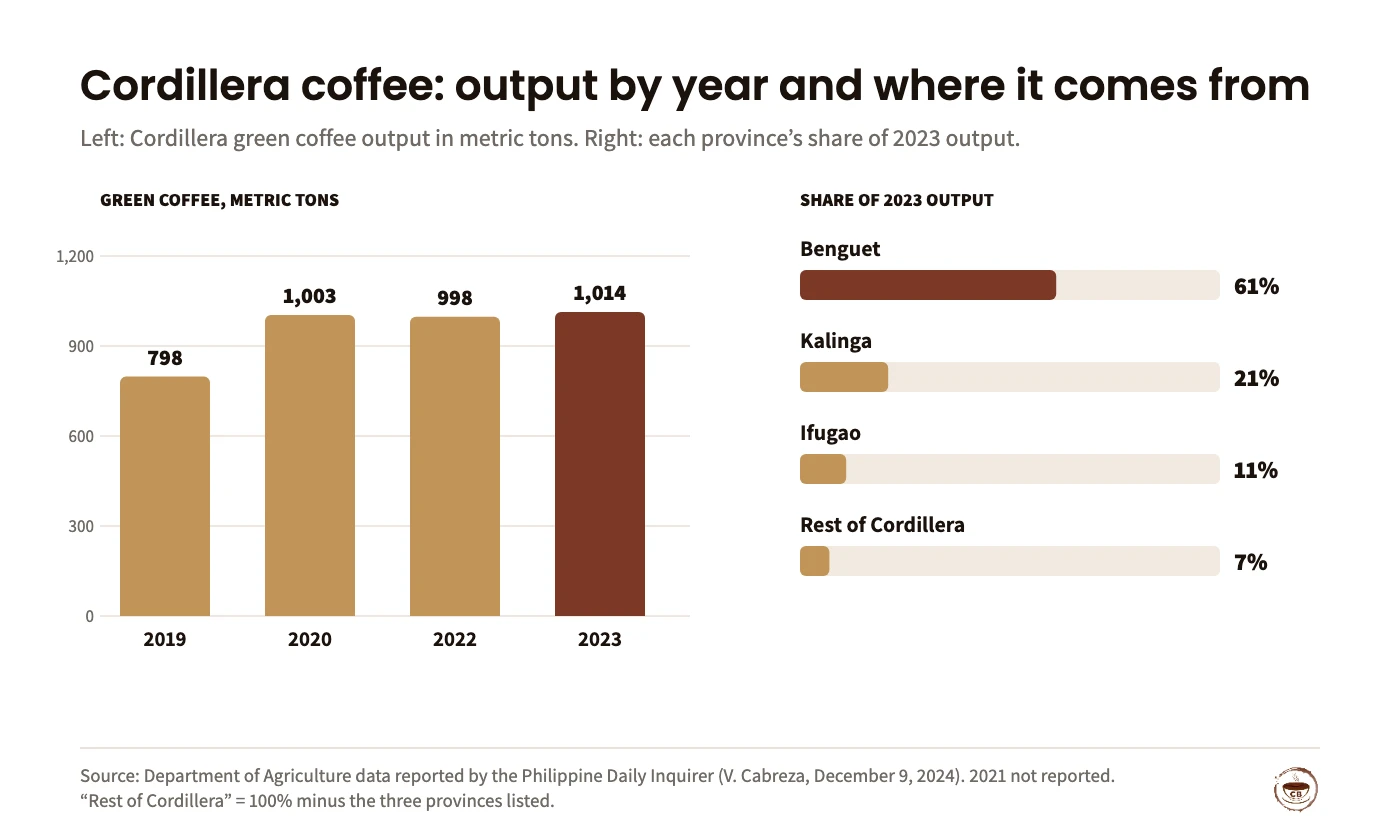
Department of Agriculture figures reported by the Philippine Daily Inquirer in December 2024 put the Cordillera’s green coffee output at 797.94 metric tons in 2019, 1,003.13 in 2020, 997.83 in 2022 and 1,013.62 in 2023. Benguet produced 61% of the 2023 total, ahead of Kalinga (21%) and Ifugao (11%). That puts Benguet at roughly 620 metric tons of green coffee a year, our calculation from those two figures.
In national terms this is small. The DA’s Philippine Coffee Industry Roadmap 2021–2025 shows the whole Cordillera producing 3.3% of the country’s coffee in 2020, while SOCCSKSARGEN alone produced 35.6%. Benguet’s weight comes from its Arabica: the Cordillera grew 694.94 metric tons (dried cherry) of Arabica in 2020, about 4.7% of all Philippine Arabica, by our calculation from the roadmap’s table.
Is Cordillera coffee mostly Arabica or Robusta?
The answer depends on the year and the source, and the two sources don’t measure the same thing:
| Source and year | Arabica | Robusta | Excelsa | Liberica |
|---|---|---|---|---|
| DA Coffee Roadmap, CAR 2020 (dried cherry) | 694.94 t (35%) | 1,266.52 t (63%) | 28.32 t (1%) | 16.49 t (1%) |
| DA data via Inquirer, Cordillera 2023 | 60% | 38% | 1% | 1% |
Either way, Robusta is a big part of the Cordillera harvest, mostly at lower elevations. If you buy “Benguet coffee” for its highland character, check that the label says Arabica and, ideally, the town or elevation.
A short history of coffee in Benguet
- 1875: Arabica is first introduced to Galliano, now Aringay in La Union, according to records cited by Valentino Macanes of Benguet State University.
- 1877: Seedlings are transplanted to the Benguet plateaus.
- 1888: An order to expand plantations sparks an uprising in Daklan, Benguet.
- Late 1990s–2000s: Demand for Cordillera Arabica grows faster than farmers can supply it.
- 2018: Atok’s cooperative coffee scores 87.06 at the Philippine Coffee Quality Competition.
- 2020s: Young Ibaloy and Kankana-ey entrepreneurs sell Cordillera coffee online during the pandemic.
Sources: Philippine Daily Inquirer (2024) for 1875–2000s and the 2020s; SunStar Baguio (2018) for the competition score.
What challenges do Benguet coffee farmers face?
- Old trees. Slow Food notes that many old trees are not pruned or rejuvenated, partly because of tradition, so they flower and fruit less.
- Fewer young farmers. The same profile says few new trees are planted because young people move to other work, and production has fallen.
- Small, scattered farms. Most coffee is grown in backyard clusters and small plots among other crops, which makes consistent volume hard.
- Government support. The DA has rejuvenated old trees and funded pulpers, roasters and storage bags in the Cordillera, according to the Inquirer.
How to brew Benguet Arabica at home
Highland Arabica is usually roasted lighter than Robusta or barako so its aroma comes through. Our own Arabica coffee beans from Benguet are a medium roast, and we describe them as bittersweet with a floral aroma and a distinct acidic note. For a first cup:
- Use a pour-over or French press. These show aroma better than a strong espresso.
- Start at about 1:16. For example, 15 g of coffee to 240 ml of water. Our coffee-to-water ratio chart has other sizes.
- Grind just before brewing. We grind for free if you don’t have a grinder; choose coarse for French press and medium for pour-over.
- Drink it black first. Taste it before adding milk or sugar, then adjust.
Giving coffee this Christmas? The Christmas Coffee Duo pairs Benguet Arabica with Batangas Robusta, and the Coffee Discovery Trio adds Kapeng Barako. See all our Christmas coffee gift sets.
Frequently asked questions
Is Benguet coffee Arabica?
Mostly, yes. Benguet is best known for highland Arabica, and Slow Food describes the traditional Benguet coffee as a Typica variety of Arabica. Robusta is also grown in the wider Cordillera, especially at lower elevations.
Where in Benguet is coffee grown?
A Benguet State University study surveyed coffee growers in all 13 municipalities of Benguet and found Arabica growing from 531 to 1,800 m above sea level. Atok, along the Halsema Highway, is one of the best-known coffee towns.
How much coffee does Benguet produce?
The Cordillera produced 1,013.62 metric tons of green coffee in 2023, and Benguet accounted for 61% of that, according to Department of Agriculture data reported by the Philippine Daily Inquirer. That works out to roughly 620 metric tons for Benguet.
Is Benguet coffee the same as Sagada coffee?
No. Both are Cordillera highland coffees, but Sagada is in Mountain Province, while Benguet is a separate province to the south that includes Atok, Kapangan and La Trinidad.
Sources
- Growing Areas and Traditional Production Practices of Arabica Coffee in Benguet — Tad-awan, Amado and Doco, Mountain Journal of Science and Interdisciplinary Research, Vol. 70, published December 13, 2013: elevations, zones, survey of 106 growers, farming practices
- Cordillera brew fuels generations — Vincent Cabreza, Philippine Daily Inquirer, December 9, 2024: Cordillera output 2019–2023, provincial shares, species mix, history
- Philippine Coffee Industry Roadmap 2021–2025 — Department of Agriculture: 2020 production by region and species (Table 7) and regional shares
- Atok is now known for good coffee — Lauren Alimondo, SunStar Baguio, November 24, 2018: Atok cooperative history, yield, 2018 competition score
- Benguet coffee (Ark of Taste) — Slow Food Foundation for Biodiversity, last modified December 8, 2018: Typica variety, elevation, threats
Cite this article: Caffeine Brothers. “Benguet Coffee: Arabica from the Cordillera, Explained (2026).” Caffeine Brothers Coffee Blog, October 2026. https://caffeinebrothers.co/benguet-coffee/
You are welcome to reference the charts and tables in this article with a link back to this page.
Want to taste highland Arabica? Try our Benguet Arabica beans, or ask about wholesale Arabica in 10 kg boxes for your café. Questions? Contact us.
 Previous Post