Robusta vs Arabica vs Barako: Which Has the Most Caffeine?
By Robin Salvador, co-founder, Caffeine Brothers
Last updated: October 13, 2026
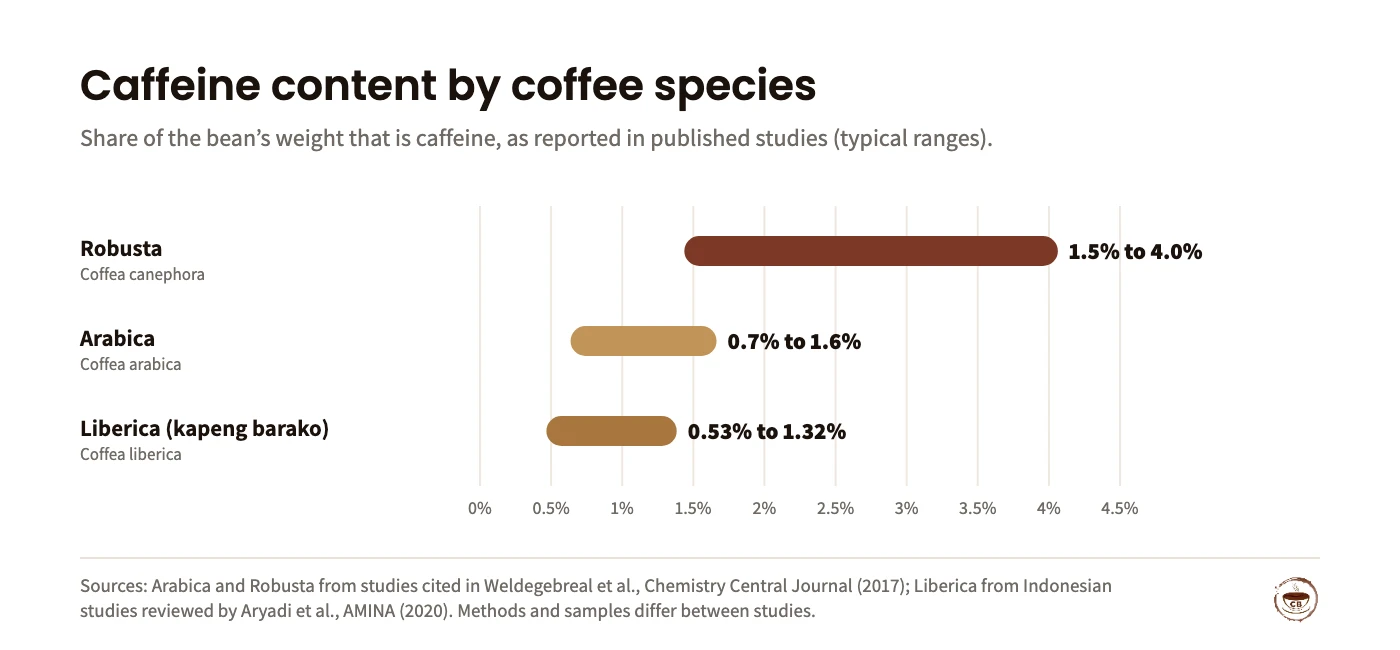
Quick answer: Robusta has the most caffeine of the coffees grown in the Philippines, usually about twice as much as Arabica. Published studies put green Robusta at 1.5% to 4.0% caffeine by weight and Arabica at 0.7% to 1.6%. Kapeng barako, which is Liberica, measured 0.53% to 1.32% in the studies we found, so it is strong in taste but not the caffeine leader.
Key takeaways
- Robusta: 1.5% to 4.0% caffeine (green beans), roughly double Arabica.
- Arabica: 0.7% to 1.6%.
- Liberica (kapeng barako): 0.53% to 1.32% in Indonesian studies, close to Arabica.
- A 200 ml mug of brewed coffee has about 80 to 110 mg of caffeine; an espresso shot about 63 mg.
- EFSA guidance for healthy adults is up to 400 mg a day from all sources (200 mg in pregnancy).
How much caffeine is in each coffee species?
Caffeine is measured as a share of the bean’s weight. The figures below come from published studies of green coffee. They vary a lot because they mix farms, varieties, growing conditions and lab methods, so read them as typical ranges, not exact values for any one bag.
| Coffee species | Caffeine (% of bean weight) | Source |
|---|---|---|
| Robusta (Coffea canephora) | 1.5% to 4.0% | Literature cited by Weldegebreal et al., 2017 |
| Arabica (Coffea arabica) | 0.7% to 1.6% | Literature cited by Weldegebreal et al., 2017 |
| Liberica, or kapeng barako (Coffea liberica) | 0.53% to 1.32% | Indonesian studies reviewed by Aryadi et al., 2020 |
| Excelsa | No reliable figure found | We found no published measurement we could check |
Two notes on these numbers. First, roasting doesn’t change caffeine much: a 2019 study in the Asian Journal of Agriculture and Biology found no significant difference in caffeine between green and roasted beans of both Liberica and Arabica. Second, the Liberica figures come from a review of small Indonesian studies with different roasting and extraction methods, so they are less settled than the Arabica and Robusta ranges.
Why does barako taste stronger if it has less caffeine?
Strength in the cup and caffeine are different things. Kapeng barako is usually roasted dark, and ours is a dark roast of 100% Liberica from Batangas. Dark roasting brings out bitterness, smoky notes and heavy body, which most people read as “strong”. So a dark, bold barako can taste stronger than a medium-roast Robusta that actually holds more caffeine.
If you want the most caffeine per scoop, choose Robusta. If you want a bold taste without more caffeine than Arabica, barako is the better fit. Our kapeng barako guide and Robusta guide cover taste and brewing for each.
How much caffeine ends up in your cup?
The cup depends on how much coffee you use and how you brew it. The National Coffee Association, quoting USDA nutrition data, gives these typical values:
| Drink | Typical serving | Caffeine | Source |
|---|---|---|---|
| Brewed (drip) coffee | 1 ounce (about 30 ml) | 12 to 16 mg | NCA, citing USDA data |
| Brewed coffee, 200 ml mug | about 6.8 ounces | about 80 to 110 mg | Our calculation from the NCA figure |
| Brewed coffee, 8-ounce cup | 8 ounces (about 240 ml) | about 96 to 128 mg | Our calculation from the NCA figure |
| Espresso | 1 shot (1 ounce) | about 63 mg | NCA, citing USDA data |
Real drinks vary far more than these averages suggest. When researchers tested 104 espressos from 26 cafés in Scotland, Italy and Spain, caffeine ranged from 48 mg to 317 mg per serving (Ludwig et al., Food & Function, 2014). Dose, bean species and cup size all moved the number.
Caffeine in the coffee you put in the brewer
Here is the caffeine contained in the ground coffee itself for two common doses: a 10 g drip bag and a 12 g mug. Not all of it ends up in your cup, so treat these as upper limits that show how the species compare.
| Coffee | Caffeine in 10 g of grounds | Caffeine in 12 g of grounds |
|---|---|---|
| Robusta | 150 to 400 mg | 180 to 480 mg |
| Arabica | 70 to 160 mg | 84 to 192 mg |
| Liberica (barako) | 53 to 132 mg | 64 to 158 mg |
How much caffeine is safe in a day?
The European Food Safety Authority (EFSA) concluded in 2015 that caffeine intakes of up to 400 mg a day, spread through the day, don’t raise safety concerns for healthy adults. Single doses of up to 200 mg are also fine for most adults. For pregnant women, EFSA’s figure is up to 200 mg a day from all sources.
With brewed coffee at about 80 to 110 mg per 200 ml mug, 400 mg is roughly four to five mugs. Strong Robusta, large mugs and extra espresso shots bring you there faster. Tea, chocolate, soft drinks and energy drinks count too.
How to choose a coffee by caffeine
- Want more caffeine? Pick Robusta. Our Batangas Robusta is a dark roast that suits espresso and iced coffee.
- Want less? Pick Arabica, like our Benguet Arabica, and brew a smaller mug.
- Want bold taste without the extra jolt? Try kapeng barako.
- Somewhere in between? A blend such as our Arabica-Robusta blend sits between the two species.
- Control the dose. Fewer grams per cup means less caffeine, whichever bean you choose. Our coffee strength calculator helps you set it.
Shopping for Christmas? Our Coffee Discovery Trio has Arabica, Robusta and barako in one box, so the receiver can taste the difference for themselves. See all Christmas coffee gift sets.
Frequently asked questions
Which coffee has the most caffeine, Robusta or Arabica?
Robusta. Studies cited in a 2017 Chemistry Central Journal paper put green Robusta at 1.5% to 4.0% caffeine by weight and Arabica at 0.7% to 1.6%, so Robusta usually has about twice as much.
Does kapeng barako have more caffeine than Robusta?
Probably not. Barako is Liberica, and the Indonesian studies collected in a 2020 review measured Liberica at 0.53% to 1.32% caffeine, which is closer to Arabica than to Robusta. Barako tastes strong because of its dark roast and heavy body.
How much caffeine is in a cup of brewed coffee?
USDA data quoted by the National Coffee Association puts brewed coffee at 12 to 16 mg of caffeine per ounce, so a 200 ml mug has roughly 80 to 110 mg. A 1-ounce espresso shot has about 63 mg.
How many cups of coffee a day is safe?
The European Food Safety Authority says up to 400 mg of caffeine a day from all sources is fine for most healthy adults, and up to 200 mg a day in pregnancy. At about 80 to 110 mg per 200 ml mug of brewed coffee, that is roughly four to five mugs, fewer if the coffee is strong Robusta or the mugs are bigger.
Sources
- Development of new analytical methods for the determination of caffeine content in aqueous solution of green coffee beans. Weldegebreal, Redi-Abshiro and Chandravanshi, Chemistry Central Journal 11:126 (2017). Used for the Arabica (0.7% to 1.6%) and Robusta (1.5% to 4.0%) ranges it cites.
- Perbandingan kadar kafein dalam kopi robusta, kopi arabika, dan kopi liberika (literature review). Aryadi, Arfi and Harahap, AMINA 2(2) (2020). Used for Liberica caffeine (0.53% to 1.32%).
- Comparison of liberica and arabica coffee: chlorogenic acid, caffeine, total phenolic and DPPH radical scavenging activity. Mubarak et al., Asian Journal of Agriculture and Biology 7(1) (2019). Used for green vs roasted caffeine.
- Variations in caffeine and chlorogenic acid contents of coffees: what are we drinking?. Ludwig et al., Food & Function (2014). Used for the 48 to 317 mg espresso range across 104 samples.
- Espresso. National Coffee Association, updated February 5, 2026. Used for USDA caffeine per ounce.
- Caffeine. European Food Safety Authority, scientific opinion of May 27, 2015. Used for daily and single-dose guidance.
Cite this article: Caffeine Brothers. “Robusta vs Arabica vs Barako: Which Has the Most Caffeine?.” Caffeine Brothers Coffee Blog, October 2026. https://caffeinebrothers.co/robusta-vs-arabica-caffeine/
You are welcome to reference the charts and tables in this article with a link back to this page.
Want to taste the difference? Browse our Philippine coffee beans, or contact us for café and office orders.
 Previous Post
 Next Post