Home Espresso Machines in the Philippines: A 2026 Buying Guide
By Robin Salvador, co-founder, Caffeine Brothers
Last updated: October 15, 2026
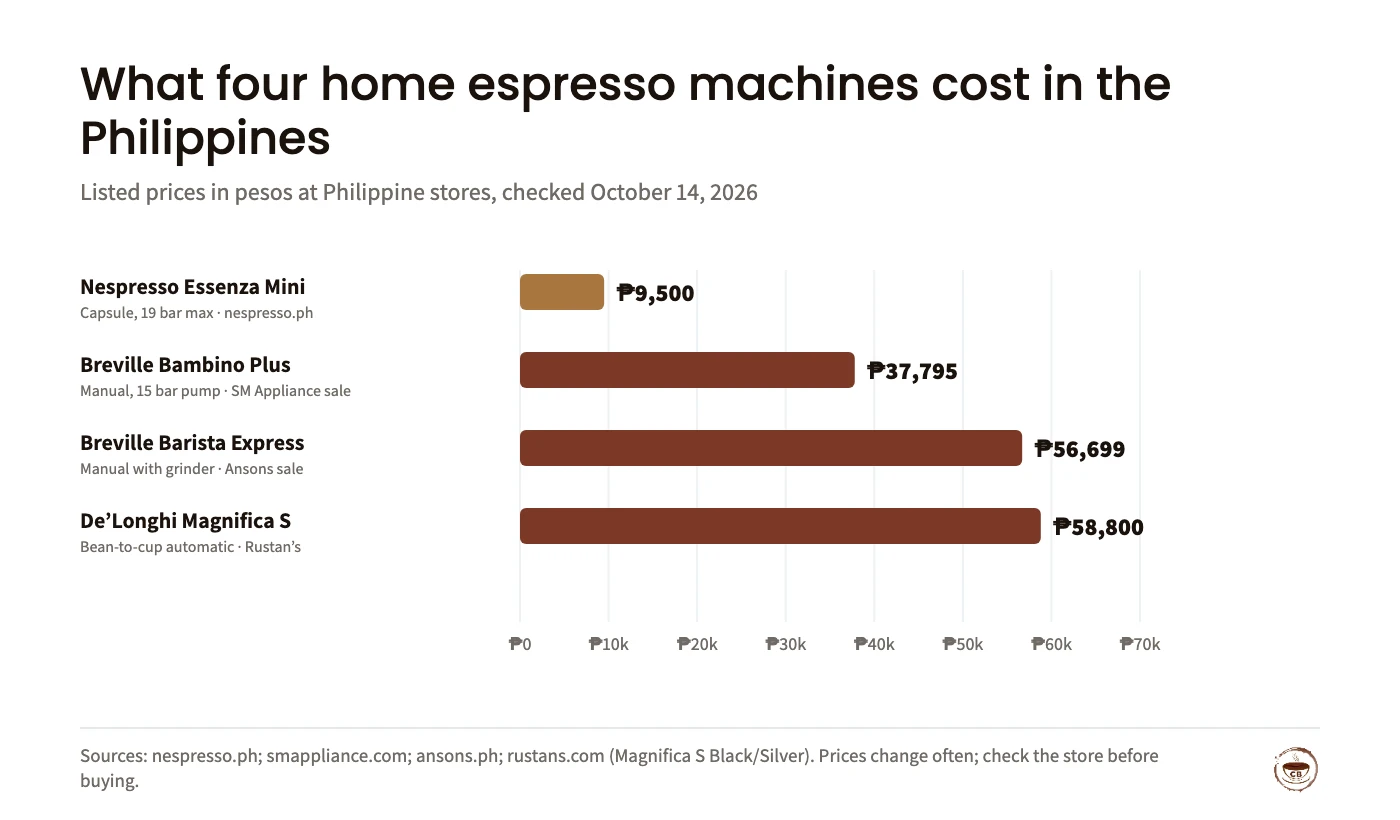
Quick answer: A home espresso machine pushes hot water through about 14 to 18 grams of finely ground coffee for 20 to 30 seconds to make a double shot. In the Philippines, check that the machine is rated for 220 volts and 60 hertz. Prices we checked on October 14, 2026 ranged from ₱9,500 for a Nespresso Essenza Mini capsule machine to ₱37,795 for a Breville Bambino Plus, ₱56,699 for a Breville Barista Express and ₱58,800 for a De’Longhi Magnifica S bean-to-cup machine.
Key takeaways
- The old SCAA definition of espresso calls for 9 to 10 atmospheres of pressure, water at 90.5 °C to 96.1 °C and a 20 to 30 second brew.
- Most home pump machines carry a 15 bar pump rating, but Breville says its machines extract at about 9 bar.
- Philippine power is 220 V at 60 Hz, so look for machines rated 220 to 240 V and 50 to 60 Hz.
- At Meralco’s October 2026 rate of ₱15.0615 per kWh, running a 1,300 W heater at full power for 10 minutes costs about ₱3.26.
- Beans for a double shot cost about ₱11.38 to ₱19.22 at our October 15, 2026 prices, depending on the bean and the dose.
What does an espresso machine need to do?
Espresso is a small, strong coffee made by forcing hot water through finely ground coffee under pressure. The National Coffee Association’s espresso guide, last updated February 5, 2026, gives a ratio of 1 gram of dry coffee to 2 grams of brewed espresso, a fine grind “like table salt,” and 20 to 30 seconds of contact between coffee and water.
Other standards add pressure and temperature. The old SCAA definition, quoted in the SCA’s 25 Magazine, uses 7 to 9 grams of coffee for a single (14 to 18 grams for a double), water at 90.5 °C to 96.1 °C, 9 to 10 atmospheres of pressure, 25 to 35 ml in the cup and a 20 to 30 second brew. The Italian “Certified Italian Espresso” conditions, as listed by Caprioli and colleagues in the Journal of Food Research in 2013, are tighter: 7 grams of coffee, 90 °C water, 9 bar and 25 seconds, each with a small tolerance.
| Parameter | NCA espresso guide | Old SCAA definition | Certified Italian Espresso |
|---|---|---|---|
| Coffee dose | Not given | 7 to 9 g single, 14 to 18 g double | 7 g ± 0.5 |
| Ratio | 1:2 coffee to espresso | Not given | Not given |
| Water temperature | “Nearly boiling” | 90.5 °C to 96.1 °C | 90 °C ± 2 at the group |
| Pressure | “High pressure” | 9 to 10 atmospheres | 9 bar ± 1 |
| Brew time | 20 to 30 s | 20 to 30 s | 25 s ± 2.5 |
| Volume in the cup | Not given | 25 to 35 ml single | 25 ml ± 2.5 |
| Grind | Fine, like table salt | Not given | Not given |
Two practical points follow. A machine needs stable water temperature and enough pressure, and you need a grinder that can go fine and consistent. Many beginners spend on the machine and skimp on the grind. Our beginner’s guide to making espresso at home walks through the full routine.
Do you need a 15 bar machine?
Most home machines advertise a 15 bar pump. That number is the pump’s rating, not the brewing pressure. Breville’s product pages for the Bambino Plus and the Barista Express (sold as Sage in the UK) both describe “a high pressure (9 bar) extraction” delivered by a 15 bar pump. Nespresso’s Essenza Mini manual lists a maximum of 19 bar. None of these figures tells you which machine makes better espresso. Temperature control, grind and dose matter more.
Which type of home espresso machine should you buy?
Home machines fall into four groups. Each trades effort for control.
- Capsule machines, such as the Nespresso Essenza Mini, use pre-dosed pods. They are the cheapest to buy and the easiest to use, and you can’t use your own beans unless you buy refillable capsules.
- Manual pump machines without a grinder, such as the Breville Bambino Plus, De’Longhi Dedica and Gaggia Classic, let you choose the beans, dose and grind. You need a separate grinder or pre-ground espresso coffee.
- Manual machines with a built-in grinder, such as the Breville Barista Express, put both jobs in one box.
- Bean-to-cup automatics, such as the De’Longhi Magnifica S, grind, dose and brew at the press of a button. They cost more and give you less control over each shot.
A moka pot is the low-cost alternative. A 2009 study in Applied Thermal Engineering by Navarini and colleagues describes it as brewing with steam pressure in a sealed aluminum kettle, which runs well below espresso pressure. The coffee is strong and works well with milk, but it is not espresso. See our moka pot guide for how to brew it.
What do home espresso machines cost in the Philippines?
We checked listed prices at Philippine stores on October 14, 2026. Sale prices change often, so treat these as a snapshot. We could not find a Philippine listing for the De’Longhi Dedica EC685 or the Gaggia Classic on the stores we checked.
| Machine | Type | Heating | Pump | Power and voltage | Philippine price (Oct 14, 2026) |
|---|---|---|---|---|---|
| Nespresso Essenza Mini | Capsule | Heats up in 30 s | Max 19 bar | 1,200 to 1,310 W, 220 to 240 V, 50 to 60 Hz | ₱9,500 (nespresso.ph) |
| Breville Bambino Plus (BES500) | Manual, no grinder | ThermoJet, ready in 3 s | 15 bar pump, 9 bar extraction | 1,600 W, 220 to 240 V, 60 Hz (Ansons listing) | ₱37,795 sale, ₱41,995 regular (SM Appliance); ₱39,689 sale (Ansons, Black Truffle) |
| Breville Barista Express (BES870) | Manual with grinder | Thermocoil with PID, 93 °C | 15 bar pump, 9 bar extraction | 1,560 W, 220 to 240 V (Ansons listing); Breville’s ANZ manual says 1,850 W | ₱56,699 sale, ₱62,999 regular (Ansons) |
| De’Longhi Magnifica S (ECAM22.110) | Bean-to-cup automatic | Not stated | 15 bar | 1,450 W, 220 to 240 V | ₱58,800 Black/Silver, ₱68,800 Black (Rustan’s) |
| De’Longhi Dedica Style (EC685) | Manual, no grinder | Thermoblock | 15 bar | 1,300 W, 220 to 240 V, 50 to 60 Hz | Not found; RM 999 in Malaysia |
| Gaggia Classic (E24) | Manual, no grinder | Brass boiler | 15 bar nominal | 1,200 W at 230 V 50 Hz; no 220 V 60 Hz version listed | Not found |
Will it work on Philippine power, and what does it cost to run?
The Philippines uses 220 volts at 60 hertz, according to the Philippine Consulate General in Guangzhou. Most machines sold here are rated 220 to 240 V and 50 to 60 Hz, which covers it. The Gaggia page lists 230 V at 50 Hz for Europe and a 220 V version for Korea, so ask a local distributor before importing one.
Running costs are small. Meralco’s typical residential rate for October 2026 is ₱15.0615 per kWh, up from ₱14.7424 in September. A 1,300 W heater running at full power for 10 minutes would use about 0.22 kWh, or about ₱3.26. A 1,600 W machine under the same assumption would cost about ₱4.02. Real use is usually lower because the heater switches on and off once the machine is hot, so read these as upper limits for a short session.
How much do the beans cost per shot?
Beans are the main running cost of a manual machine. The table uses the old SCAA double-shot range of 14 to 18 grams and our 1 kg bag prices on October 15, 2026. If your machine has no grinder, choose the fine grind when you order and we will grind it for free.
| Caffeine Brothers beans (1 kg) | Price on Oct 15, 2026 | Per gram | 14 g double | 18 g double |
|---|---|---|---|---|
| Robusta (Batangas, dark roast) | ₱813 | ₱0.813 | ₱11.38 | ₱14.63 |
| CB’s Finest Signature Blend | ₱866 | ₱0.866 | ₱12.12 | ₱15.59 |
| Arabica (Benguet, medium roast) | ₱1,068 | ₱1.068 | ₱14.95 | ₱19.22 |
Our guide to how much coffee is in a shot of espresso explains singles, doubles and ristretto doses in more detail.
How often should you descale an espresso machine?
It depends on your water. De’Longhi’s support page recommends descaling a pump espresso machine after 200 uses and says the right frequency depends on water hardness. Breville’s Barista Express manual says to descale when the clean or descale light comes on, and that replacing the water filter every two months reduces the need to descale. Nespresso’s Essenza Mini manual also links the descaling interval to water hardness.
How to choose a home espresso machine in six steps
- Decide how much work you want. Capsules take seconds, bean-to-cup machines take a button press, and manual machines need you to grind, dose and tamp.
- Check the power rating. Look for 220 to 240 V and 60 Hz, or 50 to 60 Hz, on the label or spec sheet.
- Budget for a grinder. If the machine has no grinder, set aside money for one or plan to buy fine-ground coffee.
- Compare heating systems. Thermoblock and ThermoJet machines heat up fast, while boiler machines take longer but hold heat. A PID controller keeps the temperature steady.
- Check the local warranty. Buy from an official store or authorized dealer so repairs and parts are covered in the Philippines.
- Price the beans per shot. At 14 to 18 grams per double, a kilogram of beans makes about 55 to 71 doubles.
Frequently asked questions
Is a 15 bar espresso machine better than a 9 bar machine?
Not by itself. The old SCAA definition of espresso uses 9 to 10 atmospheres of pressure, and Breville says its 15 bar pumps deliver a 9 bar extraction. The 15 bar figure is the pump’s rating, so look at temperature control and grind instead.
Can I use an espresso machine bought abroad in the Philippines?
Only if it is rated for the local supply. The Philippines uses 220 volts at 60 hertz, according to the DFA. A machine labeled 220 to 240 V and 50 to 60 Hz matches that supply. A 120 V model is built for a different supply, so don’t buy one for use here.
How much coffee do I need for a double espresso?
The old SCAA definition uses 14 to 18 grams of coffee for a double, and the National Coffee Association suggests about 1 gram of coffee for every 2 grams of espresso in the cup. At our October 15, 2026 prices that is about ₱11.38 to ₱19.22 of beans per double.
Can a moka pot make espresso?
A moka pot makes strong coffee using steam pressure in a sealed kettle, but it runs well below the 9 bar used for espresso. It is a good low-cost option if you mostly drink milk coffee. See our moka pot guide for how to brew it.
Sources
- Espresso. National Coffee Association, last updated February 5, 2026. Used for the 1:2 ratio, 20 to 30 seconds and fine grind.
- Defining the Ever-Changing Espresso. Specialty Coffee Association, 25 Magazine Issue 3, David Fasman. Used for the old SCAA espresso definition.
- Importance of Espresso Coffee Machine Parameters on the Extraction of Chlorogenic Acids in a Certified Italian Espresso. Caprioli et al., Journal of Food Research 2(3), 2013. Used for Certified Italian Espresso conditions.
- Experimental investigation of steam pressure coffee extraction in a stove-top coffee maker. Navarini et al., Applied Thermal Engineering 29, 2009. Used for how a moka pot brews.
- the Bambino Plus. Breville Australia, read October 14, 2026. Used for ThermoJet, 3 second heat-up, 15 bar pump and 9 bar extraction.
- the Barista Express. Sage Appliances UK, read October 14, 2026. Used for Thermocoil, PID at 93 °C and 15 bar pump.
- Dedica Style EC685.M. De’Longhi Malaysia, read October 14, 2026. Used for 1,300 W, voltage, 15 bar, thermoblock and RM 999.
- Magnifica S ECAM22.110.B. De’Longhi Malaysia, read October 14, 2026. Used for 1,450 W, voltage and 15 bar.
- Essenza Mini user manual. Nespresso, 2017. Used for 1,200 to 1,310 W, voltage, 19 bar maximum and descaling.
- New Classic E24. Gaggia, read October 14, 2026. Used for power by market, 15 bar nominal and brass boiler.
- Essenza Mini. Nespresso Philippines, checked October 14, 2026. Used for the ₱9,500 price and 30 second heat-up.
- BES500 Breville Bambino Plus Coffee Machine. SM Appliance, checked October 14, 2026. Used for the ₱37,795 sale and ₱41,995 regular price.
- Breville BES870 The Barista Express. Ansons, checked October 14, 2026. Used for the price, 1,560 W and voltage.
- Breville BES500BTR The Bambino Plus Black Truffle. Ansons, checked October 14, 2026. Used for the ₱39,689 price and 1,600 W, 60 Hz rating.
- De’Longhi collection. Rustan’s, checked October 14, 2026. Used for Magnifica S prices.
- About the Philippines. Philippine Consulate General in Guangzhou, DFA. Used for 220 V at 60 Hz.
- Higher Residential Rates this October 2026. Meralco, October 13, 2026. Used for ₱15.0615 and ₱14.7424 per kWh.
- How often does my pump espresso coffee machine need to be descaled?. De’Longhi UK support. Used for descaling after 200 uses.
- the Barista Express instruction book. Breville Australia and New Zealand. Used for the descale light, two-month filter guidance and 1,850 W rating.
Cite this article: Caffeine Brothers. “Home Espresso Machines in the Philippines: A 2026 Buying Guide.” Caffeine Brothers Coffee Blog, October 2026. https://caffeinebrothers.co/home-espresso-machine/
You are welcome to reference the tables and charts in this article with a link back to this page.
Got a new espresso machine? Order whole beans or ask for a fine grind on any bag in our shop, from Batangas Robusta to Benguet Arabica. Plan your doses with the tools in the Coffee Lab, or message us for help choosing a bean.
 Previous Post