Service Incentive Leave in the Philippines: Rules and Computation
By Robin Salvador, co-founder, Caffeine Brothers
Last updated: October 29, 2026
Quick answer: Service incentive leave (SIL) is five days of paid leave a year that the Labor Code gives every covered employee after one year of service. It can be used for sick days, vacation or other personal reasons, and any unused days are converted to cash at the end of the year or paid out when the employee leaves. Establishments regularly employing fewer than ten employees, and employers who already give at least five days of paid vacation leave, are exempt. At the Metro Manila minimum wage of ₱755, five SIL days are worth ₱3,775.
Key takeaways
- Article 95 of the Labor Code gives five days of SIL with pay to every employee who has rendered at least one year of service.
- Rule V of the Omnibus Rules excludes government workers, domestic helpers, managerial employees, field personnel, workers already given the benefit or at least five days of paid vacation leave, and establishments regularly employing fewer than ten employees.
- Unused SIL is commutable to cash at the end of the year, and unused days that were not converted are paid on resignation or separation at the latest salary rate.
- Under Wage Order NCR-28 (effective September 26, 2026), five days of SIL cost ₱3,775 at the ₱755 rate and ₱3,590 at the ₱718 rate.
- In Auto Bus Transport Systems v. Bautista (G.R. No. 156367, May 16, 2005), the Supreme Court held that the three-year prescriptive period for SIL claims starts when the employer refuses to pay after demand, or on separation.
Year-end is when café owners and office managers ask us most about leave: who still has days left, whether the days can be paid out with the December payroll, and how much it will cost. This guide reads Article 95 of the Labor Code, Rule V of its implementing rules, DOLE’s 2023 handbook on statutory benefits and the leading Supreme Court case, then works the numbers at the new Metro Manila minimum wage. It is a plain-language summary and not legal advice. For a specific case, ask your DOLE field office or a labor lawyer.
What does the Labor Code say about service incentive leave?
Article 95 is short. It gives “a yearly service incentive leave of five days with pay” to every employee who has rendered at least one year of service. It then exempts three groups: employees who already enjoy the benefit, employees who enjoy vacation leave with pay of at least five days, and establishments regularly employing fewer than ten employees or exempted by the Secretary of Labor because of their financial condition.
Rule V of Book III of the Omnibus Rules fills in the details. Section 3 defines “at least one year of service” as service of not less than 12 months, “whether continuous or broken,” counted from the day the employee started, including authorized absences and paid regular holidays. Section 5 says the leave “shall be commutable to its money equivalent if not used or exhausted at the end of the year.” DOLE’s 2023 handbook describes SIL as leave “that may be used for sick, vacation, and other leave purposes,” so the five days do not have to be split between sick and vacation leave.
Freshly roasted Philippine coffee
Shop our coffee beans: Arabica, Robusta, Kapeng Barako and signature blends, roasted daily in Manila, whole bean or ground. Not sure which? Take the Coffee Match Quiz.
Shop Coffee Beans →Who is entitled to SIL, and who is not?
The coverage list in Rule V, Section 1, is the one to check against your staff list. DOLE’s handbook repeats it and adds the three tests for managerial staff.
| Worker or employer | Gets SIL? | Basis |
|---|---|---|
| Rank-and-file café, office or shop employee with at least 1 year of service, in a business with 10 or more employees | Yes, 5 days a year | Labor Code Art. 95(a); Rule V Sec. 2 |
| Employee with less than 1 year of service | Not yet | Rule V Sec. 2 and 3 (12 months, continuous or broken) |
| Any employee of a business regularly employing fewer than 10 employees | No | Art. 95(b); Rule V Sec. 1(g) |
| Employee already given at least 5 days of paid vacation leave | No (already covered) | Art. 95(b); Rule V Sec. 1(e) and (f) |
| Managerial employee (manages the business or a department, directs 2 or more staff, can hire or fire or recommend it) | No | Rule V Sec. 1(c); DOLE handbook 2023 |
| Field personnel whose hours of work cannot be determined with reasonable certainty | No | Rule V Sec. 1(d); Auto Bus v. Bautista (2005) |
| Government employee | No (covered by civil service rules) | Rule V Sec. 1(a) |
| Domestic worker (kasambahay) with at least 1 year of service | Yes, 5 days under a separate law, not convertible to cash | RA 10361 Sec. 29 |
Two points trip up small employers. First, the ten-employee threshold counts the whole establishment, so a café with nine crew and a manager has ten. Second, the field personnel exclusion is narrower than it sounds. In Auto Bus, a bus driver-conductor paid a 7% commission was still entitled to SIL because dispatchers and inspectors supervised his trips. The Court said the phrase about employees paid on commission or task basis must be read together with “field personnel,” meaning workers whose hours in the field cannot be determined with reasonable certainty. So a delivery rider who clocks in and is tracked on a set schedule may well be covered. The facts of each job decide it.
How is SIL computed and converted to cash?
DOLE’s handbook gives three rules for conversion. The employee may use the leave credits or convert them to money if they are not used by the end of the year. Days that were neither used nor converted are paid when the employee resigns or is separated. The basis is the salary rate on the date of conversion, and use and conversion “may be on a pro rata basis.”
For daily-paid staff, the cash value is the number of unused days times the daily rate. For monthly-paid staff, you first need a daily rate. DOLE’s handbook lists the factors used to convert between daily and monthly pay: 365 for employees paid every day of the month, 313 for those who do not work and are not paid on rest days, and 261 for those who do not work and are not paid on Saturdays and Sundays. Use the factor your payroll already uses for that employee.
| Employee | Daily rate used | Value of 5 SIL days |
|---|---|---|
| NCR minimum, non-agriculture (NCR-28) | ₱755.00 | ₱3,775.00 |
| NCR minimum, retail or service with 15 or fewer workers (NCR-28) | ₱718.00 | ₱3,590.00 |
| ₱20,000 a month, factor 365 (paid every day) | ₱657.53 | ₱3,287.65 |
| ₱20,000 a month, factor 313 (6-day week) | ₱766.77 | ₱3,833.85 |
| ₱20,000 a month, factor 261 (5-day week) | ₱919.54 | ₱4,597.70 |
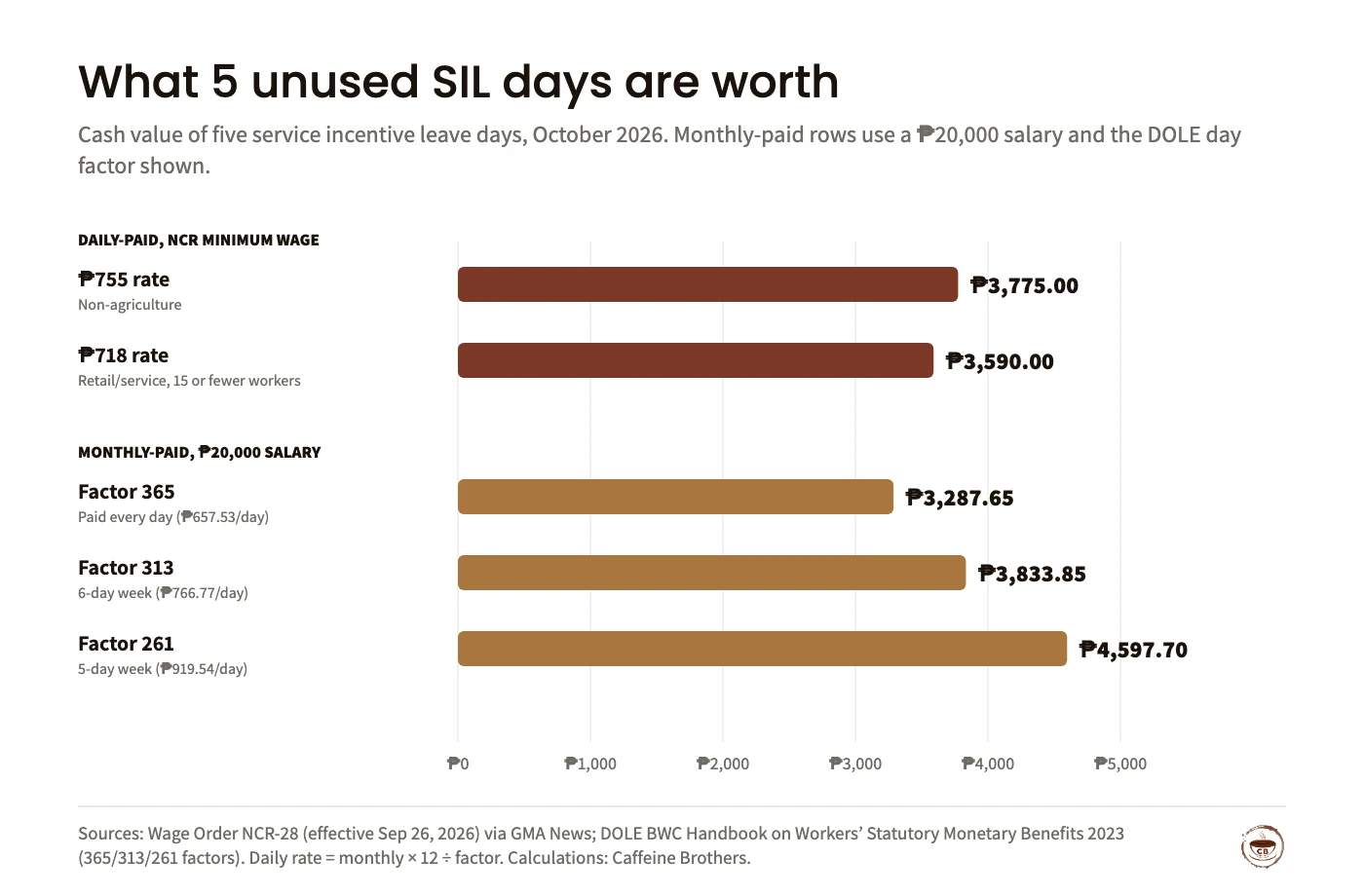
The same ₱20,000 salary gives three different SIL values because the factor changes the daily rate. A five-day-week employee has fewer paid days in the year, so each day is worth more. That is why it matters to use the factor in the employment contract or payroll policy and to apply it the same way for SIL, overtime and holiday pay. Our guide to holiday pay in the Philippines uses the same factors.
What happens to unused SIL when an employee resigns?
Unused days are paid on resignation or separation, prorated for the final partial year. DOLE’s handbook gives an example: an employee hired January 1, 2022 who resigns March 1, 2023 without using any SIL gets the 5 days earned for 2022 plus 2/12 of 5 days for January and February 2023, a total of 5.833 days.
Here is the same method with 2026 numbers. A barista in Metro Manila on the ₱755 minimum is hired January 1, 2025, never uses SIL, does not convert the 2025 days, and resigns on September 30, 2026. The 2025 entitlement is 5 days. The partial year is 9/12 of 5 days, or 3.75 days. The total is 8.75 days, paid at the rate on the conversion date. Because NCR-28 took effect on September 26, 2026, that rate is ₱755, so the payout is 8.75 × ₱755 = ₱6,606.25. Had the same barista resigned on September 15, the rate would have been the old ₱695 and the payout ₱6,081.25.
The SIL payout goes in the final pay with the prorated 13th month pay. See our 13th month pay computation guide for that part.
How long can an employee claim unpaid SIL?
Money claims under the Labor Code prescribe in three years. In Auto Bus Transport Systems v. Bautista, the Supreme Court explained that SIL is a “curious animal” among benefits because the employee can choose to use it, convert it at year-end, or let it accumulate until leaving. The Court held that the three-year period starts “from the time when the employer refuses to pay its monetary equivalent after demand of commutation or upon termination of the employee’s services.” In practice, an employee who leaves can claim all accumulated SIL that was never paid, as long as the claim is filed within three years of separation.
How does SIL compare with other paid leaves in the Philippines?
SIL is the general leave. Several laws give separate paid leaves for specific situations, and these are added on top of SIL. Check the eligibility rules in each law before applying them.
| Leave | Paid days | Who qualifies (summary) | Law |
|---|---|---|---|
| Service incentive leave | 5 days a year | Employees with at least 1 year of service, except the excluded groups above | Labor Code Art. 95 (PD 442, as amended) |
| Kasambahay annual leave | 5 days a year | Domestic workers with at least 1 year of service; unused days are not carried over or converted to cash | RA 10361 (2013), Sec. 29 |
| Solo parent leave | Up to 7 working days a year | Solo parent employees with at least 6 months of service, regardless of employment status | RA 11861 (2022), amending RA 8972 |
| Paternity leave | 7 days | Married male employees, for the first four deliveries of the legitimate spouse he lives with | RA 8187 (June 11, 1996) |
| Maternity leave | 105 days (plus 15 for solo mothers; 30 more unpaid on request) | Female workers in the public and private sector | RA 11210 (2019) |
| Special leave for women | 2 months | Women with at least 6 months of aggregate service in the last 12 months, after surgery for gynecological disorders | RA 9710 (2009), Sec. 18 |
| Leave for victims of violence against women and children | Up to 10 days | Victims under RA 9262, extendible when a protection order requires it | RA 9262 (2004), Sec. 43 |
A note on paternity leave: Akbayan Rep. Chel Diokno filed a bill in June 2026 that would give fathers up to 105 days of paid leave, with SSS reimbursing private employers, according to The Philippine Star. As of October 29, 2026, it is a bill and the 7-day rule still applies.
Is converted SIL taxable?
Revenue Regulations No. 29-2025, issued December 22, 2025, raised the de minimis ceiling for “monetised unused vacation leave credits of private employees” to 12 days a year, according to Grant Thornton Philippines. De minimis benefits are exempt from income tax and fringe benefit tax. If your accountant treats converted SIL as monetised vacation leave, five SIL days fall within the 12-day ceiling. Ask your accountant how your payroll classifies it. Our post on the Christmas gift tax exemption covers the other RR 29-2025 ceilings.
A five-step year-end SIL check for café and office owners
- Count your headcount. If the establishment regularly employs ten or more employees, SIL applies. Count everyone it regularly employs, not only the staff who have finished a year.
- List who has finished one year. Use the hire date and count 12 months of service, continuous or broken, including authorized absences and paid holidays.
- Check existing leave policies. If your policy already gives at least five days of paid vacation leave, that satisfies the law. If it gives fewer, top up to five.
- Compute the value at today’s rate. Multiply unused days by the current daily rate. Use ₱755 or ₱718 for NCR minimum-wage staff paid after September 26, 2026, and the payroll factor for monthly-paid staff.
- Pay or record it in writing. Pay converted days with the December payroll, or record that the employee chose to keep them, so the balance is clear if the employee resigns later.
For a café with 12 crew on the ₱718 rate, converting five unused days for everyone costs 12 × ₱3,590 = ₱43,080. That is worth planning for in the same month as the 13th month pay. Our barista salary guide shows the full monthly cost of a minimum-wage employee, with SSS, PhilHealth and Pag-IBIG.
Frequently asked questions
How many days is service incentive leave in the Philippines?
Five days with pay every year, for an employee who has rendered at least one year of service. The count comes from Article 95 of the Labor Code and Rule V of its implementing rules. Company policy or a CBA can give more, never less.
Is unused service incentive leave convertible to cash?
Yes. The implementing rules say unused SIL is commutable to its money equivalent at the end of the year. DOLE’s 2023 handbook adds that unused and unconverted SIL is paid out on resignation or separation, at the salary rate on the date of conversion.
Do small coffee shops have to give service incentive leave?
Establishments regularly employing fewer than ten employees are excluded under Article 95 and Rule V. A café with ten or more employees must give five days to every covered worker who has finished one year of service.
How do you compute the cash value of service incentive leave?
Multiply the unused days by the daily rate on the date of conversion. At the NCR minimum of ₱755, five days are worth ₱3,775. For monthly-paid staff, first convert the monthly salary to a daily rate with the factor your company uses (365, 313 or 261 days).
Sources
- Labor Code of the Philippines, Book Three. Labor Law PH library, modified April 2, 2024. Used for Article 95 (service incentive leave) and its exemptions.
- Omnibus Rules Implementing the Labor Code, Book III. Labor Law PH library, modified October 9, 2023. Used for Rule V: coverage exclusions, the definition of one year of service and commutation at year-end.
- Handbook on Workers’ Statutory Monetary Benefits, 2023 edition. DOLE Bureau of Working Conditions. Used for the SIL definition, managerial tests, conversion rules, the resignation illustration and the 365, 313 and 261 day factors.
- Auto Bus Transport Systems, Inc. v. Bautista, G.R. No. 156367. Supreme Court, May 16, 2005, via LawPhil. Used for the field personnel test and when the three-year prescriptive period starts.
- DOLE: P60 wage hike in NCR takes effect Sept. 26. GMA News, September 26, 2026. Used for the NCR-28 rates of ₱755 and ₱718 and the old rates of ₱695 and ₱658.
- Republic Act No. 10361 (Batas Kasambahay). LawPhil. Used for Section 29 on domestic workers’ annual leave.
- Republic Act No. 11861 (Expanded Solo Parents Welfare Act). LawPhil. Used for the 7-working-day parental leave.
- Republic Act No. 8187 (Paternity Leave Act of 1996). LawPhil, June 11, 1996. Used for the 7-day paternity leave.
- Republic Act No. 11210 (105-Day Expanded Maternity Leave Law). LawPhil. Used for the 105, 15 and 30 day maternity leave figures.
- Republic Act No. 9710 (Magna Carta of Women). LawPhil. Used for the 2-month special leave in Section 18.
- Republic Act No. 9262 (Anti-Violence Against Women and Their Children Act). LawPhil. Used for the 10-day leave in Section 43.
- Updated de minimis benefits threshold. Grant Thornton Philippines, January 19, 2026. Used for the RR 29-2025 ceiling of 12 days of monetised unused vacation leave.
- 105 days: Diokno files PAPA Leave Bill. The Philippine Star, June 20, 2026. Used for the pending paternity leave bill.
Cite this article: Caffeine Brothers. “Service Incentive Leave in the Philippines: Rules and Computation.” Caffeine Brothers Coffee Blog, October 2026. https://caffeinebrothers.co/service-incentive-leave/
You are welcome to reference the charts and frameworks in this article with a link back to this page.
Stocking the pantry for the people who keep your café or office running? See our wholesale coffee in 10 kg boxes with free Metro Manila delivery, or coffee drip bags for desks and break rooms. For a quote, contact us.
 Previous Post
 Next Post