
Separation Pay in the Philippines: Rules and Computation (2026)
By Robin Salvador, co-founder, Caffeine Brothers · Last updated: November 24, 2026
Quick answer: Separation pay is money the Labor Code requires an employer to pay when it ends a job for an authorized cause the employee did not cause. Redundancy and labor-saving devices earn one month pay per year of service. Retrenchment, closure not due to serious losses and incurable disease earn half a month per year. Either way the minimum is one month pay, and six months or more of service counts as a full year.
Key takeaways
- Articles 298 and 299 of the Labor Code (formerly 283 and 284) set the separation pay rates; the DOLE 2023 Handbook on Workers’ Statutory Monetary Benefits repeats them.
- The base is the latest salary rate plus regular allowances, following Planters’ Products v. NLRC (1989).
- An NCR worker on the ₱755 minimum wage with 5 years and 7 months of service would get about ₱118,157.50 for redundancy or ₱59,078.75 for retrenchment, using the handbook’s 313-day factor.
- Employees dismissed for a just cause and those who resign get no separation pay under the law, unless a contract, CBA or company policy grants it.
- Separation pay for causes beyond the employee’s control is tax exempt, and final pay is due within 30 days under DOLE Labor Advisory 06-2020.
What is separation pay?
Separation pay is a one-time payment owed when an employer ends employment for an authorized cause. Authorized causes are business or health reasons that do not involve wrongdoing by the employee. They are listed in Articles 298 and 299 of the Labor Code, renumbered from Articles 283 and 284 by DOLE Department Advisory No. 1, series of 2015.
It is different from final pay. Final pay is everything owed when anyone leaves a job, for any reason: unpaid salary, prorated 13th month pay, unused leave conversions and tax refunds. Separation pay is added to final pay only when the law, a contract or company policy requires it. Our final pay computation guide covers the other items. It is also different from retirement pay, which is covered in our retirement pay guide.
Freshly roasted Philippine coffee
Shop our coffee beans: Arabica, Robusta, Kapeng Barako and signature blends, roasted daily in Manila, whole bean or ground. Not sure which? Take the Coffee Match Quiz.
Shop Coffee Beans →How much separation pay is due for each cause?
| Reason for separation | Labor Code basis | Separation pay |
|---|---|---|
| Installation of labor-saving devices | Art. 298 [283] | 1 month pay or 1 month per year of service, whichever is higher |
| Redundancy | Art. 298 [283] | 1 month pay or 1 month per year of service, whichever is higher |
| Retrenchment to prevent losses | Art. 298 [283] | 1 month pay or ½ month per year of service, whichever is higher |
| Closure not due to serious losses | Art. 298 [283] | 1 month pay or ½ month per year of service, whichever is higher |
| Closure due to serious business losses | Art. 298 [283]; North Davao Mining v. NLRC (1996) | None required by law |
| Disease not curable within 6 months | Art. 299 [284] | 1 month salary or ½ month per year of service, whichever is greater |
| Reinstatement impossible through no fault of the employer | DOLE 2023 Handbook, citing Gaco v. NLRC (1994) | 1 month per year of service |
| Just cause (misconduct, neglect, fraud and similar) | Art. 297 [282] | None, with limited exceptions (see below) |
| Voluntary resignation | Art. 300 [285] | None, unless a contract, CBA or policy grants it |
In every case the law says “a fraction of at least six (6) months shall be considered one (1) whole year.” Five years and seven months counts as six years. Five years and four months counts as five.
The disease ground has an extra condition. Book VI, Rule I, Section 8 of the Omnibus Rules requires a certification by a competent public health authority that the disease cannot be cured within six months even with proper treatment. If it can be cured within that time, the employer must place the employee on leave instead.
How do you compute separation pay?
These are the steps, using the rules in the Labor Code and the DOLE 2023 Handbook:
- Identify the cause. Check which authorized cause applies, because it decides whether the rate is one month or half a month per year.
- Get the monthly pay. Use the latest salary rate and add regular allowances the employee has been receiving. The handbook says it would be an error not to integrate the allowance with the basic salary.
- Convert a daily rate if needed. The handbook suggests multiplying the daily rate by 313 and dividing by 12 for a six-day week, or by 261 and 12 for a five-day week. It calls these formulas suggestions, so follow your payroll policy if it is consistent.
- Count the years. Round up any fraction of six months or more to a full year; drop a fraction below six months.
- Multiply and apply the floor. Multiply the monthly pay by the years, halved for the half-month causes. If the result is less than one month pay, pay one month.
- Give notice and pay on time. Serve written notice on the employee and the DOLE regional office at least one month before the termination date, then release the money with the final pay within 30 days of separation.
What does separation pay look like at the NCR minimum wage?
Wage Order NCR-28 raised the Metro Manila minimum wage for non-agriculture workers to ₱755 a day from September 26, 2026, GMA News reported. Using the handbook’s 313-day factor, ₱755 × 313 ÷ 12 gives a monthly pay of ₱19,692.92. The table applies the two rates to that pay.
| Years of service credited | Redundancy or labor-saving devices (1 month per year) | Retrenchment, closure or disease (½ month per year, minimum 1 month) |
|---|---|---|
| 1 | ₱19,692.92 | ₱19,692.92 |
| 2 | ₱39,385.83 | ₱19,692.92 |
| 3 | ₱59,078.75 | ₱29,539.38 |
| 5 | ₱98,464.58 | ₱49,232.29 |
| 6 | ₱118,157.50 | ₱59,078.75 |
| 10 | ₱196,929.17 | ₱98,464.58 |
| 15 | ₱295,393.75 | ₱147,696.88 |
| 20 | ₱393,858.33 | ₱196,929.17 |
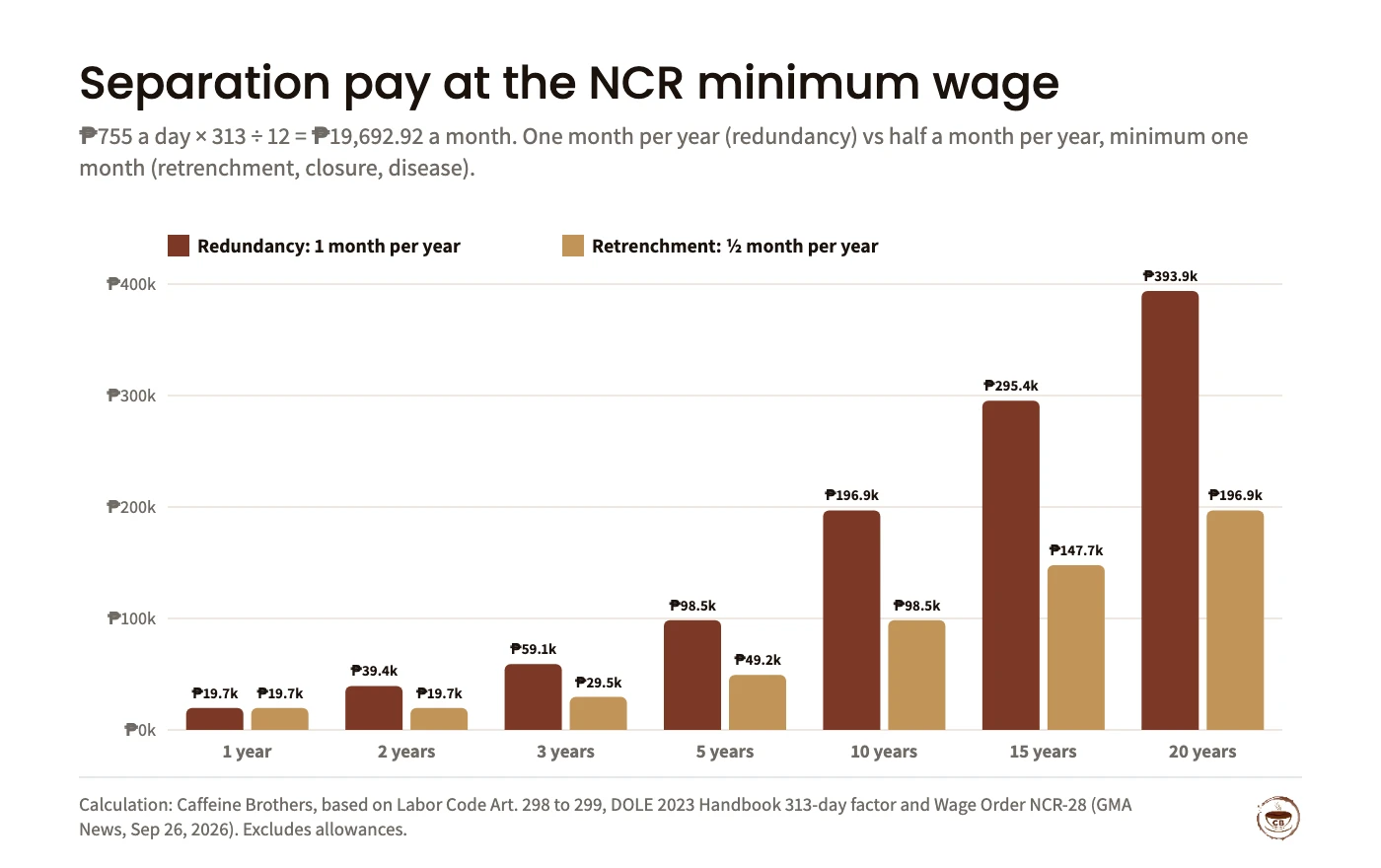
The floor matters for short service. A worker retrenched after one year gets one month pay, not half a month, and a worker with two years gets one month under either formula. For a five-day week the handbook factor is 261, which lowers the monthly pay to ₱16,421.25 and every figure in the table by the same proportion. Workers in NCR retail and service firms with 15 or fewer employees have a ₱718 daily minimum under the same wage order, which gives ₱18,727.83 a month. For rates outside Metro Manila, see our minimum wage Philippines 2026 table.
Who does not get separation pay?
Three groups usually get nothing under the law itself.
Employees dismissed for a just cause under Article 297, such as serious misconduct, willful disobedience, gross and habitual neglect, fraud or a crime against the employer. The Omnibus Rules say such a dismissal “does not entitle him to the termination pay.” In PLDT v. NLRC (1988) the Supreme Court allowed separation pay as a measure of social justice only for causes other than serious misconduct or those reflecting on the employee’s moral character. In Toyota Motor Phils. Corp. Workers Association v. NLRC (2007) it said separation pay should not be granted for any of the named just causes, while courts may still grant it for some analogous causes, weighing length of service and whether it was a first offense.
Employees who resign. Article 300 asks a resigning employee to give one month’s written notice but provides no separation pay. The Court confirmed this in Alfaro v. Court of Appeals (2001), adding that an employer who promised separation pay is bound by that promise.
Employees of a business that closes because of serious losses. In North Davao Mining Corp. v. NLRC (1996) the Supreme Court said the Labor Code imposes no obligation to pay separation benefits when closure is due to losses. The employer has to prove the losses.
Illegal dismissal is the opposite case. When reinstatement is no longer workable, for example because relations have become strained, courts award separation pay of one month salary per year of service in addition to backwages, as in Golden Ace Builders v. Talde (2010).
Is separation pay taxable?
No, when the separation is beyond the employee’s control. Section 32(B)(6)(b) of the Tax Code, quoted in the DOLE handbook, excludes from gross income amounts received because of separation due to death, sickness or other physical disability, or for any cause beyond the employee’s control. Grant Thornton Philippines explains that this covers redundancy, labor-saving devices and closure, so no withholding tax applies. The employer must keep proof of the cause in case of a BIR audit. Separation pay a company gives on resignation is a different matter, because resignation is the employee’s choice. The regular withholding rules in our withholding tax table 2026 guide then become relevant.
Are there bills to change separation pay in 2026?
None has become law. Senate Bill No. 2563 by Senator Erwin Tulfo, reported by The Manila Times and Philippine Star on November 9, 2026, would add a Labor Code article for jobs lost to artificial intelligence. It proposes at least two months pay or two months pay for every year of service, whichever is higher, plus six months’ notice to DOLE. House Bill No. 3908, filed on August 20, 2025, proposes the same two-month formula for AI-related terminations. We found no 2025 or 2026 bill that would change the general rates in Articles 298 and 299.
| Measure | Status | What it would change |
|---|---|---|
| Senate Bill No. 2563 (Sen. Erwin Tulfo) | Filed; reported Nov 9, 2026 | 2 months pay per year of service for AI-related terminations; 6 months’ notice to DOLE |
| House Bill No. 3908 (Rep. Lordan Suan) | Filed Aug 20, 2025 | 2 months pay per year of service for AI-related terminations |
| Labor Code Art. 298 and 299 | In force | Current rates apply to all other authorized causes |
Frequently asked questions
How is separation pay computed in the Philippines?
Multiply the employee’s one month pay, including regular allowances, by the years of service, counting a fraction of six months or more as a full year. Use one month per year for redundancy or labor-saving devices, and half a month per year for retrenchment, closure not due to serious losses or incurable disease. The result can never be less than one month pay.
Do resigning employees get separation pay?
Not under the Labor Code. The Supreme Court said in Alfaro v. Court of Appeals (2001) that an employee who voluntarily resigns is not entitled to separation pay, unless the employer agreed to pay it. A contract, collective bargaining agreement or company policy can still grant it.
Is separation pay taxable in the Philippines?
Separation pay received because of a cause beyond the employee’s control, such as redundancy, retrenchment or closure, is excluded from gross income under Section 32(B)(6)(b) of the Tax Code. Grant Thornton notes that the employer must be able to prove the cause if the BIR audits the payment.
When must separation pay be released?
DOLE Labor Advisory No. 06, series of 2020 says final pay, which includes separation pay when due, should be released within 30 days from the date of separation, unless a company policy or agreement is more favourable. The certificate of employment is due within three days of the employee’s request.
Sources
- Labor Code of the Philippines, Book Six: Post-Employment. Labor Law PH Library, modified Oct 9, 2023. Used for Articles 297 to 300 and 302.
- Omnibus Rules Implementing the Labor Code, Book Six. Labor Law PH Library, modified Oct 9, 2023. Used for Rule I, Sections 7 to 10.
- 2023 Handbook on Workers’ Statutory Monetary Benefits. DOLE Bureau of Working Conditions, 2023. Used for separation pay rules, notice, tax exclusion and the 313 and 261 day factors.
- Presidential Decree No. 442 (Labor Code). LawPhil Project. Used to check the original article numbers.
- PLDT v. NLRC, G.R. No. L-80609. Supreme Court, Aug 23, 1988 (LawPhil). Used for the social justice exception.
- Toyota Motor Phils. Corp. Workers Association v. NLRC, G.R. Nos. 158786 and 158789. Supreme Court, Oct 19, 2007 (LawPhil). Used for just-cause dismissals.
- North Davao Mining Corp. v. NLRC, G.R. No. 112546. Supreme Court, Mar 13, 1996 (LawPhil). Used for closure due to serious losses.
- Golden Ace Builders v. Talde, G.R. No. 187200. Supreme Court, May 5, 2010 (LawPhil). Used for separation pay in lieu of reinstatement.
- Alfaro v. Court of Appeals, G.R. No. 140812. Supreme Court, Aug 28, 2001 (LawPhil). Used for resignation.
- New guidelines in securing tax exemption ruling for separation pay. Grant Thornton Philippines, Dec 13, 2016. Used for the tax exemption.
- DOLE Labor Advisory No. 06, Series of 2020. Platon Martinez law firm, undated summary of the Jan 31, 2020 advisory. Used for the 30-day final pay rule.
- Final pay. Daily Tribune, Apr 23, 2026. Used for what final pay includes.
- DOLE: P60 wage hike in NCR takes effect Sept. 26. GMA News, Sep 26, 2026. Used for the ₱755 and ₱718 NCR rates.
- Bill protecting workers from layoffs filed. The Manila Times, Nov 9, 2026. Used for Senate Bill No. 2563.
- Bill vs AI job displacement filed. Philippine Star, Nov 9, 2026. Used for Senate Bill No. 2563.
- House Bill No. 3908. House of Representatives, 20th Congress, filed Aug 20, 2025. Used for the AI termination proposal.
Cite this article: Caffeine Brothers. “Separation Pay in the Philippines: Rules and Computation (2026).” Caffeine Brothers Coffee Blog, November 2026. https://caffeinebrothers.co/separation-pay-philippines/
You are welcome to reference the charts and tables in this article with a link back to this page.
This guide is general information, not legal advice; for a specific case, talk to DOLE or a labor lawyer. Caffeine Brothers supplies offices and HR teams across the Philippines with coffee for the pantry. See our wholesale pricing for 10 kg boxes, order drip bags for desks and meetings, or contact us for a quote.
 Previous Post