Telecommuting Act (RA 11165): Work From Home Rules for Employers
By Robin Salvador, co-founder, Caffeine Brothers
Last updated: November 16, 2026
Quick answer: The Telecommuting Act, Republic Act No. 11165, lets private employers offer work from home or work from any “alternative workplace” on a voluntary basis. It was approved on December 20, 2018. Telecommuting employees keep the same pay, overtime, night shift differential, holidays, rest periods, workload standards and training access as office-based staff. DOLE’s revised rules (Department Order 237, s. 2022) treat equipment as a business cost of the employer and require employers to report their telecommuting program to DOLE. Ecozone and other registered firms have separate work-from-home caps: 50% under the CREATE MORE Act, raised to up to 90% for one year from March 24, 2026.
Key takeaways
- RA 11165 was approved on December 20, 2018. It defines telecommuting as “a work from an alternative workplace with the use of telecommunications and/or computer technologies.”
- Work from home is voluntary under Section 4, and the terms “shall not be less than the minimum labor standards set by law.”
- DOLE Department Order 237, s. 2022 (issued September 16, 2022) replaced the first rules (DO 202-19, March 26, 2019). It covers hybrid set-ups and treats equipment as an “ordinary and necessary” cost of the employer.
- Registered business enterprises may keep incentives with up to 50% of staff on work from home under RA 12066 (CREATE MORE, November 8, 2024); FIRB Resolution No. 005-2026 temporarily allows up to 90% for one year from March 24, 2026.
- In PSA’s 2021/2022 ISLE survey, 27.0% of establishments with 20 or more workers (9,822 firms) used work from home.
Many offices still run some form of work from home, from full remote teams to one home day a week. This guide sets out what the Telecommuting Act and DOLE’s rules require, what changed for ecozone firms in 2026, and a checklist for setting up a compliant program. It is written for HR staff and small business owners. It is general information, not legal advice; check your own situation with DOLE or a labor lawyer.
What is the Telecommuting Act?
RA 11165, “An Act Institutionalizing Telecommuting as an Alternative Work Arrangement for Employees in the Private Sector,” was approved on December 20, 2018. It consolidated Senate Bill 1363 and House Bill 7402. Section 3 defines telecommuting as “a work from an alternative workplace with the use of telecommunications and/or computer technologies.” The law took effect 15 days after publication.
DOLE’s first implementing rules, Department Order 202-19, were issued on March 26, 2019 and defined an alternative workplace as “a location other than the regular workplace.” DO 237, s. 2022, issued on September 16, 2022, widened this. As quoted by SyCipLaw, it covers any location away from the employer’s principal place of business, “including but not limited to the employees’ residence, co-working spaces, or other spaces that allow for mobile working.” HRD Asia reports that DO 237 also covers work done “in whole or in part” away from the office, which brings hybrid schedules under the law.
Coffee drip bags, ready in 3 minutes
Our coffee drip bags are freshly roasted single-serve filters: just hang, pour and enjoy. ₱240 for a box of 10 (₱24 per cup).
Shop Drip Bags →Is work from home voluntary?
Yes. Section 4 says an employer “may offer a telecommuting program to its employees on a voluntary bases [sic], and upon such terms and conditions as they may mutually agree upon: Provided, That such terms and conditions shall not be less than the minimum labor standards set by law, and shall include compensable work hours, minimum number of work hours, overtime, rest days, and entitlement to leave benefits.” The employer must also give the employee written information about the terms.
Under DO 237, as summarised by SyCipLaw and ACCRALAW, either the employer or the employees can propose a program. It can be a separate policy, part of existing policies or contracts, or any other form, as long as there is evidence that both sides agreed voluntarily. Section 7 of the Act requires employers to keep documents “proving that the telecommuting work arrangement was voluntarily adopted.”
What rights do work-from-home employees keep?
Section 5 of RA 11165 requires “fair treatment.” Telecommuting employees get the same treatment as comparable employees working at the employer’s premises.
| Right under RA 11165 Sec. 5 | What it means in practice |
|---|---|
| Pay | Rate of pay, including overtime and night shift differential, not lower than the law or CBA |
| Rest and holidays | Right to rest periods, regular holidays and special non-working days |
| Workload | Same or equivalent workload and performance standards as office staff |
| Training and career | Same access to training, career development and appraisal policies |
| Equipment training | Appropriate training on the technical equipment they use |
| Collective rights | Same collective rights; can communicate with workers’ representatives |
| Isolation | Employer should let them meet colleagues regularly and access company information |
DO 237 adds that time spent at the alternative workplace counts as time at the regular workplace, and that telecommuting employees are “not considered field personnel, except when their actual hours of work cannot be determined with reasonable certainty” (SyCipLaw). In practice, overtime, night shift and holiday rules apply as usual. Our guides to overtime pay, night shift differential and rest day pay cover the rates.
What should a telecommuting agreement include?
| Topic | DO 202-19 (2019) agreement items | Added or stressed in DO 237 (2022) |
|---|---|---|
| Who can join | Eligibility | Eligibility of employees or positions |
| Where | Appropriate alternative workplace/s | Home, co-working spaces or other mobile work sites |
| Equipment | Use and cost of equipment | Minimum hardware and software; equipment as a cost of the business |
| Hours | Work day and/or hours | Hybrid, compressed or staggered schedules may be included |
| Pay and benefits | Conditions of employment, compensation and benefits; non-diminution | Same as office staff |
| Safety | Occupational safety and health | OSH standards “including mental health programs” |
| Data | Data privacy policy | Standards for data protection and confidentiality |
| Problems | Dispute settlement | Dialogue first, then DOLE conciliation or voluntary arbitration |
| Emergencies | Not listed | “Emergency protocols to address device breakdowns and weather disturbances” |
| Ending it | Termination or change of the arrangement | Duration of the program |
Who pays for laptops, internet and other equipment?
The employer, as a rule. SyCipLaw’s summary of DO 237 says facilities, equipment and supplies, including “expenses for the acquisition, proper handling, usage, maintenance, repair and return of equipment, are considered ordinary and necessary costs of the business of the employer.” The Inquirer reported the same rule in September 2022. The agreement should list what the company provides, what the employee may use of their own, and how items are returned.
On tax, we found no BIR rule that deals directly with work-from-home internet or equipment allowances. The de minimis list under RR 29-2025 (effective January 6, 2026, per activpayroll) raises ceilings for items such as rice, uniforms, laundry, medical help and Christmas gifts, but it does not list an internet or home office allowance. Ask your accountant before setting a fixed allowance. For the Christmas gift ceiling, see our gift tax guide.
How do you protect company data at home?
Section 6 makes the employer “responsible for taking the appropriate measures to ensure the protection of data,” with the Data Privacy Act of 2012 applying in a suppletory way. DO 202-19 gave examples: measures “such as… disabling of hardware, Universal Serial Bus (USB) access, and external cloud-based storage can be taken by the employer.” Put these controls in the policy so employees know them in advance.
Do you need to report work from home to DOLE?
Yes. DO 202-19 Section 7 says the employer “shall notify the DOLE on the adoption of a telecommuting work arrangement.” Under DO 237 the report is filed online through DOLE’s Establishment Report System (reports.dole.gov.ph), and SyCipLaw notes it covers all branches. Existing work-from-home policies with similar or better benefits stay valid, as long as DOLE is notified.
What are the work-from-home limits for ecozone and BOI firms?
Firms registered with an investment promotion agency, such as PEZA, have an extra rule because their tax incentives are tied to working inside the zone. The CREATE MORE Act, RA 12066 (approved November 8, 2024), says registered business enterprises (RBEs) “may institute a ‘telecommuting’ program as defined under Republic Act No. 11165… including work-from-home arrangements, which shall not cover more than fifty percent (50%) of the total workforce.” They keep their incentives within that cap.
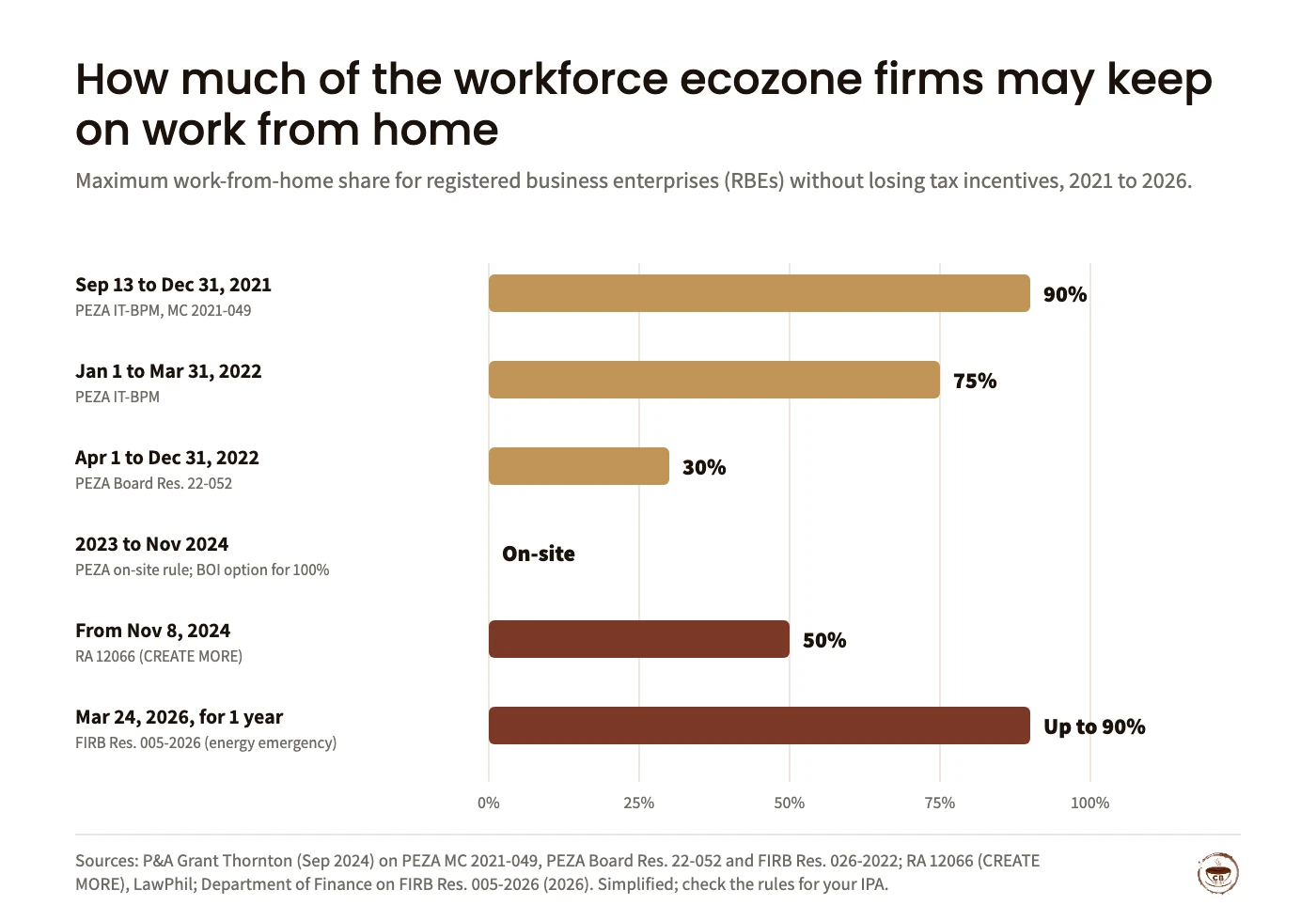
In 2026 the cap was raised temporarily. After Executive Order 110, s. 2026 declared a national energy emergency on March 24, 2026, the Fiscal Incentives Review Board issued Resolution No. 005-2026. The Department of Finance says “RBEs may adopt WFH arrangements for up to 90% of their total workforce,” that the investment promotion agency may set a lower threshold of not less than 50%, and that firms “shall not reduce its current number of employees.” The rule runs from March 24, 2026 for one year unless the executive order is extended or lifted. Going over the cap has a tax cost: the DOF summary describes a penalty based on regular income tax multiplied by the amount by which the threshold is exceeded.
DOLE also encouraged flexible work during the energy emergency. People Matters reported a DOLE advisory published on March 17, 2026, and quoted Assistant Secretary Lennard Constantine Serrano: “Any agreement must adhere to the Labor Code and general labor standards, ensuring that workers’ benefits are not diminished.”
How common is work from home in the Philippines?
The most recent official figures we found are from PSA’s Integrated Survey on Labor and Employment (ISLE) 2021/2022, released June 10, 2024, with a reference period of July 2021 to June 2022. It covers establishments with 20 or more workers.
| ISLE 2021/2022 finding | Figure |
|---|---|
| Establishments that adopted work from home | 9,822 (27.0%) |
| Highest industry: education (except public) | 63.0% |
| Lowest industry: accommodation and food service | 9.9% |
| Top challenge: no or intermittent internet connection | 60.1% |
| Establishments that would not continue WFH permanently | 63.5% |
The survey period overlaps pandemic restrictions, so current use may be lower or higher. We found no PSA count of individual telecommuting workers.
Is there a right to disconnect in the Philippines?
Not yet in law. The Telecommuting Act and the DOLE rules we read do not include one. House Bill 10790, the proposed Workers’ Right to Disconnect Act, was filed on August 13, 2026 by Rep. Patrick Michael “PM” D. Vargas. It would amend Article 84 of the Labor Code so that time spent reading and answering work messages after hours counts as hours worked, bar discipline for ignoring after-hours messages, and require employers to set after-hours communication policies. It is pending.
How to set up a work-from-home program in 7 steps
- Decide who is eligible. List the roles that can work remotely and any minimum tenure or performance rules.
- Write the program. Cover the items in the agreement table above, including hours, overtime approval, equipment, data rules and emergency protocols.
- Get written agreement. Have each employee sign or accept the terms and keep the records, since Section 7 asks for proof that the arrangement was voluntary.
- Provide equipment. Issue laptops, headsets or internet support and record what was issued and how it is returned.
- Track time. Use a log or system for start, break and end times so overtime and night shift hours are paid correctly.
- Report to DOLE. File the telecommuting report through the Establishment Report System.
- Review regularly. Schedule in-person meetings, check workloads against office staff and update the policy when rules change, such as the 2026 ecozone cap.
What does coffee cost for a remote team?
Coffee is not a legal requirement for remote staff, but many companies send it as a perk. Using our prices on November 16, 2026 and a planning figure of 2 cups of 10 g a day for 22 workdays (44 cups a month), the monthly cost per employee looks like this:
| Option | Price checked Nov 16, 2026 | Cost per 10 g cup | Per employee per month (44 cups) |
|---|---|---|---|
| Coffee drip bags, box of 10 | ₱240 | ₱24.00 | ₱1,056.00 |
| Arabica beans, 1 kg | ₱1,068 | ₱10.68 | ₱469.92 |
| Kapeng Barako beans, 1 kg | ₱858 | ₱8.58 | ₱377.52 |
| Robusta beans, 1 kg | ₱813 | ₱8.13 | ₱357.72 |
| Robusta wholesale, 10 kg box | ₱7,730 | ₱7.73 | ₱340.12 |
Drip bags need only hot water, which suits staff without a brewer. Bags of beans are cheaper per cup but need a grinder or a ground option (coarse, normal or fine). For office pantry planning, see our office pantry checklist and our guide to coffee breaks under the Labor Code.
Frequently asked questions
Is work from home mandatory under the Telecommuting Act?
No. Section 4 of RA 11165 says an employer “may offer” a telecommuting program on a voluntary basis, on terms both sides agree on. Under DO 237, s. 2022, either the employer or the employees can propose one, and the employer should keep proof that it was voluntarily agreed.
Who pays for the laptop and internet of a work-from-home employee?
Law firm summaries of DOLE Department Order 237, s. 2022 say facilities, equipment and supplies, including their purchase, maintenance, repair and return, are “ordinary and necessary costs of the business of the employer.” Write the details into the telecommuting agreement, and ask your accountant how any allowance is taxed.
Do work-from-home employees get overtime and holiday pay?
Yes. Section 5 of RA 11165 says telecommuting employees get the same treatment as comparable workers on the employer’s premises, including overtime, night shift differential, rest periods, regular holidays and special non-working days. DO 237 treats work at the alternative workplace as work at the regular workplace.
Do employers need to report a work-from-home program to DOLE?
Yes. The implementing rules require the employer to notify DOLE when it adopts a telecommuting arrangement. Under DO 237 this is done through DOLE’s Establishment Report System at reports.dole.gov.ph.
Can an employer call a work-from-home employee back to the office?
The rules allow either party to end or change the arrangement in line with the telecommuting policy or agreement, at no cost to the employee. Spell out the notice period and the process in the agreement.
Sources
- Republic Act No. 11165 (Telecommuting Act). LawPhil, approved December 20, 2018. Definitions, Sections 4 to 7, effectivity
- Telecommuting. Labor Law PH, updated April 20, 2025. DO 202-19 text on agreements, DOLE notice, data security
- DOLE issues revised implementing rules of the Telecommuting Act. SyCipLaw via Conventus Law, 2022. DO 237 alternative workplace, field personnel, equipment costs, ERS reporting
- DOLE revised IRR of the Telecommuting Act. ACCRALAW, October 26, 2022. DO 237 issued September 16, 2022
- Telecommuting law: legal obligations for HR. HRD Asia. “In whole or in part,” field personnel rule
- Work from everywhere covered by telecommute law. Philippine Daily Inquirer, September 30, 2022. Equipment as a business cost
- Republic Act No. 12066 (CREATE MORE Act). LawPhil, approved November 8, 2024. 50% work-from-home cap for RBEs
- FIRB allows temporary WFH for ecozone businesses amid national energy emergency. Department of Finance, 2026. FIRB Resolution No. 005-2026, up to 90% for one year
- CREATE-ing more through work from home. P&A Grant Thornton, September 2024. PEZA WFH caps 2021 to 2022, BOI 100% option
- Philippines officially allows flexible work schemes for private firms. People Matters, March 17, 2026. DOLE advisory, Serrano quote
- Highlights of the 2021/2022 ISLE Part VII. Philippine Statistics Authority, Ref. No. 2024-173, released June 10, 2024. WFH adoption figures
- House Bill No. 10790 (Workers’ Right to Disconnect Act). House of Representatives, 20th Congress, filed August 13, 2026
- Philippines increases tax-free limits for employee benefits. activpayroll. RR 29-2025 de minimis ceilings, effective January 6, 2026
This article is general information about Philippine labor rules as of November 16, 2026, not legal or tax advice. Rules for ecozone firms in particular may change; check the latest DOLE, FIRB and PEZA issuances.
Cite this article: Caffeine Brothers. “Telecommuting Act (RA 11165): Work From Home Rules for Employers.” Caffeine Brothers Coffee Blog, November 2026. https://caffeinebrothers.co/telecommuting-act/
You are welcome to reference the charts and tables in this article with a link back to this page.
Sending coffee to a remote or hybrid team? Our coffee drip bags need only hot water, and wholesale 10 kg boxes come with free delivery in Metro Manila. Contact us for a quote.
 Previous Post