3-in-1 Coffee vs Brewed Coffee: Cost and Sugar per Cup
By Robin Salvador, co-founder, Caffeine Brothers
Last updated: October 17, 2026
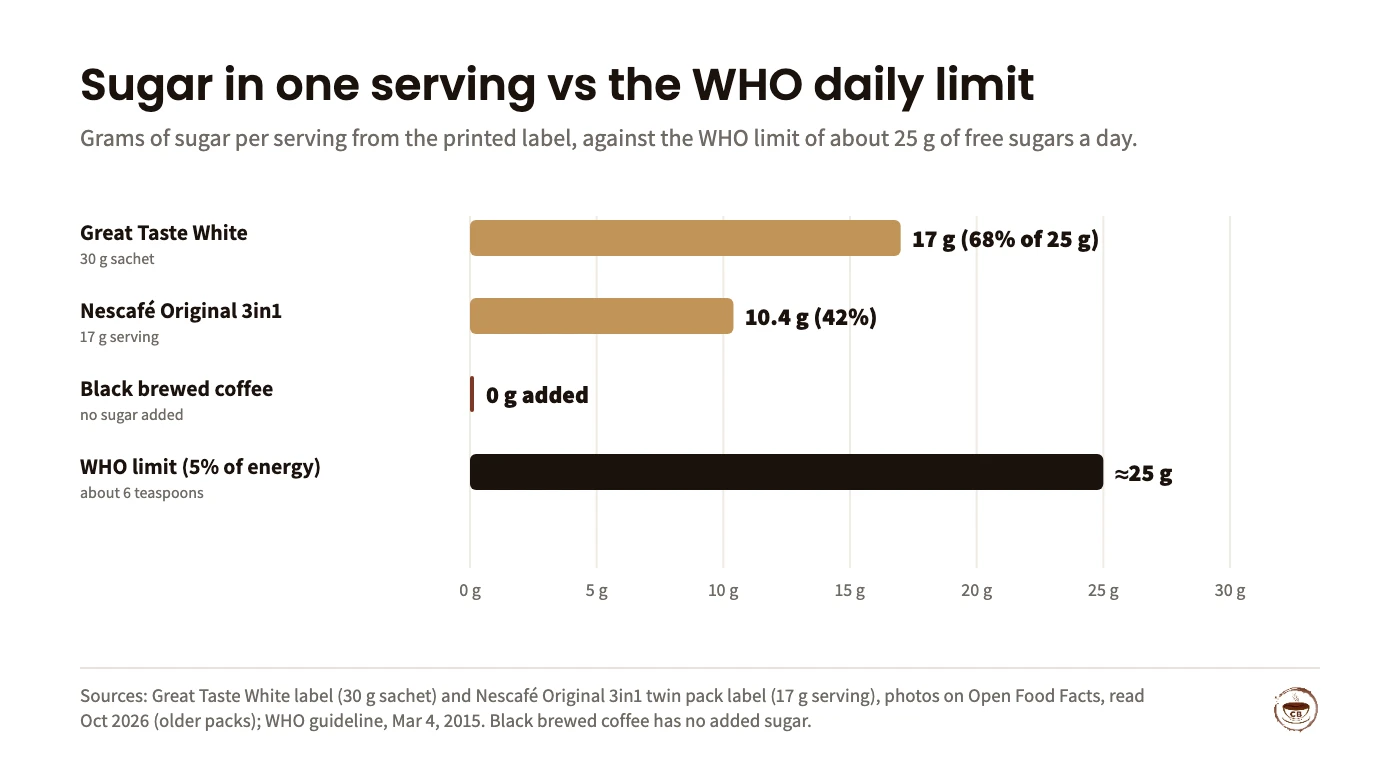
Quick answer: A 3-in-1 coffee sachet costs ₱4.70 to ₱10.00 at the DTI suggested retail prices effective May 11, 2026. A black cup brewed with 10 g of our beans costs ₱8.13 to ₱14.60 at October 17, 2026 shop prices, so the price gap per cup is small. The bigger difference is sugar. The two sachet labels we read list 10.4 g and 17 g of sugar per serving, which is 42% to 68% of the 25 g daily target in the WHO sugar guideline. Black brewed coffee has none added.
Key takeaways
- DTI’s SRP bulletin effective May 11, 2026 lists six 3-in-1 items, from Café Puro 17 g at ₱4.70 to Great Taste Original Twin Pack 33 g at ₱10.00. San Mig Coffee 3-in-1 Original 20 g rose from ₱7.00 to ₱7.50 in that bulletin.
- At 10 g of coffee per cup, Caffeine Brothers beans cost ₱8.13 a cup (Robusta, 1 kg bag) to ₱14.60 a cup (Arabica, 200 g bag) on October 17, 2026.
- A Great Taste White label lists 17 g of sugars in a 30 g sachet. An older Nescafé Original 3in1 label lists 10.4 g in a 17 g serving, and sugar is the first ingredient on Nescafé’s Philippine product page.
- 3-in-1 coffee is exempt from the TRAIN law tax on sweetened beverages. House bills heard in September 2026 propose taxing it.
- USDA counts 5.5 million 60 kg bags of soluble coffee imports into the Philippines in 2025/26, about 90% of all coffee imports.
How much does a 3-in-1 sachet cost in 2026?
The Department of Trade and Industry (DTI) publishes suggested retail prices (SRP) for basic necessities and prime commodities, and coffee is on the list. The bulletin effective May 11, 2026 is the one linked on DTI’s SRP page in October 2026. It covers six items under “Coffee 3-in-1 Original.” The bulletin before it, effective February 2 to May 10, 2026, had the same items and prices except San Mig Coffee.
| Product | Size | SRP, Feb 2, 2026 | SRP, May 11, 2026 | Price per gram of sachet |
|---|---|---|---|---|
| Café Puro | 17 g | ₱4.70 | ₱4.70 | ₱0.28 |
| Blend 45 3-in-1 Original | 18 g | ₱5.50 | ₱5.50 | ₱0.31 |
| San Mig Coffee 3-in-1 Original | 20 g | ₱7.00 | ₱7.50 | ₱0.38 |
| Nescafé Original | 20 g | ₱7.75 | ₱7.75 | ₱0.39 |
| Kopiko Black | 30 g | ₱8.50 | ₱8.50 | ₱0.28 |
| Great Taste Original Twin Pack | 33 g | ₱10.00 | ₱10.00 | ₱0.30 |
An SRP is the price DTI suggests. Shelf prices in supermarkets and sari-sari stores can be different, and DTI asked for a price freeze on basic necessities, coffee included, until May 10, 2026, according to an April 17, 2026 notice relayed by ASEAN Consumer.
Price per gram tells you less than it seems. A sachet is mostly sugar and creamer: Nescafé’s Philippine page for Nescafé Original lists the ingredients as “Sugar, Coffee creamer” first, then the coffee. None of the labels we read says how many grams of coffee are inside, so you cannot compare coffee content directly.
Freshly roasted Philippine coffee
Shop our coffee beans: Arabica, Robusta, Kapeng Barako and signature blends, roasted daily in Manila, whole bean or ground. Not sure which? Take the Coffee Match Quiz.
Shop Coffee Beans →How much does a cup of brewed coffee cost?
We priced a black cup at 10 g of ground coffee, which is the amount in each of our drip bags. The formula is the bag price divided by its grams, times 10. Prices are from our shop on October 17, 2026. Grinding is free, so ground and whole bean cost the same.
| Coffee | 200 g bag | Per 10 g cup | 1 kg bag | Per 10 g cup |
|---|---|---|---|---|
| Robusta (Batangas, dark roast) | ₱231 | ₱11.55 | ₱813 | ₱8.13 |
| Kapeng Barako (100% Liberica) | ₱242 | ₱12.10 | ₱858 | ₱8.58 |
| CB’s Finest Signature Blend | ₱244 | ₱12.20 | ₱866 | ₱8.66 |
| Arabica-Robusta Blend | ₱274 | ₱13.70 | ₱991 | ₱9.91 |
| Arabica (Benguet, medium roast) | ₱292 | ₱14.60 | ₱1,068 | ₱10.68 |
| Drip bags, box of 10 | ₱240 per box | ₱24.00 per bag | n/a | n/a |
A 1 kg bag makes 100 cups at this dose. For an office pantry, the per-cup maths changes again with 10 kg wholesale boxes; our office coffee cost per cup guide works through that.
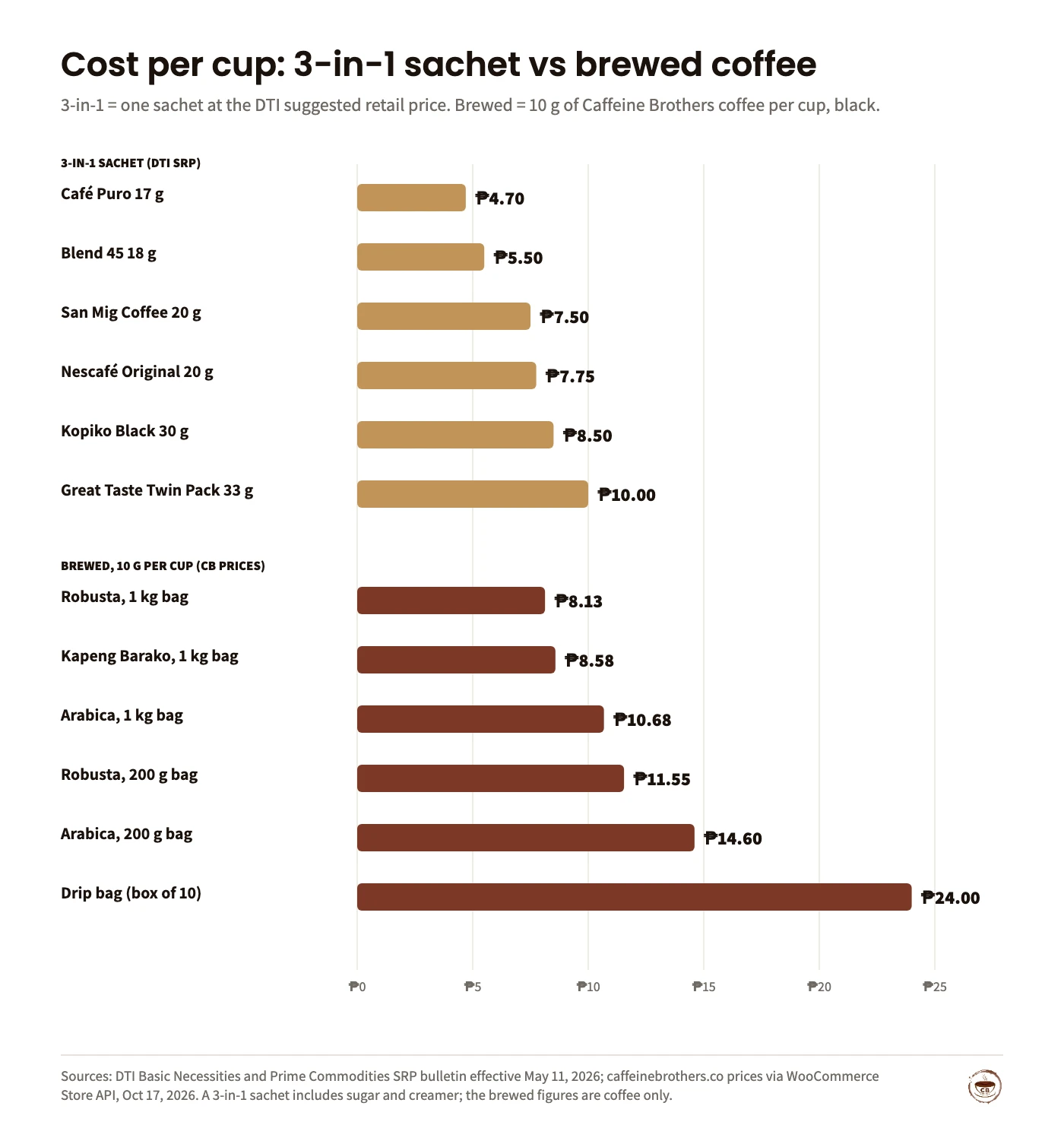
Put side by side, the cheapest brewed cup (₱8.13 from a 1 kg bag of Robusta) costs about the same as a Kopiko Black sachet (₱8.50) and less than a Great Taste Original Twin Pack (₱10.00). Café Puro and Blend 45 are still cheaper per sachet. Brewing from a 200 g bag costs ₱1.55 to ₱9.90 more per cup than the sachets in the DTI list. Drip bags cost the most because each one is packed and sealed separately. They are the closest brewed option to the tear-and-pour habit of a sachet.
How much sugar is in a 3-in-1 sachet?
The Philippine product pages on nescafe.com that we checked list ingredients but no nutrition panel. So we read the printed labels from package photos on Open Food Facts, a public product database. Both labels cite RENI 2002 values, which suggests older packaging.
| Product | Serving on label | Sugar | Energy | Share of 25 g WHO target |
|---|---|---|---|---|
| Great Taste White Coffee Mix | 1 sachet, 30 g | 17 g | 140 kcal | 68% |
| Nescafé Original 3in1 (twin pack) | 17 g | 10.4 g | 72 kcal | 42% |
| Black brewed coffee | 1 cup | 0 g added | not labelled | 0% |
The Nescafé label is for a 17 g serving, while DTI’s current list has a 20 g Nescafé Original sachet, so the sugar in today’s sachet may be different. We could not verify a label for Kopiko Brown, so it is left out.
In its March 4, 2015 guideline, the World Health Organization recommends keeping free sugars below 10% of total energy intake. It adds a conditional recommendation to go below 5%, which it describes as roughly 25 grams, or 6 teaspoons, a day for adults. That works out to about 4 g per teaspoon. On those numbers, one Great Taste White sachet holds about 4 teaspoons of sugar and one Nescafé Original 3in1 serving about 2.5. Two Great Taste White sachets a day add up to 34 g, which is over the 25 g target before any other food.
The creamer adds fat as well. The Great Taste White label lists 5 g of total fat, all of it saturated, which the label marks as 25% of the daily value.
Does 3-in-1 have less caffeine than brewed coffee?
The Philippine brand pages we read do not state caffeine per sachet. General reference figures exist. Mayo Clinic’s caffeine page (February 6, 2025) lists about 96 mg in an 8 oz (237 ml) cup of brewed coffee and about 62 mg in the same size cup of instant. USDA FoodData Central lists instant coffee powder at 3,142 mg of caffeine per 100 g, which is about 31 mg per gram of powder. A 3-in-1 sachet contains far less than 20 g of coffee powder, since most of its weight is sugar and creamer.
With brewed coffee you control the dose. Robusta beans generally carry more caffeine than Arabica; our Robusta vs Arabica caffeine article has the figures. EFSA considers up to 400 mg of caffeine a day, and single doses up to 200 mg, safe for healthy adults, and 200 mg a day for pregnant women.
Is 3-in-1 coffee taxed like soft drinks?
Not under current law. Section 150-B of the TRAIN law (Republic Act No. 10963, 2017) taxes sweetened beverages at ₱6 per liter, or ₱12 per liter for drinks sweetened only with high fructose corn syrup. The same section excludes “ground coffee, instant soluble coffee, and pre-packaged powdered coffee products,” which is where 3-in-1 sachets fall.
That could change. House Bill 5005, reported by GMA News on September 30, 2025, proposed raising the rates to ₱20 and ₱40 per liter and covering “all sweetened coffee products, including the three-in-one coffee.” At a House hearing reported on September 14, 2026, lawmakers discussed rates of ₱9 to ₱20 per liter, and a Department of Finance undersecretary said the department was open to removing the coffee exemption. Interaksyon reported on September 16, 2026 that a ₱6 tax on 3-in-1 coffee was still being reviewed by the committee. None of these had become law in the reports we read.
How much of the coffee Filipinos drink is instant?
No source we found gives the share of Filipinos who drink 3-in-1. Trade data gives a strong hint. In its July 2026 Coffee: World Markets and Trade report, the USDA Foreign Agricultural Service lists the Philippines as the largest importer of soluble (instant) coffee among the countries it tracks.
| Marketing year | Consumption | Total imports | Soluble imports | Production |
|---|---|---|---|---|
| 2021/22 | 7,190 | 6,540 | 5,700 | 450 |
| 2023/24 | 6,590 | 5,940 | 5,000 | 450 |
| 2024/25 | 6,190 | 5,740 | 5,000 | 450 |
| 2025/26 | 6,525 | 6,075 | 5,500 | 450 |
| 2026/27 forecast | 6,725 | 6,250 | 5,500 | 475 |
In 2025/26, soluble coffee made up 5,500 of the 6,075 thousand bags imported, about 90%. Local production was 450 thousand bags. Most of that instant coffee ends up in jars, refills and sachets.
How to switch from 3-in-1 to brewed coffee without spending much more
- Buy a bigger bag. Going from a 200 g bag to a 1 kg bag of Robusta cuts the cost per 10 g cup from ₱11.55 to ₱8.13.
- Weigh 10 g per cup at first. A cheap kitchen scale keeps each cup consistent so you can judge the taste and the cost.
- Use the brewer you already have. A French press, a drip machine or a plain cone filter all work. Our brewing methods compared guide lists ratios and times for each.
- Lower the sugar in steps. If you are used to sachet sweetness, start with one teaspoon (about 4 g) and use less each week.
- Add milk if you miss the creaminess. Fresh or evaporated milk gives body without the creamer’s hydrogenated oil.
- Keep the beans sealed. Store the bag closed, away from heat and light; see how long coffee beans stay fresh in the Philippines.
Frequently asked questions
Is 3-in-1 coffee cheaper than brewed coffee?
At the DTI suggested retail prices effective May 11, 2026, a 3-in-1 sachet costs ₱4.70 to ₱10.00. A black cup made with 10 g of Caffeine Brothers coffee costs ₱8.13 to ₱14.60 at October 17, 2026 prices. The cheapest sachets are cheaper, but brewed coffee from a 1 kg bag costs about the same as the pricier sachets.
How much sugar is in a 3-in-1 coffee sachet?
The labels we read list 17 g of sugars in a 30 g Great Taste White sachet and 10.4 g in a 17 g serving of Nescafé Original 3in1. That is 42% to 68% of the roughly 25 g a day that WHO suggests as a further reduction target. Pack sizes change, so check the label on the sachet you buy.
Does 3-in-1 coffee have less caffeine than brewed coffee?
Philippine brand pages do not list caffeine per sachet. Mayo Clinic lists about 62 mg for an 8 oz cup of instant coffee and about 96 mg for brewed coffee. The real amount depends on how much coffee is in the sachet or how many grams of beans you brew.
Is 3-in-1 coffee covered by the sugar tax?
Not at present. The TRAIN law (RA 10963) excludes ground coffee, instant soluble coffee and pre-packaged powdered coffee products from the sweetened beverage tax. Bills heard in the House in September 2026 propose removing that exemption, but none had become law in the reports we read as of October 17, 2026.
Sources
- Basic Necessities and Prime Commodities SRP bulletin, effective May 11, 2026. DTI. Used for the 3-in-1 SRPs.
- Basic Necessities and Prime Commodities SRP bulletin, effective February 2 to May 10, 2026. DTI. Used for the earlier San Mig Coffee price.
- DTI: no price increase for BNPCs until May 10. ASEAN Consumer, April 17, 2026. Used for the price freeze.
- Caffeine Brothers shop. Prices read from the WooCommerce Store API on October 17, 2026. Used for brewed cost per cup.
- Great Taste White Coffee Mix. Open Food Facts, label photo, entry modified September 17, 2026. Used for sugar, energy and fat.
- Nescafé Original 3in1 Twin Pack. Open Food Facts, label photo, entry modified January 2, 2026. Used for sugar and energy.
- NESCAFÉ Original. Nestlé Philippines, read October 17, 2026. Used for the ingredient order.
- WHO calls on countries to reduce sugars intake among adults and children. World Health Organization, March 4, 2015. Used for the 10% and 25 g targets.
- Republic Act No. 10963 (TRAIN law). LawPhil, 2017. Used for Section 150-B rates and the coffee exclusion.
- Bill imposing increased taxes on sweetened beverages, 3-in-1 coffee eyed. GMA News, September 30, 2025. Used for House Bill 5005.
- Higher excise tax on sweetened beverages urged. GMA News, September 14, 2026. Used for the House hearing and DOF position.
- Proposed taxes on 3-in-1 coffee, ice cream. Interaksyon, September 16, 2026. Used for the status of the proposal.
- Caffeine content for coffee, tea, soda and more. Mayo Clinic, February 6, 2025. Used for brewed and instant caffeine per cup.
- Beverages, coffee, instant, regular, powder (FDC 171893). USDA FoodData Central, SR Legacy, April 2019. Used for caffeine per 100 g of instant powder.
- Caffeine. European Food Safety Authority, opinion of May 2015. Used for the 400 mg and 200 mg figures.
- Coffee: World Markets and Trade. USDA Foreign Agricultural Service, July 2026. Used for Philippine consumption, imports and production.
Cite this article: Caffeine Brothers. “3-in-1 Coffee vs Brewed Coffee: Cost and Sugar per Cup.” Caffeine Brothers Coffee Blog, October 2026. https://caffeinebrothers.co/3-in-1-coffee-vs-brewed-coffee/
You are welcome to reference the charts and frameworks in this article with a link back to this page.
Want brewed coffee with no equipment? Our coffee drip bags hold 10 g each and need only hot water and a mug. For bigger bags, browse the shop, work out your own cost per cup with the Coffee Lab calculators, or message us with questions.
 Previous Post
 Next Post