
Kape Alamid: Civet Coffee in the Philippines, Explained
By Robin Salvador, co-founder, Caffeine Brothers
Last updated: October 17, 2026
Quick answer: Kape alamid is coffee made from beans that a palm civet ate and passed. Gatherers collect the droppings, wash and dry the beans, then roast them. In the Philippines it is gathered in Batangas, South Cotabato, Cotabato, Kalinga and Sulu, among other places. On October 17, 2026 one Manila retailer sold it at ₱1,099 per 100 g, about 7.5 times the ₱146 per 100 g of our Benguet Arabica in a 200 g bag. Studies show the civet’s gut changes the bean’s proteins, but no test can prove whether a bag came from wild or caged civets. Caffeine Brothers does not sell civet coffee.
Key takeaways
- Local names differ by region: alamid in Tagalog areas, musang in several regions, motit in the Cordillera and balos among the B’laan of Mt. Matutum.
- Marcone’s 2004 study found less protein in civet beans than in controls, for example 13.5% vs 14.5% in Indonesian kopi luwak, plus signs that storage proteins had been broken down.
- A 2016 study of 16 Bali plantations found all 48 caged civets had compromised welfare. In 2011, Vie Reyes of Bote Central estimated that 80% of Philippine civet coffee came from caged animals.
- Under RA 9147, commercial breeding of wildlife needs a wildlife farm permit. DENR Region V lists the common palm civet as “other wildlife species,” not threatened but still protected.
- ECHOstore listed civet coffee at ₱1,099 per 100 g and ₱125 per 10 g drip bag on October 17, 2026, compared with ₱24 for one of our 10 g drip bags.
What is kape alamid?
Palm civets are wild mammals that eat ripe coffee cherries. The fruit is digested, and the hard beans pass through. Farmers and gatherers then “collect, clean, dry, roast” them, as an Inquirer report from Cotabato put it in September 2024. The beans are sold as civet coffee, kape alamid, or under the Indonesian name kopi luwak.
The animal’s scientific name depends on the source. DOST material uses Paradoxurus hermaphroditus, the Asian palm civet. Mongabay’s 2023 report from South Cotabato calls it the Philippine palm civet, Paradoxurus philippinensis, and the Mammal Diversity Database lists that species as split from P. hermaphroditus after a 2015 study by Veron and colleagues. Either way, it is a palm civet of the genus Paradoxurus.
| Local name | Where it is used | Source |
|---|---|---|
| Alamid (kape alamid) | Tagalog areas such as Batangas | GMA News, Nov 27, 2013; Manila Times |
| Musang (kape musang) | Several regions; “kape musang” in Mindanao | GMA News, 2013; Manila Times |
| Motit (kape motit) | Cordillera | Manila Times (undated) |
| Balos | B’laan communities of Mt. Matutum, South Cotabato; Cotabato | Mongabay, Apr 2023; DOST-STII |
| Milo | Indigenous peoples in Makilala, Cotabato | Inquirer, Sep 20, 2024 |
Where is civet coffee produced in the Philippines?
There is no official national figure for civet coffee output. What exists are reports from individual areas, and most volumes are self-reported by the producers.
| Area | What the reports say | Source and date |
|---|---|---|
| Batangas (Lipa, Mt. Malarayat) | A gatherer couple collected up to 8 kg a day at the March to May peak | AFP via Inquirer, Oct 30, 2011 |
| South Cotabato (Mt. Matutum, Polomolok) | B’laan communities gather droppings of wild civets and fine members who cage civets | Mongabay, Apr 2023; Inquirer, Aug 4, 2012 |
| Cotabato (Makilala) | About 200 ha of arabica host civets; on one 22 ha farm, droppings fell from at least 10 kg a day to 5 kg as at least 20 civets were killed by hunters | Inquirer, Sep 20, 2024 |
| Kalinga (Tabuk) | Gawidan Farmers Association, 42 farmers, gathering civet coffee | Philippine Coffee Board, Mar 21, 2017 |
| Sulu (Panamao) | A cooperative reported 460 kg of roasted civet beans in 2012 and 1,260 kg in total since 2008 | Inquirer, Jun 1, 2013 |
| Davao City | Mt. Apo Civet Coffee said it kept civets in cages | GMA News, Nov 27, 2013 |
Our guides to Philippine coffee origins and Benguet coffee cover regular coffee from these and other regions.
How much does kape alamid cost?
Civet coffee prices vary widely, and many older figures are still quoted online. The table puts them in date order. Only the October 2026 row reflects prices today.
| Date | Price reported | Source |
|---|---|---|
| Oct 2011 | Gatherers sold beans for as low as ₱1,200 per kg, about five times ordinary beans; ₱295 a cup in a Manila café | AFP via Inquirer, Oct 30, 2011 |
| Aug 2012 | ₱1,000 per kg at farmgate; regular beans fetched about 10% of that | Inquirer, Aug 4, 2012 |
| Nov 2013 | Retail up to ₱25,000 per kg for one brand; ₱13,000 per kg for some local brands | GMA News, Nov 27, 2013 |
| Apr 2023 | Dried beans about US$16 per kg; roasted Kafe Balos US$89 per kg | Mongabay, Apr 2023 |
| Oct 17, 2026 | ₱1,099 per 100 g (pure), ₱715 per 100 g (blend), ₱125 per 10 g drip bag | ECHOstore product pages |
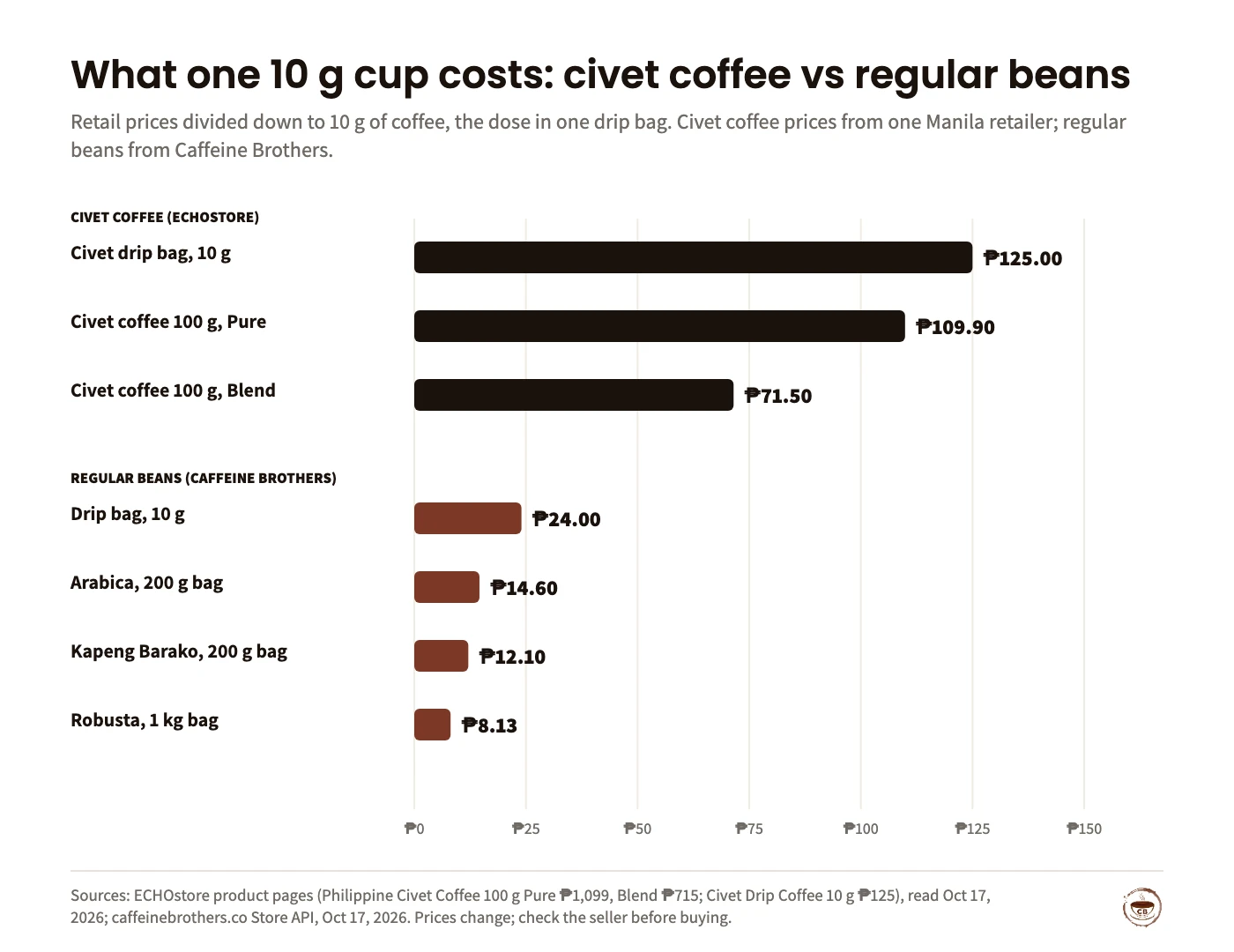
At 10 g per cup, the pure civet coffee works out to ₱109.90 a cup and the single drip bag to ₱125. Our Benguet Arabica costs ₱14.60 a cup from a 200 g bag (₱292), and our Robusta costs ₱8.13 a cup from a 1 kg bag (₱813). The “blend” version is cheaper because part of it is regular coffee. If a civet coffee is priced close to ordinary beans, ask what share of it is civet coffee.
Does the civet really change the coffee?
A few lab studies have looked at this. They agree that the beans change in the civet’s gut. They do not agree on how much the cup changes.
- Massimo Marcone’s 2004 study in Food Research International compared Indonesian kopi luwak and Ethiopian civet coffee with regular beans. Protein was lower in every civet sample: 13.5% vs 14.5% for kopi luwak and 12.1% vs 13.2% and 11.4% vs 12.7% for two Ethiopian samples. Gel tests showed storage proteins had been broken down, and the bean surfaces had small pits. No Philippine samples were included.
- At De La Salle University, Chan and Garcia (2011) compared civet and regular Robusta from Tagaytay. Civet beans had about 28% less alpha-tocopherol (vitamin E) in the oil and about 4.5% more caffeine before roasting, with the same surface pitting.
- A 2016 DLSU doctoral thesis by E.V. Garcia on Philippine civet coffee found 96 volatile compounds and concluded that roasting changed the metabolite profile more than passage through the civet did.
- Jumhawan and colleagues (2013) used 21 bean samples to propose chemical markers for spotting fake kopi luwak, noting “a serious issue about adulteration and fakes in the market.”
- A 2025 study in Scientific Reports of 68 scat samples from wild civets on Indian Robusta estates found higher total fat in the civet beans. News coverage said protein and caffeine were lower, but the paper’s abstract reports no difference, so treat those two claims with care.
Marcone’s cupping panel found lower body and acidity in the civet samples. Taste is personal, and none of these studies tested Philippine kape alamid against a well-roasted regular Philippine coffee in a blind cupping.
Wild or caged: why it matters
Some producers keep civets in cages and feed them coffee cherries. In a study published in Animal Welfare in 2016, Carder and colleagues made unannounced visits to 16 plantations in Bali in May 2013 and assessed 48 wild-caught caged civets. Mean scores on a 0 to 4 scale were 0.25 for water, 0.38 for social interaction and 0.75 for food, and the authors wrote that “all of the civets were experiencing compromised welfare.” Fourteen of the 16 plantations made caged civet coffee on site.
The Philippines has its own reports. GMA News reported in 2013 that Mt. Apo Civet Coffee in Davao kept civets in cages and that PETA had released video from a Davao farm. In 2011, Vie Reyes of Bote Central, which said it produced about three tons a year, told AFP she estimated that 80% of Philippine civet coffee came from caged animals. In South Cotabato, B’laan communities on Mt. Matutum fine members who cage civets, Mongabay reported in 2023.
The hard part is checking. World Animal Protection calls wild-sourced civet coffee “the only humane option,” and UTZ Certified stopped certifying producers that cage civets in 2014. But National Geographic reported in 2016 that there was no way to tell whether a bag came from wild or caged civets, and the Philippine Coffee Board told GMA News in 2013 that it “is not a policing body.” Chemical tests such as Jumhawan’s can help show whether beans passed through a civet. They cannot show how the civet lived.
Is civet coffee legal in the Philippines?
The Wildlife Resources Conservation and Protection Act (RA 9147, 2001) covers wild animals, including those “in captivity or are being bred.” Section 17 requires a wildlife farm or culture permit for commercial breeding, and only the progeny may be traded. Section 27 makes it illegal to collect, hunt, possess, trade, maltreat or transport wildlife unless otherwise allowed. DENR Region V described the common palm civet in February 2021 as “other wildlife species” under DAO 2019-09, meaning it is not on the threatened list but is still protected.
Penalties in the 2001 text for other wildlife species are lower than some reports suggest: 10 days to 1 month and ₱1,000 to ₱5,000 for collecting or possessing, and 1 to 6 months and/or ₱5,000 to ₱20,000 for killing. The Inquirer’s 2024 report quoted a local officer citing one month to eight years and fines up to ₱5 million, which in the law applies to other offenses. We read the 2001 text only. The law does not mention gathering droppings, so anyone planning to sell civet coffee should ask DENR first. This is not legal advice.
How to buy civet coffee more carefully
- Ask where it was gathered. A seller who sources from wild civets should be able to name the town or community.
- Ask about cages directly. Ask whether any civets are kept or fed on the farm. A vague answer is a warning sign.
- Be careful with “100% wild” labels. No certification or lab test can prove it today.
- Check whether it is pure or blended. The same retailer sold a 100 g pure pack at ₱1,099 and a blend at ₱715 on October 17, 2026.
- Compare it with good regular coffee. Try a fresh Philippine coffee first, such as Sagada coffee or kapeng barako, so you know what you are paying extra for.
Frequently asked questions
What is kape alamid?
Kape alamid is coffee made from beans that a palm civet ate and passed. Gatherers collect the droppings, then clean, dry and roast the beans. Alamid is the Tagalog name; the same coffee is called musang, motit or balos in other regions.
Is kape alamid the same as kopi luwak?
It is made the same way. Kopi luwak is the Indonesian name, and much of the published research, including Marcone’s 2004 study and the 2016 Bali welfare study, looked at Indonesian civet coffee. Philippine civet coffee has been studied separately at De La Salle University.
How much does civet coffee cost in the Philippines?
On October 17, 2026, ECHOstore listed Philippine civet coffee at ₱1,099 per 100 g for its pure version, ₱715 for a blend and ₱125 for a single 10 g drip bag. GMA News reported retail prices of up to ₱25,000 per kg in 2013. Prices vary a lot by seller and by how much regular coffee is blended in.
Does Caffeine Brothers sell civet coffee?
No. We roast Philippine Arabica from Benguet, Robusta from Batangas, Kapeng Barako (100% Liberica) and our blends, roasted daily and delivered nationwide. We do not sell civet coffee.
Sources
- Civet hunting threatens specialty coffee in Cotabato. Inquirer Mindanao, September 20, 2024. Used for the process, Makilala areas, farm volumes and penalty quote.
- Civet coffee controversy: caged cats or the wild and the free?. GMA News, November 27, 2013. Used for names, Davao caged civets, prices and the Coffee Board quote.
- How animal dung coffee is making big money. Manila Times, undated. Used for regional names.
- Philippine tribe boosts livelihoods and conservation with civet poop coffee. Mongabay, April 2023. Used for balos, B’laan rules and prices.
- Science chief eyes copying civet coffee production process. DOST-STII, undated. Used for the name balos and species name.
- Paradoxurus philippinensis. Mammal Diversity Database, read October 17, 2026. Used for the species split.
- Civets, tribal folk find harmony. Inquirer, August 4, 2012. Used for Mt. Matutum and 2012 farmgate price.
- Civet coffee brings hope to the Cordilleras. Philippine Coffee Board, March 21, 2017. Used for Kalinga.
- Sulu civet coffee cooperative report. Inquirer, June 1, 2013. Used for Sulu volumes.
- Civet coffee gatherers in Batangas (AFP). Inquirer/AFP, October 30, 2011. Used for Lipa volumes, 2011 prices and the 80% caged estimate.
- Philippine Civet Coffee 100g. ECHOstore, read October 17, 2026. Used for current prices, with the store’s civet drip coffee pages.
- Composition and properties of Indonesian palm civet coffee (Kopi Luwak) and Ethiopian civet coffee. Marcone, Food Research International 37, 2004. Used for protein and structure.
- Comparative Physicochemical Analyses of Regular and Civet Coffee. Chan and Garcia, Manila Journal of Science 7(1), 2011. Used for Philippine civet coffee chemistry.
- A multi-omics approach to finding potential biomarkers in Philippine civet coffee. E.V. Garcia, De La Salle University, 2016. Used for volatiles and roasting effect.
- GC-MS authentication method developed for world’s most expensive coffee beans. LCGC, September 19, 2013, on Jumhawan et al. 2013. Used for authentication markers.
- Civet coffee study, Kodagu, India. Scientific Reports, October 23, 2025. Used for fat findings and the reporting conflict.
- A preliminary assessment of welfare of civets on Bali coffee plantations. Carder et al., Animal Welfare 25, 2016. Used for welfare scores.
- Kopi luwak and captive civets. National Geographic, April 29, 2016. Used for the verification problem.
- Civet coffee. World Animal Protection, undated. Used for the wild-sourced position.
- Caged civet coffee banned by UTZ Certified. World Animal Protection, June 4, 2014.
- Republic Act No. 9147. Wildlife Resources Conservation and Protection Act, 2001. Used for permits and penalties.
- Common palm civet turned over in Sorsogon. DENR Region V, February 2021. Used for the civet’s status.
Cite this article: Caffeine Brothers. “Kape Alamid: Civet Coffee in the Philippines, Explained.” Caffeine Brothers Coffee Blog, October 2026. https://caffeinebrothers.co/kape-alamid/
You are welcome to reference the charts and frameworks in this article with a link back to this page.
Looking for Philippine coffee you can drink every day? Our Benguet Arabica, Batangas Robusta and Kapeng Barako are roasted daily and delivered nationwide. Browse the shop or message us if you need help choosing.
 Previous Post