Private Label Coffee in the Philippines: FDA, Labels and Costs
By Robin Salvador, co-founder, Caffeine Brothers
Last updated: October 28, 2026
Quick answer: Private label coffee is coffee roasted and packed by one company and sold under another company’s brand. In the Philippines, the brand owner counts as a food “trader” under FDA rules. It needs an FDA License to Operate (₱1,000 to ₱30,000 plus 1%, based on declared capital), a Certificate of Product Registration for each coffee (₱200 or ₱250 per year of validity plus 1%), a label that meets DOH Administrative Order 2014-0030, and a roaster with an FDA license that covers the product. A trademark with IPOPHL is optional but protects the brand.
Key takeaways
- DOH AO 2014-0029 defines a trader as the registered owner of a food product who subcontracts manufacture to a licensed manufacturer. That is the private label model.
- FDA’s food trader LTO fee runs from ₱1,000 (declared capital of ₱250,000 or less) to ₱30,000 (₱50 million and up), plus a 1% legal research fee, with 14 working days listed for processing.
- Roasted coffee beans and grounds are low-risk food. The CPR fee is ₱200 or ₱250 per year of validity plus 1%, and an initial CPR is valid for 2 to 5 years.
- AO 2014-0030 lists 11 mandatory label items. A brand that did not roast the coffee must say “Manufactured for” or “Packed for.” Plain coffee is named as an example of food that can skip the nutrition facts panel.
- IPOPHL’s listed fees for one trademark class come to ₱3,570 for a small entity and ₱5,712 for a big entity, before any agent fees.
What is private label coffee?
Private label (also called white label) means you sell a product under your brand while another company makes it. For coffee, the roaster sources and roasts the beans, grinds them if needed, and packs them in your bag with your label. You handle the brand, the sales and the customer.
It suits cafés that want retail bags on the counter, hotels and restaurants that want house coffee, corporate gift buyers, online sellers and resellers. The alternative is roasting yourself, which means a roaster, a food manufacturer license and a lot more work.
Freshly roasted Philippine coffee
Shop our coffee beans: Arabica, Robusta, Kapeng Barako and signature blends, roasted daily in Manila, whole bean or ground. Not sure which? Take the Coffee Match Quiz.
Shop Coffee Beans →Who is responsible for what under FDA rules?
Philippine food regulation has a word for the private label brand owner: trader. DOH Administrative Order 2014-0029 defines a trader as an establishment that is a “registered owner of food and food products” and that “subcontracts the manufacture of such product to a licensed manufacturer.” The same order defines a toll manufacturer as one that does contract manufacturing under defined, agreed and controlled conditions.
| Role | Who it is in a private label deal | What FDA expects |
|---|---|---|
| Trader | Your brand | Its own License to Operate as a food trader. A notarized toll manufacturing or repacking agreement with an FDA-licensed toll manufacturer or repacker (AO 2014-0029 Annex). Holds the product registrations as market authorization holder (FDA Circular 2026-0002). |
| Toll manufacturer | The roaster | A License to Operate as food manufacturer, repacker or toll manufacturer that lists the product line. FDA Circular 2026-0002 says a CPR application is denied if the product line is not yet on that license. |
| Distributor or wholesaler | Anyone who resells your packed bags in bulk | A separate distributor LTO (₱8,000 plus 1% for importers, exporters and wholesalers in FDA’s fee list). |
In plain terms, the label carries your name, so FDA treats the product as yours. Before you sign with any roaster, ask for a copy of its FDA License to Operate and check that it covers roasted coffee.
How much does the FDA License to Operate cost?
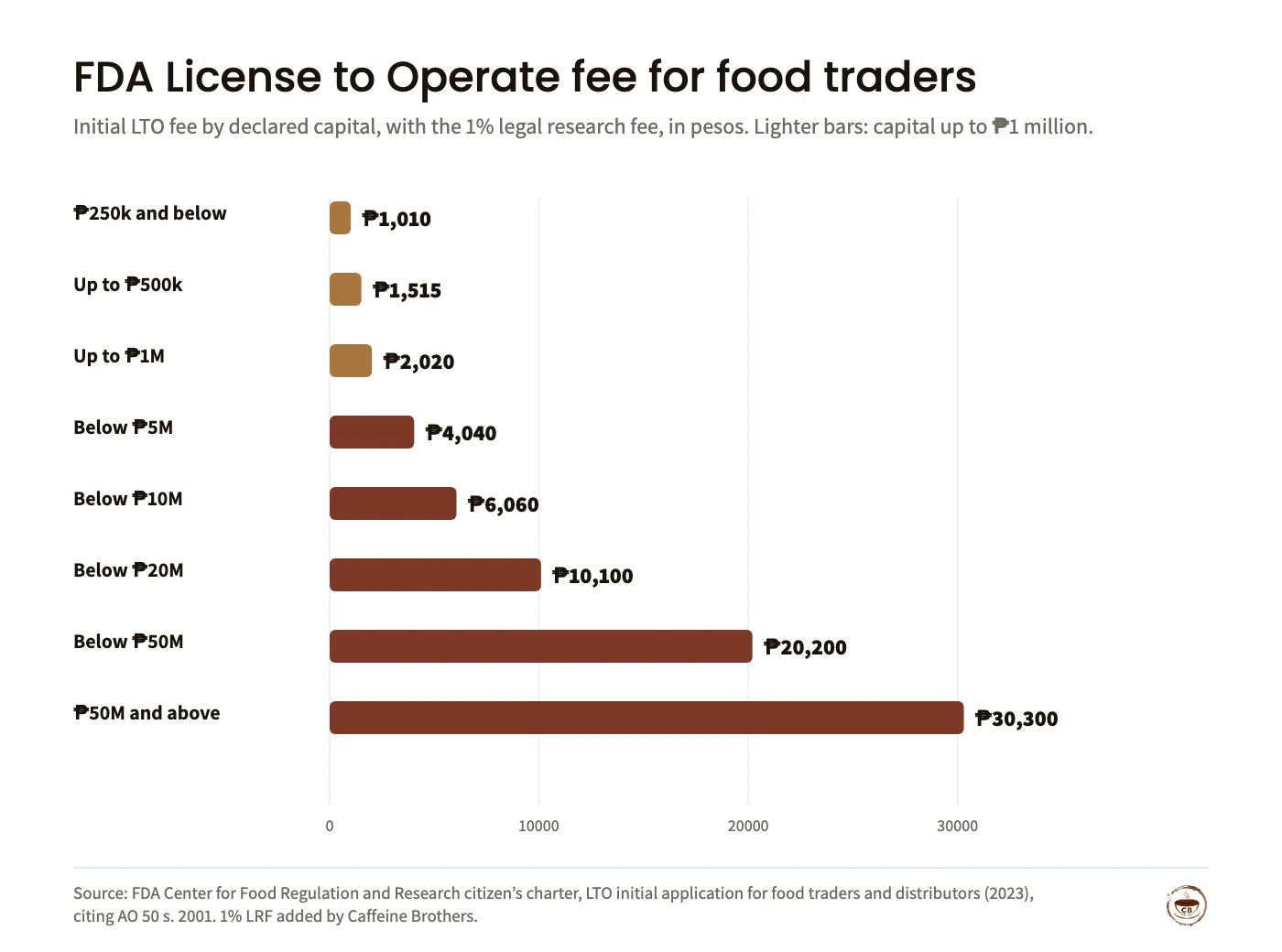
FDA’s citizen’s charter for food traders and distributors sets the trader fee by declared capital, under the fee schedule in Administrative Order 50 s. 2001. A 1% legal research fee is added. New traders prove capital with a notarized statement of initial capitalization or, for older companies, the latest audited financial statement.
| Declared capital | LTO fee (₱) | With 1% LRF (₱) |
|---|---|---|
| ₱250,000 and below | 1,000 | 1,010 |
| Over ₱250,000 to ₱500,000 | 1,500 | 1,515 |
| Over ₱500,000 to ₱1 million | 2,000 | 2,020 |
| Over ₱1 million, below ₱5 million | 4,000 | 4,040 |
| ₱5 million, below ₱10 million | 6,000 | 6,060 |
| ₱10 million, below ₱20 million | 10,000 | 10,100 |
| ₱20 million, below ₱50 million | 20,000 | 20,200 |
| ₱50 million and above | 30,000 | 30,300 |
The charter lists 14 working days for an initial trader license: up to 11 working days for evaluation after payment, then 3 working days for the decision. Under AO 2014-0029 an initial LTO is valid for two years and a renewed one for five.
You apply online through the FDA eServices portal. The charter’s checklist asks for the e-application with your location plan and GPS coordinates, a qualified person, proof of business registration (DTI for a sole proprietor, SEC for a corporation), a mayor’s permit if your business address differs from your registered address, proof of capital, and payment. Our guide to coffee shop permits covers the DTI and local permits that come first.
Does each coffee need a Certificate of Product Registration?
Yes. FDA Circular 2026-0002, dated June 4, 2026, now governs CPR applications through the eServices system. It says the market authorization holder (the trader, in a private label deal) is responsible for filing CPRs and for the product’s safety. It also asks for one CPR per product per manufacturing plant.
Coffee is in the low-risk group. The circular’s Annex A lists food category 14.1.5, “Coffee, coffee substitutes, tea, herbal infusions,” among low-risk foods, and FDA’s 2023 citizen’s charter gives “roasted coffee beans, coffee grounds” as examples. Low risk means simpler technical requirements than, say, dairy or ready-to-eat food.
| CPR item | What the FDA documents say |
|---|---|
| Risk class for roasted coffee | Low risk (Annex A of FDA Circular 2026-0002, food category 14.1.5) |
| Fee, initial or regular renewal | ₱200 per year of validity (Conventional Food Category 1) or ₱250 (Category 2), plus 1% LRF |
| Fee, automatic renewal | ₱1,000 (Category 1) or ₱1,250 (Category 2) for 5 years, plus 1% LRF |
| Validity | 2 years minimum to 5 years maximum for an initial CPR; 5 years on renewal (AO 2014-0029) |
| Processing time | 20 working days from posted payment (FDA Circular 2026-0002) |
| Certificates of analysis | Issued within 24 months before payment; in-house COAs accepted if FDA has verified the lab (FDA Circular 2026-0002) |
| Label change after approval | Amendment fee ₱200 plus 1% for most changes; ₱1,000 plus 1% to change or extend shelf life (FDA CFRR charter) |
At ₱200 a year, a CPR costs ₱400 for two years of validity and ₱1,000 for five, plus 1%. If you sell three coffees, budget three CPRs. Whether a different grind or bag size of the same coffee needs its own CPR is not spelled out in the documents we read; FDA’s CPR amendment list includes an “additional packaging type,” which suggests some packaging changes can be added to an existing CPR. Ask FDA before you file.
What must a private label coffee bag say?
DOH Administrative Order 2014-0030, signed September 8, 2014, lists the minimum label information for all prepackaged food. Here is how each item applies to a bag of roasted coffee.
| Required item (AO 2014-0030) | What it means for coffee |
|---|---|
| Product name | The true nature of the food, shown prominently, e.g. “Roasted Ground Coffee” or “Whole Bean Robusta Coffee.” A fanciful name must sit next to the real one. |
| Brand name or trademark | Your brand, placed with the product name. |
| Ingredients | Not needed for a single-ingredient food such as 100% coffee. Needed for blends with sugar, creamer or flavours, in descending order, with flavours declared as natural, nature-identical or artificial. |
| Net contents | Metric weight, e.g. “Net wt. 250 g.” Multi-unit packs show count, unit size and total, e.g. “10 x 10 g drip bags (net wt. 100 g).” |
| Name and address | Of the manufacturer, packer, trader or distributor. If your company did not make it, your name must be qualified by “Manufactured for” or “Packed for.” |
| Lot identification | A lot code marked permanently on each bag. |
| Storage condition | Required only if the product needs special storage beyond room temperature. |
| Expiry or consume-before date | Day, month in words, year, e.g. “Expiry date: 27 April 2027.” |
| Allergen information | Needed if the product contains a listed allergen, such as milk in a coffee mix. |
| Directions for use | Where needed for correct use, e.g. brewing ratio on drip bags. |
| Nutrition facts | Coffee is named as an example of food with insignificant nutrients that may be exempt, “as determined by FDA.” Mixes with sugar or creamer are not in that position. |
Two rules catch first-time brand owners. The “Manufactured for” wording is required whenever the company on the label did not make the product. And the expiry date has a fixed format: numbers for day and year, words for the month. If you plan health or nutrition claims, read the order’s claims section first; it bars claims that a food can prevent, cure or treat disease.
Should you register a trademark?
FDA does not require a trademark, but AO 2014-0030 does say no brand name may be identical to one already registered with FDA in the same product class. Registering with the Intellectual Property Office of the Philippines (IPOPHL) protects the name you are about to print on every bag. These are the fees on IPOPHL’s trademark fee schedule.
| IPOPHL fee (per class) | Small entity (₱) | Big entity (₱) |
|---|---|---|
| Filing fee | 1,200 | 2,592 |
| Allowance / publication for opposition | 900 | 960 |
| Issuance of certificate of registration | 570 | 1,200 |
| Publication of registration (2nd publication) | 900 | 960 |
| Subtotal to registration | 3,570 | 5,712 |
| 3rd-year Declaration of Actual Use | 900 | 1,920 |
| Renewal of registration | 3,100 | 6,600 |
How much coffee do you need to start?
Minimums depend on the roaster. Ours is 50 kg for private label, and we also offer toll packaging. The table uses our public 10 kg wholesale prices to show what the coffee alone costs for a 50 kg run, before roasting-to-order, bags, printing and packing, which we quote separately.
| Coffee | 10 kg box price | Per kg | 50 kg of coffee | Coffee in a 250 g bag |
|---|---|---|---|---|
| Robusta (Batangas, dark) | ₱7,730 | ₱773 | ₱38,650 | ₱193.25 |
| Kapeng Barako (Liberica, dark) | ₱8,160 | ₱816 | ₱40,800 | ₱204.00 |
| CB’s Finest blend | ₱8,300 | ₱830 | ₱41,500 | ₱207.50 |
| Arabica-Robusta blend | ₱9,420 | ₱942 | ₱47,100 | ₱235.50 |
| Arabica (Benguet, medium) | ₱10,150 | ₱1,015 | ₱50,750 | ₱253.75 |
Our wholesale page shows these prices live, and our cost per cup breakdown helps if you plan to brew the same coffee in your café.
A seven-step plan for launching a private label coffee
- Register the business. DTI for a sole proprietorship or SEC for a corporation, then your barangay clearance, mayor’s permit and BIR registration.
- Check the name. Search IPOPHL and FDA for identical brand names in coffee before you design anything, then file your trademark.
- Pick a roaster and get its license. Ask for its FDA License to Operate and confirm roasted coffee is on its product list. Agree on coffee, roast, grind, bag size and minimum order.
- Sign a notarized toll manufacturing agreement. AO 2014-0029 lists this as a requirement for a food trader’s license.
- Apply for your trader LTO. File on FDA eServices with proof of capital and pay the fee for your capital bracket.
- Design a compliant label, then file the CPR. Use the 11-item checklist above, with “Manufactured for” and an expiry date in the right format. File one CPR per product once your LTO is approved.
- Print and sell only after the CPR arrives. FDA defines the initial application as filed before you engage in manufacture, sale or distribution of the product.
For tax registration choices once sales start, see our guides to percentage tax and BMBE registration.
Frequently asked questions
Do I need an FDA license to sell private label coffee?
Yes. Under DOH Administrative Order 2014-0029, a trader is the registered owner of a food product who subcontracts its manufacture to a licensed manufacturer, and traders need a License to Operate (LTO). FDA Circular 2026-0002 treats LTO holders who are traders as the market authorization holder responsible for registering each product.
How much is the FDA License to Operate for a coffee trader?
FDA’s citizen’s charter sets the food trader LTO fee by declared capital, from ₱1,000 for ₱250,000 and below to ₱30,000 for ₱50 million and above, plus a 1% legal research fee. The charter lists 14 working days for an initial application.
Does roasted coffee need a Certificate of Product Registration?
Yes. Roasted coffee beans and coffee grounds are listed as low-risk processed food in FDA’s citizen’s charter, and coffee falls under food category 14.1.5 in Annex A of FDA Circular 2026-0002. The listed CPR fee is ₱200 or ₱250 per year of validity plus 1%, depending on fee category, with an initial validity of 2 to 5 years.
Does a coffee label need nutrition facts?
AO 2014-0030 exempts foods with insignificant amounts of all the nutrients in the panel and names coffee as an example, “as determined by FDA.” The exemption is lost in practice if you add sugar, creamer or flavours, or make a nutrition claim, so check with FDA for blends and flavoured products.
What is the minimum order for Caffeine Brothers private label coffee?
Our private label minimum is 50 kg, and we also offer toll packaging. For a quote on roasting, grind, bag size and packing, send us your plan through the wholesale page or contact form.
Sources
- DOH Administrative Order No. 2014-0029: Rules and Regulations on the Licensing of Food Establishments and Registration of Processed Food. Department of Health, September 8, 2014 (FAOLEX copy). Used for the trader, manufacturer and toll manufacturer definitions, the toll agreement requirement, LTO validity and CPR validity.
- DOH Administrative Order No. 2014-0030: Revised Rules and Regulations Governing the Labeling of Prepackaged Food Products. Department of Health, September 8, 2014 (FAOLEX copy). Used for the 11 mandatory label items, “Manufactured for,” date format, nutrition labeling exemptions, language and misbranding.
- FDA Circular No. 2026-0002: Guidelines on the Use of eServices for the Registration of Processed Food Products. Food and Drug Administration, signed June 4, 2026, with Annex A. Used for market authorization holder rules, the product line requirement, one CPR per product per plant, COA age, 20 working days and the low-risk classification of coffee.
- License to Operate: Initial Application for Food Traders and Distributors. FDA Center for Food Regulation and Research citizen’s charter (2023). Used for LTO fees by capital, distributor fee, requirements and 14 working days.
- CFRR Citizen’s Charter 2023. FDA Center for Food Regulation and Research, June 2023. Used for CPR fees, automatic renewal fees and the roasted coffee low-risk example.
- CPR Amendment (Initial Application Approved from Modified E-Registration). FDA CFRR citizen’s charter extract (2023). Used for amendment fees and the additional packaging type amendment.
- Schedule of Trademark-Related Fees. Intellectual Property Office of the Philippines, read October 28, 2026. Used for filing, publication, certificate, DAU and renewal fees.
- Caffeine Brothers wholesale prices. Checked October 28, 2026 through the store’s product feed. Used for 10 kg box prices and the 50 kg private label minimum.
Cite this article: Caffeine Brothers. “Private Label Coffee in the Philippines: FDA, Labels and Costs.” Caffeine Brothers Coffee Blog, October 2026. https://caffeinebrothers.co/private-label-coffee-philippines/
You are welcome to reference the tables and charts in this article with a link back to this page.
Planning your own coffee brand? See our wholesale and private label options (50 kg minimum, toll packaging available), request a free sample, or contact us with your bag size and volume. This article is general information, not legal advice; confirm requirements with FDA and IPOPHL before you file.
 Previous Post