Percentage Tax in the Philippines: A Guide for Coffee Shops
By Robin Salvador, co-founder, Caffeine Brothers
Last updated: October 26, 2026
Quick answer: Percentage tax in the Philippines is 3% of gross quarterly sales, paid by businesses that are not VAT-registered and whose annual gross sales do not exceed ₱3,000,000. It is filed on BIR Form 2551Q within 25 days after each quarter. A coffee shop with ₱600,000 of sales in a quarter owes ₱18,000. A sole proprietor can replace both percentage tax and graduated income tax with the 8% gross sales option. Micro and small taxpayers who file late pay a 10% surcharge instead of 25%.
Key takeaways
- Section 116 of the Tax Code, as amended by the Ease of Paying Taxes (EOPT) Act of January 5, 2024, sets percentage tax at 3% of gross quarterly sales. The 1% CREATE rate ended June 30, 2023.
- The ₱3,000,000 VAT threshold decides the regime: at or below it, a non-VAT café pays 3%; above it, the café must register for 12% VAT.
- Self-employed individuals can choose 8% on gross sales above ₱250,000 instead of the graduated rates and the 3% tax. Corporations cannot.
- The 2551Q is due April 25, July 25, October 25 and January 25. In 2027, April 25 and July 25 fall on a Sunday.
- For a micro taxpayer, ₱18,000 of tax paid 3 months late costs ₱2,070 in surcharge and interest, against ₱5,040 at the regular rates.
Many of the cafés we supply are owner-run shops in their first or second year, and the quarterly percentage tax return is one of the first BIR filings they meet. This guide reads the amended Tax Code sections and the BIR regulations on penalties, then works the numbers for a small coffee shop. It is a plain-language summary and not tax advice. Your accountant or Revenue District Office should confirm how the rules apply to your registration.
What is percentage tax?
Percentage tax is a business tax on sales for people and companies that are exempt from VAT. Section 116 of the National Internal Revenue Code, as amended by RA 11976, says a person whose sales are exempt under Section 109(CC) and who is not VAT-registered “shall pay … a tax equivalent to three percent (3%) of his gross quarterly sales.” Cooperatives are exempt. The same section keeps the note that the rate was 1% from July 1, 2020 to June 30, 2023, the temporary cut under the CREATE Act.
The tax is on sales, so a café pays it even in a quarter that loses money. That is the main difference from income tax, which is on profit.
Coffee beans for your café
Caffeine Brothers supplies cafés, offices and restaurants with freshly roasted Philippine coffee in 10 kg wholesale boxes from ₱773/kg, with free Metro Manila delivery and a free sample before you commit.
See Wholesale Prices →Does a coffee shop pay percentage tax, VAT or 8%?
It depends on gross sales and on whether the business is owned by one person or by a corporation or partnership. The VAT exemption in Section 109(BB) covers sellers whose gross annual sales do not exceed ₱3,000,000. Section 236(G) requires VAT registration once sales for the past 12 months exceed ₱3,000,000, or when there are reasonable grounds to expect that in the next 12 months.
| Café owner and sales | Business tax | Income tax |
|---|---|---|
| Sole proprietor, gross sales ₱3,000,000 or less, graduated option | 3% percentage tax, quarterly 2551Q | Graduated rates (0% up to ₱250,000 taxable income, then 15% to 35%) |
| Sole proprietor, gross sales ₱3,000,000 or less, 8% option | None (covered by the 8%) | 8% of gross sales above ₱250,000 |
| Corporation or partnership, gross sales ₱3,000,000 or less, not VAT-registered | 3% percentage tax, quarterly 2551Q | Corporate income tax (8% option not available) |
| Any café with gross sales above ₱3,000,000 | 12% VAT (registration required) | Graduated or corporate rates |
If you are a sole proprietor, ask your RDO how to record your choice between graduated rates plus 3% and the flat 8%. We compared the three regimes, including BMBE registration, in our BMBE registration guide.
How do you compute percentage tax?
Multiply gross sales for the quarter by 3%. There are no deductions for rent, beans or wages. Every ₱100 of sales carries ₱3 of tax. On a drink priced at ₱120, which we use only as an example, that is ₱3.60.
| Gross sales per quarter | Annual equivalent | 3% percentage tax per quarter | Tax per year |
|---|---|---|---|
| ₱150,000 | ₱600,000 | ₱4,500 | ₱18,000 |
| ₱300,000 | ₱1,200,000 | ₱9,000 | ₱36,000 |
| ₱600,000 | ₱2,400,000 | ₱18,000 | ₱72,000 |
| ₱720,000 | ₱2,880,000 | ₱21,600 | ₱86,400 |
| ₱750,000 | ₱3,000,000 (VAT threshold) | ₱22,500 | ₱90,000 |
To put the ₱3.60 in context, the beans for an 18 g double shot cost ₱13.91 with Robusta, ₱14.94 with our CB’s Finest blend and ₱18.27 with Arabica at our 10 kg wholesale prices on October 26, 2026 (₱7,730, ₱8,300 and ₱10,150 per box). On a ₱120 drink, the tax is about a quarter of the bean cost of a Robusta double.
When is the 2551Q due?
Section 128, as amended by the EOPT Act, says the quarterly return is filed and the tax paid “within twenty-five (25) days after the end of each taxable quarter.” You can file and pay electronically or manually, through an authorized agent bank, a Revenue District Office through its revenue collection officer, or an authorized tax software provider. If your VAT registration is cancelled, percentage tax starts from the date of cancellation.
| Quarter | Covers | Due date | Day |
|---|---|---|---|
| Q4 2026 | October to December 2026 | January 25, 2027 | Monday |
| Q1 2027 | January to March 2027 | April 25, 2027 | Sunday |
| Q2 2027 | April to June 2027 | July 25, 2027 | Sunday |
| Q3 2027 | July to September 2027 | October 25, 2027 | Monday |
| Q4 2027 | October to December 2027 | January 25, 2028 | Tuesday |
Two of the 2027 deadlines fall on a Sunday. Watch for a BIR advisory on those dates, and file before the weekend if you are unsure. A return with no sales for the quarter is still a return. Ask your RDO whether you need to file a zero 2551Q.
What happens if you file late?
Section 248 adds a surcharge of 25% of the tax due when a return is not filed and paid on time. Section 249 adds interest at double the legal interest rate, which Grant Thornton puts at 12% a year in its example. The EOPT Act cut both for micro and small taxpayers: Section 45 sets a 10% surcharge and halves the interest. RR 8-2024 and RR 6-2024, effective April 27, 2024, carry out these rules. A micro taxpayer has gross sales below ₱3,000,000, so most non-VAT cafés are in that group.
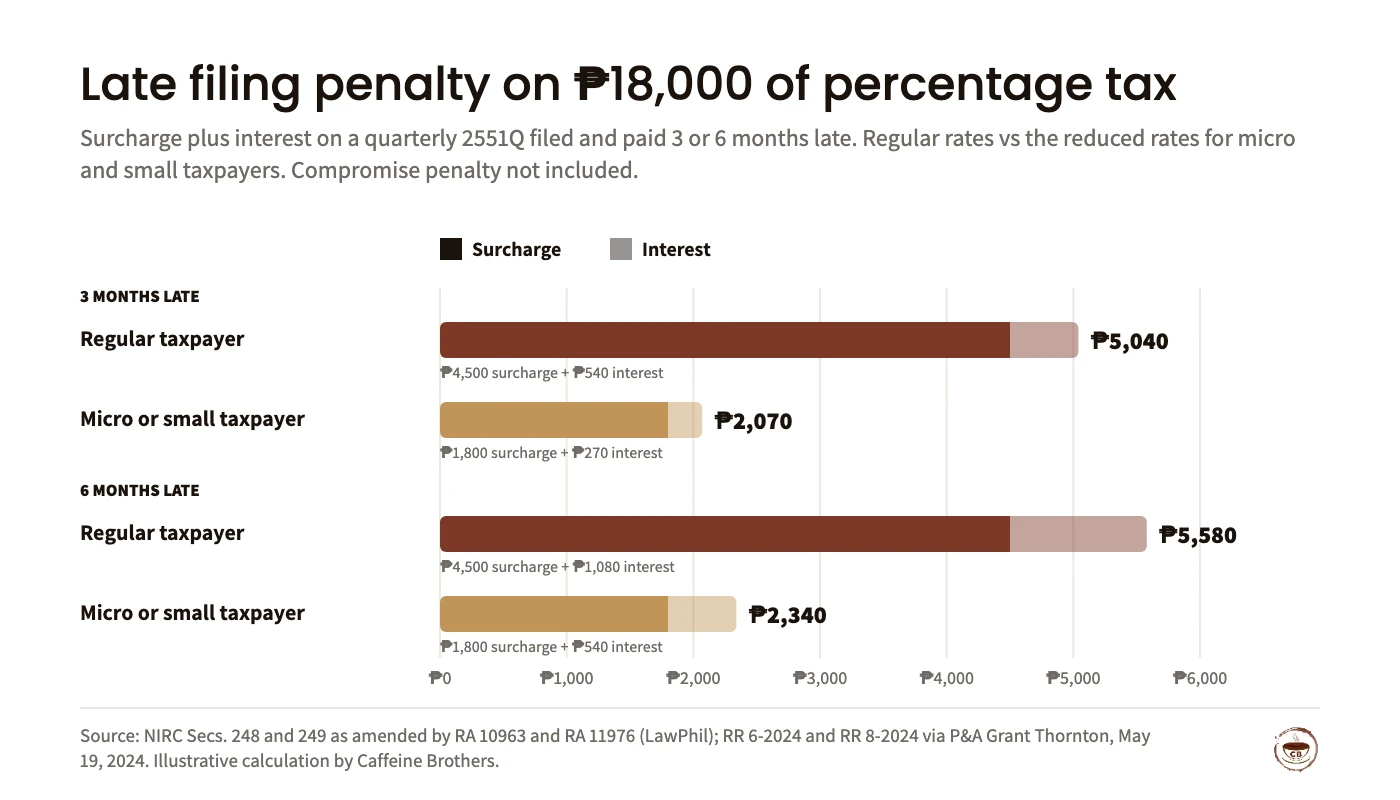
The example uses the ₱18,000 quarter from the table. At the regular rates, three months late adds ₱4,500 of surcharge and ₱540 of interest. For a micro taxpayer, the surcharge is ₱1,800 and the interest ₱270. A compromise penalty can be added on top. For micro and small taxpayers, RR 6-2024 sets it at 50% of the usual rate, according to Grant Thornton.
What invoices does a non-VAT café issue?
Under Section 237 as amended by the EOPT Act, a business issues a registered sales invoice for each sale of ₱500 or more. Sales below ₱500 can be covered by one invoice for the day’s total at closing, as long as that total is at least ₱500. A customer can always ask for an invoice whatever the amount. VAT-registered sellers must invoice every sale. Your quarterly gross sales for the 2551Q should match your invoices.
Does BMBE registration remove percentage tax?
No. Section 7 of RA 9178 exempts a barangay micro business enterprise from “tax for income arising from the operations of the enterprise.” It does not mention percentage tax, so a BMBE café that is not VAT-registered still files the 2551Q. Business permits and local fees are a separate matter, covered in our coffee shop permits guide.
Is percentage tax going away?
Not under current law. Fiscal Solutions reported on November 28, 2025 that the Senate is reviewing Senate Bill No. 1450, which would abolish the VAT system and remove the 3% percentage tax on VAT-exempt businesses with sales up to ₱3,000,000. It gave no committee action or vote. Until a law is passed, the 3% applies.
A five-step percentage tax routine for café owners
- Confirm your registration. Check your Certificate of Registration for “percentage tax” and, if you are a sole proprietor, whether you chose the 8% option for the year.
- Total your quarter from invoices. Add every invoice, including end-of-day summary invoices for small sales, for the three months.
- Multiply by 3%. ₱300,000 of quarterly sales means ₱9,000 of tax.
- File and pay by the 25th. File electronically or manually through an authorized agent bank, your RDO’s revenue collection officer or an authorized tax software provider, and note the Sunday deadlines in April and July 2027.
- Track the ₱3,000,000 line. Once your trailing 12-month sales pass it, you must register for VAT. Plan prices before you get there.
Running a café also means service charge rules for staff. See our guide to service charge in the Philippines.
Frequently asked questions
What is the percentage tax rate in the Philippines in 2026?
The percentage tax under Section 116 of the Tax Code is 3% of gross quarterly sales. The temporary 1% rate under the CREATE Act ran only from July 1, 2020 to June 30, 2023. Cooperatives are exempt.
When is the deadline for BIR Form 2551Q?
The quarterly percentage tax return is due within 25 days after the end of each quarter: April 25, July 25, October 25 and January 25. Under the Ease of Paying Taxes Act, you can file and pay electronically or manually through an authorized agent bank, a Revenue District Office collection officer or an authorized tax software provider.
Can a coffee shop skip percentage tax by choosing the 8% income tax?
Yes, if the owner is a self-employed individual whose gross sales do not exceed ₱3,000,000. The 8% tax on gross sales above ₱250,000 replaces both the graduated income tax and the 3% percentage tax. Corporations and partnerships cannot use the 8% option.
Does BMBE registration remove percentage tax?
No. Section 7 of RA 9178 exempts a barangay micro business enterprise from tax on income from its operations. It does not mention percentage tax, so a BMBE café that is not VAT-registered still files the quarterly 2551Q.
Sources
- Republic Act No. 11976 (Ease of Paying Taxes Act). The LawPhil Project. Approved January 5, 2024. Used for amended Section 116 (3% of gross quarterly sales, cooperatives exempt, 1% from July 1, 2020 to June 30, 2023), Section 128 (quarterly return within 25 days, where to file and pay), Section 21 taxpayer groups, Section 237 invoicing (₱500 threshold, end-of-day invoice), Section 248 (25% surcharge) and Section 45 concessions for micro and small taxpayers.
- Republic Act No. 10963 (TRAIN Law). The LawPhil Project. Approved December 19, 2017. Used for the 8% option in lieu of graduated rates and percentage tax, the ₱3,000,000 VAT threshold (Section 109(BB)), mandatory VAT registration (Section 236(G)), the 12% VAT rate, the 2023 graduated tax table and Section 249 interest at double the legal rate.
- EOPT is here: revised rules on taxpayer classification and reduced penalties for micro and small taxpayers. P&A Grant Thornton, May 19, 2024. Used for RR 8-2024 and RR 6-2024, the effectivity date, the 10% surcharge, the 6% interest example and the 50% compromise penalty rate.
- Republic Act No. 9178 (Barangay Micro Business Enterprises Act of 2002). The LawPhil Project. Used for the Section 7 income tax exemption of BMBEs.
- Philippines: Senate proposes abolishing VAT and 3% percentage tax. Fiscal Solutions, November 28, 2025. Used for the pending Senate Bill No. 1450.
Cite this article: Caffeine Brothers. “Percentage Tax in the Philippines: A Guide for Coffee Shops.” Caffeine Brothers Coffee Blog, October 2026. https://caffeinebrothers.co/percentage-tax-philippines/
You are welcome to reference the charts and frameworks in this article with a link back to this page.
Keeping a close eye on costs per cup? Our wholesale coffee comes in 10 kg boxes with free Metro Manila delivery, and the calculators in our Coffee Lab help you price drinks. For more on running the numbers, read financial fundamentals for café owners or contact us for a quote.
 Previous Post