Service Charge in the Philippines: Rules for Cafés (2026)
By Robin Salvador, co-founder, Caffeine Brothers
Last updated: October 22, 2026
Quick answer: In the Philippines, every peso of service charge a café, restaurant or hotel collects must go to its covered employees, shared equally by hours or days worked, with managers excluded. This has been the rule since Republic Act No. 11360 took effect on September 4, 2019. DOLE Department Order No. 242, Series of 2024 requires payout at least every 16 days and bars counting the share toward the minimum wage.
Key takeaways
- RA 11360, approved August 7, 2019, replaced the old 85% staff and 15% management split with 100% to covered employees.
- Covered employees are all non-managerial staff, regardless of position or employment status. DO 242 (signed February 1, 2024) dropped the “direct employ” limit in the 2019 rules.
- Shares are based on actual hours or days of work and must be paid at least twice a month, no more than 16 days apart.
- Service charge shares cannot be used to meet a minimum wage. In Metro Manila a small café must still pay at least ₱718 a day under NCR-28.
- No law requires a café to charge a service charge, and Article 96 sets no rate.
We supply beans to cafés across the Philippines, and owners often ask what they can and cannot do with the service charge line on the bill. This guide reads the law and DOLE’s implementing rules directly and works through an example payout. It is a plain-language summary and not legal advice. For a specific dispute, contact your DOLE field office.
What is a service charge under Philippine law?
DOLE’s 2023 handbook defines service charges as “the amount collected by establishments, such as hotels, restaurants and other similar establishments, that is added to the bills for work or services rendered.” DO 242 uses a shorter version: “the amount that is added to the bill for work or service rendered.” Article 96 of the Labor Code, as amended, then says: “All service charges collected by hotels, restaurants and similar establishments shall be distributed completely and equally among the covered workers except managerial employees.”
Nothing in Article 96 or DO 242 requires an establishment to add a service charge, and neither sets a percentage. The rules apply once a business chooses to collect one. A café that does not add a service charge on the bill has nothing to distribute under this article.
Coffee beans for your café
Caffeine Brothers supplies cafés, offices and restaurants with freshly roasted Philippine coffee in 10 kg wholesale boxes from ₱773/kg, with free Metro Manila delivery and a free sample before you commit.
See Wholesale Prices →What changed with RA 11360 and DO 242?
Before 2019, Article 96 split service charges 85% to rank-and-file staff and 15% to management. RA 11360 removed management’s share. The 2019 implementing rules, DO 206, limited covered workers to those “under the direct employ” of the establishment. DO 242, signed on February 1, 2024, superseded DO 206 and removed that phrase, so the definition now covers “all employees, except managerial employees … regardless of their position, designations, or employment status.”
| Rule | Old Article 96 (before Sep 4, 2019) | RA 11360 + DO 206 (2019 to 2024) | DO 242, s. 2024 (current) |
|---|---|---|---|
| Share for staff | 85% | 100% | 100% |
| Share for management | 15% | 0% | 0% |
| Who shares | Covered employees | Non-managerial staff under the establishment’s direct employ | All non-managerial employees, any status |
| Basis of split | Equal | Equal, by actual hours or days | Equal, by actual hours or days |
| Payout frequency | Not stated here | Every 2 weeks or twice a month, max 16 days | At least every 2 weeks or twice a month, max 16 days |
| Counts toward minimum wage? | Not stated here | No | No |
| Disputes | Not stated here | Grievance machinery, then DOLE regional office | Grievance machinery or CBA, then DOLE regional, provincial, field or satellite office through SEnA |
Whether agency-supplied workers now share is less settled. A May 2024 Daily Tribune column by Nilo Divina reads DO 242 as aiming to include contractual, non-regular and agency workers. The order itself only says employment status no longer matters. If you use an agency for dishwashing or cleaning, ask DOLE or your lawyer before leaving those workers out.
Key dates for the service charge law
| Date | What happened |
|---|---|
| August 7, 2019 | RA 11360 approved |
| August 19, 2019 | Published in Manila Bulletin and BusinessMirror |
| September 4, 2019 | RA 11360 took effect |
| November 19, 2019 | DO 206 (first implementing rules) signed, published November 26, 2019 |
| December 26, 2019 | Labor Advisory No. 14, s. 2019 on service charges and non-diminution of benefits |
| February 28, 2020 | Labor Advisory No. 10, s. 2020 clarifying the law’s effectivity date |
| February 1, 2024 | DO 242 signed, superseding DO 206; effective 15 days after publication in two newspapers |
How should a café split the service charge?
Section 3 of DO 242 says service charges “shall be distributed completely and equally, based on actual hours or days of work or service rendered, among the covered employees.” In practice that means a rate per hour (or per day) for the whole pool, multiplied by each person’s hours. Here is a simple example for one 15-day pay period.
- Total the service charges actually collected in the period. In our example the café collected ₱12,000.
- Remove managerial employees as the law defines them: people who set and carry out policy or can hire, discipline or dismiss, or effectively recommend it. Title alone does not decide it.
- Add up hours worked by everyone else, including part-time and fixed-term staff. Here that is 96 + 96 + 88 + 64 + 40 = 384 hours.
- Divide the pool by total hours. ₱12,000 ÷ 384 = ₱31.25 per hour.
- Multiply by each person’s hours and pay out within 16 days of the last distribution. Keep the computation on file.
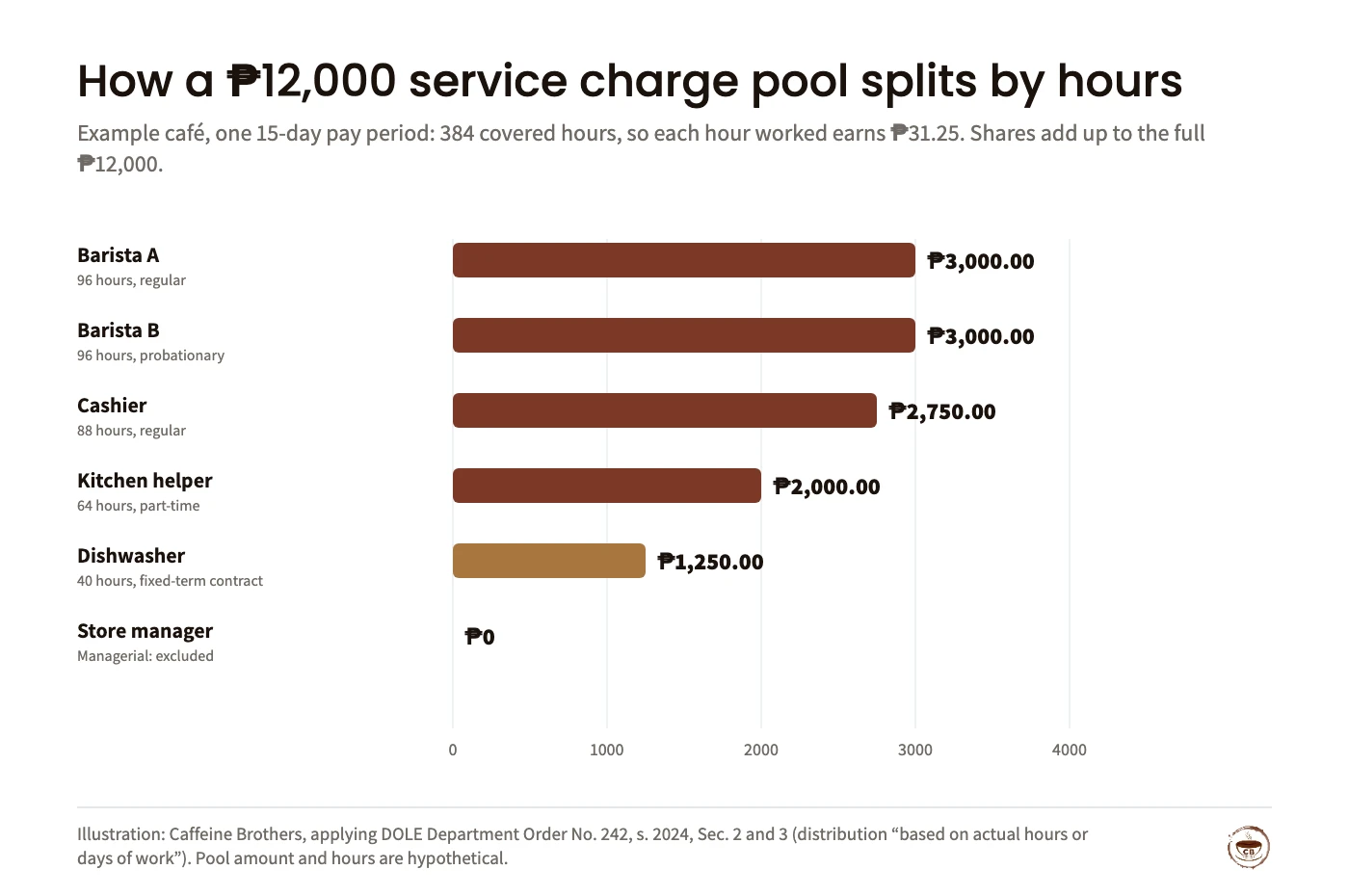
| Staff member | Status | Hours | Share at ₱31.25/hour |
|---|---|---|---|
| Barista A | Regular | 96 | ₱3,000.00 |
| Barista B | Probationary | 96 | ₱3,000.00 |
| Cashier | Regular | 88 | ₱2,750.00 |
| Kitchen helper | Part-time | 64 | ₱2,000.00 |
| Dishwasher | Fixed-term contract | 40 | ₱1,250.00 |
| Store manager | Managerial | Not counted | ₱0 |
| Total | 384 | ₱12,000.00 |
If the café tracks days instead of hours, the same pool over 48 staff-days (12, 12, 11, 8 and 5 days of 8 hours) works out to ₱250 a day and gives the same shares. A points system that gives a senior barista a bigger per-hour share than a junior one sits poorly with that wording, because the distribution must be equal. Check with DOLE before using one.
Can service charges count toward the minimum wage?
No. Section 5 of DO 242 says that when the minimum wage is raised, “service charges paid to the covered employees shall not be considered” in checking compliance. A Metro Manila café with 15 or fewer workers must pay at least ₱718 a day since Wage Order NCR-28 took effect on September 26, 2026. Paying ₱650 a day and pointing to a ₱100 daily service charge share does not meet that floor. Our barista salary guide shows the full monthly cost of a minimum wage hire, and night shifts add the premium in our night shift differential guide.
Section 7 also protects existing benefits. If staff already received more than the law requires, for example a separate allowance on top of their service charge share, the new rules cannot be used to reduce it.
What if staff dispute the split?
Disputes go first to the café’s grievance machinery or the collective bargaining agreement. If there is none, or it is inadequate, the dispute is referred to the DOLE regional, provincial, field or satellite office with jurisdiction over the workplace, for conciliation through the Single-Entry Approach (SEnA). DOLE offices monitor compliance under DO 238, s. 2023. Clear payslips that show the pool, total hours and each share make this much less likely.
What this means for a café’s pricing
Because the whole service charge belongs to staff, it cannot cover rent, beans or breakage. Those have to be in the menu price. As a reference point, the coffee in an 18 g double shot costs ₱13.91 with our Robusta at the 10 kg rate of ₱7,730, ₱14.94 with CB’s Finest at ₱8,300, and ₱18.27 with Arabica at ₱10,150 (prices checked October 22, 2026). Our financial fundamentals for café owners and the calculators in the Coffee Lab help you build those costs into prices. If you are still setting up, our coffee shop permits guide covers registration fees.
Frequently asked questions
Is service charge mandatory in the Philippines?
No law requires a café or restaurant to add a service charge. Article 96 of the Labor Code, as amended by RA 11360, governs what happens to service charges once an establishment collects them: all of it goes to covered employees.
Who gets the service charge in a restaurant or café?
All employees except managerial employees, regardless of position, designation or employment status and however they are paid. DOLE Department Order No. 242, Series of 2024 removed the earlier wording that limited this to staff under the direct employ of the establishment.
Can management keep part of the service charge?
No. Before RA 11360 took effect on September 4, 2019, 85% went to employees and 15% to management. The law now requires service charges to be distributed completely and equally among covered employees.
How often must service charges be distributed?
At least once every two weeks or twice a month, at intervals of no more than 16 days, under Section 4 of DOLE Department Order No. 242, Series of 2024.
Sources
- Republic Act No. 11360. The LawPhil Project. Approved August 7, 2019. Used for the amended text of Article 96, the definition of managerial employees and the non-diminution clause.
- DOLE Department Order No. 242, Series of 2024. Labor Law PH library, page modified July 13, 2024. Used for the revised implementing rules signed February 1, 2024: coverage, definitions, distribution by hours or days, the 16-day frequency, the minimum wage rule and SEnA dispute referral.
- Labor Code of the Philippines, Book Three. Labor Law PH library, page modified April 2, 2024. Used for Article 96 as it now reads.
- Handbook on Workers’ Statutory Monetary Benefits, 2023 edition. DOLE Bureau of Working Conditions. Used for the definition of service charges and the timeline of RA 11360 and DO 206 (publication and effectivity dates, Labor Advisory No. 14, s. 2019 and No. 10, s. 2020).
- New guidelines for service charge. Nilo Divina, Daily Tribune, May 2, 2024. Used for the old 85/15 split and the changes from DO 206 to DO 242. Law firm commentary.
- DOLE: P60 wage hike in NCR takes effect Sept. 26. GMA News, September 26, 2026. Used for the NCR-28 minimum wage of ₱718 for retail and service establishments with 15 or fewer workers.
- Caffeine Brothers wholesale prices. Checked October 22, 2026 through the store’s product feed. Used for the bean cost per double shot.
Cite this article: Caffeine Brothers. “Service Charge in the Philippines: Rules for Cafés (2026).” Caffeine Brothers Coffee Blog, October 2026. https://caffeinebrothers.co/service-charge-philippines/
You are welcome to reference the charts and frameworks in this article with a link back to this page.
Running a café? Our wholesale coffee comes in 10 kg boxes with free Metro Manila delivery, roasted daily from Philippine-grown beans. Contact us for a quote or a sample.
 Previous Post