Single-Use Plastic Ban in the Philippines: Rules for Coffee Shops
By Robin Salvador, co-founder, Caffeine Brothers
Last updated: November 15, 2026
Quick answer: The Philippines has no national ban on single-use plastics as of November 2026. The rules a coffee shop actually faces come from its city or municipality. Quezon City, for example, bans single-use cups, straws, stirrers and cutlery for dine-in customers under Ordinance SP-2876, s.2019, with fines of ₱1,000 to ₱5,000. The Extended Producer Responsibility (EPR) Act of 2022 applies to large companies with assets above ₱100 million, so most independent cafés are exempt, but a franchise brand can be covered.
Key takeaways
- RA 9003 (2001) lets the National Solid Waste Management Commission (NSWMC) list and phase out non-environmentally acceptable products, but the list it issued in December 2024 has no single-use plastics (EcoWaste Coalition, April 15, 2025).
- NSWMC Resolution 1428 (February 2, 2021) added plastic straws and coffee stirrers to that list by an 11 to 3 vote, but no phase-out followed.
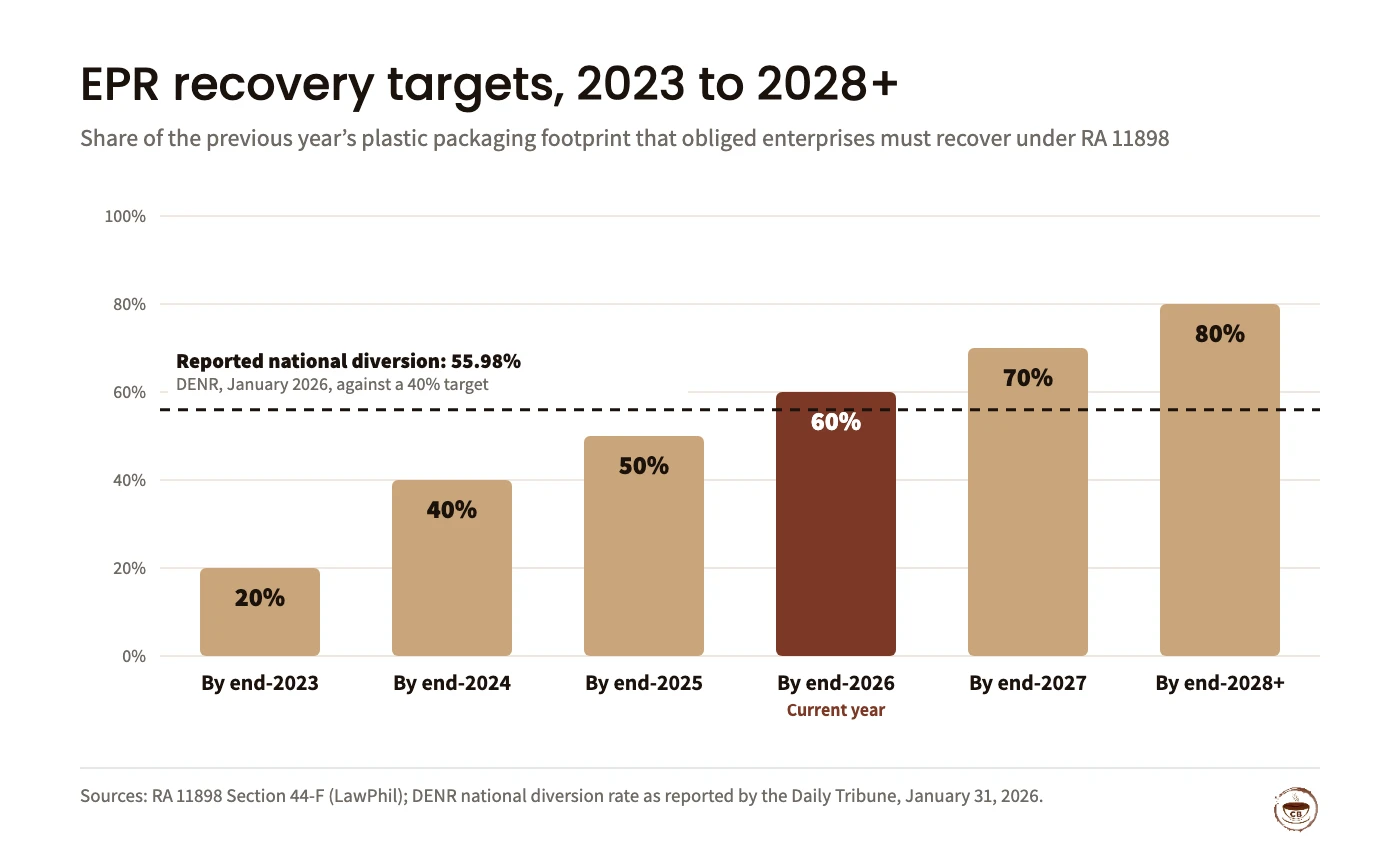
- RA 11898, the EPR Act, lapsed into law on July 23, 2022. Large companies must recover 60% of their plastic packaging footprint by December 31, 2026 and 80% by 2028.
- DENR reported a national EPR diversion rate of 55.98% and 1,017 registered companies in January 2026, and sent 155 show cause letters in August 2026.
- City ordinances do the real work: Quezon City, Makati, Pasig, Muntinlupa and Parañaque all ban some mix of plastic bags, styrofoam and disposable dine-in ware.
Is single-use plastic banned in the Philippines?
Not nationwide. Three national rules touch plastics, and none of them stops a café from handing a customer a plastic cup with a lid and straw.
The first is the Ecological Solid Waste Management Act, RA 9003, dated January 26, 2001. Section 29 tells the NSWMC to prepare a list of non-environmentally acceptable products (NEAP). Products on the list can only be banned if the Commission first finds alternatives at no more than 10% higher cost. Section 48(10) then prohibits “the manufacture, distribution or use of non-environmentally acceptable packaging materials,” with a first-offense fine of ₱500,000 plus 5% to 10% of net annual income.
That penalty only works once a list exists, and for two decades it did not. In February 2021 the Commission voted to add plastic soft drink straws and coffee stirrers. Manila Bulletin reported that 11 members voted for it and 3 against. Six months later BusinessWorld reported that the DENR was still ordering the NSWMC to publish the list in two national newspapers, and a later Rappler report described the ban as at a standstill. In December 2024 the Commission adopted Resolution 1707, an official NEAP list of four items: lead paint above 90 ppm, toys and school supplies with phthalates, water pipes with lead, and BPA feeding bottles and sippy cups. EcoWaste Coalition noted that single-use plastics “remain glaringly absent.”
The second rule is NSWMC Resolution 1363, signed February 12, 2020. It bans unnecessary single-use plastics such as straws, stirrers, cutlery and thin plastic cups in government offices only. A café inside a government building may feel it through its lease, but private cafés elsewhere are not covered.
The third is the EPR Act, covered below. It puts the burden on large brand owners, not on small shops.
| Rule | Date | What it covers | Does it bind a small café? |
|---|---|---|---|
| RA 9003, Secs. 29, 30, 48(10) | Jan 26, 2001 | Phase-out of products on the NEAP list; ₱500,000 first-offense fine | Only for listed items; no single-use plastics are on the list |
| NSWMC Res. 1363 | Feb 12, 2020 | Straws, stirrers, cutlery, thin cups and bags in government offices | No, government offices only |
| NSWMC Res. 1428 | Feb 2, 2021 | Adds plastic straws and coffee stirrers to the NEAP list | No phase-out took effect |
| RA 11898 (EPR Act) | Jul 23, 2022 | Recovery targets for plastic packaging of large enterprises | No, unless the brand’s combined assets exceed ₱100 million |
| NSWMC Res. 1707 | Dec 2024 | Official NEAP list of 4 non-plastic items | No |
| City ordinances | 2003 to 2025 | Bags, styrofoam, dine-in disposables (varies by city) | Yes, where the café operates |
Coffee beans for your café
Caffeine Brothers supplies cafés, offices and restaurants with freshly roasted Philippine coffee in 10 kg wholesale boxes from ₱773/kg, with free Metro Manila delivery and a free sample before you commit.
See Wholesale Prices →What does the EPR Act require, and who is covered?
RA 11898 amended RA 9003 and lapsed into law on July 23, 2022 without the President’s signature. Its implementing rules are DENR Administrative Order 2023-02, dated January 24, 2023.
The law covers “large enterprises that generate plastic packaging waste.” A large enterprise has total assets, excluding land, above the medium-enterprise ceiling in RA 9501. That ceiling is ₱100 million: RA 9501 defines micro enterprises as up to ₱3 million in assets, small as ₱3 million to ₱15 million, and medium as ₱15 million to ₱100 million (GMA News, May 23, 2008). Section 44-B states that micro, small and medium enterprises “shall not be covered,” with one exception that matters for cafés. If the total assets of all enterprises carrying the same brand, label or trademark exceed the medium ceiling, they are obliged. A franchisee of a large coffee chain can fall under that rule even if its own branch is small.
Section 44-C lists the packaging covered: sachets, labels, laminates and other flexible packaging; rigid packaging including caps, lids, cutlery, plates, drinking straws and sticks; single-use plastic bags given at the point of sale; and polystyrene. In café terms, that is most of what goes out the door with a takeaway drink.
Obliged companies must recover a growing share of the plastic footprint they generated in the year before. Fines run from ₱5 million to ₱10 million for a first offense and up to ₱20 million plus automatic suspension of the business permit for a third.
| Deadline | Recovery target | Status |
|---|---|---|
| Dec 31, 2023 | 20% | Past |
| Dec 31, 2024 | 40% | Past |
| Dec 31, 2025 | 50% | Past |
| Dec 31, 2026 | 60% | Current year |
| Dec 31, 2027 | 70% | Coming |
| Dec 31, 2028 and every year after | 80% | Coming |
How is the EPR Act working so far?
The DENR figures have improved, but they come from news reports and the years are not always labelled the same way.
- For the first compliance year, the Philippine News Agency reported on June 5, 2024 that 917 companies had registered as of May 6, 2024, up from 667 in 2023, and that they diverted 124,986 tonnes, or 20% of a 624,547-tonne footprint.
- At the DENR EPR recognition event reported by the Daily Tribune on January 31 and February 1, 2026, the national diversion rate was 55.98% against a 40% target, with 1,017 registered entities across 201 EPR programs and more than 246 million kilograms of plastic diverted.
- GMA News reported on August 20, 2026 that the DENR issued 155 show cause letters to companies not meeting their EPR obligations, and gave audited 2024 recovery rates of 59.98% for rigid and 56.33% for flexible plastics. The Tribune gave 55.60% for rigid, so the two reports differ on that figure.
The Tribune report says the 55.98% was diverted “in 2025” but compares it with a 40% target, which the law sets for December 31, 2024. GMA attributes the same rates to 2024. We treat the figure as the latest reported result, published in January 2026. Down To Earth also noted on September 1, 2026 that recovery counts include co-processing, which means burning plastic as fuel in cement kilns.
Which city ordinances apply to coffee shops?
This is where a café owner needs to look first. Each city writes its own rules, so the same takeaway cup can be fine in one city and a ₱1,000 fine in the next.
Quezon City is the clearest case. Ordinance SP-2876, s.2019 defines restaurants to include “coffee shops,” and bans single-use items for dine-in customers: plastic spoons, forks and knives, plastic and paper cups, plates, plastic and paper straws, coffee stirrers and styrofoam. Paper cups and paper straws are included, so swapping plastic for paper does not satisfy the dine-in rule. The city deferred enforcement during the pandemic and said it would start on July 1, 2021. A separate ordinance, SP-2868, s.2019, bans the distribution of plastic bags by restaurants, fast food chains and food stalls, with an exception for bags without handles used for unpacked food.
| City | Ordinance | What is banned | Fines |
|---|---|---|---|
| Quezon City | SP-2876, s.2019 | Single-use cups (plastic and paper), straws, stirrers, cutlery, plates and styrofoam for dine-in | ₱1,000; ₱3,000 + cease and desist; ₱5,000 + permit revocation and closure |
| Quezon City | SP-2868, s.2019 | Plastic bags at malls, supermarkets, restaurants and food stalls | ₱1,000; ₱3,000; ₱5,000 + closure order |
| Makati | 2003-095 | Plastic bags for dry goods and as secondary packaging; styrofoam food and drink containers | Establishments ₱5,000 or 30 days to 1 year; possible permit cancellation |
| Pasig | No. 9, s.2010 | Styrofoam food containers; plastic bags for dry goods | ₱500; ₱1,000; ₱2,500 and/or up to 6 months |
| Muntinlupa | No. 10-109 | Plastic bags for dry goods; styrofoam | ₱500; ₱1,000; ₱2,500 (sources differ on the 3rd-offense penalty) |
| Parañaque | No. 18-40, s.2019 | Styrofoam and single-use plastic in business establishments | Up to ₱5,000; 3rd offense adds permit cancellation and closure |
| Lapu-Lapu City | No. 16-182-2025 | Single-use plastics (small business penalties shown) | ₱500 to ₱1,000; ₱2,000 to ₱3,000 + 15-day suspension; ₱4,000 to ₱5,000; revocation |
Outside Metro Manila, Cebu City bans styrofoam and single-use plastics at public events (SunStar, March 12, 2020). We could not confirm current rules for Manila, Pasay, Taguig, Mandaluyong or San Juan from a dated primary source, so check with the city hall if you operate there.
What bills are pending in Congress?
Several bills in the 20th Congress would create a national rule. They are filed bills, not law, and we found no report of committee approval in 2026.
- HB 915 (Rep. Bernadette Barbers, July 1, 2025): a nationwide ban, with fines of ₱5,000, ₱20,000 and ₱50,000.
- HB 5590 (Rep. Salvador Pleyto Sr., October 16, 2025): would ban single-use plastic foodware such as cutlery, plates and cups at commercial establishments one year after the law takes effect. Retailer fines start at ₱50,000.
- HB 6853 (Rep. Ricardo Cruz Jr., December 15, 2025) and HB 9829 (Rep. Eric Yap, June 8, 2026): a minimum ₱5 fee per single-use plastic item given out.
- HB 7705 (Rep. Robert Nazal, February 10, 2026) and HB 9398 (Rep. King George Collantes, May 25, 2026): ban and phase-out bills.
- Senate Bill 1472: a ₱20 per kilogram excise tax on single-use plastic bags, accepted for consideration on November 3, 2025 according to Bloomberg Tax.
Earlier versions passed the House and stalled. HB 9147 passed third reading on July 28, 2021 in the 18th Congress, and HB 4102, a plastic bag tax, passed the House in the 19th Congress.
How much single-use packaging does a café go through?
The national numbers are large. The World Bank’s 2021 market study says the Philippines generates 2.7 million tons of plastic waste a year, that an estimated 20% ends up in the ocean, and that only 28% of key plastic resins were recycled in 2019. A 2019 GAIA waste assessment of 21 sites, reported by Philstar on March 8, 2019, estimated almost 164 million sachets thrown away each day, or 591 sachets per person a year.
At café level the count adds up fast. As an illustration, a kiosk selling 150 takeaway drinks a day for 26 days a month hands out 3,900 cups, 3,900 lids and up to 3,900 straws. If a third of those customers stayed to drink inside a Quezon City café, 1,300 cups, lids and straws a month would need to be reusable instead.
Bean packaging is another place where size matters. A café buying 10 kg of coffee a month as 200 g retail pouches opens 50 bags. The same 10 kg in our wholesale box comes as 10 bags of 1 kg.
How to check what applies to your coffee shop
- Find your city’s ordinance. Ask the city environment and natural resources office (CENRO or ENRO) or the business permits office for the current plastic and styrofoam ordinance. Get the ordinance number and the fine schedule in writing.
- Separate dine-in from takeaway. In Quezon City the cup, straw and cutlery ban applies to dine-in. Plan reusable mugs, glasses, spoons and plates for anyone eating or drinking inside.
- Check your bags. Quezon City, Makati, Pasig and Muntinlupa all restrict plastic bags. Keep reusable or paper bags for sale and know your city’s exceptions for unpacked food.
- Drop styrofoam. Most of the ordinances above ban polystyrene food containers outright.
- Ask your franchisor about EPR. If you run a branch of a brand whose combined assets exceed ₱100 million, ask the franchisor whether it is registered under RA 11898 and what it needs from you.
- Watch Congress. HB 5590 would give commercial establishments one year after it takes effect to stop using single-use foodware. A national law would sit on top of city rules.
For the other permits a café needs, see our guides to coffee shop permits in the Philippines and business permit renewal. Small cafés checking whether they count as micro enterprises can also read our BMBE registration guide.
This article summarizes laws and news reports for general information. It is not legal advice; confirm the rules with your local government before changing your operations.
Frequently asked questions
Is there a national single-use plastic ban in the Philippines?
No. As of November 2026 there is no national law that bans single-use plastics. The EPR Act of 2022 sets recovery targets for large companies, and several 2025 and 2026 bills that would ban or charge for single-use plastics are still pending in Congress.
Are plastic straws and coffee stirrers banned?
The National Solid Waste Management Commission voted on February 2, 2021 to add plastic straws and coffee stirrers to its list of non-environmentally acceptable products, but no phase-out took effect. The official list the Commission issued in December 2024 does not include single-use plastics. Some cities, such as Quezon City for dine-in customers, ban them locally.
Does the EPR Act apply to small coffee shops?
Usually not. RA 11898 covers large enterprises, meaning assets above the RA 9501 medium-enterprise ceiling of ₱100 million. Micro, small and medium enterprises are exempt unless all businesses under the same brand together exceed that ceiling, which can apply to a franchise.
What is the fine for using plastic cups for dine-in in Quezon City?
Under Ordinance SP-2876, s.2019 the fine is ₱1,000 for a first offense, ₱3,000 plus revocation of the environmental clearance and a cease and desist order for a second, and ₱5,000 plus revocation of the business permit and a closure order for a third.
Sources
- Republic Act No. 9003, Ecological Solid Waste Management Act of 2000. LawPhil. Sections 3, 29, 30, 48 and 49, read November 15, 2026
- Republic Act No. 11898, Extended Producer Responsibility Act of 2022. LawPhil. Coverage, MSME exemption, covered packaging, targets and fines
- DENR Administrative Order 2023-02 (EPR implementing rules). FAOLEX, dated January 24, 2023. Obliged enterprise definition
- Arroyo signs MSME law, redefines micro, small traders. GMA News, May 23, 2008. RA 9501 asset ranges
- Philippines may soon prohibit use of plastic straws, stirrers. Philstar, February 3, 2021. Resolution 1428
- Plastic straws, stirrers placed on list of non-environmentally acceptable products. Manila Bulletin, February 3, 2021. 11 to 3 vote
- DENR orders release of non-environmentally acceptable product list. BusinessWorld, August 12, 2021. Publication status
- Proposed ban on straws, stirrers at a standstill. Rappler, 2022. No phase-out
- EcoWaste Coalition refuses to sign NEAPP resolution, urges ban on single-use plastics. EcoWaste Coalition, April 15, 2025. Resolution 1707 items
- NSWMC resolution on single-use plastics in government offices. Philippine Daily Inquirer, February 25, 2020. Resolution 1363
- Quezon City Ordinance SP-2876, s.2019. Quezon City Government. Dine-in ban, coffee shops in the definition, fines
- Quezon City Ordinance SP-2868, s.2019. Quezon City Government. Plastic bag ban and fines
- QC to resume ban on plastic bags, single-use plastics. Quezon City Government, February 13, 2021. Enforcement from July 1, 2021
- Makati plastic ban starts June 20. Philstar, June 19, 2013. Ordinance 2003-095
- Pasig City Ordinance No. 9, s.2010. UNEP LEAP, version dated June 17, 2010
- EcoWaste Coalition lauds Muntinlupa ordinance. EcoWaste Coalition, January 2010. Ordinance 10-109 fines
- Parañaque to ban single-use plastics starting June. Philippine Daily Inquirer, January 7, 2020. Ordinance 18-40
- Vendors cited for using single-use plastic. Philstar/The Freeman, July 28, 2026. Lapu-Lapu Ordinance 16-182-2025
- Measures passed to shrink plastic pollution in Cebu City. SunStar Cebu, March 12, 2020
- PHL exceeds plastic waste recovery targets, DENR says. Daily Tribune, January 31, 2026. 55.98% diversion
- DENR cites EPR partners as plastic waste recovery hits 56%. Daily Tribune, February 1, 2026. 1,017 entities, 201 programs
- DENR: 155 show cause letters issued to firms over plastic waste. GMA News, August 20, 2026
- EPR first-year compliance report. Philippine News Agency, June 5, 2024. 917 companies, 124,986 tonnes
- EPR in Asia Pacific: the Philippines built a tough plastic penalty. Down To Earth, September 1, 2026. Co-processing
- Market Study for the Philippines: Plastics Circularity Opportunities and Barriers. World Bank, March 21, 2021. 2.7 million tons, 20%, 28%
- Filipinos throw away almost 164 M sachets daily: report. Philstar, March 8, 2019, on the GAIA waste assessment
- House Bill 5590, Single-Use Plastic Reduction Act of 2025. House of Representatives, filed October 16, 2025
- House Bill 915. House of Representatives, filed July 1, 2025. Other 20th Congress bills (HB 6853, 7705, 9398, 9829) are in the same archive
- Philippines Senate considers bill to impose excise tax on single-use plastic bags. Bloomberg Tax, November 19, 2025. SB 1472
- House approves bill imposing tax on single-use plastic bags on final reading. Philippine Daily Inquirer. HB 4102, 19th Congress
- Single-use plastic bill approved on final reading. ABS-CBN News, July 28, 2021. HB 9147
Cite this article: Caffeine Brothers. “Single-Use Plastic Ban in the Philippines: Rules for Coffee Shops.” Caffeine Brothers Coffee Blog, November 2026. https://caffeinebrothers.co/single-use-plastic-ban-philippines/
You are welcome to reference the charts and tables in this article with a link back to this page.
Running a café or office pantry? Our wholesale 10 kg boxes come as 10 × 1 kg bags of Philippine-grown coffee, roasted daily, with free Metro Manila delivery. Try the Coffee Lab calculators for cost per cup, or contact us for a quote.
 Previous Post
 Next Post