
Typica Coffee: The Heirloom Arabica Behind Benguet Coffee
By Robin Salvador, co-founder, Caffeine Brothers
Last updated: November 15, 2026
Quick answer: Typica is one of the two original lines of cultivated Arabica coffee, alongside Bourbon. It came from Yemen to Java with the Dutch in 1696 and 1699, and from there to Amsterdam, Paris and the Americas. World Coffee Research describes it as a tall, low-yielding plant with large beans, good cup quality and very high susceptibility to coffee leaf rust. In the Philippines it is the traditional Arabica of Benguet: a 2013 Benguet State University survey found Typica in 53 of 152 Arabica samples, more than any other cultivar.
Key takeaways
- World Coffee Research lists Typica as tall, with large beans, low yield potential, very good quality at high altitude and first production in year 4 (catalog page modified May 25, 2023).
- Typica belongs to the Bourbon-Typica genetic group, which a 2020 study of 736 Arabica accessions found to have extremely low genetic variation.
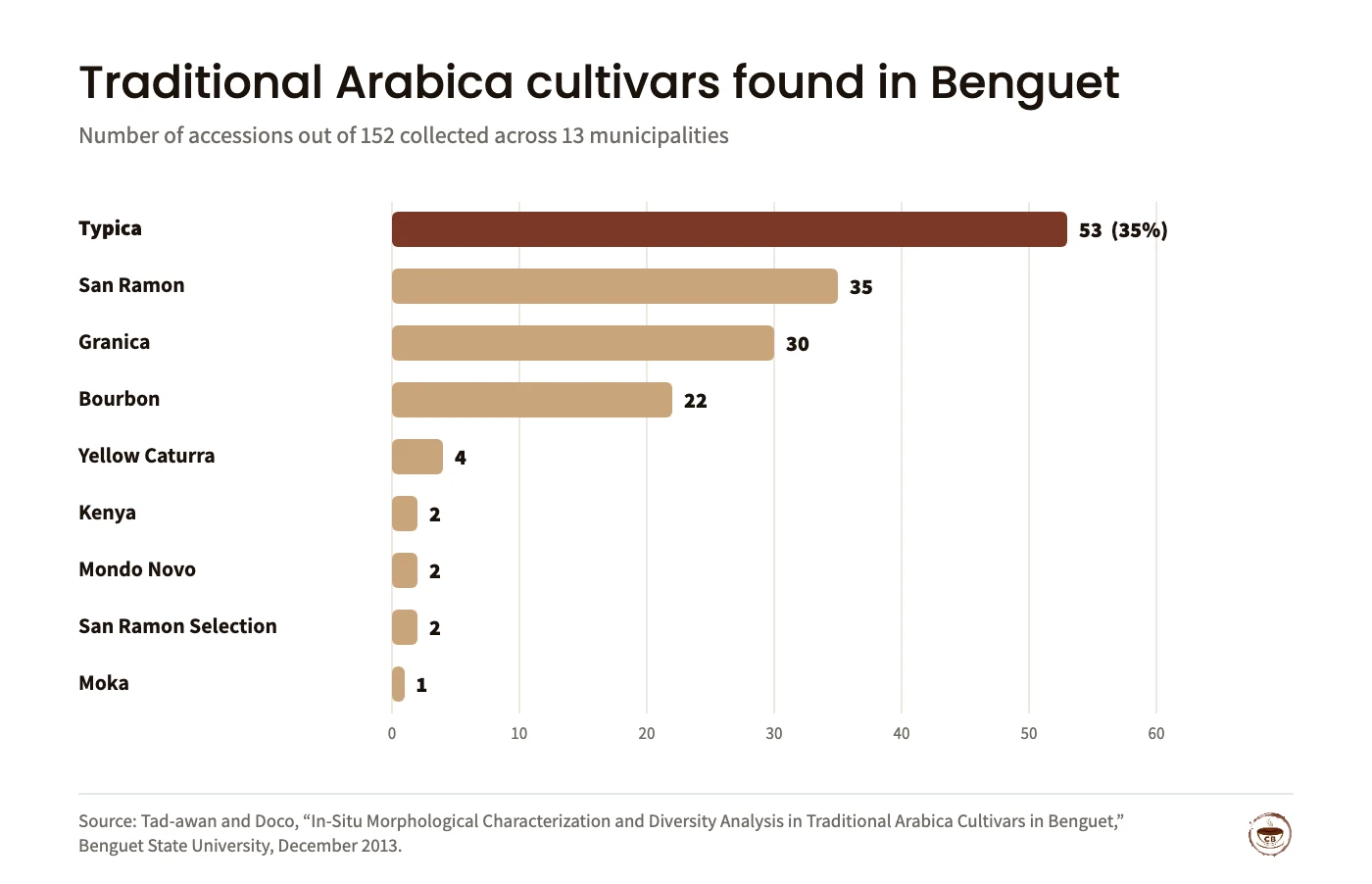
- Tad-awan and Doco (Benguet State University, 2013) found Typica in 53 of 152 traditional Arabica accessions across 13 Benguet municipalities, about 35%.
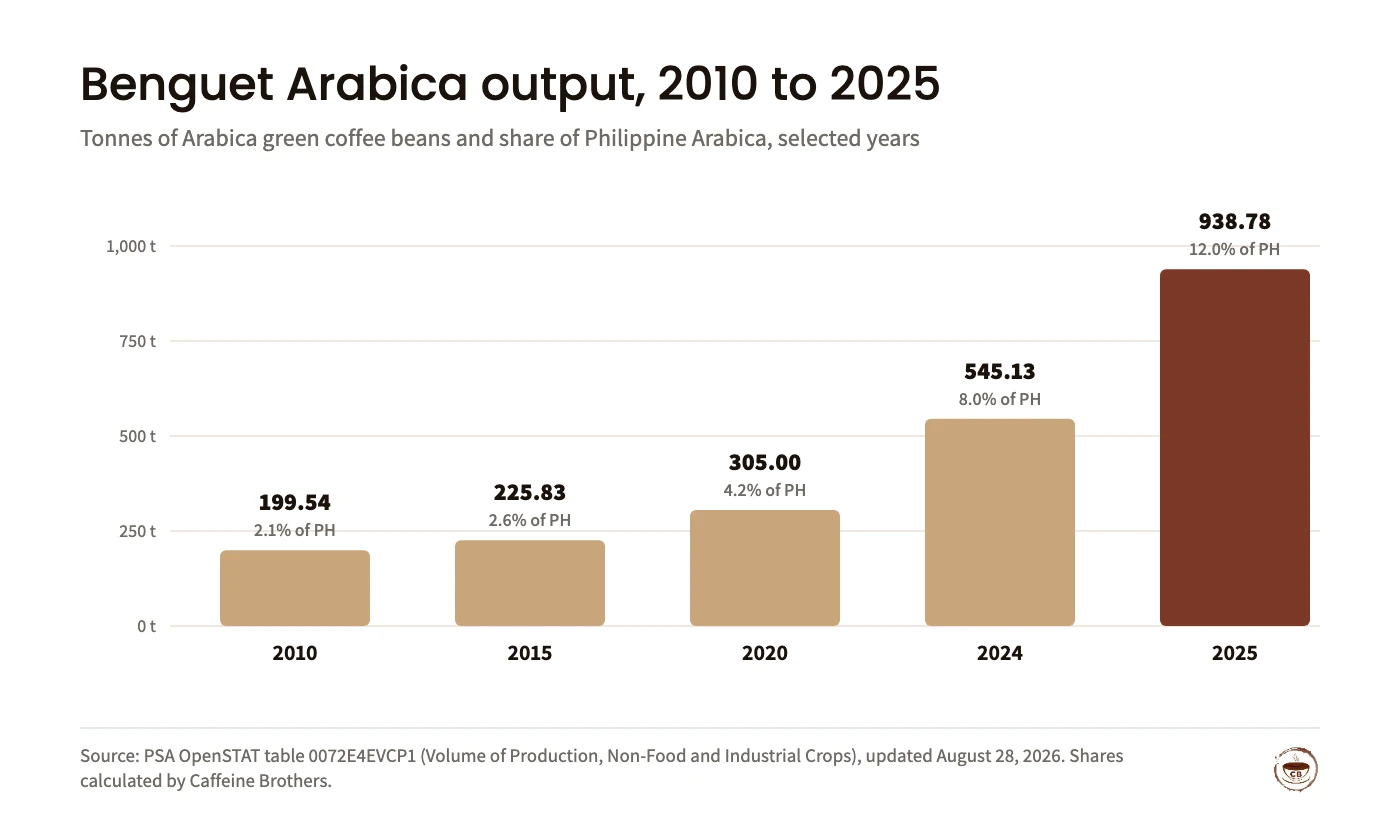
- Benguet produced 938.78 tonnes of Arabica green coffee beans in 2025, 12.0% of the national 7,849.82 tonnes and 4.7 times its 2010 output (PSA OpenSTAT, updated August 28, 2026).
- Slow Food’s Ark of Taste lists Benguet coffee from Atok as a Typica at about 1,600 meters and warns that old, unpruned trees are cutting production.
What is Typica coffee?
Typica is a variety of Coffea arabica, the species behind most specialty coffee. World Coffee Research (WCR), the industry-funded research group that keeps the most used variety catalog, calls it “one of the most culturally and genetically important C. arabica coffees in the world.” It also lists several other names for the same line, including Criollo, Arábigo, Blue Mountain and Sumatra.
On the farm, WCR describes Typica as “a tall variety characterized by very low production, susceptibility to the major diseases, and good cup quality.” The plant grows tall, its new leaves come out bronze, and its beans are large. It needs medium fertilization and starts bearing in its fourth year.
That combination explains both why Typica is admired and why many farms replaced it. It can taste very good at altitude, but it gives fewer cherries per tree than modern varieties and has little defense against coffee leaf rust.
Try Benguet Arabica
Our Arabica Coffee Beans from Benguet are medium roasted daily: floral aroma, bright acidity, smooth finish. From ₱292 (200 g) to ₱1,068 (1 kg).
Shop Arabica →Where did Typica come from?
Arabica coffee comes from Ethiopia and was taken to Yemen in the 15th or 16th century, according to WCR. From Yemen, seeds reached India. Typica descends from the Indian seeds that the Dutch took to Java. A genetic study by Scalabrin and colleagues in Scientific Reports (2020) traces the Indian seeds to around 1670 and says they “gave rise to the Typica variety after the Dutch brought some seeds from India to today’s Indonesia in 1696 and 1699.”
| Year | Event | Source |
|---|---|---|
| 15th or 16th century | Arabica taken from Ethiopia to Yemen | WCR |
| 1696 and 1699 | Seeds sent from India’s Malabar coast to Batavia (Java) | WCR; Scalabrin et al. 2020 |
| 1706 | A single Typica plant taken from Java to the Amsterdam botanical garden | WCR (VERA Files gives 1711) |
| 1714 | A plant shared with France | WCR |
| 1719 to 1723 | Typica reaches the Americas (Suriname 1719 per WCR; 1723 per Scalabrin) | WCR; Scalabrin et al. 2020 |
| 1730 to 1779 | Jamaica 1730, Santo Domingo 1735, Cuba 1748, Costa Rica 1779 | WCR |
| Until the 1940s | Most plantations in South and Central America planted with Typica | WCR |
The sources do not agree on every date. WCR gives 1706 for the plant that went to Amsterdam, while a 2022 VERA Files article gives 1711. WCR dates Typica’s arrival in the Americas to Dutch Guiana (Suriname) in 1719, while Scalabrin and colleagues give 1723. We show both where they differ.
WCR says Typica is still widely planted in Peru, the Dominican Republic and Jamaica, where it is sold as Jamaica Blue Mountain.
How does Typica compare with Bourbon and Catimor?
Bourbon is Typica’s sister line. French missionaries took Arabica from Yemen to Bourbon Island, now Réunion, in the early 1700s, and its descendants form the other half of the Bourbon-Typica group. Catimor varieties are much newer crosses between Caturra and the Timor Hybrid, bred for rust resistance and yield. We covered Catimor in more detail in our Catimor guide.
| Trait (WCR rating) | Typica | Bourbon | Costa Rica 95 (Catimor) |
|---|---|---|---|
| Stature | Tall | Tall | Dwarf/compact |
| Bean size | Large | Average | Average |
| Yield potential | Low | Medium | High |
| Quality potential at high altitude | Very good | Very good | Low |
| Optimal altitude | High | High | Low to medium |
| Coffee leaf rust | Susceptible | Susceptible | Susceptible (resistance has broken down in Costa Rica) |
| Nematodes | Susceptible | Susceptible | Susceptible |
| First production | Year 4 | Year 4 | Year 3 |
| Planting density | 3,000 to 4,000 per ha | 3,000 to 4,000 per ha | 5,000 to 6,000 per ha |
| Nutrition requirement | Medium | Medium | High |
WCR’s “high” altitude band depends on latitude. For farms between 5° and 15° from the equator it means above 1,300 meters, and above 15° it means above 1,000 meters. Benguet sits at about 16°N, so most of its 1,000 to 1,800 meter coffee farms fall in the high band for Typica by WCR’s definition.
Why does Typica have so little genetic variety?
All the Typica trees in the world trace back to a few seeds. Scalabrin and colleagues genotyped 736 Arabica accessions and found that cultivated Arabica passed through a recent and severe bottleneck. They write that breeders in Latin America worked from “these two narrow genetic bases,” Typica and Bourbon, and that the resulting cultivars show “high susceptibility to the major coffee diseases and pests.”
A 2022 study by Montagnon and colleagues in Agronomy, based on 555 samples, places the Typica/Bourbon cluster mainly in the Ibb and Dhamar areas of Yemen. It found 30 alleles in that cluster against 39 in the “Ethiopian Legacy” group.
This matters in the Philippines because coffee leaf rust has already wiped out a Typica-era industry once. The Philippine Coffee Board writes that the country was reputed to be the fourth largest coffee exporter by 1886, that the boom “lasted until 1889,” and that after rust hit in 1891 production fell to one sixth within two years.
Is Typica grown in the Philippines?
Yes, and it is the variety most tied to Benguet. Three sources point the same way.
- Tad-awan and Doco of Benguet State University collected 152 traditional Arabica accessions across 13 Benguet municipalities. “Typica had the highest number of accessions with 53,” followed by San Ramon (35), Granica (30) and Bourbon (22). Most were found at 1,001 to 2,000 meters, and the Typica cluster came mostly from Atok and Kibungan. The paper was published in the BSU research journal in December 2013.
- A 2017 SunStar report on a BSU study in Mountain Province found five varieties in 101 accessions and called Typica “the original variety grown in the Province.”
- Slow Food’s Ark of Taste entry for Benguet coffee (page modified December 8, 2018) describes it as “a Typica variety from the Arabica species, that has adapted to the local conditions,” grown at about 1,600 meters in Atok, mainly by Igorot farmers.
The Philippine Coffee Board’s profile for the Cordillera lists the varieties grown there as Red Bourbon, Yellow Bourbon, Typica, Mondo Novo and Caturra, at 1,000 to 1,800 meters above sea level.
How Typica first reached the Cordillera is less clear. An Inquirer feature on Cordillera coffee says Arabica was first introduced in Galiano (now Aringay, La Union) by military governor Manuel Scheidnagel in 1875 and “transplanted in 1877” to highland plateaus at about 1,219 meters. Slow Food says Benguet coffee has been grown “for over 80 years,” which would place it in the 20th century. The two may describe different plantings. The often-told story of a Franciscan friar planting coffee in Lipa in 1740 is called a “myth” on the Philippine Coffee Board’s own history page, and a 2022 VERA Files report quoting food historian Felice Prudente Sta. Maria calls it apocryphal.
How much Arabica does Benguet produce?
The Philippine Statistics Authority (PSA) does not count coffee by variety, so there is no official Typica figure. It does count Arabica by province. Benguet’s Arabica output has risen sharply while the national total fell.
| Year | Benguet Arabica (t) | Cordillera Arabica (t) | Philippine Arabica (t) | Benguet share of PH Arabica |
|---|---|---|---|---|
| 2010 | 199.54 | 275.16 | 9,710.26 | 2.1% |
| 2015 | 225.83 | 291.04 | 8,716.97 | 2.6% |
| 2020 | 305.00 | 347.47 | 7,328.73 | 4.2% |
| 2024 | 545.13 | 587.04 | 6,835.70 | 8.0% |
| 2025 | 938.78 | 977.75 | 7,849.82 | 12.0% |
In 2025 Benguet grew 96.0% of the Cordillera’s Arabica. Its output was 4.7 times the 2010 level, while national Arabica output was 19.2% lower than in 2010. Arabica made up 22.0% of all Philippine green coffee beans in 2025 (7,849.82 of 35,645.64 tonnes). Our Benguet coffee guide has the full Cordillera picture.
Slow Food’s warning still stands next to those numbers. Its entry says the variety “is in danger of extinction because many farmers are not able to prune or rejuvenate their old trees.” Rising provincial output and ageing Typica trees can both be true, since farms also grow San Ramon, Granica, Bourbon and newer varieties.
What does Typica taste like?
WCR rates Typica’s quality potential at high altitude as very good and calls its cup quality good, with high quality in Central America. It does not publish flavor notes for the variety, and taste depends as much on altitude, picking, processing and roasting as on variety. We have not run a tasting of Typica against other varieties, so we make no flavor claim of our own.
Competition results do not settle the question either. Benguet’s Oliver Oliem won the Arabica category of the 2018 Philippine Coffee Quality Competition with 87.06 points (SunStar, March 24, 2018), but none of the reports we read named the variety of his lot. See our PCQC guide for later results.
How to buy and brew a Typica or Benguet Arabica
- Ask for the variety. Many Philippine roasters, including us, sell Benguet Arabica without a variety label because farms grow mixed cultivars. If the variety matters to you, ask the seller whether the lot is Typica and how they know.
- Check the altitude and town. Atok and Kibungan were the main Typica areas in the BSU survey. Lots from 1,000 meters and above fit WCR’s high-altitude band for Benguet’s latitude.
- Pick a medium roast to start. A medium roast keeps more of the bean’s own character than a dark roast; our roast level guide explains the difference.
- Weigh the dose. We plan cups at 10 g of coffee. At our November 15, 2026 prices, 10 g of Benguet Arabica costs ₱10.68 from a 1 kg bag (₱1,068) and ₱14.60 from a 200 g bag (₱292).
- Use it fresh. Buy whole beans or a grind matched to your brewer, and finish the bag within a few weeks of roasting.
Frequently asked questions
What is Typica coffee?
Typica is one of the oldest cultivated varieties of Coffea arabica. World Coffee Research describes it as a tall variety with large beans, low yield, very high susceptibility to coffee leaf rust and good cup quality at high altitude.
Is Typica grown in the Philippines?
Yes. A Benguet State University survey published in 2013 found Typica to be the most common traditional Arabica cultivar in Benguet, with 53 of 152 accessions, mostly in Atok and Kibungan. Slow Food lists Benguet coffee, a Typica grown at about 1,600 meters in Atok, in its Ark of Taste.
Is Typica better than Catimor?
They suit different farms. World Coffee Research rates Typica’s quality potential at high altitude as very good and Costa Rica 95, a Catimor, as low, but Costa Rica 95 has high yield potential, bears from year 3 and grows best at low to medium altitude. Typica has low yield and very high rust susceptibility.
Is Caffeine Brothers Arabica a Typica?
Our Arabica is grown in Benguet and roasted medium, but we do not label it by variety. Benguet farms grow a mix of traditional cultivars, including Typica, San Ramon, Granica and Bourbon.
Sources
- Typica. World Coffee Research varieties catalog, modified May 25, 2023. Traits, history, other names
- Bourbon. World Coffee Research varieties catalog, modified June 3, 2024. Comparison traits
- Costa Rica 95. World Coffee Research varieties catalog, modified May 15, 2023. Catimor comparison
- A single polyploidization event at the origin of the tetraploid genome of Coffea arabica is responsible for the extremely low genetic variation in wild and cultivated germplasm. Scalabrin et al., Scientific Reports 10:4642, 2020. Typica origin and bottleneck
- Deciphering Early Movements and Domestication of Coffea arabica. Montagnon et al., Agronomy 12(12):3203, 2022. Typica/Bourbon cluster in Yemen
- In-Situ Morphological Characterization and Diversity Analysis in Traditional Arabica Cultivars in Benguet. Tad-awan and Doco, Benguet State University, December 13, 2013. 152 accessions, 53 Typica
- Benguet Coffee. Slow Food Foundation Ark of Taste, modified December 8, 2018. Atok Typica, 1,600 m
- Philippine Coffee. Philippine Coffee Board, published March 22, 2012, modified January 4, 2021. History and Cordillera varieties
- Kape: Myths, tall tales and history. VERA Files, October 14, 2022. Lipa friar story
- Cordillera brew fuels generations. Philippine Daily Inquirer. 1875 and 1877 introduction
- Non-Food and Industrial Crops: Volume of Production by Province (0072E4EVCP1). PSA OpenSTAT, updated August 28, 2026. Arabica output
- Arabica coffee, identified diseases in Mountain Province. SunStar Baguio, April 26, 2017. Mountain Province varieties
- Ilocos, Benguet coffee named best in PH. SunStar, March 24, 2018. 2018 PCQC Arabica winner
Cite this article: Caffeine Brothers. “Typica Coffee: The Heirloom Arabica Behind Benguet Coffee.” Caffeine Brothers Coffee Blog, November 2026. https://caffeinebrothers.co/typica-coffee/
You are welcome to reference the charts and tables in this article with a link back to this page.
Want to taste Benguet Arabica? Our Arabica coffee beans are grown in Benguet and roasted medium every day. Browse the rest of the shop, see wholesale 10 kg boxes for cafés, or contact us with questions.
 Previous Post
 Next Post