Medium Roast vs Dark Roast Coffee: Caffeine, Taste and Weight
By Robin Salvador, co-founder, Caffeine Brothers
Last updated: October 25, 2026
Quick answer: Medium roast coffee is roasted until the beans are medium brown with a dry surface. Dark roast goes further, past the start of the second crack, until the beans are shiny, oily and close to black. Dark roasts taste more bitter and less acidic. Medium roasts keep more of the bean’s own flavour and acidity. Caffeine is about the same: most studies we read found little or no difference by roast. Dark roasts do lose more weight in the roaster, about 15% to 16% against about 13% for a medium roast.
Key takeaways
- Sweet Maria’s measured average weight loss of 13.3% at City+ (a medium roast), 15.1% at Full City+ and 15.6% at French roast (dark).
- That means about 1.153 kg of green coffee for each kilo of City+ roast and 1.185 kg for French roast, 31 g more.
- In a 2022 study of Arabica from three roasters, caffeine was 11.9 to 13.0 mg per gram across light, medium and dark roasts, with no significant difference.
- Other studies disagree: one found less caffeine in darker roasts and one found more in brewed coffee. The National Coffee Association says light roasts have slightly more.
- Chlorogenic acids and acidity fell with darker roasting in most studies we read.
What is the difference between medium and dark roast?
Roasting heats green coffee until it turns brown, loses most of its moisture and develops the aroma we know. The National Coffee Association (NCA) groups roasts into three colour bands. Medium roast is “medium brown in color with a stronger flavor and a non-oily surface.” Dark roast “produces shiny black beans with an oily surface and a pronounced bitterness.” Names such as Full City, Vienna, French and Italian describe points along that range, and the NCA warns that one roaster’s dark can differ from another’s.
Roasters often judge the stage by sound. At first crack the beans pop like popcorn. Sweet Maria’s describes City+ as just past first crack, Full City as on the verge of second crack, and Vienna to French as second crack under way, the point where roast character starts to overshadow the bean’s origin. Our guide to roast levels explains the whole range from light to dark.
| Medium roast | Dark roast | |
|---|---|---|
| Colour and surface | Medium brown, dry surface | Shiny, dark brown to black, oily surface |
| Roast stage | After first crack, before second crack | Into or through second crack |
| Acidity | Higher | Lower |
| Taste | More of the bean’s origin flavour | Roast flavour, more bitterness |
| Caffeine per gram | About the same in most studies | About the same in most studies |
| Weight lost in the roaster | About 13% to 14.5% (City+ to Full City) | About 15% to 16% (Full City+ to French) |
| Arabica roast temperature in one study | 202 °C to 209 °C | 212 °C to 217 °C |
Does dark roast have more caffeine?
This is the most common question, and the research does not give one neat answer. The NCA says light roasts have “a slightly higher amount of caffeine” and that the bold taste of a dark roast is not linked to caffeine. Caffeine is fairly stable under heat, which is why several studies find almost no change. Here is what the studies we read actually measured.
| Study | Coffee tested | What happened to caffeine in darker roasts |
|---|---|---|
| Hečimović et al., Food Chemistry, 2011 | Two Arabica and two Robusta varieties, light, medium and dark | Decreased. Light-roasted Robusta (“Cherry”) had the most caffeine of all samples. |
| Montenegro et al., Food Research International, 2021 | Arabica, green plus light, medium and dark | Not affected by roasting. |
| Kim et al., Food Science and Biotechnology, 2021 | Ethiopian Arabica, four roasts, brewed as espresso and drip | Increased in the brewed coffee. |
| Cwiková et al., Foods, 2022 | 15 Arabica samples, light, medium and dark | No significant difference (11.9 to 13.0 mg per g). |
| Król et al., as cited by Cwiková et al. | Not described in the citing paper | Decreased: 6.42 (light), 5.77 (medium), 2.63 (dark) mg per g. |
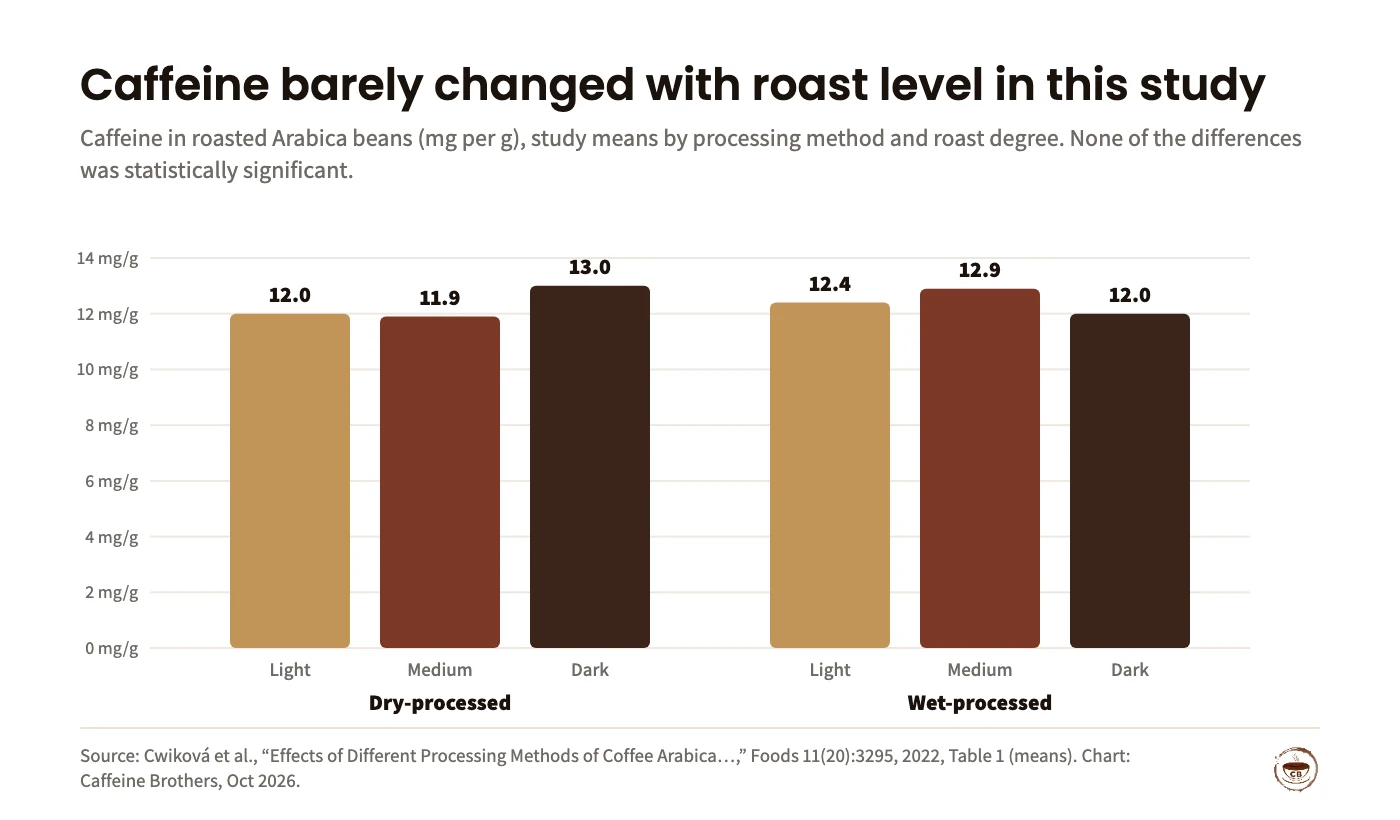
Using the Cwiková figures, a 10 g dose of roasted Arabica holds about 119 mg to 130 mg of caffeine in the beans, whatever the roast. How much ends up in the cup depends on the brewing method. The species makes a bigger difference than the roast: Robusta generally has more caffeine than Arabica, as we explain in Robusta vs Arabica vs Barako caffeine. At Caffeine Brothers our dark roasts are Robusta and Liberica and our medium roast is Arabica, so our dark roasts may well carry more caffeine, but because of the bean, not the roast.
One more practical point: if you measure coffee by the scoop rather than by weight, roast level can change how many grams you get, because beans swell as they roast. We did not find a measured figure for this, so the simplest fix is to weigh your coffee.
How much weight does coffee lose in a medium vs dark roast?
Coffee loses water and some mass as it roasts. Sweet Maria’s, a US green coffee seller, publishes average weight loss by roast stage from air and drum roasters. It notes that your own roaster may differ, and a commenter reports reaching City+ at 16% on a Probat drum roaster.
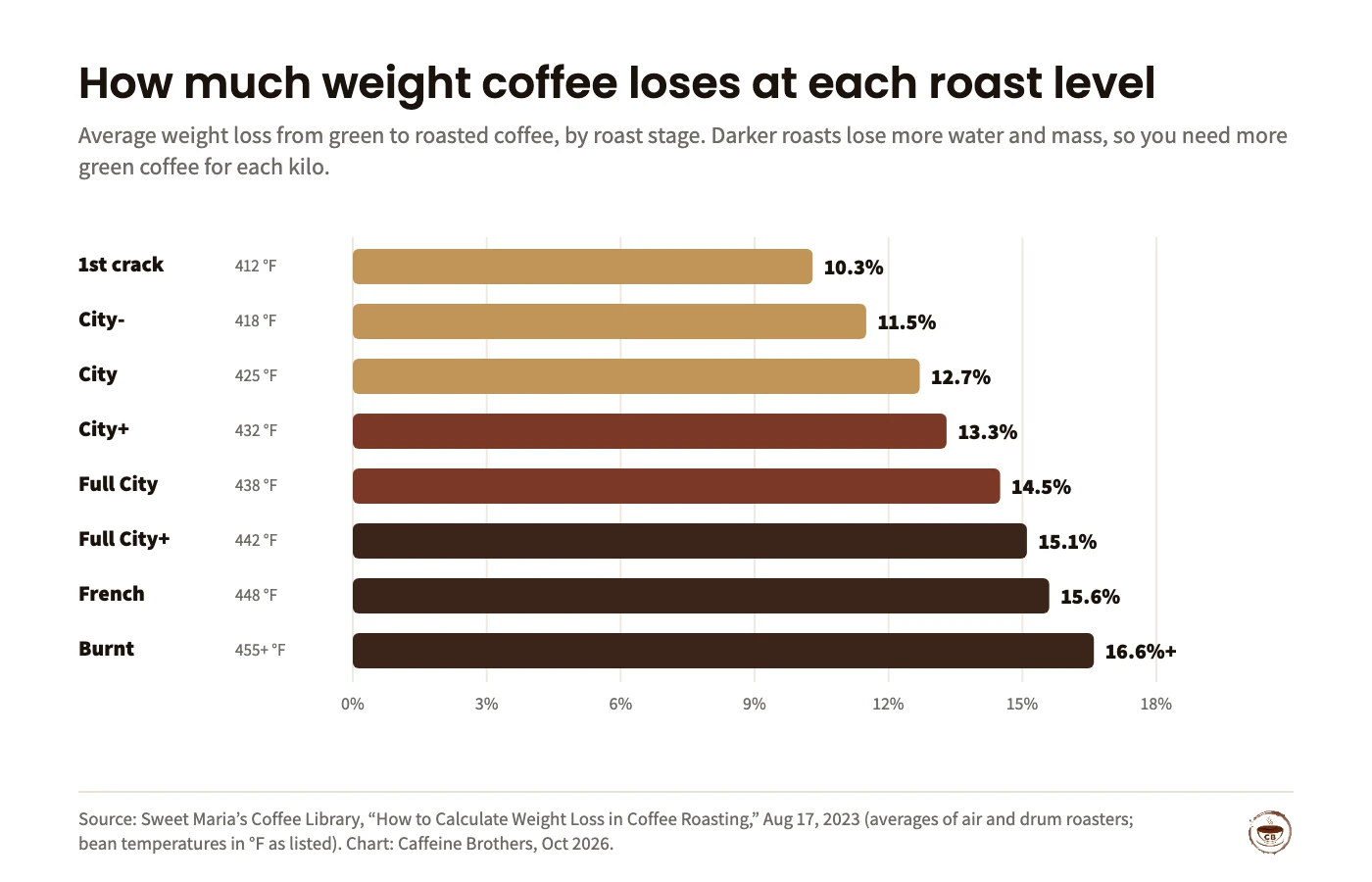
| Roast stage | Weight loss | Green coffee for 1 kg roasted | Green bean cost per roasted kg at ₱228.67/kg (Robusta) | Green bean cost per roasted kg at ₱264.65/kg (Arabica) |
|---|---|---|---|---|
| City+ (medium) | 13.3% | 1.153 kg | ₱263.75 | ₱305.25 |
| Full City (medium-dark) | 14.5% | 1.170 kg | ₱267.45 | ₱309.53 |
| Full City+ (dark) | 15.1% | 1.178 kg | ₱269.34 | ₱311.72 |
| French (dark) | 15.6% | 1.185 kg | ₱270.94 | ₱313.57 |
The difference between a medium and a dark roast works out to about 31 g of green coffee per roasted kilo, or around ₱7 to ₱8 at 2025 farmgate prices. It is a small part of what you pay for roasted coffee, so roast level is mainly a taste choice, not a price one.
Temperatures vary by roaster too. In the Cwiková study, the three roasters reported light roasts at 194 °C to 197 °C, medium at 202 °C to 209 °C and dark at 212 °C to 217 °C. Sweet Maria’s lists higher bean temperatures (City+ at 432 °F, about 222 °C) and says to “take the temperatures as a ballpark figure.” Each roaster measures differently, so colour, sound and weight loss are better guides than a single number.
How do medium and dark roasts taste?
The NCA says that “the lighter the roast, the more acidic your brewed coffee will be,” and that darker roasts are less acidic still, with more bitterness. Lab work points the same way. Kim et al. (2021) found that reducing sugars, titratable acidity, organic acids and chlorogenic acid all fell as the roast got darker. Bolka and Emire (2020) found that trigonelline and total chlorogenic acids dropped during roasting, with darker roasts lowest. In the Cwiková study, roast degree explained 46% of the variation in chlorogenic acid, though the pattern there was less tidy.
In plain terms: a medium roast tastes more of where the coffee came from, with brighter acidity. A dark roast tastes more of the roast itself, with more bitterness and body and less acidity. Neither is better. The NCA’s advice is to try different roasts and see what you like.
Which should you choose? A five-step guide
- Start with how you drink it. If you take coffee black and like bright, lighter flavours, start with a medium roast. If you add milk, condensed milk or sugar, many people find a dark roast stands up better.
- Pick the bean, then the roast. Species changes caffeine and taste more than roast does. In our range, the Arabica is a medium roast and the Robusta and Liberica are dark.
- Match the brewer. The NCA notes that espresso roasts are often medium to dark. For brewers, grind sizes and ratios, see our brewing methods comparison.
- Weigh, don’t scoop. Use a scale so you know the dose. That way, a change in roast changes the taste, not the strength.
- Brew it fresh. The NCA suggests resting roasted beans about 2 to 3 days and brewing them about 2 to 7 days after roasting for peak flavour.
Medium and dark roasts at Caffeine Brothers
We roast daily in Manila. Here is how our coffees line up by roast, with prices from our shop on October 25, 2026.
| Coffee | Origin | Roast | 200 g | 1 kg | Per 10 g cup (1 kg) |
|---|---|---|---|---|---|
| Arabica | Benguet | Medium | ₱292 | ₱1,068 | ₱10.68 |
| CB’s Finest Signature Blend | Batangas and Benguet | Medium and dark blend | ₱244 | ₱866 | ₱8.66 |
| Robusta | Batangas | Dark | ₱231 | ₱813 | ₱8.13 |
| Kapeng Barako (Liberica) | Batangas | Dark | ₱242 | ₱858 | ₱8.58 |
If you want both, CB’s Finest is our mix of medium and dark roasted coffee. For a strong, traditional dark roast, read more about kapeng barako.
Frequently asked questions
Does dark roast coffee have more caffeine than medium roast?
Not in any consistent way. Two studies we read found no significant difference, one found less caffeine in darker roasts and one found more in the brewed coffee. The National Coffee Association says light roasts have slightly more caffeine and that a dark roast’s strong taste is not a sign of more caffeine. The coffee species and how much you use matter more.
Is dark roast less acidic than medium roast?
Yes, in taste and in lab measurements. The National Coffee Association says darker roasts brew less acidic coffee, and a 2021 study of Ethiopian Arabica found titratable acidity and chlorogenic acid fell as the roast got darker.
Which is better for espresso and milk drinks?
It depends on what you like. The National Coffee Association notes that coffee sold as an espresso roast is often medium to dark. Darker roasts bring more bitterness and body, which many people like with milk, while medium roasts keep more of the bean’s own flavour.
Which Caffeine Brothers coffees are medium and dark roast?
Our Benguet Arabica is a medium roast. Our Batangas Robusta and Kapeng Barako (Liberica) are dark roasts. CB’s Finest Signature Blend mixes medium and dark roasted coffee from Batangas and Benguet.
Sources
- Roasts. National Coffee Association, About Coffee, updated January 14, 2025. Used for roast colour bands, acidity, caffeine and resting/brewing times.
- How to Calculate Weight Loss in Coffee Roasting. Sweet Maria’s Coffee Library, August 17, 2023. Used for weight loss and bean temperature by roast stage and the formula.
- Using Sight to Determine Degree of Roast. Sweet Maria’s Coffee Library, published August 1, 2022, modified January 9, 2023. Used for roast stage descriptions and the “ballpark” note on temperatures.
- Effects of Different Processing Methods of Coffee Arabica on Colour, Acrylamide, Caffeine, Chlorogenic Acid, and Polyphenol Content. Cwiková et al., Foods 11(20):3295, October 2022. Used for caffeine and chlorogenic acid by roast (Table 1), roast temperatures and the Król et al. figures.
- Comparative study of polyphenols and caffeine in different coffee varieties affected by the degree of roasting. Hečimović et al., Food Chemistry 129(3):991 to 1000, 2011. Used for the finding that caffeine fell with darker roasting.
- Bioactive compounds… of green and roasted coffee extracts obtained by microwave-assisted extraction. Montenegro et al., Food Research International 140:110014, 2021. Used for caffeine not affected by roasting and chlorogenic acid degradation.
- Physicochemical characteristics of Ethiopian Coffea arabica cv. Heirloom coffee extracts with various roasting conditions. Kim et al., Food Science and Biotechnology 30(2):235 to 244, 2021. Used for acidity, chlorogenic acid and caffeine trends in brewed coffee.
- Effects of coffee roasting technologies on cup quality and bioactive compounds of specialty coffee beans. Bolka and Emire, Food Science and Nutrition 8(11):6120 to 6130, 2020. Used for trigonelline and chlorogenic acid falling with darker roasts.
- Commercial Crops: Farmgate Prices by Commodity, Region and Province. PSA OpenSTAT, table 0032M4AFN08, updated August 28, 2026. Used for 2025 green Robusta and Arabica farmgate prices.
- Caffeine Brothers shop prices. Checked October 25, 2026 through the store’s product feed. Used for our prices and roast levels.
Cite this article: Caffeine Brothers. “Medium Roast vs Dark Roast Coffee: Caffeine, Taste and Weight.” Caffeine Brothers Coffee Blog, October 2026. https://caffeinebrothers.co/medium-roast-vs-dark-roast/
You are welcome to reference the charts and frameworks in this article with a link back to this page.
Want to taste the difference yourself? Order our medium roast Benguet Arabica and dark roast Batangas Robusta, roasted daily and delivered nationwide, or browse the full shop. Buying for a café or office? See wholesale or contact us.
 Previous Post
 Next Post