
Sarangani Coffee: Output, Prices and Farms in 2026
By Robin Salvador, co-founder, Caffeine Brothers
Last updated: November 18, 2026
Quick answer: Sarangani coffee is coffee grown in the uplands of Sarangani province in SOCCSKSARGEN (Region XII), mostly by indigenous Blaan, Tagakaulo and T’boli farmers. PSA data show the province produced 181.47 metric tons of green coffee beans in 2025, about 0.51% of the national total, with an unusually high Arabica share of 42%. Output is down 36% from its 2019 peak even though the planted area nearly doubled since 2010, and Sarangani farmers were paid far less per kilo of Robusta than the national average in 2025.
Key takeaways
- 2025 output: 181.47 t of green coffee beans (Robusta 93.04 t, Arabica 76.48 t, Excelsa 11.95 t), PSA OpenSTAT.
- Sarangani ranked 25th among provinces for total coffee and 11th for Arabica in 2025, and last of the four provinces in Region XII.
- Coffee area grew from 667 ha (2010) to 1,239.17 ha (2025), but output fell from 283.75 t (2019) to 181.47 t.
- The 2025 Robusta farmgate price was ₱98.14/kg in Sarangani vs ₱228.67/kg nationally. Monthly prices rose to ₱200 from April 2026.
- Malungon farmers won the top two Fine Robusta places (83.58 and 83.33) at the first Kape Sarangani competition in 2022.
Where is Sarangani coffee grown?
Sarangani is the province at the southern tip of Mindanao that wraps around Sarangani Bay, next to General Santos City. PhilAtlas, using PSA census data, lists a land area of 3,642.16 km² and a 2020 population of 558,946 across seven municipalities. Malungon is the largest town by area at 750.92 km².
The Department of Agriculture’s SAAD program describes the province’s upland areas as supporting “corn and coffee production” and names the indigenous Blaan, Tagakaulo and T’boli communities who farm them. The same page calls Sarangani “one of the poorest provinces in the country,” which is why it is a SAAD target province. Coffee here is mostly a smallholder crop grown alongside corn, bananas and other upland crops.
Sarangani sits in the same region as the country’s top producer. In 2025 its neighbour Sultan Kudarat produced 15,689.08 t, more than 86 times Sarangani’s volume, and South Cotabato produced 596.64 t.
How much coffee does Sarangani produce?
The Philippine Statistics Authority (PSA) publishes coffee output by province in OpenSTAT. The production table was last updated August 28, 2026 and runs to 2025. All figures below are green coffee beans (GCB), the dried and hulled beans before roasting.
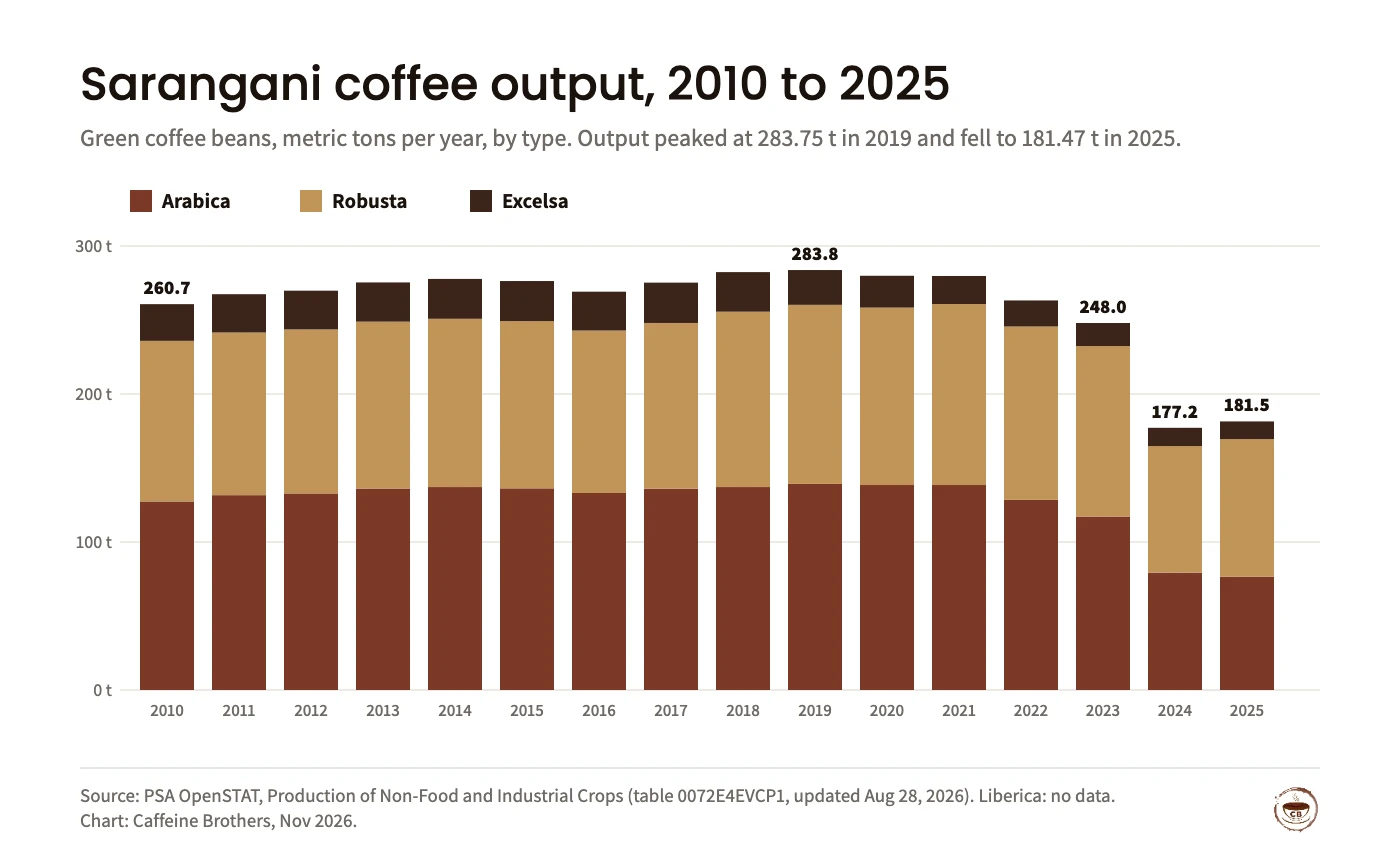
Output was steady at 260 to 284 t a year from 2010 to 2021, peaking at 283.75 t in 2019. It then slid to 247.96 t in 2023 and dropped 28.6% to 177.16 t in 2024, mostly because Arabica fell from 117.21 t to 79.26 t. In 2025 it edged up 2.4% to 181.47 t. Over the same 15 years the Philippines fell 24.6% and Region XII grew 20.1%, so Sarangani’s 30.4% decline is steeper than the national trend and runs against its region.
| Measure (2025) | Sarangani | Philippines |
|---|---|---|
| Green coffee beans | 181.47 t | 35,645.64 t |
| Arabica share of output | 42.1% | 22.0% |
| Robusta share of output | 51.3% | 72.2% |
| Area planted/harvested | 1,239.17 ha | 124,982.58 ha |
| Bearing trees | 387,728 | 84,839,827 |
| Output per hectare | 0.146 t | 0.285 t |
| Output per bearing tree | 0.468 kg | 0.420 kg |
| Change in output since 2010 | −30.4% | −24.6% |
Why is Sarangani’s yield per hectare so low?
The area numbers tell a different story from the output numbers. PSA puts Sarangani’s coffee area at 667 ha in 2010 and 1,239.17 ha in 2025, an 85.8% increase. Bearing trees rose only 11.2% over the same period, from 348,670 to 387,728. As a result, output per hectare fell from 0.391 t in 2010, level with the national 0.389 t, to 0.146 t in 2025, about half the national 0.285 t.
PSA does not explain the gap. One reading is that much of the added area holds young or sparsely planted trees that are not yet bearing; Sarangani has 313 bearing trees per hectare against 679 nationally. Seedling programs fit that picture: in January 2026 DA-SAAD delivered 4,000 more coffee seedlings worth ₱880,000 to a workers’ association in Poblacion, Malapatan, on a production area of about 15 hectares. We could not find a provincial hectare count to compare with PSA.
| Type (2025) | Output | Area | Bearing trees | t/ha (PH) | kg/tree (PH) |
|---|---|---|---|---|---|
| Arabica | 76.48 t | 563.67 ha | 214,228 | 0.136 (0.520) | 0.357 (0.738) |
| Robusta | 93.04 t | 623.50 ha | 155,351 | 0.149 (0.255) | 0.599 (0.372) |
| Excelsa | 11.95 t | 52.00 ha | 18,149 | 0.230 (0.266) | 0.658 (0.465) |
| All coffee | 181.47 t | 1,239.17 ha | 387,728 | 0.146 (0.285) | 0.468 (0.420) |
Robusta is the bright spot. Each bearing Robusta tree in Sarangani gave 0.599 kg of green beans in 2025, well above the national 0.372 kg. Arabica trees gave less than half the national figure per tree, and Arabica output has fallen 40% since 2010.
What do Sarangani coffee farmers get paid?
PSA’s farmgate price table (0032M4AFN08, updated August 28, 2026) reports the average price paid to farmers. Sarangani has a full Robusta series. Arabica has only one annual value (₱215.23/kg in 2024) and there is no Excelsa price.
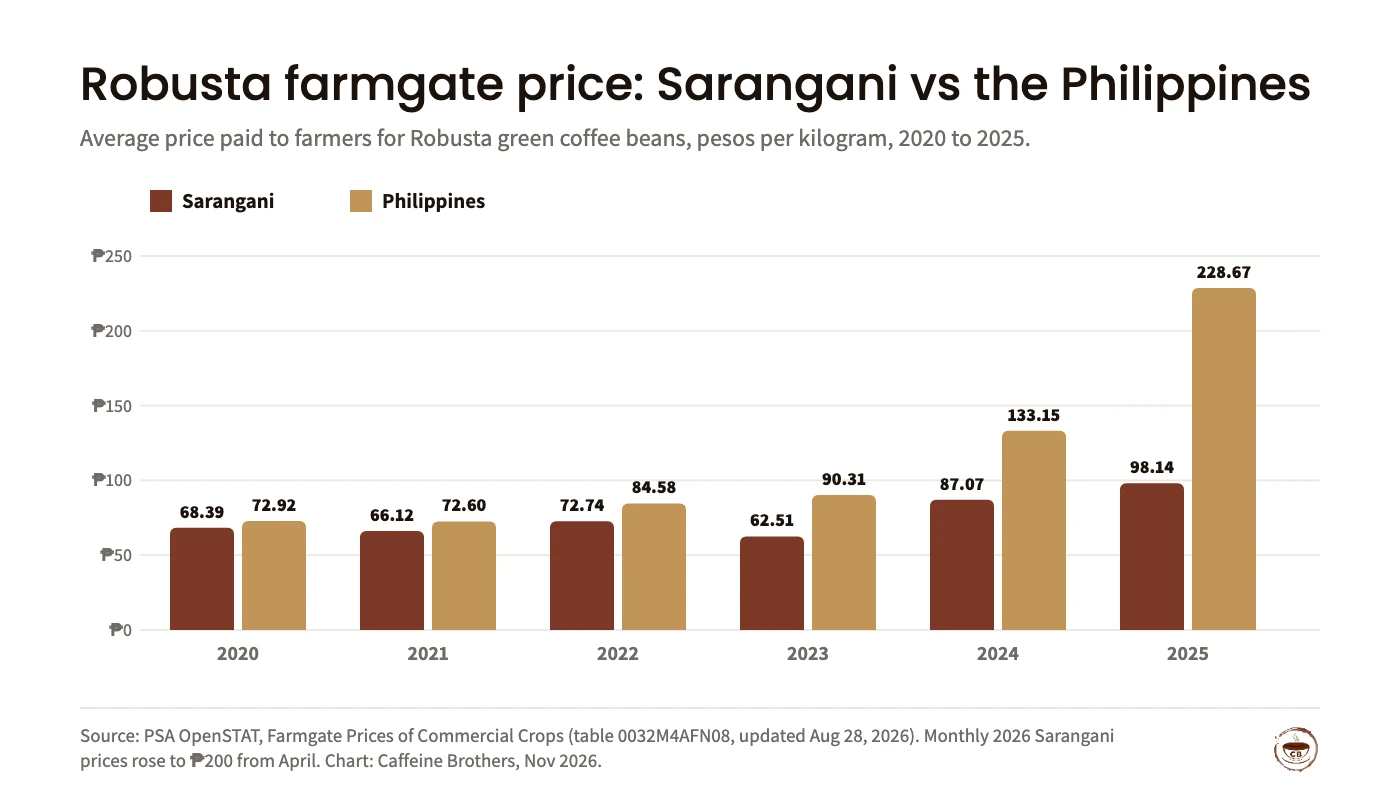
In 2020 Sarangani farmers got 93.8% of the national average Robusta price. By 2025 they got 42.9%: ₱98.14 against ₱228.67 per kilo. The national price more than tripled from 2020 to 2025 (+213.6%) as world prices rose, while Sarangani’s rose 43.5%. We discussed those national swings in our coffee price guide.
| Month (2026) | Sarangani Robusta | Philippines Robusta | Sarangani Arabica |
|---|---|---|---|
| January | ₱91.00 | ₱228.03 | no data |
| February | ₱95.00 | ₱224.23 | no data |
| March | ₱100.00 | ₱208.80 | no data |
| April | ₱200.00 | ₱220.19 | ₱215.00 |
| May | ₱200.00 | ₱191.03 | ₱215.00 |
| June | ₱200.00 | ₱168.83 | ₱215.00 |
The 2026 monthly figures show a sudden change. Sarangani’s Robusta price doubled from ₱100 in March to ₱200 in April and stayed there through June, above the national average in May and June. PSA gives no reason, and a provincial series built on few reports can jump. Treat it as a reported price, not a trend, until the July to December figures come out.
Which Sarangani farmers have won quality competitions?
Sarangani coffee has done well in local and regional cupping contests, though we found no Sarangani winner in the national Philippine Coffee Quality Competition results reported for 2023, 2024 and 2026 (see our PCQC article). Scores of 80 and above are the usual line for fine or specialty grade.
| Event | Result | Score | Source |
|---|---|---|---|
| SKCOFFEE localized cupping, Isulan, Jan 24 to 28, 2022 | Inag Coffee (Renny Boy Takyawan, Malungon) highest of 22 samples | Not stated | SunStar Davao, Mar 13, 2022; PIA |
| 1st Kape Dose, Sep 29 to Oct 1, 2022 | Kubli Kusin (Upo, Maitum) highest cupping score | Not stated | PIA, Jan 2023 |
| 1st Kape Sarangani, Nov 23 to 25, 2022 | 1st Ramil Libana (Upper Lumabat, Malungon), Fine Robusta | 83.58 | PIA, Dec 2022 |
| 1st Kape Sarangani, 2022 | 2nd Jaime Aban (Lower Mainit, Malungon) | 83.33 | PIA, Dec 2022 |
| 1st Kape Sarangani, 2022 | 3rd Arkohami Alab (Poblacion, Malapatan) | 80.66 | PIA, Dec 2022 |
| Kape Dose 2023 | 4th Kubli Kusin (Upo Valley Farmers Association, Maitum) | 83.83 | PIA, Mar 2023; MindaNews, Sep 10, 2023 |
| Kape Dose 2025 | Sarangani sent three Robusta entries; top places went to Sultan Kudarat | None placed | SunStar, Apr 11, 2025 |
Prize money at the 2022 provincial contest was ₱20,000, ₱15,000 and ₱10,000 for the top three. The Office of the Provincial Agriculturist also presented a five-year Sarangani Coffee Industry Roadmap at that event, and PIA reported in May 2023 that the provincial government had named coffee one of its top five priority commodities.
Who is building Sarangani’s coffee industry?
- Farmer groups: the Upo Valley Farmers Association and Basug-Tungal Farmers Association in Maitum, the MACARBA agrarian reform group in Malungon, and the Sarangani Coffee Industry Development Council, which Takyawan chaired in 2022.
- Government: DA-SAAD seedlings (4,000 in January 2026), DAR post-harvest equipment worth ₱249,000 for MACARBA (a pulper and dehuller), DTI training for Maitum associations reported in February 2024, and local events such as Kape Malungon (first held Nov 17, 2022) and Kape Maitum (May 5, 2023).
- Partners: ACDI/VOCA’s PhilCAFE project, USAID Safe Water and DTI’s RAPID Growth program, which supported the 2022 provincial competition and coffee mentor training.
Takyawan told SunStar in 2022 that he wants Sarangani to become “one of the producers of premium Robusta and Arabica coffee in the country.” The competition scores suggest the beans can get there; the production and price data show how far there is to go.
How to buy or taste Sarangani coffee
- Look for farm or association names. Sarangani coffee usually reaches buyers through associations and local events in Maitum, Malungon and Malapatan, not national brands.
- Ask for the processing and the grade. Fine Robusta, as the provincial contest defined it, has no category 1 defects and few secondary defects.
- Check the roast date. Small-batch Robusta is best within a few weeks of roasting, whichever province it comes from.
- Compare price per gram. For reference, our Batangas Robusta is ₱231 for 200 g and ₱813 per kilo (Nov 18, 2026), or about ₱8.13 per 10 g cup at the 1 kg price.
Frequently asked questions
How much coffee does Sarangani produce?
PSA recorded 181.47 metric tons of green coffee beans from Sarangani in 2025: 93.04 t Robusta, 76.48 t Arabica and 11.95 t Excelsa. That is about 0.51% of the Philippines’ 35,645.64 t and the 25th largest total among provinces.
Is Sarangani coffee Arabica or Robusta?
Both. Robusta was 51.3% of 2025 output and Arabica 42.1%, with Excelsa making up the rest. That Arabica share is almost twice the national figure of 22.0%, and Sarangani ranked 11th among provinces for Arabica volume.
Which towns in Sarangani grow coffee?
Coffee from all seven municipalities (Alabel, Glan, Kiamba, Maasim, Maitum, Malapatan and Malungon) was entered in the first Kape Sarangani quality competition in November 2022. Malungon farmers took the top two Fine Robusta places, and Maitum and Malapatan farmers have placed in regional and provincial contests.
Does Caffeine Brothers sell Sarangani coffee?
No. Caffeine Brothers roasts Benguet Arabica, Batangas Robusta, Batangas Kapeng Barako (Liberica) and two blends. This article uses public data to describe Sarangani coffee; it is not a product listing.
Sources
- Production of Non-Food and Industrial Crops by Province (0072E4EVCP1). Philippine Statistics Authority OpenSTAT, updated Aug 28, 2026. Sarangani, Region XII and national coffee output 2010 to 2025, by type; provincial ranks.
- Area Planted/Harvested of Non-Food and Industrial Crops (0092E4EAHM1). PSA OpenSTAT, updated Sep 1, 2026. Coffee area by type.
- Number of Bearing Trees (0122E4EBTM1). PSA OpenSTAT, updated Aug 28, 2026. Bearing coffee trees by type.
- Farmgate Prices of Commercial Crops (0032M4AFN08). PSA OpenSTAT, updated Aug 28, 2026. Robusta and Arabica farmgate prices, 2020 to June 2026.
- Sarangani farmers receive additional P1.24M banana and coffee seedlings support from SAAD. DA-SAAD, Jan 27, 2026. 4,000 seedlings, ₱880,000, about 15 ha in Malapatan.
- SAAD Phase 2: Sarangani. DA-SAAD, Jul 3, 2025. Municipalities, indigenous groups, upland crops.
- Young farmer’s agri vision for Sarangani. SunStar Davao, Mar 13, 2022. Inag Coffee, SKCOFFEE cupping result, Coffee Industry Development Council.
- Malungon coffee tops in MunaTo’s Coffee Quality Competition. Philippine Information Agency, Dec 2022. 1st Kape Sarangani results, prizes, roadmap.
- Kape Dose competition highlights finest coffee farmers, producers in SOCCSKSARGEN. PIA, Mar 2023. Kubli Kusin 4th, 83.83.
- Café in Maitum town: not your typical cafe. MindaNews, Sep 10, 2023. Kusin, Upo Valley Farmers Association.
- Coffee farmers and enthusiasts unite at 1st Kape Maitum event. PIA, May 2023. Coffee as a top five priority commodity.
- Sultan Kudarat farmers celebrate success at Kape Dose 2025. SunStar, Apr 11, 2025. Sarangani’s three Robusta entries.
- DAR boosts coffee production of Sarangani farmers. Department of Agrarian Reform, undated. ₱249,000 equipment for MACARBA.
- Sarangani province profile. PhilAtlas, citing PSA 2020 census. Area, population, municipalities.
- Robusta Coffee Beans (Batangas, Dark Roast). Caffeine Brothers, prices read Nov 18, 2026 from the WooCommerce Store API.
Cite this article: Caffeine Brothers. “Sarangani Coffee: Output, Prices and Farms in 2026.” Caffeine Brothers Coffee Blog, November 2026. https://caffeinebrothers.co/sarangani-coffee/
You are welcome to reference the charts and tables in this article with a link back to this page.
Curious how Philippine Robusta tastes when it is roasted fresh? Try our Batangas Robusta or Benguet Arabica, browse the shop, or ask about 10 kg wholesale boxes for your café. Questions? Contact us.
 Previous Post
 Next Post