
Bourbon Coffee: History, Traits and Where It Grows in Benguet
By Robin Salvador, co-founder, Caffeine Brothers
Last updated: November 17, 2026
Quick answer: Bourbon coffee is a variety of Arabica named after Bourbon Island, now La Réunion, where French missionaries planted seeds from Yemen in the early 1700s. It spread to Brazil around 1860 and became one of the two parent lines, with Typica, of most Arabica grown in Latin America. World Coffee Research rates it tall, medium-yielding, early-ripening and very good in the cup at high altitude, but susceptible to leaf rust. In the Philippines it grows in Benguet: a 2013 survey found 22 Bourbon trees among 152 traditional Arabica accessions.
Key takeaways
- Bourbon came from Yemen. Scalabrin and colleagues (Scientific Reports, 2020) date the move to Bourbon Island to 1715, “with very few seeds.”
- It reached Brazil around 1860 (World Coffee Research) and East Africa through French missionaries from 1893.
- Caturra, Pacas and Villa Sarchi are natural Bourbon mutations; Mundo Novo is a Bourbon and Typica cross.
- In Benguet State University’s survey of 152 Arabica accessions, Bourbon was the fourth most common cultivar with 22, after Typica (53), San Ramon (35) and Granica (30).
- In a 2011 organic trial in La Trinidad, Red Bourbon gave the most green beans per tree of 10 cultivars: 465.47 g against 125.68 g for Typica.
If you read Arabica labels from Latin America or East Africa, you will see “Bourbon” often. It sits beside Typica as one of the two old lines most Arabica descends from, and it has quietly been part of the Cordillera’s coffee for decades. This guide covers where Bourbon came from, how it differs from Typica and its descendants, and what Philippine research says about it.
Where does Bourbon coffee come from?
Arabica coffee reached the wider world from Yemen through a few small seed lots. Scalabrin et al. (2020) describe two of them: seeds taken to India in 1670, and a shipment “in 1715, from Yemen to Bourbon Island (today Ile de la Réunion) with very few seeds. The latter gave rise to the Bourbon variety that reached the Americas and East Africa in the mid-19th century.” The study notes that coffee growing in Yemen itself “started from a narrow genetic basis.”
World Coffee Research gives the same story in its variety catalog (page modified June 3, 2024): French missionaries introduced Bourbon to the island “in the early 1700s,” and “Until the mid-19th century, Bourbon did not leave the island.” It was introduced to Brazil “around 1860” and spread north through South and Central America. A Benguet State University paper, citing a 2012 source, puts the move to Brazil and Central America “Between 1860 and 1870.” The sources agree on the decade.
East Africa got Bourbon a different way. Spiritan missionaries planted Bourbon seeds from La Réunion at a mission in Bura, in the Taita Hills of Kenya, in 1893, and moved seedlings near Nairobi in 1899 (World Coffee Research, SL34 page). Genetic tests later showed that not all of these “French Mission” lines are Bourbon: SL34 turned out to be related to Typica, while SL28 is related to the Bourbon group.
Montagnon et al. (Agronomy, 2022) sampled coffee across Yemen and found a “Typica/Bourbon” cluster, mainly in Ibb and Dhamar, making up 27% of their Yemeni samples. They write that cultivated varieties around the world “originate from the ‘Ethiopian Legacy’ and ‘Typica/Bourbon’ clusters.”
Try Benguet Arabica
Our Arabica Coffee Beans from Benguet are medium roasted daily: floral aroma, bright acidity, smooth finish. From ₱292 (200 g) to ₱1,068 (1 kg).
Shop Arabica →How is Bourbon different from Typica and Caturra?
World Coffee Research lists Bourbon as “One of the most culturally and genetically important C. arabica varieties in the world, known for excellent quality in the cup at the highest altitudes.” Its optimal altitude is rated High, which for farms between 5° and 15° latitude, where most of the Philippines lies, means above 1,300 meters. The table compares it with Typica and with Caturra, its best-known mutation.
| Trait | Bourbon | Typica | Caturra |
|---|---|---|---|
| Stature | Tall | Tall | Dwarf (compact) |
| New leaf tip colour | Green | Bronze | Green |
| Bean size | Average | Large | Average |
| Yield potential | Medium | Low | Medium |
| Cup quality potential at high altitude | Very good | Very good | Good |
| Coffee leaf rust | Susceptible | Susceptible | Susceptible |
| First production | Year 4 | Year 4 | Year 3 |
| Nutrition requirement | Medium | Medium | High |
| Fruit ripening | Early | Average | Average |
The practical difference for a farmer is the yield. Bourbon is rated medium and Typica low, and the catalog uses Bourbon as its own reference point for “Medium.” Both are tall, so they need more room and more labor at harvest than compact plants. Both are susceptible to coffee leaf rust, coffee berry disease and nematodes, which is why breeders crossed their descendants with the rust-resistant Timor Hybrid to create groups such as Catimor and Sarchimor.
World Coffee Research also notes that Bourbon “has largely been replaced by varieties that descend from it (notably including Caturra, Catuai, and Mundo Novo),” although it is still grown in El Salvador, Guatemala, Honduras and Peru.
Which coffee varieties come from Bourbon?
Most of the Arabica planted in Latin America in the 20th century started as a Bourbon mutation or a Bourbon cross. Scalabrin et al. write that Arabica production “is still based to a large extent on cultivars developed long ago by line selection within the ‘Typica’ and ‘Bourbon’ varieties or among seedlings originating from crosses between these varieties.” The best-known members of the family are below.
| Variety | Relation to Bourbon | Where and when | Note |
|---|---|---|---|
| Caturra | Natural mutation of Bourbon | Found in Minas Gerais, Brazil, between 1915 and 1918; selection by IAC from 1937 | Compact plant; very high rust susceptibility |
| Pacas | Natural mutation of Bourbon | Found in 1949 on a Pacas family farm, Santa Ana, El Salvador | About 25% of El Salvador’s coffee production |
| Villa Sarchi | Natural mutation of a Bourbon population | Found in Costa Rica in the 1950s or 1960s | Parent of the Sarchimor group with Timor Hybrid |
| Mundo Novo | Natural cross of Bourbon and Typica | Found in 1943 in São Paulo, Brazil; distributed from 1952 | Crossed with Caturra to make Catuai |
| SL28 | Selected in Kenya, 1935 | Scott Agricultural Laboratories | “Related to the Bourbon genetic group” in recent genetic tests |
| Laurina (Bourbon Pointu) | Mutation selected on Réunion | Early 19th century | Dwarf, Christmas tree shape, about half the usual caffeine |
Laurina, also called Bourbon Pointu, is the curiosity of the family. Lécolier et al. (Euphytica, 2009) say it was selected on La Réunion at the beginning of the 19th century and that, compared with common Bourbon, its trees are dwarf with “a characteristic Christmas-tree shape.” Baumann et al. (Phytochemistry, 1998) measured single-bean caffeine in Laurina from 0.36% to 1.08% and linked the lower level to the genes “responsible for the reduction in half the ‘normal’ caffeine content.”
You may also see Red, Yellow, Pink and Orange Bourbon on labels. World Coffee Research has no separate pages for these, and the colour names refer to the ripe cherry. Montagnon et al. found that Pink Bourbon actually groups with Ethiopian-background varieties, not with Bourbon, so a colour name does not prove Bourbon ancestry.
Is Bourbon grown in the Philippines?
Yes, mainly in the Cordillera. The Philippine Coffee Board lists the Cordillera varieties as “Red Bourbon, Yellow Bourbon, Typica, Mondo Novo, Caturra” at 1,000 to 1,800 meters above sea level. The best field data comes from Benguet State University. Tad-awan and Doco collected 152 Arabica accessions in 13 Benguet municipalities and published the results in the BSU Research Journal on December 13, 2013.
| Cultivar | Accessions found | Share of 152 |
|---|---|---|
| Typica | 53 | 34.9% |
| San Ramon | 35 | 23.0% |
| Granica | 30 | 19.7% |
| Bourbon (Red Bourbon) | 22 | 14.5% |
| Yellow Caturra | 4 | 2.6% |
| Kenya | 2 | 1.3% |
| Mondo Nuvo | 2 | 1.3% |
| San Ramon Selection | 2 | 1.3% |
| Moka | 1 | 0.7% |
| Total | 152 | 100% |
The survey found Red Bourbon in Tublay, Kibungan, Atok, La Trinidad, Bokod, Kabayan, Kapangan, Buguias and Itogon, with the most in Tublay. None turned up in Bakun, Mankayan, Tuba or Sablan, and the survey recorded no Yellow Bourbon. Red Bourbon trees were tall with dark purple ripe fruit, had the widest fruits in the study and were among the earliest to harvest. For more on the province, see our guide to Benguet coffee.
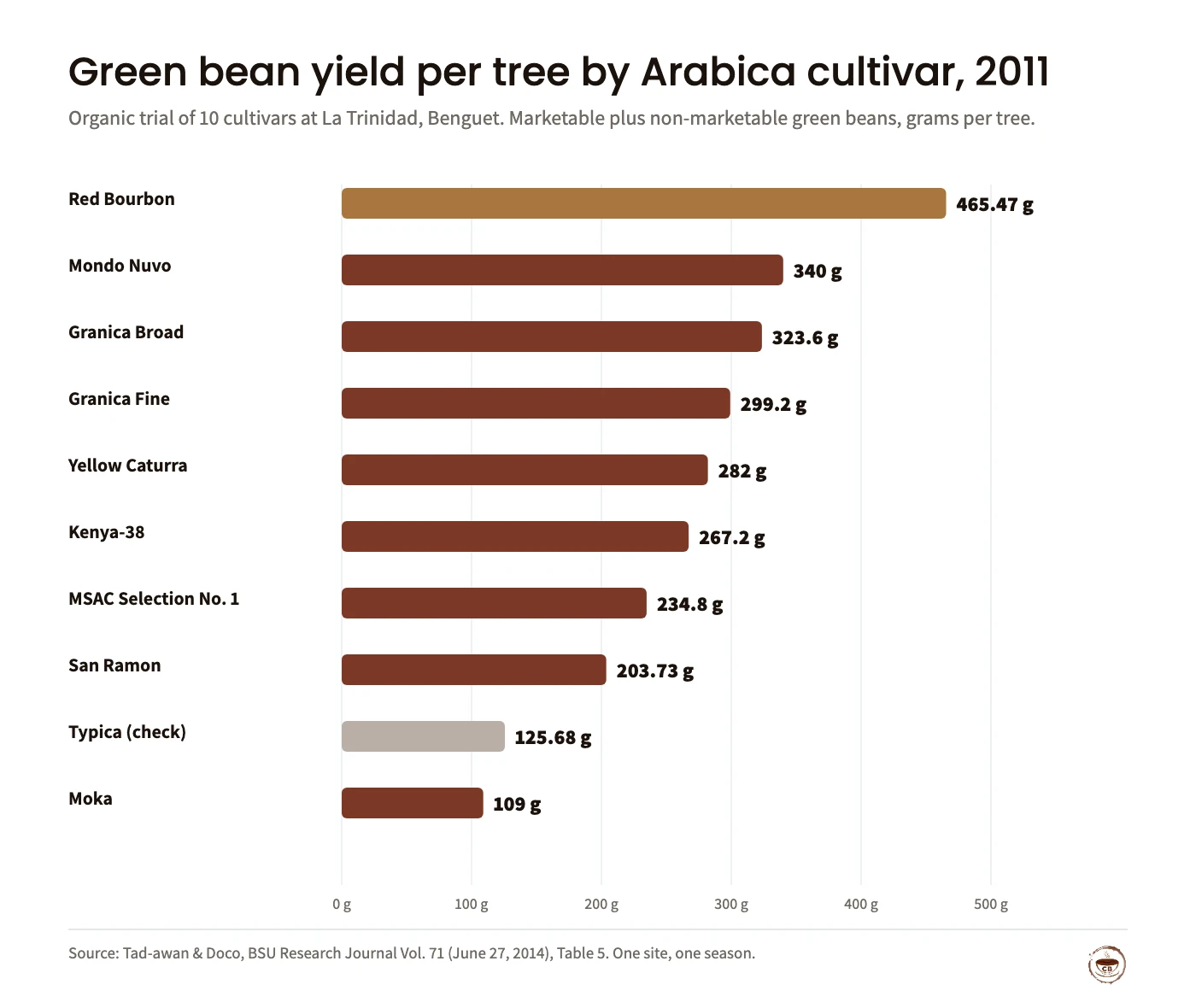
A second BSU study tested 10 cultivars under organic management in La Trinidad for three years (published June 27, 2014). Red Bourbon produced the heaviest fresh berries, 1.97 kg per tree, and the most green beans in 2011, 465.47 g per tree against 125.68 g for the Typica check. Its 100-bean weight was 22 g, in the heavier group. The authors recommended Granica Broad, Mondo Nuvo, Red Bourbon and MSAC Selection No. 1 for organic production. On cup quality, a small panel rated Red Bourbon among the cultivars that were “liked slightly,” the same rating as Typica. These are one site and one season’s yields, and the authors called all the yields “very low” compared with other countries.
Elsewhere, a USDA-funded PhilCAFE trial at Kapatagan, Davao del Sur, was testing 19 Arabica varieties including Bourbon and Pacamara from Hawaii and Bourbon Amarello (Yellow Bourbon) from Brazil (SunStar Davao, January 19, 2020). We did not find published results from that trial. In Bukidnon, Finca de Garces showed a Bourbon coffee alongside its Catimor in 2023, and the farm told SunStar its Bourbon “is difficult to grow” (SunStar, August 3, 2023). We found no official Philippine Coffee Quality Competition result that names Bourbon as a winning variety.
How much Arabica does Benguet produce?
National statistics do not split Arabica by variety, so there is no official Bourbon output figure. What PSA does publish is Arabica production by province. Benguet’s output has grown fast while the national total has fallen since 2010.
| Area | 2010 | 2020 | 2024 | 2025 |
|---|---|---|---|---|
| Philippines | 9,710.26 | 7,328.73 | 6,835.70 | 7,849.82 |
| Cordillera (CAR) | 275.16 | 347.47 | 587.04 | 977.75 |
| Benguet | 199.54 | 305.00 | 545.13 | 938.78 |
In 2025 Benguet produced 938.78 tons of Arabica green beans, 12.0% of the national 7,849.82 tons and 4.7 times its 2010 output. Benguet alone rose 72.2% from 2024. How much of that is Bourbon is not measured anywhere we could find.
Does Bourbon coffee taste different?
Most claims about Bourbon’s taste are tasting notes from sellers, not measurements. The peer-reviewed evidence is narrower. Ramos et al. (Journal of the Science of Food and Agriculture, 2016) studied Yellow Bourbon from the Mantiqueira de Minas region of Brazil and found that samples scoring 88 points or more on the SCAA protocol were linked to farms at 1,200 meters and above. That supports what World Coffee Research says about Bourbon at high altitude, but it measures one region, not Bourbon against other varieties.
Altitude, processing and roast change the cup at least as much as variety. When you compare two coffees labelled Bourbon, check where they were grown and how they were processed before crediting the variety.
How to buy and brew a Bourbon coffee
- Read the label for the variety and origin. A lot labelled “Bourbon” should also name the farm or region and the altitude. Colour names such as Pink Bourbon may not be genetically Bourbon.
- Check the processing method. Washed, natural and honey processing change the flavor more than most people expect.
- Pick a roast that suits your brewer. Light to medium roasts show more of the origin in pour-over; medium to dark roasts suit espresso and milk drinks. Our roast comparison explains the differences.
- Weigh your coffee and water. Use the ratio for your brewer from our brewing methods guide and adjust to taste.
- Brew within a few weeks of roasting and keep beans sealed away from heat and light.
Caffeine Brothers’ Arabica is grown in Benguet and roasted to a medium roast. We do not label our Arabica by variety, and Benguet farms commonly grow several cultivars, including Typica and Bourbon, side by side. Here is what a 10 g cup costs at today’s prices.
| Caffeine Brothers Arabica (Benguet, medium roast) | Price | Cost per 10 g cup |
|---|---|---|
| 200 g Arabica pouch | ₱292 | ₱14.60 |
| 1 kg Arabica bag | ₱1,068 | ₱10.68 |
| 10 kg Arabica wholesale box | ₱10,150 | ₱10.15 |
Frequently asked questions
What is Bourbon coffee?
Bourbon is a variety of Arabica coffee (Coffea arabica). World Coffee Research says French missionaries took it from Yemen to Bourbon Island, now La Réunion, in the early 1700s, which is where the name comes from. It is a tall plant with medium yield and very good cup quality at high altitude.
Is Bourbon coffee related to bourbon whiskey?
No. The coffee is named after Bourbon Island in the Indian Ocean, now La Réunion. It has no link to the whiskey, and Bourbon coffee contains no alcohol.
What is the difference between Bourbon and Typica?
Both come from the same narrow Yemeni base and both are susceptible to leaf rust. In the World Coffee Research catalog, Bourbon has green new leaf tips, average beans and medium yield, while Typica has bronze leaf tips, large beans and low yield.
Is Bourbon grown in the Philippines?
Yes. A Benguet State University survey published in 2013 found 22 Bourbon accessions among 152 traditional Arabica trees in Benguet. The Philippine Coffee Board lists Red and Yellow Bourbon among Cordillera varieties, and a Bukidnon farm has shown a Bourbon coffee.
Sources
- Bourbon. World Coffee Research varieties catalog, modified June 3, 2024. Traits, history, replacement by descendants
- Typica. World Coffee Research, modified May 25, 2023. Traits for comparison
- Caturra. World Coffee Research, modified August 11, 2025. Bourbon mutation, 1915 to 1918, IAC 1937
- Pacas. World Coffee Research, modified August 11, 2025
- Villa Sarchi. World Coffee Research, modified August 11, 2025
- Mundo Novo. World Coffee Research, modified August 11, 2025
- SL28. World Coffee Research, modified August 31, 2025
- SL34. World Coffee Research, modified August 11, 2025. Bura mission 1893, French Mission
- A single polyploidization event at the origin of the tetraploid genome of Coffea arabica. Scalabrin et al., Scientific Reports 10:4642, 2020. 1715 Bourbon Island, narrow genetic base
- Deciphering early movements and domestication of Coffea arabica through a comprehensive genetic diversity study covering Ethiopia and Yemen. Montagnon et al., Agronomy 12(12):3203, December 16, 2022. Typica/Bourbon cluster in Yemen, Pink Bourbon grouping
- Unraveling the origin of Coffea arabica ‘Bourbon pointu’ from La Réunion. Lécolier et al., Euphytica 168, 2009
- Non-destructive analysis of natural variability in bean caffeine content of Laurina coffee. Baumann et al., Phytochemistry 49, 1998
- Discrimination of the sensory quality of Coffea arabica cv. Yellow Bourbon. Ramos et al., Journal of the Science of Food and Agriculture 96, 2016
- In-situ morphological characterization and diversity analysis in traditional Arabica cultivars in Benguet. Tad-awan and Doco, BSU Research Journal Vol. 70, December 13, 2013
- Morphological variations, yield performance, and GxE interaction analysis in Arabica coffee cultivars for organic production in Benguet. Tad-awan and Doco, BSU Research Journal Vol. 71, June 27, 2014. Yield and cupping by cultivar
- Philippine Coffee. Philippine Coffee Board. Cordillera varieties and altitude
- Cultivating coffee at the foothills of Mt. Apo. SunStar Davao, January 19, 2020. PhilCAFE varietal trial
- Finca de Garces: The taste of Bukidnon coffee. SunStar, August 3, 2023
- Non-food and industrial crops: volume of production. Philippine Statistics Authority OpenSTAT, updated August 28, 2026. Arabica green coffee beans by province
Cite this article: Caffeine Brothers. “Bourbon Coffee: History, Traits and Where It Grows in Benguet.” Caffeine Brothers Coffee Blog, November 2026. https://caffeinebrothers.co/bourbon-coffee/
You are welcome to reference the charts and tables in this article with a link back to this page.
Want to taste Benguet Arabica? Our Arabica coffee beans are roasted daily and ground free to your brewer, and the shop has our other Philippine coffees. Cafés can contact us for wholesale pricing.
 Previous Post