Matcha vs Coffee: Caffeine, L-Theanine and What Studies Show
By Robin Salvador, co-founder, Caffeine Brothers
Last updated: November 11, 2026
Quick answer: A standard bowl of thin matcha (2 g of powder) has about 64 mg of caffeine, using the 3.2 g per 100 g figure in Japan’s official food composition table. A 200 ml cup of brewed coffee has about 90 mg, according to EUFIC. Coffee usually gives you more caffeine per cup, but thick matcha or a heavy scoop can match it. Matcha also contains L-theanine, though the studies behind the “calm energy” claim are small and mostly used pure L-theanine at doses higher than a normal bowl provides.
Key takeaways
- Japan’s Standard Tables of Food Composition (8th edition) list matcha powder at 3.2 g of caffeine per 100 g, or 32 mg per gram, as quoted by Japan’s Ministry of Agriculture (MAFF) on a page updated August 28, 2026.
- Measured matcha varies a lot: three store-bought products tested in 2022 had 14.1 to 16.1 mg per gram, while a range of 18.9 to 44.4 mg per gram is cited in a 2020 review.
- Ippodo Tea’s standard thin matcha uses 2 g of powder and 60 ml of water at 80 °C. That works out to about 64 mg of caffeine at the official table value.
- EUFIC puts brewed coffee at about 90 mg per 200 ml cup and espresso at about 80 mg per 60 ml.
- Only one controlled study we found tested matcha itself on attention and mood (23 people, 4 g of matcha). It found small effects on attention speed and no significant change in mood.
How much caffeine is in matcha compared with coffee?
Matcha is powdered green tea leaf. You whisk the powder into water and drink all of it, so the caffeine depends mostly on how many grams you use. Coffee is an extract: hot water pulls caffeine out of the grounds, and you throw the grounds away.
The table below puts official and published figures on the same serving basis. The matcha rows use the official table value of 32 mg per gram. The brewed coffee row shows three figures because the sources use different strengths.
| Drink and serving | Caffeine | Source (read November 11, 2026) |
|---|---|---|
| Thin matcha (usucha): 2 g powder, 60 ml water | About 64 mg | Ippodo serving size; MEXT 3.2 g/100 g via MAFF |
| Thick matcha (koicha): 4 g powder, 30 ml water | About 128 mg | Ippodo serving size; MEXT via MAFF |
| Matcha, MAFF example: 1.5 g in 70 ml hot water | 48 mg | MAFF caffeine page |
| Sencha (steeped green tea), 200 ml | 40 mg | MAFF: 20 mg per 100 ml |
| Green tea, 250 ml cup | About 38 mg | EUFIC |
| Gyokuro (shaded green tea), 100 ml | 160 mg | MAFF; strong brew of 10 g leaves in 60 ml |
| Brewed coffee, 200 ml | About 90 mg | EUFIC |
| Brewed coffee, 200 ml (strong brew) | About 120 mg | MAFF: 60 mg per 100 ml, brewed 10 g in 150 ml |
| Brewed coffee, 200 ml | 81 to 108 mg | USDA data via NCA: 12 to 16 mg per ounce |
| Espresso, 60 ml double | About 80 mg | EUFIC (USDA via NCA: 63 mg per 1 oz shot) |
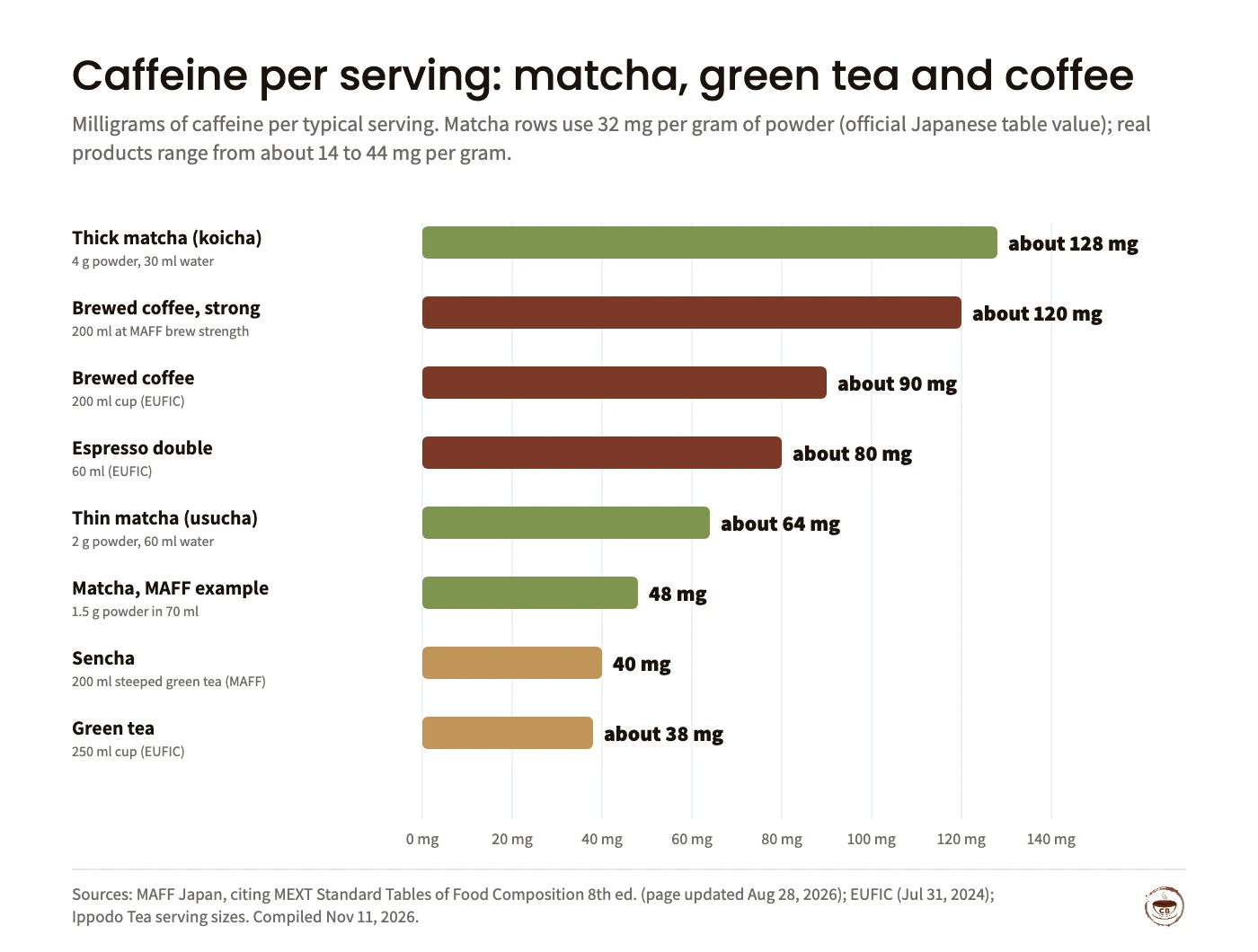
So a normal bowl of thin matcha has a bit less caffeine than a normal cup of coffee. A thick koicha, or a latte made with two or three teaspoons of powder, can have as much or more. If you want to compare coffees with each other, our guide to Robusta vs Arabica caffeine shows how much the bean species changes the number.
Why do matcha caffeine figures vary so much?
Because matcha products differ. Grade, harvest, leaf age and how much stem is left in all change the result, and published studies tested very different samples. Here is what we found when we compared the sources side by side.
| Source | What was tested | Caffeine per gram | In a 2 g bowl |
|---|---|---|---|
| MEXT Standard Tables of Food Composition, 8th ed. (via MAFF, updated Aug 28, 2026) | Official table value for matcha powder | 32 mg | 64 mg |
| Koláčková et al., Antioxidants, Apr 30, 2022 | 3 commercial products bought in Zlín, Czech Republic, in 2021 | 14.1 to 16.1 mg | 28.2 to 32.2 mg |
| Koláčková et al. 2020, as cited by Kochman et al., Molecules, Dec 27, 2020 | Matcha samples; count not stated in the review | 18.9 to 44.4 mg | 37.8 to 88.8 mg |
| For comparison: coffee beans (Kochman et al.) | Ground coffee, cited range | 10 to 12 mg | 100 to 120 mg in a 10 g dose of grounds |
The lowest and highest matcha figures differ by about three times. The official table value sits in the middle. If you drink matcha for its caffeine, the label on your own tin, if it lists caffeine, tells you more than any average. The same review that cites the matcha range puts green teas in general at 11.3 to 24.67 mg per gram.
Coffee has the opposite problem. The grounds hold 10 to 12 mg per gram, but how much ends up in your cup depends on the brew method, the grind and the time. Our brewing methods guide gives the ratios the National Coffee Association recommends for each method.
Does matcha give calmer energy than coffee?
This is the most common claim, and the evidence is thin. Matcha contains L-theanine, an amino acid found in tea. The idea is that L-theanine smooths out the effect of caffeine. Here is what the studies we read actually tested.
- Haskell and colleagues (Biological Psychology, 2008) gave 250 mg of L-theanine and 150 mg of caffeine, alone and together. The combination improved some speed and accuracy measures and raised “alert” ratings. L-theanine on its own increased headache ratings.
- Owen and colleagues (Nutritional Neuroscience, 2008) tested 50 mg of caffeine with and without 100 mg of L-theanine in 27 people. The combination improved attention-switching speed and accuracy.
- Giesbrecht and colleagues (Nutritional Neuroscience, 2010) gave 97 mg of L-theanine with 40 mg of caffeine to 44 young adults. Task-switching accuracy and alertness improved, with no significant effects on the other tasks.
- Dietz and colleagues (Food Research International, 2017) tested 4 g of matcha in 23 people. They reported no significant changes in mood and only slight effects on attention speed and memory.
Three of those four studies used pure L-theanine, not matcha. The amounts also matter. The 2022 Czech study measured 4.22 to 9.85 mg of L-theanine per gram of matcha, so a 2 g bowl would hold about 8 to 20 mg, well below the 97 to 250 mg used in the trials. Another study cited in the 2020 review found up to 44.65 mg per gram, which would be about 89 mg per bowl. A 2022 review in Current Research in Food Science concluded that evidence on matcha and brain function is still limited and that conclusions cannot be drawn.
Caffeine itself is well studied. EUFIC, summarising the European Food Safety Authority, says caffeine increases alertness and attention at doses above 75 mg. Both a strong bowl of matcha and a cup of coffee can pass that.
What about catechins, and is matcha safe to drink every day?
Green tea is rich in catechins, mainly EGCG. The 2022 Czech study measured 7,610 to 16,900 micrograms of EGCG per gram of matcha, which is about 15 to 34 mg in a 2 g bowl.
In 2018 the European Food Safety Authority reviewed green tea catechins. It found that catechins from green tea infusions prepared in the traditional way are generally considered safe. It estimated average intake from green tea drinks at 90 to 300 mg of EGCG a day. It also found that 800 mg or more of EGCG a day, taken as a food supplement, raised liver enzyme levels. In the EU, green tea extract in foods and supplements must now stay below 800 mg of EGCG per daily serving. These limits are about extract pills and fortified products. A few bowls of matcha come nowhere near 800 mg at the levels measured above.
The practical limit for both drinks is caffeine. EFSA’s guidance, as summarised by EUFIC, is that up to 400 mg a day is safe for most adults, single doses up to 200 mg raise no safety concerns, pregnant or breastfeeding women should stay at or below 200 mg a day, and around 100 mg close to bedtime can affect sleep in some people.
Matcha vs coffee: how do they compare side by side?
| Matcha (thin, usucha) | Brewed coffee | |
|---|---|---|
| What you drink | The whole powdered leaf, whisked into water | An extract; the grounds are filtered out |
| Typical serving | 2 g powder, 60 ml water at 80 °C (Ippodo) | 200 ml cup (EUFIC serving) |
| Caffeine per serving | About 64 mg (28 to 89 mg across studies) | About 90 mg (EUFIC) |
| Servings to reach 400 mg a day | About 6 bowls at 64 mg | About 4 cups at 90 mg |
| L-theanine | About 8 to 20 mg per 2 g bowl (2022 study); higher in other samples | None reported in coffee |
| Evidence on mood | One 23-person matcha trial: no significant mood change | Caffeine effects on alertness are well documented |
Which is better comes down to taste and how much caffeine you want. If you like matcha, drink it. If you want a stronger and cheaper daily cup, coffee usually gives you more caffeine for your money. Many people drink both: coffee in the morning, a lighter green tea or thin matcha in the afternoon.
What does a cup of Philippine coffee cost?
We don’t sell matcha, so we can only price the coffee side. At our live prices on November 11, 2026, a 10 g dose of Caffeine Brothers coffee costs:
| Coffee (roast) | 200 g bag | Per 10 g cup (200 g) | 1 kg bag | Per 10 g cup (1 kg) |
|---|---|---|---|---|
| Batangas Robusta (dark) | ₱231 | ₱11.55 | ₱813 | ₱8.13 |
| Kapeng Barako, 100% Liberica (dark) | ₱242 | ₱12.10 | ₱858 | ₱8.58 |
| CB’s Finest blend | ₱244 | ₱12.20 | ₱866 | ₱8.66 |
| Arabica-Robusta blend | ₱274 | ₱13.70 | ₱991 | ₱9.91 |
| Benguet Arabica (medium) | ₱292 | ₱14.60 | ₱1,068 | ₱10.68 |
| Coffee drip bag (10 g, box of 10) | ₱240 a box | ₱24.00 a bag |
If you are moving from matcha to coffee and want something gentler, a medium-roast Arabica brewed a little weaker is a common starting point. Robusta and Barako give a heavier, more bitter cup. Our Vietnamese coffee guide shows one way people use strong Robusta with milk.
How to switch between matcha and coffee without overdoing caffeine
- Count grams for matcha. One level teaspoon is about 2 g (Ippodo), or roughly 64 mg of caffeine at the official table value.
- Count cups for coffee. A 200 ml cup is about 90 mg; an espresso double about 80 mg.
- Add up the day. Stay at or below 400 mg if you are a healthy adult, and at or below 200 mg if you are pregnant or breastfeeding.
- Keep single servings at 200 mg or less. Two scoops of matcha in a large latte plus an extra shot can pass that.
- Stop caffeine several hours before bed. EFSA notes that about 100 mg close to bedtime can affect sleep in some people.
This article is general information about food composition and published research. It is not medical advice. If you have a health condition or take medication, ask your doctor about caffeine.
Frequently asked questions
Does matcha have more caffeine than coffee?
Usually not per serving. A 2 g bowl of thin matcha has about 64 mg at the official Japanese table value of 32 mg per gram, while EUFIC puts a 200 ml cup of brewed coffee at about 90 mg. Thick matcha (4 g) has about 128 mg, which is more than a typical cup of coffee.
How much caffeine is in one teaspoon of matcha?
Ippodo Tea says a level teaspoon is about 2 g. At 32 mg per gram (MEXT 8th edition, via MAFF), that is about 64 mg. Published studies found 14.1 to 44.4 mg per gram, so one teaspoon can hold about 28 to 89 mg depending on the product.
Is matcha healthier than coffee?
The sources we read do not show that one is healthier. Matcha contains L-theanine and catechins such as EGCG; coffee contains more caffeine per cup. The only controlled matcha study we found (23 people) showed small effects on attention and no significant change in mood. Both are safe for most adults within EFSA’s 400 mg a day caffeine guidance.
Does matcha give energy without the crash?
That claim is weakly supported. Small trials found that L-theanine combined with caffeine improved some attention measures, but most used pure L-theanine at 97 to 250 mg, more than a 2 g bowl of matcha usually provides. A 2022 review said evidence on matcha and brain function is still limited.
How many cups of matcha a day is safe?
Caffeine is the limit. At about 64 mg per 2 g bowl, six bowls reach about 400 mg, the daily amount EFSA considers safe for most adults. EFSA found that green tea catechins from normally prepared tea are generally safe; its concern was 800 mg or more of EGCG a day from supplements.
Sources
- カフェインについて (About caffeine). Ministry of Agriculture, Forestry and Fisheries of Japan, last updated August 28, 2026. Citing the Standard Tables of Food Composition in Japan 2020 (8th ed.): matcha 3.2 g/100 g, 48 mg in 1.5 g; gyokuro 160 mg/100 ml; sencha 20 mg/100 ml; coffee 60 mg/100 ml
- Health Benefits and Chemical Composition of Matcha Green Tea: A Review. Kochman et al., Molecules 26(1):85, December 27, 2020 (Europe PMC full text). Matcha caffeine 18.9 to 44.4 mg/g; green teas 11.3 to 24.67 mg/g; coffee beans 10 to 12 mg/g; L-theanine up to 44.65 mg/g
- Koláčková et al., matcha tea study. Antioxidants 11(5):889, April 30, 2022 (Europe PMC full text). 3 commercial products; caffeine 14.1 to 16.1 mg/g; L-theanine 4.22 to 9.85 mg/g; EGCG 7,610 to 16,900 µg/g
- How to prepare usucha (thin matcha). Ippodo Tea, undated (US version modified November 10, 2026). 2 g matcha, 60 ml water at 80 °C, whisk 15 seconds
- Koicha (thick matcha). Ippodo Tea, published March 8, 2023. 4 g matcha, 30 ml water at 80 °C
- Caffeine levels in different foods and drinks. EUFIC, last updated July 31, 2024. Brewed coffee 90 mg per 200 ml; espresso 80 mg per 60 ml; green tea about 38 mg per 250 ml; 400 mg a day; 200 mg single dose; 200 mg in pregnancy
- EFSA opinion on the safety of caffeine. EUFIC, last updated June 23, 2015. About 100 mg close to bedtime can affect sleep
- Caffeine Q&As. EUFIC, last updated December 8, 2016. Alertness and attention at doses above 75 mg
- Espresso. National Coffee Association, modified February 5, 2026. USDA data: 63 mg per 1 oz shot; brewed coffee 12 to 16 mg per ounce
- Scientific opinion on the safety of green tea catechins. EFSA Journal 16(4):5239, 2018 (abstract via Europe PMC). Infusions generally safe; 90 to 300 mg EGCG a day from tea; 800 mg or more a day from supplements raised serum transaminases
- Due to Risk of Liver Damage, EU Limits Green Tea Extract with EGCG in Foods. Food Safety Magazine, December 7, 2022. Below 800 mg EGCG per daily serving
- The effects of L-theanine, caffeine and their combination on cognition and mood. Haskell et al., Biological Psychology 77:113 to 122, 2008. 250 mg L-theanine, 150 mg caffeine
- The combined effects of L-theanine and caffeine on cognitive performance and mood. Owen et al., Nutritional Neuroscience, 2008. 27 participants; 50 mg caffeine, 100 mg L-theanine
- The combination of L-theanine and caffeine improves cognitive performance and increases subjective alertness. Giesbrecht et al., Nutritional Neuroscience, 2010. 44 young adults; 97 mg L-theanine, 40 mg caffeine
- An intervention study on the effect of matcha tea, in drink and snack bar formats, on mood and cognitive performance. Dietz et al., Food Research International 99:72 to 83, 2017. 23 participants, 4 g matcha; no significant changes in mood
- The therapeutic potential of matcha tea: A critical review on human and animal studies. Sokary et al., Current Research in Food Science, epub November 23, 2022 (Europe PMC). Evidence on cognition limited
- FY2025 Annual Report on Food, Agriculture and Rural Areas, Chapter 4 Section 1. MAFF, May 29, 2026. Green tea exports ¥72.1 billion in 2025, up 98.2%, driven by powdered tea including matcha
Cite this article: Caffeine Brothers. “Matcha vs Coffee: Caffeine, L-Theanine and What Studies Show.” Caffeine Brothers Coffee Blog, November 2026. https://caffeinebrothers.co/matcha-vs-coffee/
You are welcome to reference the charts and tables in this article with a link back to this page.
Prefer coffee? Browse our Philippine-grown beans, from Benguet Arabica to Batangas Robusta, or try coffee drip bags for a no-equipment cup at work. Questions about grind or roast? Contact us.
 Previous Post
 Next Post