Maternity Leave Philippines: 105-Day Rules and Pay for Cafés
By Robin Salvador, co-founder, Caffeine Brothers
Last updated: November 7, 2026
Quick answer: Under Republic Act 11210, a female worker in the Philippines gets 105 days of maternity leave with full pay for live childbirth, 120 days if she is a solo parent, and 60 days for miscarriage or emergency termination of pregnancy. She may add 30 days without pay. SSS pays a maternity benefit based on her salary credits, capped at ₱70,000 for 105 days, and the employer pays any salary differential up to her full pay unless it qualifies for an exemption, such as a retail or service business with no more than 10 workers.
Key takeaways
- The leave is 105 days with full pay for any live birth, normal or caesarean, and applies to every pregnancy regardless of civil status or how many times she has given birth.
- She qualifies for the SSS benefit with at least three monthly contributions in the 12 months before the semester of childbirth, and after notifying her employer.
- SSS computes the benefit from the six highest monthly salary credits divided by 180, and benefits use salary credits only up to ₱20,000. That puts the 105-day maximum at ₱70,000.
- The employer advances the full SSS benefit within 30 days of the leave application, and SSS reimburses 100%.
- For a Metro Manila crew member paid ₱718 or ₱755 a day, the SSS benefit nearly matches full pay, so our worked example shows no salary differential due. At ₱30,000 a month the differential is ₱26,425.
Many cafés are run by small teams, and a 105-day absence is a real scheduling and cash-flow question. This guide reads RA 11210, the SSS maternity benefit rules and DOLE’s 2023 Handbook on Workers’ Statutory Monetary Benefits, then works through the numbers at 2026 pay levels. It pairs with our guides to the SSS contribution table 2026, PhilHealth contributions and Pag-IBIG contributions.
How long is maternity leave in the Philippines?
RA 11210, the 105-Day Expanded Maternity Leave Law, was approved on February 20, 2019. DOLE’s 2023 handbook says it was published in the Manila Bulletin on February 23, 2019 and took effect on March 11, 2019. Section 3 grants 105 days of maternity leave with full pay to covered female workers in government and the private sector, “regardless of civil status or the legitimacy of her child.”
| Situation | Leave | Paid? | Legal basis |
|---|---|---|---|
| Live childbirth, normal or caesarean | 105 days | Full pay | RA 11210 Secs 3 and 5 |
| Live childbirth, mother is a qualified solo parent | 105 + 15 = 120 days | Full pay | RA 11210 Sec 3; RA 8972 as amended by RA 11861 |
| Miscarriage or emergency termination of pregnancy | 60 days | Full pay | RA 11210 Sec 3 |
| Optional extension after live childbirth | 30 days | Without pay | RA 11210 Sec 5(b) |
| Leave days she may give to the child’s father or an alternate caregiver | Up to 7 of her 105 days | Paid as part of her leave | RA 11210 Sec 6 |
| Paternity leave for a married father (separate law) | 7 days | Full pay | RA 8187 |
The leave can be split between prenatal and postnatal days as long as the total does not exceed 105 days and the postnatal part is at least 60 days (Section 9). It cannot be deferred. Section 3 says it must be taken “in a continuous and uninterrupted manner.” For the extra 30 days without pay, the employee gives written notice at least 45 days before her maternity leave ends, with no prior notice needed in a medical emergency.
Section 6 lets the mother allocate up to seven of her paid days to the child’s father, “whether or not the same is married to the female worker,” or to an alternate caregiver if the father is absent or incapacitated. This is on top of the seven-day paternity leave that RA 8187 gives married male employees. The SSS page adds that the allocation option does not apply to miscarriage or emergency termination of pregnancy.
Coffee beans for your café
Caffeine Brothers supplies cafés, offices and restaurants with freshly roasted Philippine coffee in 10 kg wholesale boxes from ₱773/kg, with free Metro Manila delivery and a free sample before you commit.
See Wholesale Prices →Who qualifies for the SSS maternity benefit?
Section 5(a) of RA 11210 and the SSS Maternity Benefit page set two conditions for an employed member:
- She has paid at least three monthly contributions in the 12-month period immediately before the semester of childbirth, miscarriage or emergency termination of pregnancy. SSS counts only contributions paid before that semester.
- She has notified her employer of the pregnancy and the expected date of delivery, and the employer has passed the notice to SSS. The SSS page says employers file the Maternity Notification through their My.SSS account.
A “semester” here means two consecutive quarters ending in the quarter of the delivery, and quarters end in March, June, September and December. For a baby due in February 2027, the semester is October 2026 to March 2027, so SSS looks at contributions from October 2025 to September 2026.
The benefit applies in every instance of pregnancy, with no limit on the number of times. For twins or triplets, SSS pays one maternity benefit per delivery. If an employee’s service ends and she gives birth within 15 calendar days, Section 8 says she still gets maternity leave with full pay because the right had already accrued.
How is the SSS maternity benefit computed?
The SSS page gives the steps. Count 12 months back from the month before the semester of contingency. Add the six highest monthly salary credits (MSC) in that period. Divide by 180 to get the average daily salary credit, which is the daily maternity allowance. Multiply by 105 days for live childbirth, 120 for a solo parent, or 60 for miscarriage or emergency termination.
One detail sets the ceiling. SSS Circular 2024-006 lists monthly salary credits from ₱5,000 up to ₱35,000 for contributions, but says benefits under the regular SS program are computed on an MSC of ₱5,000 to ₱20,000. The part above ₱20,000 goes to the Mandatory Provident Fund. So the largest regular maternity benefit is:
- 6 × ₱20,000 = ₱120,000, divided by 180 = ₱666.67 a day
- 105 days: ₱70,000
- 120 days (solo parent): ₱80,000
- 60 days (miscarriage or emergency termination): ₱40,000
Employed members do not claim the money directly. Section 5(a)(2) says the employer advances the full payment within 30 days from the filing of the leave application, and SSS reimburses the employer 100% once it receives proof of payment. Since September 1, 2021, the SSS page says benefit and reimbursement applications are filed online through My.SSS. Claims can be filed within 10 years of the delivery.
What is the salary differential and who pays it?
RA 11210 promises “full pay” during the leave. When the SSS benefit is lower than the worker’s regular wage for the leave period, Section 5(c) makes the private employer pay the difference, called the salary differential.
DOLE Department Advisory No. 01, series of 2019 (July 9, 2019) sets the method. As summarized by PwC Philippines, it has four steps:
- Full pay = monthly salary × the leave period in months (105 days = 3.5 months). For daily-paid workers, monthly salary = daily rate × factor rate ÷ 12; PwC’s example uses a factor of 313 for a six-day week.
- Find the employee’s own share of SSS, PhilHealth and Pag-IBIG contributions for the leave period.
- Compute the SSS maternity benefit: (MSC × 6 ÷ 180) × 105 days.
- Salary differential = full pay minus the employee’s contributions minus the SSS benefit.
The BIR’s Revenue Memorandum Circular 105-2019 (October 9, 2019) treats the salary differential as exempt from income tax and withholding tax, according to P&A Grant Thornton. That replaced the advisory’s earlier line that the differential was taxable.
Worked examples at 2026 pay levels
The table applies those four steps to six pay levels. It assumes the same salary for the whole year, so the six highest salary credits are all equal. Employee contribution shares are from SSS Circular 2024-006 (5% of MSC), PhilHealth’s 5% premium split equally between employer and employee, and Pag-IBIG’s ₱200 employee share on the ₱10,000 maximum fund salary. NCR daily rates are from Wage Order NCR-28, effective September 26, 2026.
| Monthly pay | Full pay, 105 days | SSS benefit | Employee contributions, 3.5 months | Salary differential |
|---|---|---|---|---|
| ₱18,727.83 (₱718/day × 313 ÷ 12) | ₱65,547.42 | ₱64,750.00 (MSC ₱18,500) | ₱5,576.20 | ₱0 (formula gives −₱4,778.78) |
| ₱19,692.92 (₱755/day × 313 ÷ 12) | ₱68,925.21 | ₱68,250.00 (MSC ₱19,500) | ₱5,835.62 | ₱0 (formula gives −₱5,160.41) |
| ₱20,000 | ₱70,000.00 | ₱70,000.00 | ₱5,950.00 | ₱0 (formula gives −₱5,950.00) |
| ₱25,000 | ₱87,500.00 | ₱70,000.00 (capped) | ₱7,262.50 | ₱10,237.50 |
| ₱30,000 | ₱105,000.00 | ₱70,000.00 (capped) | ₱8,575.00 | ₱26,425.00 |
| ₱35,000 | ₱122,500.00 | ₱70,000.00 (capped) | ₱9,887.50 | ₱42,612.50 |
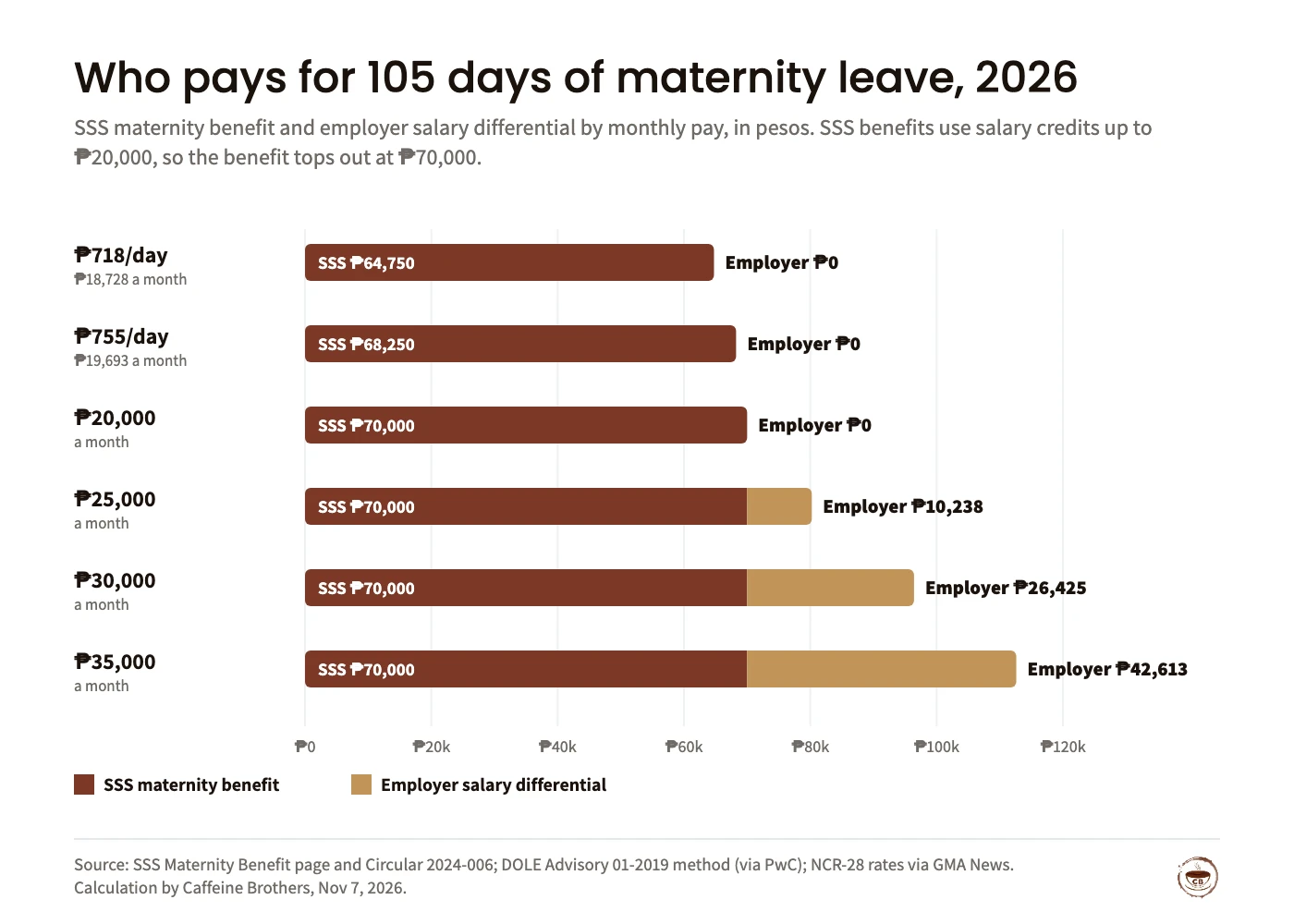
Two points stand out. At Metro Manila minimum wage, the SSS benefit is close to the worker’s gross pay for 3.5 months, and once her own contribution shares are deducted, the advisory’s formula leaves nothing for the employer to add. Above ₱20,000 a month, the SSS benefit stops growing at ₱70,000 while full pay keeps rising, so the employer’s share grows quickly. A café supervisor or roaster on ₱30,000 a month means a differential of ₱26,425.
The cash flow matters even when the differential is zero. The employer advances the SSS benefit within 30 days, which is ₱64,750 for a ₱718-a-day crew member, and then waits for reimbursement. For a small café, it helps to have the Maternity Notification filed early and the employer’s disbursement account enrolled in My.SSS, which the SSS page requires before benefits can be credited.
Your own case may differ from the table. A worker whose pay changed during the year, who has allowances included in full pay, or whose contributions were not all posted before the semester will get different figures. DOLE’s advisory is the method; the employer’s payroll records are the inputs.
Which employers are exempt from paying the salary differential?
Section 5(c) of RA 11210 lists four exemptions, subject to DOLE guidelines:
- Distressed establishments
- Retail and service establishments and other enterprises employing not more than 10 workers
- Micro-business enterprises with total assets of not more than ₱3,000,000, in production, processing, manufacturing, trading or services
- Employers already giving the same or better benefits
The exemption is not automatic. The law says employers claiming it must submit a justification to DOLE every year. The SSS page says the application is filed with DOLE “every 1st quarter of the year,” while Alburo Law Offices, summarizing the DOLE guidelines, says it is filed “within the first semester of every calendar year” at the DOLE office where the business mainly operates. Check the current deadline with your DOLE field office. According to the same law office summary, a Certificate of Exemption is valid for one year, and a small retail or service business supports its claim with an owner’s affidavit on the number of workers over the past 12 months. A micro enterprise uses its BMBE certificate, which our BMBE registration guide explains.
An exemption covers only the salary differential. The employer still advances the SSS benefit, files the notification and reimbursement, and keeps the worker’s job. Section 15 of RA 11210 guarantees security of tenure, and Section 16 bars employers from discriminating against women to avoid the benefits.
What happens if an employer does not comply?
Section 5(a)(5) says that if a worker gives birth without the required contributions having been remitted by her employer, or without the employer having notified SSS of the pregnancy, the employer pays SSS damages equal to the benefit she would have received. Section 18 sets penalties for anyone who fails or refuses to comply with the law: a fine of ₱20,000 to ₱200,000, imprisonment of six years and one day to 12 years, or both. For companies, the managing head, directors or partners are liable.
Section 8 adds a separate rule for dismissals. If a pregnant worker is terminated without just cause, the employer pays her full salary for 105 days (or 60 days for miscarriage or emergency termination), in addition to the SSS benefit she should have received.
A checklist for café owners
- When an employee tells you she is pregnant, ask for the Maternity Notification Form and proof of pregnancy, and file the notification with SSS through your My.SSS employer account.
- Check that her contributions are posted, especially the three months needed before the semester of delivery.
- Enrol your company disbursement account in the SSS Disbursement Account Enrollment Module so reimbursements can be credited.
- Within 30 days of her leave application, advance the SSS benefit, plus any salary differential unless you hold a valid exemption certificate.
- File the Maternity Benefit Reimbursement Application online after delivery, with the birth certificate or medical documents SSS lists.
- Plan coverage for 105 to 135 days. If she allocates up to seven days to the child’s father, his employer needs her written notice.
- If you plan to claim an exemption next year, prepare the DOLE application and supporting documents early in the year.
This guide is general information based on the laws and agency pages listed below, read on November 7, 2026. It is not legal or tax advice. For a specific case, ask your DOLE field office, SSS branch or accountant.
Frequently asked questions
How many days is maternity leave in the Philippines?
RA 11210 gives 105 days with full pay for live childbirth, 120 days for a qualified solo parent, and 60 days for miscarriage or emergency termination of pregnancy. The mother may add 30 days without pay after a live birth with written notice to her employer.
How much is the SSS maternity benefit?
SSS adds the six highest monthly salary credits in the 12 months before the semester of delivery, divides by 180 and multiplies by 105 days. Because benefits use salary credits only up to ₱20,000, the maximum is ₱70,000 for 105 days, ₱80,000 for 120 days and ₱40,000 for 60 days.
Does the employer have to pay the salary differential?
Yes, unless the employer has a DOLE exemption. The exempt groups under RA 11210 are distressed establishments, retail or service businesses with no more than 10 workers, micro enterprises with assets up to ₱3 million, and employers already giving equal or better benefits. The exemption must be renewed each year.
Is the salary differential taxable?
No. BIR Revenue Memorandum Circular 105-2019 treats the salary differential as exempt from income tax and withholding tax, the same as the SSS maternity benefit, according to P&A Grant Thornton.
Can maternity leave be given to the father?
The mother may allocate up to seven of her paid maternity leave days to the child’s father, married or not, or to an alternate caregiver. This is separate from the seven-day paternity leave that RA 8187 gives married male employees.
Is maternity leave available for a second or third baby?
Yes. RA 11210 grants maternity leave in every instance of pregnancy, miscarriage or emergency termination of pregnancy, regardless of frequency.
Sources
- Republic Act No. 11210 (105-Day Expanded Maternity Leave Law). LawPhil. Approved Feb 20, 2019. Sections 3 to 9, 15, 16 and 18
- Maternity Benefit. Social Security System, read Nov 7, 2026. Qualifying conditions, computation, MSC ₱20,000 benefit base, employer advance and online filing
- SSS Circular No. 2024-006, Schedule of SSS Contributions Effective January 2025. Social Security System. MSC brackets, employee shares, benefit computation on MSC ₱5,000 to ₱20,000
- 2023 Handbook on Workers’ Statutory Monetary Benefits. DOLE Bureau of Working Conditions, 2023. Maternity leave (pp. 29 to 30), paternity leave (p. 31), effectivity dates
- DOLE Department Advisory No. 001-19. Digest PH. July 9, 2019. Guidelines on computing the salary differential
- Salary differential under the new maternity leave law. PwC Philippines, Aug 5, 2019. Four-step formula, worked example, distressed establishment tests
- Salary differential under the Expanded Maternity Leave Law exempt from tax. P&A Grant Thornton. RMC 105-2019 (Oct 9, 2019)
- Who may be exempted from paying the salary differential. Alburo Law Offices, Jun 1, 2022. Exemption documents, filing period, one-year validity
- PhilHealth Advisory No. 2026-0042. PhilHealth, 2026. 5% premium effective January 2025
- PhilHealth Contribution 2024 and 2025. Triple i Consulting, Jul 16, 2024. Premium shared equally by employer and employee
- PAG-IBIG increases the Maximum Fund Salary (Circular 460). Forvis Mazars, Jan 25, 2024. ₱10,000 maximum fund salary, 2% employee share
- DOLE: P60 wage hike in NCR takes effect Sept. 26. GMA News, Sept 26, 2026. ₱755 and ₱718 NCR minimum wages under Wage Order NCR-28
Cite this article: Caffeine Brothers. “Maternity Leave Philippines: 105-Day Rules and Pay for Cafés.” Caffeine Brothers Coffee Blog, November 2026. https://caffeinebrothers.co/maternity-leave-philippines/
You are welcome to reference the charts and tables in this article with a link back to this page.
Running a small café team through a long leave? Our financial fundamentals for café owners and Coffee Lab calculators help you plan costs, and our wholesale coffee comes in 10 kg boxes with free Metro Manila delivery. Contact us for a café supply quote.
 Previous Post
 Next Post