
Turkish Coffee: How to Make It, Ratio, Grind and Caffeine
By Robin Salvador, co-founder, Caffeine Brothers
Last updated: November 13, 2026
Quick answer: Turkish coffee is very finely ground coffee simmered with cold water (and sugar, if you like) in a small long-handled pot called a cezve, then poured unfiltered into a small cup with its foam. Türkiye’s official 2026 specification uses 1 g of coffee per 10 ml of water, cups of 60 to 90 ml, a grind of 75 to 125 microns, and heating to 88 to 92 °C over 2.5 to 3 minutes without boiling. One cup held 112 mg of caffeine in a 2018 study, compared with 64 mg for an espresso.
Key takeaways
- UNESCO added “Turkish coffee culture and tradition” to its Representative List of the Intangible Cultural Heritage of Humanity in 2013.
- Türkiye registered “Türk Kahvesi / Turkish Coffee” as a traditional product name on March 10, 2026. The specification sets 1 g of coffee per 10 ml of water and a 60 to 90 ml cup.
- The grind is finer than espresso: an average particle size of 75 to 125 microns in the official text.
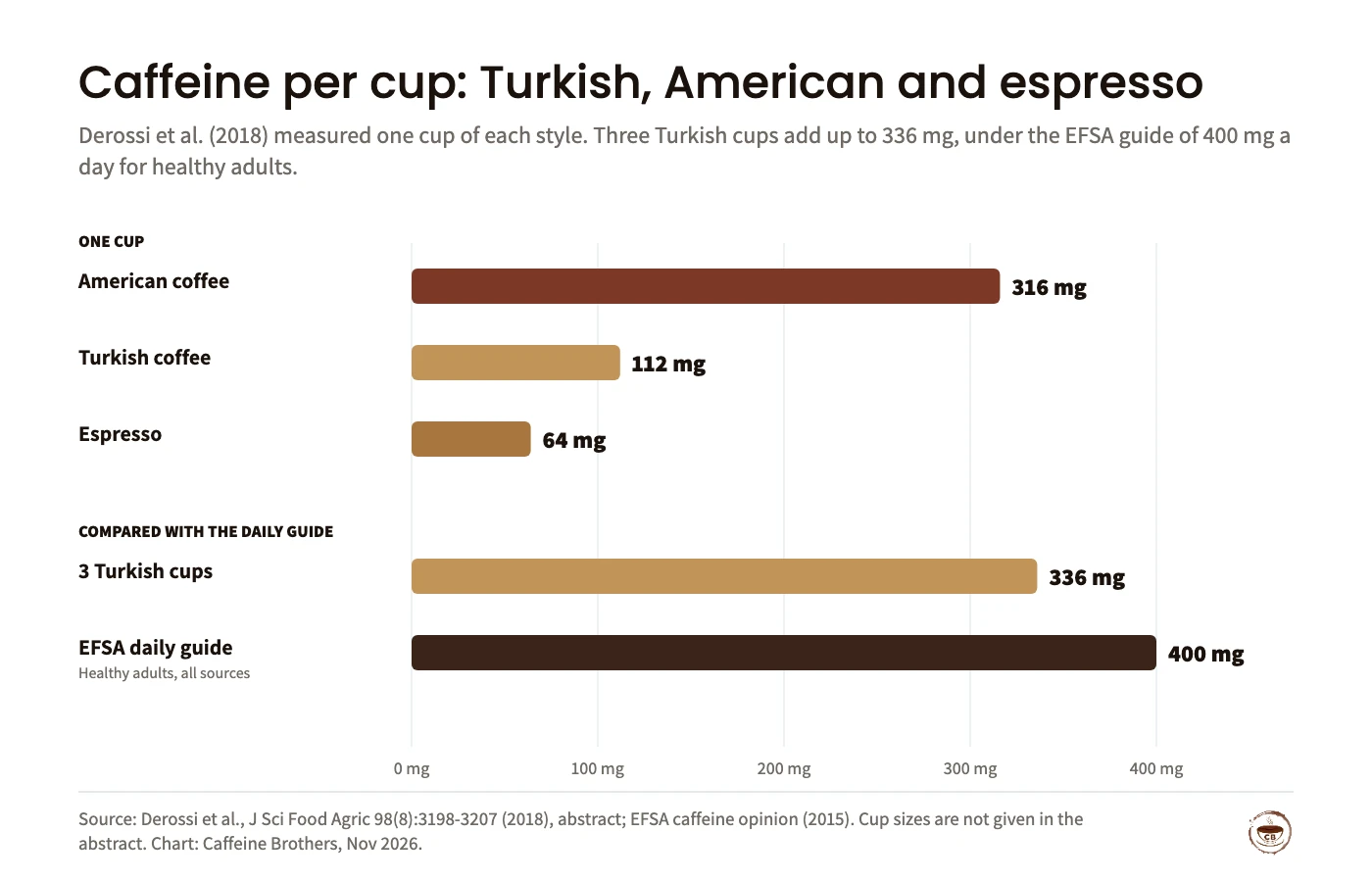
- Derossi et al. (2018) measured 112 mg of caffeine per Turkish cup. Three cups (336 mg) stay under the EFSA guide of 400 mg a day for healthy adults.
- A 7 g cup made with our beans costs about ₱5.69 to ₱7.48 in coffee at 1 kg prices (November 13, 2026).
What is Turkish coffee?
Turkish coffee is a brewing method, and any bean can be used. You put cold water, very finely ground coffee and optional sugar in a cezve, heat it slowly until a thick foam forms, and pour everything into the cup. Nothing is filtered out, so the grounds settle at the bottom of the cup and you stop drinking before you reach them. Our older guide to unfiltered coffee puts it next to the French press and moka pot.
UNESCO describes the tradition in plain terms: “The freshly roasted beans are ground to a fine powder,” brewed slowly on a stove “to produce the desired foam” and “served in small cups, accompanied by a glass of water.” The listing also notes that the grounds left in the cup are often used to tell a person’s fortune. A 2023 UNESCO Courier feature adds that it is usually served with Turkish delight.
The same method goes by other names. Wikipedia lists Greek coffee (made in a briki), Bosnian coffee (made in a džezva) and Armenian coffee, which is often flavored with cardamom. Outside Türkiye, people often call the pot an ibrik.
What are the official measurements?
There is no international standard for Turkish coffee. In a 2017 TRT Haber report, a board member of the Turkish Coffee Culture and Research Association said there was no universally accepted standard. That changed in part on March 10, 2026, when Türkiye’s patent office (TÜRKPATENT) registered “Türk Kahvesi / Turkish Coffee” as a traditional product name for the Union of Chambers and Commodity Exchanges of Türkiye (TOBB). The registration describes how the product and the drink should be made.
| Item | Official specification | What it means at home |
|---|---|---|
| Beans | Arabica and/or Robusta; light, medium or dark roast | Any of our five coffees fits |
| Grind | Average particle size 75 to 125 microns; grinding temperature not above 40 °C | Powder-fine, finer than espresso |
| Ratio | 1 g of coffee to 10 ml of water | 6 g for 60 ml, 7 g for 70 ml, 9 g for 90 ml |
| Cup (fincan) | 60 to 90 ml | A small coffee cup |
| Water | Cold or room temperature, never preheated | Start with tap or filtered water from the fridge or jug |
| Heating | Reach 88 to 92 °C in 2.5 to 3 minutes; do not boil | Low to medium flame, watch the foam |
| Sugar per cup | None; az (2 to 3 g); orta (3 to 4.5 g); şekerli (4 to 6 g) | Add sugar before heating |
| Serving | Share the foam first, then the coffee; serve with water | Pour slowly so every cup gets foam |
The registration lets one cezve make several cups at once. Household cezves in Türkiye are sold by cup count. Korkmaz, a large Turkish cookware brand, sells them in 2, 3, 4 and 5 cup sizes, and its online store says most of its coffee cups hold 75 to 80 ml.
How do different recipes compare?
Recipes agree on the method and differ on the details. The biggest disagreement is whether the coffee should boil. The official specification and the GoTürkiye brochure from the Ministry of Culture and Tourism say it should not. Kurukahveci Mehmet Efendi, a coffee company founded in 1871, tells you to bring the coffee “to another boil” after pouring off the first foam. Wikipedia says the pot is brought “just to the boil.”
| Recipe | Coffee per cup | Water | Heat | Boil? |
|---|---|---|---|---|
| TÜRKPATENT registration (Mar 10, 2026) | 1 g per 10 ml (6 to 9 g) | 60 to 90 ml, cold | 88 to 92 °C in 2.5 to 3 min | No |
| GoTürkiye brochure (undated) | 1 teaspoon | 1 coffee cup, room temperature | Low heat, about 3 min; foam at about 80 °C, second rise at about 90 °C | No |
| Kurukahveci Mehmet Efendi guide | 1 teaspoon (6 g) | 1 coffee cup | Heat slowly until it foams, then again | Yes, twice |
| Hancı et al. (2013) lab method | 5 g | 100 ml | In a cezve, removed at the first boil | To first boil |
We follow the official version in the steps below because it is the most specific and the most recent. If you prefer a stronger, more bitter cup, letting it rise a second time is the traditional variation many cafés use.
How to make Turkish coffee in six steps
- Measure the water with your cup. Fill the serving cup with cold water and pour it into the cezve. Do this once per cup, up to the pot’s cup size.
- Add 1 g of coffee per 10 ml of water. For a 70 ml cup that is 7 g, about one heaped teaspoon. Use powder-fine coffee.
- Add sugar now, if you want it. The official bands are 2 to 3 g for a little sugar, 3 to 4.5 g for medium and 4 to 6 g for sweet.
- Stir well, then stop stirring. Mix until the coffee sinks and no dry clumps float. Stirring after you start heating breaks the foam.
- Heat slowly until the foam rises. On low to medium heat it should take 2.5 to 3 minutes to reach 88 to 92 °C. Lift the cezve off as soon as the foam climbs toward the rim, before it boils.
- Spoon foam into each cup, then pour. Share the foam first, then pour the rest slowly down the side. Serve with a glass of water and let the grounds settle for a minute before drinking.
What grind and beans should you use?
Grind is the hard part. The official text asks for an average particle size of 75 to 125 microns. In a 2022 storage study in the journal GIDA, Coşgun and Torun tested Turkish-style grinds they called very fine (47.13 to 54.64 µm), fine (89.25 to 119.88 µm) and fine-medium (248.77 to 312.23 µm). A UNESCO Courier interview with a Turkish Coffee Culture and Research Association board member describes the beans as ground “even thinner than in Italian espresso.”
Our bags come whole bean or ground coarse, normal or fine. We don’t publish a micron size for our fine grind, so if you want true Turkish texture, buy whole beans and grind them in a Turkish hand mill or a burr grinder that can go finer than espresso. If you are not sure your grinder can manage it, message us before you order. Our grind size guide explains why finer grinds extract faster.
For beans, the specification allows Arabica, Robusta or both, at any roast. The UNESCO Courier interview calls the traditional roast medium. Our Benguet Arabica is our medium roast. If you like a heavier, more bitter cup with sugar, our dark-roast Batangas Robusta or Kapeng Barako are the closer match to that style. These are suggestions based on roast level; we have not run a tasting.
How much caffeine is in Turkish coffee?
Two studies give per-cup numbers. Derossi and colleagues (Journal of the Science of Food and Agriculture, 2018) measured 316 mg of caffeine in an American cup, 112 mg in a Turkish cup and 64 mg in an espresso. The abstract does not give the cup sizes, so treat the comparison as one lab’s recipes. The authors note that one American, three Turkish and five espresso cups contain similar totals of 316, 336 and 320 mg.
A 2013 study from Düzce University in Türkiye (Hancı and colleagues) brewed 5 g of two Turkish coffee brands in 100 ml of water in a cezve and measured 858 and 827 mg of caffeine per liter by HPLC, the highest concentration among the drinks they tested. That is the caffeine in the liquid, so a bigger cup means more caffeine. Below, we scale their figures to common cup sizes.
| Cup size | Brand 1 (858 mg/L) | Brand 2 (827 mg/L) | Note |
|---|---|---|---|
| 60 ml | 51 mg | 50 mg | Smallest cup in the official range |
| 75 ml | 64 mg | 62 mg | Typical Korkmaz cup (75 to 80 ml) |
| 90 ml | 77 mg | 74 mg | Largest cup in the official range |
| Espresso, 60 ml (EUFIC) | About 80 mg | For comparison | |
| Brewed coffee, 200 ml (EUFIC) | About 90 mg | For comparison |
For context, the European Food Safety Authority says single doses up to 200 mg and daily intakes up to 400 mg do not raise safety concerns for healthy adults, and that 100 mg close to bedtime may affect sleep. Pregnant women are advised to stay under 200 mg a day. Our Robusta vs Arabica caffeine article explains why Robusta beans push these numbers up.
Kurukahveci Mehmet Efendi says Turkish coffee “contains less caffeine in one serving than other types of coffee.” Per cup, that matches Derossi’s comparison with American coffee but not with espresso, and per milliliter it is a strong drink.
When did Turkish coffee start?
The sources agree on the 16th century and disagree on the exact years. The UNESCO Courier quotes a Turkish writer who says the first coffee house in Istanbul opened in 1554. Kurukahveci Mehmet Efendi also gives 1554, in the Tahtakale district, and says Istanbul was introduced to coffee in 1543 by Özdemir Pasha. Wikipedia says coffee was in use in Istanbul by 1539 and that the first coffee house opened in 1554, “some say 1551.” The official 2026 registration simply says the 1500s.
What does a cup cost with Philippine beans?
Because a Turkish cup uses only 6 to 9 g of coffee, it is one of the cheapest ways to drink our beans. The table uses live prices from our shop on November 13, 2026, at the official 1 g per 10 ml ratio.
| Coffee (roast) | 200 g price | 1 kg price | 7 g cup, 200 g bag | 7 g cup, 1 kg bag | 9 g cup, 1 kg bag |
|---|---|---|---|---|---|
| Robusta (dark) | ₱231 | ₱813 | ₱8.09 | ₱5.69 | ₱7.32 |
| Kapeng Barako (dark) | ₱242 | ₱858 | ₱8.47 | ₱6.01 | ₱7.72 |
| CB’s Finest (medium and dark) | ₱244 | ₱866 | ₱8.54 | ₱6.06 | ₱7.79 |
| Arabica-Robusta blend | ₱274 | ₱991 | ₱9.59 | ₱6.94 | ₱8.92 |
| Arabica (medium) | ₱292 | ₱1,068 | ₱10.22 | ₱7.48 | ₱9.61 |
If you drink Turkish coffee often, a 1 kg bag ground fine or whole bean for a home grinder keeps the cost under ₱10 a cup. For other low-cost methods, see our comparison of moka pot vs French press and the brewing methods guide.
Frequently asked questions
What is the coffee to water ratio for Turkish coffee?
Türkiye’s 2026 registration of Turkish coffee as a traditional product name sets the ratio at 1 g of coffee to 10 ml of water. For a 70 ml cup that is 7 g, about one heaped teaspoon. Kurukahveci Mehmet Efendi’s own brewing guide uses one teaspoon, or 6 g, per cup.
Should Turkish coffee boil?
The official Turkish specification says no: the coffee should reach 88 to 92 °C in 2.5 to 3 minutes and must not boil, because boiling creates unwanted flavors. Some brand guides and Wikipedia describe bringing it up to a boil. In practice, take the cezve off the heat as soon as the foam rises.
How much caffeine is in a cup of Turkish coffee?
A 2018 study by Derossi and colleagues measured 112 mg in one cup of Turkish coffee, against 64 mg for an espresso and 316 mg for an American cup. A 2013 Turkish lab study found 827 to 858 mg per liter, which works out to about 62 to 64 mg in a 75 ml cup. The amount depends on dose and cup size.
Can I make Turkish coffee with Philippine coffee beans?
Yes. The Turkish specification allows Arabica, Robusta or both, at light, medium or dark roast. What matters most is a very fine, powder-like grind of about 75 to 125 microns, which usually means grinding whole beans in a Turkish hand mill or a grinder that goes finer than espresso.
Do you stir Turkish coffee?
Stir the water, coffee and sugar together before you heat the cezve, then stop. The GoTürkiye brochure from Türkiye’s Ministry of Culture and Tourism says to stir before heating and not after, so the foam stays on top.
Sources
- Turkish coffee culture and tradition. UNESCO Intangible Cultural Heritage, inscribed 2013 (8.COM). Preparation, serving and fortune telling
- Turkish coffee, not just a drink but a culture. The UNESCO Courier, March 31, 2023 (modified April 4, 2025). Cezve, Turkish delight, 1554, medium roast and grind
- Türk Kahvesi / Turkish Coffee, traditional product name No. G8. TÜRKPATENT, registered March 10, 2026. Ratio, cup size, grind, temperature, sugar levels
- Turkish Coffee brochure. GoTürkiye (Ministry of Culture and Tourism), undated. Home method, foam temperatures, no boiling
- With Cezve brew guide. Kurukahveci Mehmet Efendi, read Nov 13, 2026. 6 g per cup, two boils; history and caffeine claims on related pages
- Türk kahvesine standart aranıyor. TRT Haber, May 24, 2017. No accepted standard at the time
- Storage of Turkish coffee with different particle sizes. Coşgun and Torun, GIDA 47(5), October 30, 2022. Grind sizes in microns
- Derossi et al. 2018 (abstract). Journal of the Science of Food and Agriculture 98(8):3198-3207, via PubMed. Caffeine per cup
- Hancı et al. 2013. Düzce Tıp Dergisi 15(3):34-38. Caffeine per liter of Turkish coffee by HPLC
- Caffeine levels in different foods and drinks. EUFIC, updated July 31, 2024. Espresso and brewed coffee figures
- Caffeine. European Food Safety Authority topic page and 2015 opinion. 200 mg, 400 mg, 100 mg near bedtime
- Kahve fincan takımı. Korkmaz official store, read Nov 13, 2026. Cup volumes; cezve cup counts on the cezve category page
- Turkish coffee. Wikipedia, read Nov 13, 2026. Regional names, 1539 and 1551 dates (secondary source)
- Caffeine Brothers shop. Live prices, November 13, 2026
Cite this article: Caffeine Brothers. “Turkish Coffee: How to Make It, Ratio, Grind and Caffeine.” Caffeine Brothers Coffee Blog, November 2026. https://caffeinebrothers.co/turkish-coffee/
You are welcome to reference the charts and tables in this article with a link back to this page.
Want to try Turkish coffee with Philippine beans? Browse our coffee shop for whole beans or fine-ground bags of Arabica, Robusta and Barako, all roasted daily. Contact us if you have questions about grind.
 Previous Post
 Next Post