
Sulu Coffee: Kahawa Sug and the Excelsa Province
By Robin Salvador, co-founder, Caffeine Brothers
Last updated: October 28, 2026
Quick answer: Sulu coffee, called Kahawa Sug by the Tausug, is coffee grown in Sulu province in the Sulu archipelago, southwestern Mindanao. In 2025 Sulu produced 2,216.78 tonnes of green coffee beans, the third-highest output of any Philippine province and 6.2% of the national total, according to the Philippine Statistics Authority (PSA). It grows all four commercial types and leads the country in Excelsa. Its farmgate prices in 2025 were well below the national average.
Key takeaways
- Sulu produced 2,216.78 t of green coffee in 2025, behind only Sultan Kudarat (15,689.08 t) and Bukidnon (2,245.70 t).
- The 2025 mix was 1,165.80 t Robusta, 610.54 t Excelsa, 436.66 t Arabica and 3.77 t Liberica. Sulu grew 30.8% of all Philippine Excelsa.
- Output fell 11.9% from 2024 to 2025 while national output rose 11.5%. Sulu’s Liberica dropped from 71.80 t to 3.77 t with no change in reported area.
- Sulu farmgate prices in 2025 were ₱142.97 a kilo for green Robusta, ₱168.47 for Arabica and ₱105.87 for Excelsa, against national averages of ₱228.67, ₱264.65 and ₱358.03.
- Since 2024, an EU-funded People in Need project has trained Sulu farmers in Patikul and Talipao in pruning and rejuvenating old trees.
Where is Sulu, and what is Kahawa Sug?
Sulu is an island province in the Sulu archipelago, in southwestern Mindanao. Coffee has been part of daily life there since the 1800s, and the province still grows more of it than all but two others.
Kahawa Sug means “coffee of Sulu.” People in Need (PIN), an aid group working in the province, explains the name as the Arabic qahwah joined to Sūg, a Tausug word meaning “current” that is used for the Sulu archipelago. Both PIN and the Philippine Coffee Board describe the same habits: the coffee is usually taken black, served with bangbang (snacks) or a latal platter, and poured back and forth between two cups to cool it. PIN calls the local coffee shops kahawaan.
The usual origin story credits Herman Leopold Schück, a Prussian seafarer who became a blood brother of Sultan Jamalul Alam. The Philippine Coffee Board says he planted a 20,000-plant coffee farm in the mid-1800s. Wikipedia, citing a 2007 University of the Philippines Press biography by a descendant, places the farm at Lukut Lapas, now barangay Anuling in Patikul. Both sources say the plants were Robusta. We could not find a primary record of the variety, so treat that detail as tradition.
Is Sulu part of BARMM?
Not anymore. On September 9, 2024 the Supreme Court ruled that Sulu is not part of the Bangsamoro Autonomous Region in Muslim Mindanao (BARMM). The province had voted against the Bangsamoro Organic Law in 2019 but was included anyway because the former ARMM provinces voted as one unit. The court found that inclusion unconstitutional, as reported by Philstar on the day of the announcement.
This matters if you look up coffee statistics. PSA’s OpenSTAT crop tables still show Sulu’s numbers inside the BARMM total and add a separate footnoted “Sulu” line elsewhere in the list, which currently has no data. All Sulu figures in this article come from the line under BARMM.
How much coffee does Sulu produce?
PSA’s production table (updated August 28, 2026) counts 2,216.78 tonnes of green coffee beans for Sulu in 2025. That puts it third among provinces, a whisker behind Bukidnon and far behind Sultan Kudarat. Sulu also grew more coffee per hectare and per tree than the national average, as the table below shows.
| Measure (2025) | Sulu | Philippines | Sulu share |
|---|---|---|---|
| Green coffee beans | 2,216.78 t | 35,645.64 t | 6.2% |
| Area planted | 4,161 ha | 124,982.58 ha | 3.3% |
| Bearing trees | 3,444,300 | 84,839,827 | 4.1% |
| Output per hectare | 0.53 t | 0.29 t | n/a |
| Output per bearing tree | 0.64 kg | 0.42 kg | n/a |
The long-run picture is steadier than most provinces. Sulu grew 2,525.28 t in 2010 and 2,515.86 t in 2024, staying between about 2,400 t and 2,600 t for fifteen years. Because national output fell over the same period, Sulu’s share rose from 5.3% in 2010 to 7.9% in 2024. PIN’s 2021 market study put Sulu at 8.1% of national production, which matches PSA’s 2021 numbers (2,465.32 t of 30,303.59 t).
2025 broke the pattern. Sulu’s output fell 11.9% to 2,216.78 t while the country grew 11.5%, mostly because of the jump in Sultan Kudarat. Over 2010 to 2025, Sulu is down 12.2% and the Philippines is down 24.6%.
| Year | Sulu (t) | Philippines (t) | Sulu share |
|---|---|---|---|
| 2010 | 2,525.28 | 47,268.01 | 5.3% |
| 2015 | 2,453.27 | 36,170.91 | 6.8% |
| 2020 | 2,449.17 | 30,320.48 | 8.1% |
| 2021 | 2,465.32 | 30,303.59 | 8.1% |
| 2023 | 2,473.06 | 30,023.39 | 8.2% |
| 2024 | 2,515.86 | 31,979.26 | 7.9% |
| 2025 | 2,216.78 | 35,645.64 | 6.2% |
One number does not fit. PIN’s August 2024 article says Sulu produces “around 7,300 metric tons annually.” That is about 3.3 times PSA’s green bean figure. PIN does not say whether it means fresh cherries, dried berries or green beans, and PSA’s old dried-berry series for Sulu (4,930.63 t in 2021) does not match it either. We use PSA’s green bean series throughout.
Which coffee types grow in Sulu?
Sulu is one of the few provinces that grows all four commercial species in volume. The mix is what sets it apart: more than a quarter of its output is Excelsa, a type most provinces grow in small amounts.
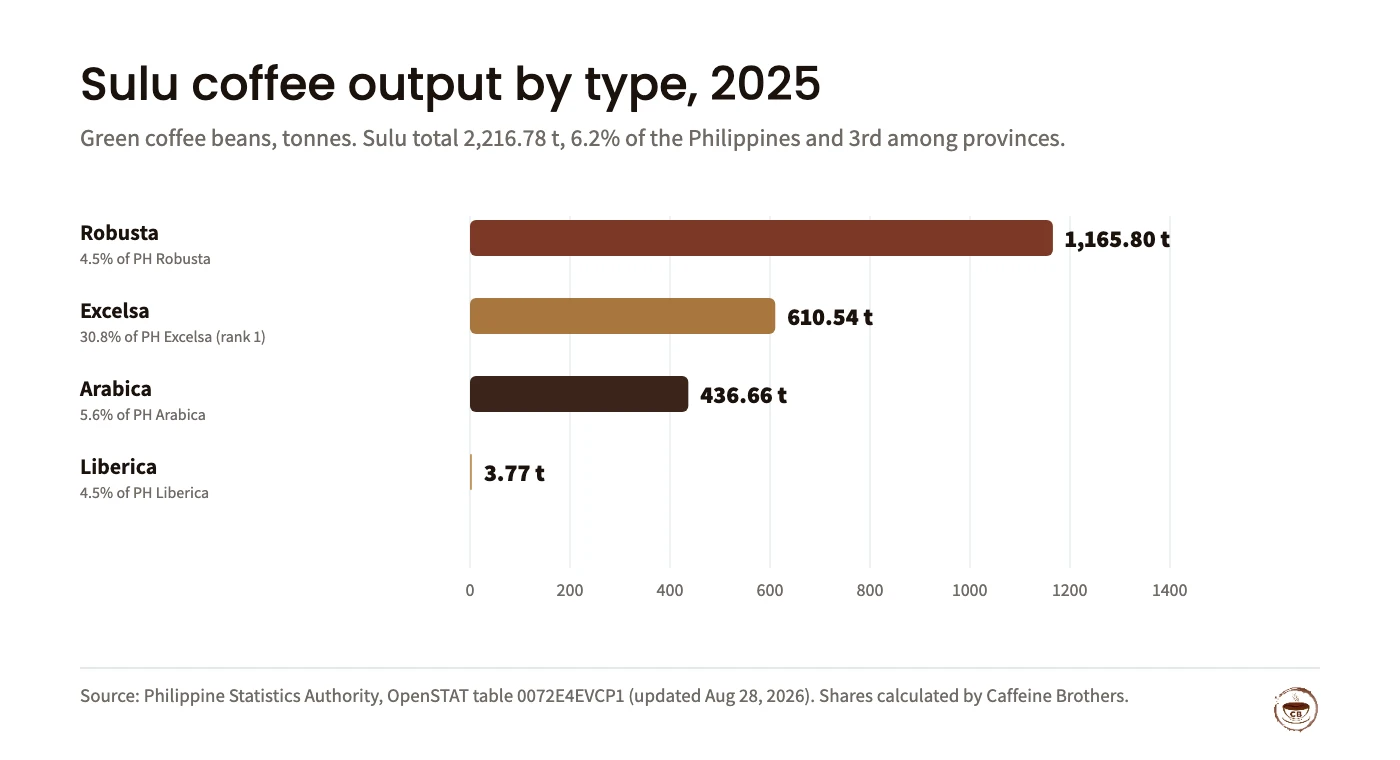
| Type (2025) | Sulu output | Share of Sulu | Share of PH output | Sulu area | Share of PH area |
|---|---|---|---|---|---|
| Robusta | 1,165.80 t | 52.6% | 4.5% | 1,623 ha | 1.6% |
| Excelsa | 610.54 t | 27.5% | 30.8% | 1,240 ha | 16.6% |
| Arabica | 436.66 t | 19.7% | 5.6% | 700 ha | 4.6% |
| Liberica | 3.77 t | 0.2% | 4.5% | 598 ha | 45.1% |
| All coffee | 2,216.78 t | 100% | 6.2% | 4,161 ha | 3.3% |
Excelsa is Sulu’s standout. Its 610.54 t was more than double the next province, Davao del Sur (277.06 t). Sulu got 0.49 t of Excelsa per hectare against a national 0.27 t. If you want to know more about the type itself, see our guide to Excelsa coffee.
Liberica is the puzzle. Sulu holds 598 ha of Liberica, 45.1% of the national area, and 430,300 bearing Liberica trees, 56.5% of the national count. Yet PSA records only 3.77 t of Liberica output in 2025, down from 71.80 t in 2024, while the area did not change. That drop alone accounts for 68.03 t of the 122.94 t fall in national Liberica output that year. We found no report explaining it. It could be a data revision, a bad harvest or a shift in how the crop was counted, so treat it with care. Liberica is the species sold as Kapeng Barako; see our Kapeng Barako guide for how it is grown in Batangas.
Robusta area also moved. PSA shows Sulu’s Robusta area rising from 1,025 ha in 2024 to 1,623 ha in 2025 and Robusta bearing trees from 928,000 to 1,378,000, yet Robusta output fell from 1,304.56 t to 1,165.80 t. New plantings take years to reach full yield, which may explain part of the gap, but PSA does not comment on it.
How much do Sulu farmers get paid for coffee?
Less than most. PSA’s farmgate price table (updated August 28, 2026) shows Sulu’s 2025 average for green Robusta at ₱142.97 a kilo, 62.5% of the national average of ₱228.67. Green Arabica fetched ₱168.47 against ₱264.65 nationally, and Excelsa ₱105.87 against ₱358.03.
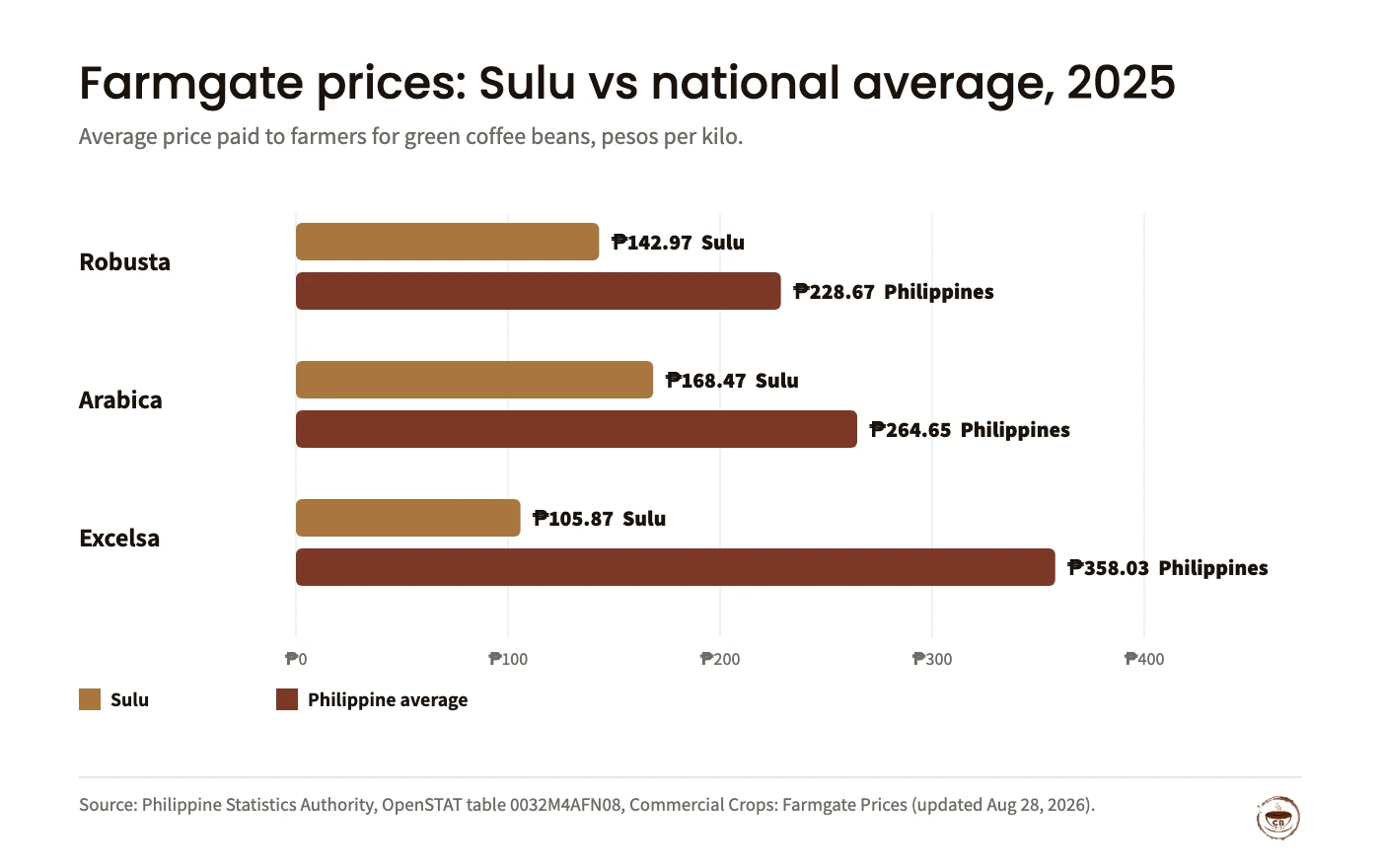
| Green coffee, ₱/kg | 2020 | 2023 | 2024 | 2025 |
|---|---|---|---|---|
| Sulu Arabica | 86.24 | 87.64 | 89.23 | 168.47 |
| Philippines Arabica | 103.25 | 228.76 | 211.28 | 264.65 |
| Sulu Excelsa | 81.17 | 83.99 | 84.77 | 105.87 |
| Philippines Excelsa | 82.04 | 89.49 | 145.20 | 358.03 |
| Sulu Robusta | no data | no data | no data | 142.97 |
| Philippines Robusta | 72.92 | 90.31 | 133.15 | 228.67 |
For years Sulu prices barely moved: Arabica stayed between ₱86 and ₱90 a kilo from 2020 to 2024 while the national average more than doubled. 2025 was the first big rise, to ₱168.47. Our coffee price guide covers the national and world price swings behind those averages.
As a rough illustration, multiplying each type’s 2025 output by its Sulu farmgate price gives about ₱166.7 million for Robusta, ₱64.6 million for Excelsa and ₱73.6 million for Arabica, or about ₱305 million in all. This is our calculation from PSA averages, not a PSA figure, and it leaves out Liberica, which has no Sulu price.
Why are Sulu yields and prices the way they are?
PIN’s 2024 article gives the clearest account we found. It says conflict involving the Abu Sayyaf Group from the 1990s left farms abandoned and kept most Kahawa Sug inside local markets. It reports that the military declared the island of Sulu, including Patikul, free of Abu Sayyaf in 2023, and residents of Kabbon Takas returned to rebuild.
PIN’s market study of Sulu and Basilan, as summarised in that article, found low use of good agricultural practices: little pruning, no rejuvenation of old trees, weak post-harvest handling, and no direct access to large buyers. Farmers described the local single-pass stripping harvest as the “armalite” method. Stripping picks ripe and unripe cherries together, which lowers quality and helps explain why buyers pay less.
Those findings fit the price data, though no source we read measured the link directly.
What is being done to revive Sulu coffee?
Several programs have reached Sulu farmers since 2024. The steps below summarise what each source reports.
- Training in Kabbon Takas, Patikul (2024). PIN’s Leveraging and Expanding Agri-Aqua Production in Bangsamoro (LEAP) project, funded by the European Union, ran planting, rejuvenation and fertilisation sessions for 94 farmers, 54 of them women. The barangay is one of 20 chosen for coffee work.
- Training of trainers in Patikul and Talipao (2024 to 2025). PIN’s July 2024 to August 2025 newsletter reports 60 barangay focal leaders trained in planting, pruning, rejuvenation and pest management.
- Farmer cluster leaders. The same newsletter says 17 of 32 Sulu cluster leaders at a refresher training were women, and that a 40-year-old farm that had never been rejuvenated was starting to bear again.
- Better drying. A Sulu farmer quoted in the newsletter says his community built nurseries and a solar dryer, and that the barangay now prohibits drying coffee on the ground or by the roadside.
- Coconut-coffee intercropping (May 2025). The Agricultural Training Institute (ATI-RTC XII) trained 30 farmers in Patikul on a coconut-coffee system from May 7 to 9, 2025, with the provincial agriculture office and the Philippine Coconut Authority.
PIN’s newsletter adds a useful timeline: newly planted trees take 3 to 4 years to the first harvest, and rejuvenated trees 1 to 2 years. Any gains from this work would show up in PSA data from about 2026 onward.
How does Sulu compare with other big coffee provinces?
Sulu sits in a cluster of Mindanao provinces that dominate Philippine output. We have written about Sultan Kudarat, which grew 44.0% of the country’s coffee in 2025, and Bukidnon, which grew 2,245.70 t, just 28.92 t more than Sulu. Bukidnon is almost all Robusta (98.9%), while Sulu has the most mixed profile of the three.
What does this mean if you are buying coffee?
Kahawa Sug is hard to find outside Mindanao, and Caffeine Brothers does not sell it. We roast Batangas Robusta, Batangas Liberica (Kapeng Barako) and Benguet Arabica. If you like strong black coffee in the Sulu style, our Robusta costs ₱231 for 200 g or ₱813 a kilo, and Kapeng Barako ₱242 or ₱858 (prices checked October 28, 2026).
Frequently asked questions
What is Kahawa Sug?
Kahawa Sug is the Tausug name for Sulu coffee. It joins the Arabic word qahwah with Sug, the Tausug name for the Sulu archipelago. It is usually drunk black, often with bangbang snacks or a latal platter, and is poured back and forth between two cups to cool it.
How much coffee does Sulu produce?
PSA counts 2,216.78 tonnes of green coffee beans for Sulu in 2025, third among Philippine provinces after Sultan Kudarat and Bukidnon and 6.2% of national output. A 2024 People in Need article cites around 7,300 tonnes a year, but that figure does not match PSA’s green bean series and its basis is not stated.
What kind of coffee grows in Sulu?
All four commercial types. In 2025, PSA’s output split was 52.6% Robusta, 27.5% Excelsa, 19.7% Arabica and 0.2% Liberica. Sulu grew 30.8% of all Philippine Excelsa, more than any other province.
Is Sulu still part of BARMM?
No. On September 9, 2024 the Supreme Court ruled that Sulu is not part of the Bangsamoro Autonomous Region in Muslim Mindanao, because the province rejected the Bangsamoro Organic Law in the 2019 plebiscite. PSA’s crop tables still list Sulu under BARMM, with a separate footnoted line for Sulu.
Does Caffeine Brothers sell Sulu coffee?
No. We roast Philippine Robusta and Liberica (Kapeng Barako) from Batangas and Arabica from Benguet. If you like strong, black lowland coffee in the Kahawa Sug style, our Batangas Robusta and Kapeng Barako are the closest match in our range.
Sources
- Non-Food and Industrial Crops: Volume of Production, by Region, Province, Quarter, and Semester, 2010 to 2026. Philippine Statistics Authority, OpenSTAT, updated August 28, 2026. Used for production by type, 2010 to 2025, provincial ranks and shares (read through the PxWeb API).
- Non-Food and Industrial Crops: Area Planted/Harvested, by Region, Province, Quarter, and Semester, 2010 to 2026. PSA OpenSTAT, updated September 1, 2026. Used for Sulu and national coffee area by type.
- Non-Food and Industrial Crops: Number of Bearing Trees/Hills/Vines, by Region, Province, Quarter, and Semester, 2010 to 2026. PSA OpenSTAT, updated August 28, 2026. Used for bearing trees and per-tree output.
- Commercial Crops: Farmgate Prices by Commodity, Region and Province, Monthly, 2010 to 2026. PSA OpenSTAT, updated August 28, 2026. Used for Sulu and national farmgate prices.
- Brewing Peace and Reviving Sulu’s Coffee Industry. People in Need Philippines, August 20, 2024. Used for the name, customs, conflict history, 2021 market study findings, the 7,300 t figure and the Kabbon Takas training.
- BAEP-LEAP newsletter, July 2024 to August 2025. People in Need Philippines, PDF dated August 15, 2025. Used for the 8.1% share, trainer and cluster leader numbers, years to first harvest and the drying rule.
- Kahawa Sug of the Tausug. Philippine Coffee Board, January 3, 2020. Used for the Schück origin story and serving customs.
- Kahawa Sug. Wikipedia, read October 28, 2026. Used for the plantation location; secondary source, flagged in the text.
- Supreme Court: Sulu not part of BARMM. Philstar, September 9, 2024. Used for the ruling and its basis.
- Coconut-coffee system training empowers Sulu farmers through CFIDP program. Agricultural Training Institute RTC XII, May 9, 2025. Used for the May 2025 training.
- Caffeine Brothers shop prices. Checked October 28, 2026 through the store’s product feed. Used for our Robusta and Kapeng Barako prices.
Cite this article: Caffeine Brothers. “Sulu Coffee: Kahawa Sug and the Excelsa Province.” Caffeine Brothers Coffee Blog, October 2026. https://caffeinebrothers.co/sulu-coffee/
You are welcome to reference the tables and charts in this article with a link back to this page.
Looking for strong Philippine coffee you can order today? Try our Batangas Robusta or Kapeng Barako, roasted daily and delivered nationwide, or browse the full shop. Buying for a café or office? See wholesale or contact us.
 Previous Post
 Next Post