
Bukidnon Coffee: Output, Farms and the Arabica Push
By Robin Salvador, co-founder, Caffeine Brothers
Last updated: October 21, 2026
Quick answer: Bukidnon is the Philippines’ second biggest coffee province. The Philippine Statistics Authority (PSA) records 2,245.70 metric tons of green coffee beans from Bukidnon in 2025, or 6.3% of the national 35,645.64 t, grown on 9,042 hectares. Almost all of it is Robusta (98.9% of output). Bukidnon farmers also win national Arabica awards, and the province’s coffee roadmap aims to brand it the country’s “Arabica Capital.”
Key takeaways
- PSA OpenSTAT puts Bukidnon’s 2025 output at 2,245.70 t of green beans, behind only Sultan Kudarat (15,689.08 t).
- Robusta covers 9,008 of Bukidnon’s 9,042 hectares in 2025. Arabica covers 25 hectares and Excelsa 9.
- Bukidnon’s output barely moved from 2010 (2,312.40 t) to 2025, while national output fell 24.6% over the same years.
- Gloria Lagawan of Malaybalay City won the Arabica category of the 2026 Philippine Coffee Quality Competition with 86.41 points (MindaNews, June 8, 2026).
- The Bukidnon Integrated Coffee Center in Malaybalay, run by DA-10 with Nestlé Philippines, trains farmers under the Nescafé Plan.
Bukidnon sits in the middle of northern Mindanao. PhilAtlas lists a land area of 10,498.59 km², 20 municipalities and 2 cities, and a 2020 population of 1,541,308. Malaybalay City is the capital. Coffee is one of the province’s long-standing upland crops, and the numbers below come from the PSA’s own crop tables, which were last updated in late August and early September 2026.
How much coffee does Bukidnon produce?
In 2025 Bukidnon produced 2,245.70 t of green coffee beans, according to the PSA OpenSTAT production table (updated August 28, 2026). Only Sultan Kudarat produced more, with 15,689.08 t, or 44.0% of the country’s output. Sulu (2,216.78 t) was close behind Bukidnon, and Davao del Sur (1,573.83 t) and Cavite (1,229.74 t) followed. For comparison, Benguet, home of the Cordillera Arabica we covered in our Benguet coffee guide, produced 1,011.77 t.
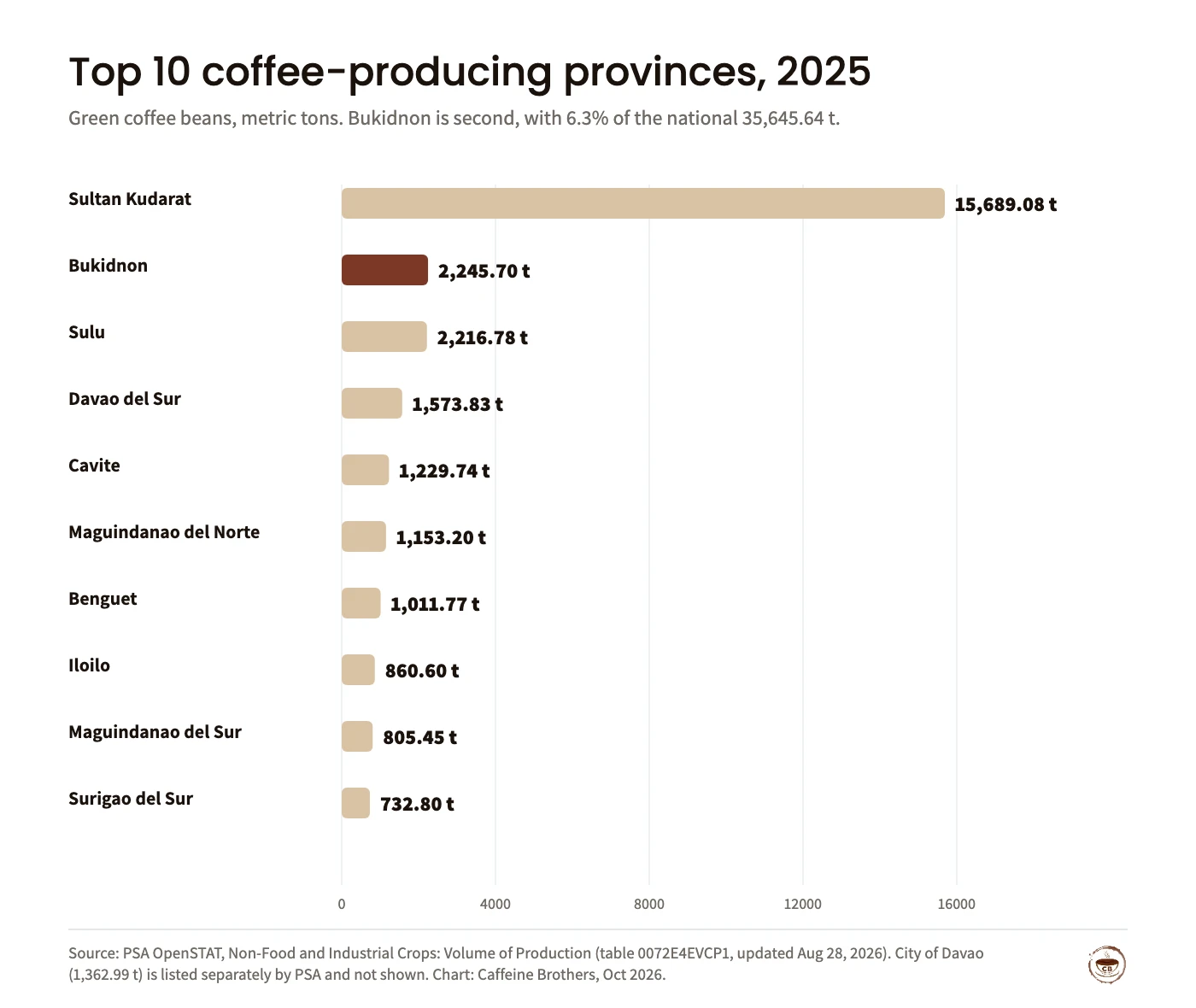
The table below puts Bukidnon next to the national totals for area, bearing trees and output. PSA reports output as green coffee beans, which is the dried, hulled bean before roasting.
| 2025 (PSA) | Bukidnon | Philippines | Bukidnon share |
|---|---|---|---|
| Area (hectares) | 9,042 | 124,982.58 | 7.2% |
| Bearing trees | 4,539,389 | 84,839,827 | 5.4% |
| Green coffee beans (metric tons) | 2,245.70 | 35,645.64 | 6.3% |
| Robusta green beans (t) | 2,220.66 | 25,731.07 | 8.6% |
| Arabica green beans (t) | 20.83 | 7,849.82 | 0.3% |
| Output per bearing tree (kg) | 0.49 | 0.42 | n/a |
| Output per hectare (t) | 0.25 | 0.29 | n/a |
Two things stand out. Each bearing tree in Bukidnon yields a little more than the national average (0.49 kg against 0.42 kg of green beans). Output per hectare is a little lower (0.25 t against 0.29 t). The PSA area figure is labelled “area planted/harvested,” so it may include young trees that are not yet bearing, which would pull the per-hectare number down. We have not found a PSA note that settles this.
Is Bukidnon coffee Robusta or Arabica?
By area and by volume, Bukidnon is Robusta country. Of the 9,042 hectares PSA lists for 2025, 9,008 are Robusta, 25 are Arabica and 9 are Excelsa. Robusta made up 2,220.66 t of the province’s 2,245.70 t, which is 98.9%. Bukidnon alone grew 8.6% of the country’s Robusta.
Robusta is the hardier of the two main species and carries more caffeine than Arabica. If you want to know how it compares with Arabica in the cup and in caffeine, our Robusta coffee guide covers the basics.
Arabica is the small part of the Bukidnon story in the official numbers, and the fast-growing one. PSA records 2.50 t of Bukidnon Arabica in 2010 and 20.83 t in 2025, with Arabica area rising from 10 to 25 hectares. Those are still tiny numbers. The 25 hectares hold 9,250 bearing trees, against 4,524,998 Robusta trees.
How has Bukidnon’s output changed since 2010?
Bukidnon has been steady while the country slipped. National green bean output fell from 47,268.01 t in 2010 to a low near 30,000 t from 2018 to 2023, then recovered to 35,645.64 t in 2025. Bukidnon stayed between about 1,974 t and 2,548 t in every year of the series.
| Year | Bukidnon (t) | Philippines (t) | Bukidnon share |
|---|---|---|---|
| 2010 | 2,312.40 | 47,268.01 | 4.9% |
| 2015 | 2,127.35 | 36,170.91 | 5.9% |
| 2020 | 2,242.28 | 30,320.48 | 7.4% |
| 2021 | 2,548.15 | 30,303.59 | 8.4% |
| 2024 | 2,338.96 | 31,979.26 | 7.3% |
| 2025 | 2,245.70 | 35,645.64 | 6.3% |
From 2024 to 2025 Bukidnon’s output fell 4.0% while national output rose 11.5%. Much of the national rise came from other provinces, so Bukidnon’s share dropped from 7.3% to 6.3%. Over the full series, Bukidnon’s 2025 output was 2.9% below 2010, while the national total was 24.6% below. Our article on Amadeo and the coffee capital title shows the opposite pattern in Cavite, where output swung widely in the same PSA tables.
Why does Bukidnon want to be the “Arabica Capital”?
The Department of Agriculture’s Northern Mindanao office (DA-10) reported that a resolution to adopt the Bukidnon Coffee Roadmap for 2025 was poised for approval, with the goal of making Bukidnon the country’s “Arabica Capital.” The DA-10 article names outdated growing methods, scattered growers, limited marketing channels and thin financing as the main problems. It also says DA-10’s drone team would map coffee areas, identify varieties and profile farmers to build baseline data.
That baseline matters, because the competition results and the PSA table tell different stories. PSA shows 25 hectares of Bukidnon Arabica. Yet Bukidnon growers keep placing at the top of the national Arabica category. Small specialty lots can win awards without adding much tonnage, so both can be true. Until DA-10’s mapping is published, treat the Arabica area figure as the official count, not a full census.
| Competition | Bukidnon result | Score | Reported by |
|---|---|---|---|
| PCQC 2023, Arabica | 1st: Manolito Garces, Pangantucan (New Eden). Also Best Natural. | 86 | DTI Region 10, June 5, 2023 |
| PCQC 2026, Arabica | 1st: Gloria Lagawan, Malaybalay City | 86.41 | MindaNews, June 8, 2026 |
| PCQC 2026, Arabica | 9th: Maynard Joseph Garces, Pangantucan | 83.84 | MindaNews, June 8, 2026 |
| PCQC 2026, Arabica | 10th: Hermalyn Salido, Pangantucan | 83.77 | MindaNews, June 8, 2026 |
| PCQC 2026, Arabica | 11th: Geralyn Duyongan, Impasugong | 83.24 | MindaNews, June 8, 2026 |
MindaNews reported that 10 of the 12 winning Arabica entries in 2026 came from Mindanao. The competition is organized by the Department of Trade and Industry, the Department of Agriculture and the Barista and Coffee Academy of Asia.
Who supports Bukidnon coffee farmers?
The biggest program on record is the Bukidnon Integrated Coffee Center (BICC) at the Northern Mindanao Agricultural Crops and Livestock Research Complex in Malaybalay City. DA-10 describes it as a training and research site set up with Nestlé Philippines and the central hub of the Nescafé Plan, with TESDA-certified training in coffee production. A DA-10 and Nestlé workshop held there on May 11 and 12 worked toward a memorandum of agreement, with Nestlé supporting nursery training and DA-10 offering soil suitability maps and geotagging.
In October 2024, the Philippine News Agency (via Edge Davao) reported that Agriculture Secretary Francisco Laurel Jr. pledged at least ₱1 billion for the coffee industry, focused on Northern Mindanao, during a visit to the BICC. He handed support to 16 farmer associations in the Mindanao Robusta Coffee Project, a DA and Nestlé partnership, and said the country needs “at least an additional 30,000 hectares” for coffee.
The same report quotes Nestlé as saying the country needs about 400,000 metric tons of coffee beans a year and that it produces about 40,000 t locally. Those figures do not line up with PSA’s 31,979.26 t of green beans for all of 2024, so they likely use a different measure. We report them as Nestlé’s statements, not as PSA data.
For farm income, a PIDS discussion paper published February 5, 2026 (DP 2026-02) surveyed 150 coffee farmers in Region X, which includes Bukidnon. It found a return on investment of 55% to 60% for selling fresh cherries and 85% to 95% for dried parchment and hulled beans. Arabica green beans had the highest return, with an ROI of 95%. In plain terms, farmers who dry and hull their own coffee keep more of its value.
How to read Philippine coffee statistics like these
- Check the unit. PSA reports both dried berries and green coffee beans. This article uses green beans, which is what roasters buy.
- Check the update date. The PSA tables used here were updated August 28 and September 1, 2026, and recent years can be revised.
- Separate provinces from cities. PSA lists some cities, like the City of Davao, on their own line.
- Compare species, not just totals. A province can be second overall and still have very little Arabica.
- Treat company figures as statements. Industry numbers in news reports may use different units from PSA.
For the national picture and imports, see our Philippine coffee statistics page.
What does Philippine Robusta and Arabica cost from us?
We do not sell Bukidnon coffee. If you want to taste the two species Bukidnon grows, our Robusta is from Batangas and our Arabica is from Benguet, both roasted daily. These are our shop prices on October 21, 2026.
| Coffee (Caffeine Brothers) | Origin and roast | 200 g | 1 kg | Per 10 g cup (1 kg bag) |
|---|---|---|---|---|
| Robusta | Batangas, dark roast | ₱231 | ₱813 | ₱8.13 |
| Kapeng Barako | Batangas Liberica, dark roast | ₱242 | ₱858 | ₱8.58 |
| Arabica | Benguet, medium roast | ₱292 | ₱1,068 | ₱10.68 |
Frequently asked questions
How much coffee does Bukidnon produce?
PSA OpenSTAT records 2,245.70 metric tons of green coffee beans from Bukidnon in 2025. That is 6.3% of the national total of 35,645.64 t and the second highest of any province, after Sultan Kudarat.
Is Bukidnon coffee Arabica or Robusta?
Mostly Robusta in the official numbers. PSA lists 9,008 of Bukidnon’s 9,042 hectares as Robusta and only 25 hectares as Arabica for 2025. Bukidnon Arabica still wins national competitions, and the provincial roadmap aims to make the province the country’s Arabica capital.
Which Bukidnon farmers won the 2026 Philippine Coffee Quality Competition?
MindaNews reported on June 8, 2026 that Gloria Lagawan of Malaybalay City placed first in the Arabica category with 86.41 points. Other Bukidnon placers included Maynard Joseph Garces and Hermalyn Salido of Pangantucan and Geralyn Duyongan of Impasugong.
Does Caffeine Brothers sell Bukidnon coffee?
No. Our Robusta and Kapeng Barako come from Batangas and our Arabica comes from Benguet. This article reports public data on Bukidnon and does not describe our products.
Sources
- Non-Food and Industrial Crops: Volume of Production, by Region, Province, Quarter, and Semester, 2010-2026. Philippine Statistics Authority, OpenSTAT, updated August 28, 2026. Used for green coffee bean output by province and species, 2010 to 2025.
- Non-Food and Industrial Crops: Area Planted/Harvested, 2010-2026. Philippine Statistics Authority, OpenSTAT, updated September 1, 2026. Used for coffee area by species.
- Non-Food and Industrial Crops: Number of Bearing Trees/Hills/Vines, 2010-2026. Philippine Statistics Authority, OpenSTAT, updated August 28, 2026. Used for bearing coffee trees.
- Bukidnon profile. PhilAtlas. Used for land area, population (2020 census) and number of cities and municipalities.
- Coffee stakeholders scale up NorMin’s coffee roadmap, to brand Bukidnon as Arabica capital. Department of Agriculture Regional Field Office 10 (undated). Used for the roadmap goal, named problems, CEMF funding and drone mapping.
- DA-10, Nestlé Phl strengthen partnership for NorMin coffee industry dev’t. Department of Agriculture Regional Field Office 10 (undated; workshop held May 11 and 12). Used for the Bukidnon Integrated Coffee Center.
- DA pledges P1-B support for NorMin coffee farming, reduced imports. Philippine News Agency via Edge Davao, October 31, 2024. Used for the ₱1 billion pledge, the 30,000 hectare quote and Nestlé’s figures.
- Mindanao farmers dominate coffee quality competition. MindaNews, June 8, 2026. Used for PCQC 2026 Arabica results.
- Bukidnon Arabica coffee is PHL best. Department of Trade and Industry Region 10, June 5, 2023. Used for PCQC 2023 Arabica results and entry count.
- A Comprehensive Economic Analysis of the Coffee Value Chain in Region X. Medalla, Orlanes, Ampoloquio and Tagas, PIDS Discussion Paper 2026-02, February 5, 2026. Used for the farmer survey size and ROI ranges.
- Caffeine Brothers shop prices. Checked October 21, 2026. Used for the price table.
Cite this article: Caffeine Brothers. “Bukidnon Coffee: Output, Farms and the Arabica Push.” Caffeine Brothers Coffee Blog, October 2026. https://caffeinebrothers.co/bukidnon-coffee/
You are welcome to reference the charts and frameworks in this article with a link back to this page.
Want to taste Philippine Robusta and Arabica side by side? Try our Batangas Robusta and Benguet Arabica, or browse the full shop. Contact us if you need help choosing a roast or grind.
 Previous Post
 Next Post