
Catimor Coffee: What It Is and How It Grows in the Philippines
By Robin Salvador, co-founder, Caffeine Brothers
Last updated: October 29, 2026
Quick answer: Catimor is a group of Arabica coffee varieties bred from a cross between Caturra and Timor Hybrid, a natural Arabica and Robusta hybrid from the island of Timor. Breeders in Portugal began the crosses in 1967 to get compact, high-yielding trees that resist coffee leaf rust. World Coffee Research says catimor is “not a distinct variety” but a group of related varieties, and it rates their cup quality potential at high altitude from low to good depending on the line. In the Philippines, a natural-process catimor from Bansalan, Davao del Sur won the Arabica category of the 2021 national coffee competition with 85.86 points.
Key takeaways
- Catimor comes from Caturra crossed with Timor Hybrid. The Timor Hybrid appeared on Timor in the 1920s, and Portugal’s CIFC received its seeds in 1958 or 1959, according to World Coffee Research.
- T8667, Costa Rica 95, Lempira and Catisic are catimor selections from the same Timor Hybrid 832/1 × Caturra cross. Catimor 129 comes from a Colombian line using Timor Hybrid 1343.
- World Coffee Research lists T8667 with high yield potential, low quality potential at high altitude and intermediate leaf rust resistance, and notes Costa Rica 95 is now susceptible to rust in Costa Rica.
- Marites Arellano’s natural catimor, grown at 1,560 m in Balutakay, Bansalan, won PCQC 2021 Arabica with 85.86 points (MindaNews).
- Philippine Arabica output was 7,849.82 tonnes of green beans in 2025, 22.0% of national coffee output and 19.2% below 2010, according to PSA.
Catimor comes up often when people read Philippine coffee competition results or the back of a single-origin bag. This guide explains where catimor came from, what the main catimor lines are, how they rate for yield, rust and cup quality, and what we know about catimor in the Philippines. Every figure comes from World Coffee Research’s variety catalog, the Philippine Statistics Authority, published studies or news reports, listed at the end.
What is catimor coffee?
Catimor is a family of Arabica coffee varieties made by crossing Caturra, a compact Arabica variety, with Timor Hybrid. World Coffee Research (WCR) describes Timor Hybrid as “a natural cross between C. arabica and C. canephora (Robusta) that appeared spontaneously on the island of Timor in 1920s.” Its Robusta genes are what give catimor its resistance to coffee leaf rust, the fungus Hemileia vastatrix.
The name joins the two parents: CATurra and TIMOR. WCR stresses that, “contrary to common belief, Catimor is not a distinct variety. Instead, it is a group of many different distinct varieties with similar parentage.” So a bag that just says “catimor” tells you the family, not the exact line.
Where did catimor come from?
WCR’s catalog page for T8667 gives the history. In 1958 or 1959, the Centro de Investigação das Ferrugens do Cafeeiro (CIFC) in Portugal received two shipments of Timor Hybrid seed and selected two plants with high rust resistance. In 1967, breeders there started crossing rust-resistant Timor Hybrid lines with compact Caturra to get trees that resist rust and can be planted densely. Two early crosses were Red Caturra CIFC 19/1 × HDT CIFC 832/1 (HW26) and Red Caturra CIFC 19/1 × HDT CIFC 832/2 (H46). After testing at the Instituto Agronômico de Campinas in Brazil, the hybrids were called “Catimor.”
The timing mattered. Leaf rust reached the Americas around then, and in 1978 the CATIE research station in Costa Rica received fifth-generation seed of the cross, which it named T-8667. Selection work in Central America then produced Costa Rica 95 (ICAFE, Costa Rica), Lempira (IHCAFE, Honduras) and Catisic (El Salvador). Catimor lines were also selected and released in Malawi and Papua New Guinea, WCR says.
How do the main catimor lines compare?
WCR’s catalog rates each variety on the same scales, using Caturra as the reference for yield and bean size. Here are three catimor lines as the catalog listed them when we read it on October 29, 2026.
| Trait (WCR scale) | T8667 | Costa Rica 95 | Catimor 129 |
|---|---|---|---|
| Lineage | Timor Hybrid 832/1 × Caturra | Timor Hybrid 832/1 × Caturra (ICAFE selection) | Caturra × Timor Hybrid 1343 (Cenicafé line) |
| Stature | Dwarf/compact | Dwarf/compact | Dwarf/compact |
| Yield potential | High | High | High |
| Quality potential at high altitude | Low | Low | Good |
| Optimal altitude | Low to medium | Low to medium | High |
| Coffee leaf rust | Intermediate resistance | Low resistance/susceptible | Intermediate resistance |
| Coffee berry disease | Susceptible | Susceptible | Resistant |
| Bean size | Average | Average | Large |
| First production | Year 3 | Year 3 | Year 2 |
| Planting density | 5,000 to 6,000 per ha (single stem) | 5,000 to 6,000 per ha (single stem) | 3,000 to 4,000 per ha (single stem) |
Two notes from the catalog stand out. WCR’s T8667 summary still describes it as “resistant to rust,” but its trait rating is intermediate resistance. For Costa Rica 95, WCR adds that it “has been confirmed through scientific evaluation to be susceptible to coffee leaf rust in Costa Rica.” WCR also warns that “a variety that is resistant to a disease today may not be resistant tomorrow.” Catimor 129, which Malawi released in 2006, was chosen there because it resisted both leaf rust and coffee berry disease.
What altitude suits catimor in the Philippines?
WCR gives optimal altitude in bands that depend on latitude, because farms nearer the equator need more height for the same cool conditions. T8667 and Costa Rica 95 are rated low to medium. Between 5° and 15° north or south, that band is 700 to 1,300 meters. North of 15°, it is 400 to 1,000 meters.
That splits the Philippines. Bansalan in Davao del Sur sits at about 6.8°N, inside the 5° to 15° band. La Trinidad, Benguet’s capital, sits at about 16.5°N, north of 15°. On WCR’s scale, then, a farm at 1,560 meters in Bansalan is above the low-to-medium band for T8667. Catimor 129 is rated for high altitude, which WCR defines as above 1,300 meters at 5° to 15° and above 1,000 meters north of 15°. These are catalog guidelines, and the catalog does not say which catimor lines are planted in the Philippines.
Does catimor taste good?
Catimor has a mixed reputation for cup quality, and the evidence is mixed too. WCR rates the quality potential at high altitude of T8667 and Costa Rica 95 as low and Catimor 129 as good.
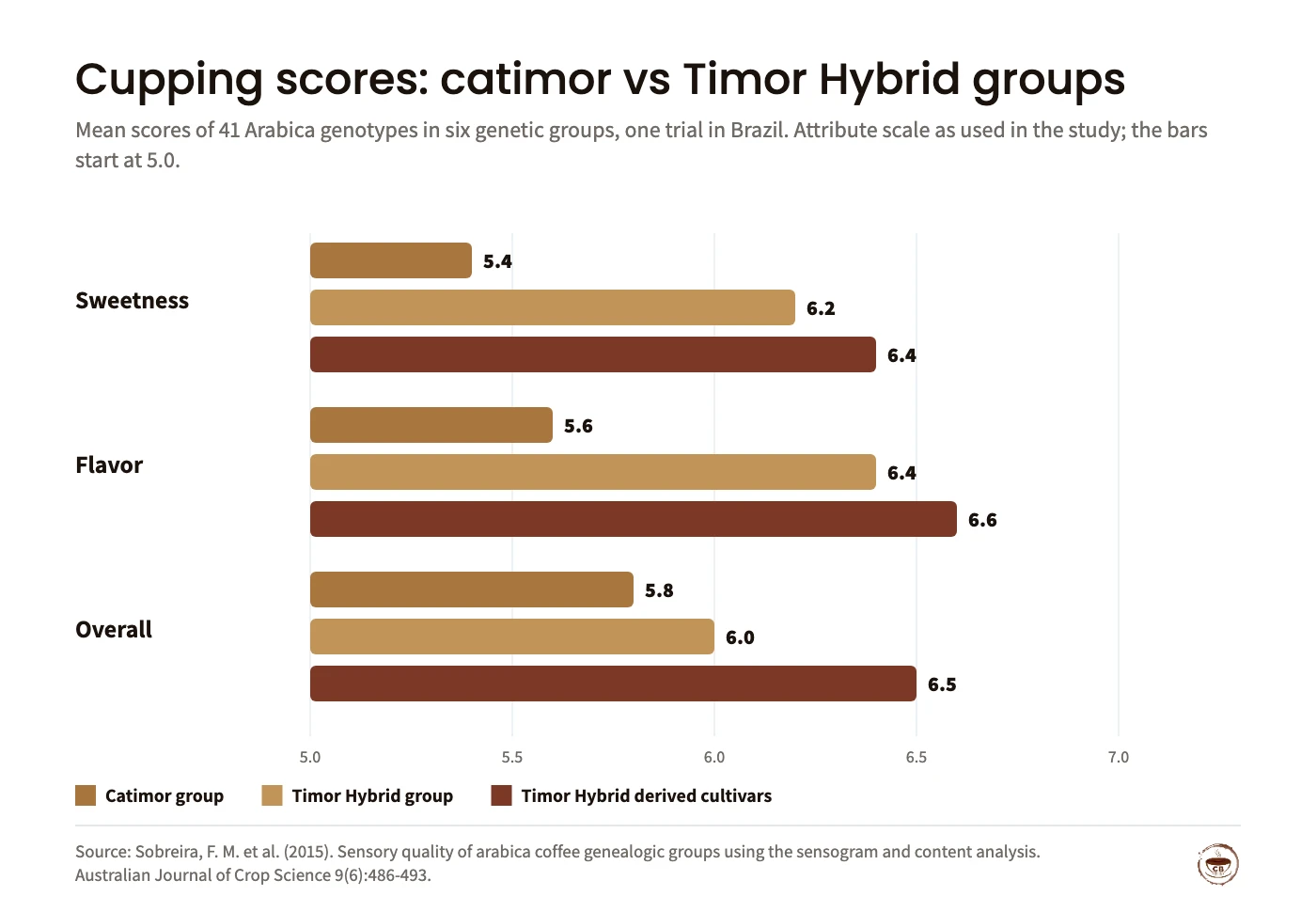
A 2015 study in the Australian Journal of Crop Science by Sobreira and colleagues cupped 41 Arabica genotypes from six genetic groups grown in Brazil. The authors found so much variation within groups that most attributes showed no statistical difference between groups. Where differences showed, the catimor group had low sweetness (5.4), intermediate flavor (5.6) and overall (5.8), and 5.9 to 6.0 for the other attributes. The Timor Hybrid group and the cultivars derived from it scored higher on flavor, and only the Timor Hybrid derived cultivars had a final score statistically above the Bourbon, Caturra, catimor and traditional groups.
The Philippine competition record shows how much the farm and the processing matter. MindaNews reported that the 2021 Philippine Coffee Quality Competition (PCQC) Arabica champion was Marites Arellano of Balutakay, Barangay Managa, Bansalan, with a natural-process coffee scoring 85.86. In the reporter’s words, “It is of the catimor variety and grown at an altitude of 1,560 meters above sea level.” A single competition lot is not a rule for the whole group, but it shows a well-farmed catimor can cup very well.
How common is catimor in the Philippines?
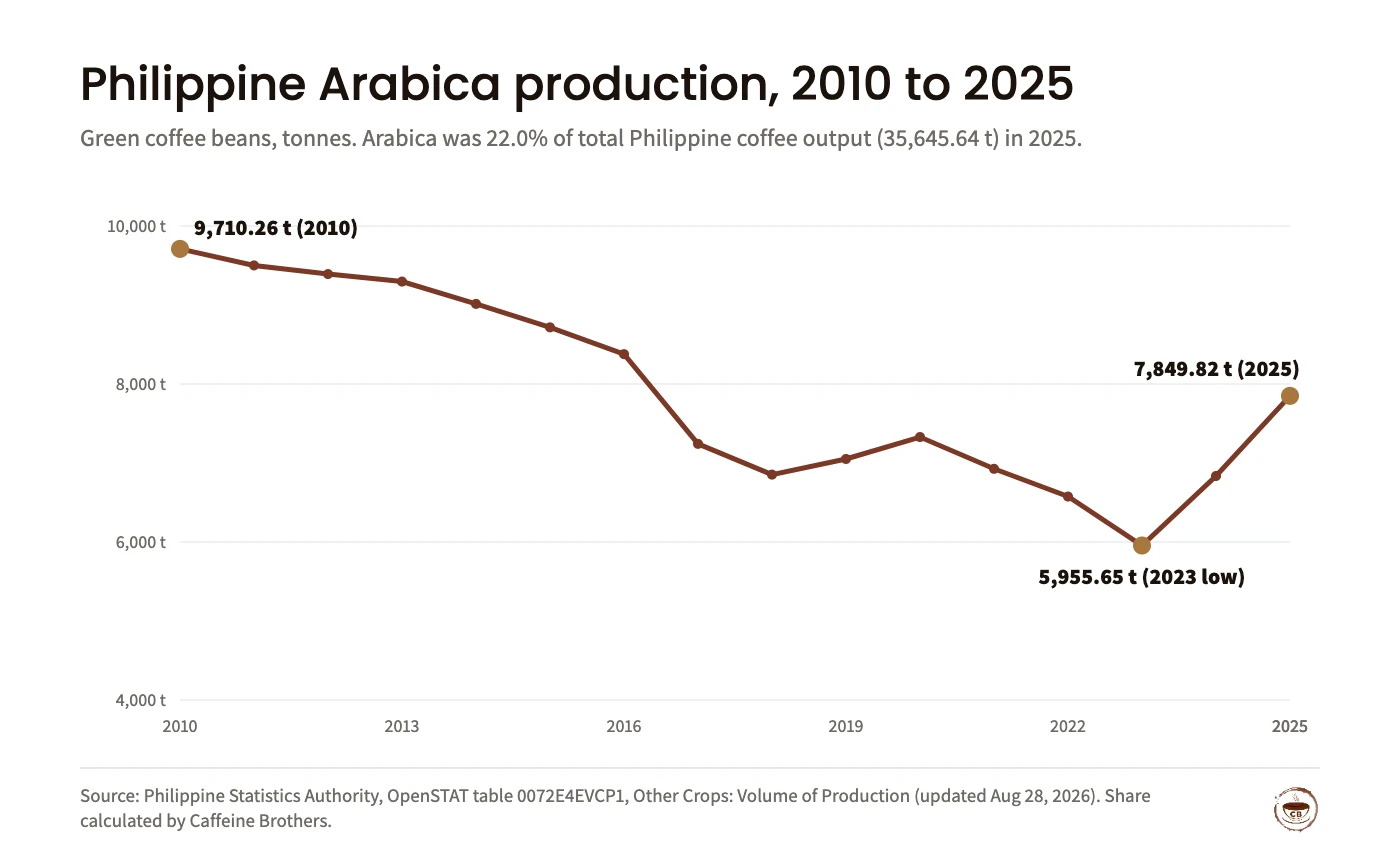
No public dataset we found counts coffee trees by variety in the Philippines. PSA reports Arabica only as a species. Its OpenSTAT production table (updated August 28, 2026) shows Philippine Arabica output falling from 9,710.26 tonnes of green beans in 2010 to a low of 5,955.65 tonnes in 2023, then recovering to 7,849.82 tonnes in 2025. That was 22.0% of total coffee output of 35,645.64 tonnes. Our posts on Benguet coffee and Davao coffee break down where that Arabica grows.
What we do have is project reporting. WCR says the five-year PhilCAFE project, funded by the United States Department of Agriculture and run by ACDI/VOCA with WCR from 2019 to September 2023, aimed to support 13,700 coffee farmers. It set up 18 on-farm technology trials and 2 variety trial sites, which WCR calls “the first legal introduction of new arabica coffee varieties to the Philippines.” At one site, a farmer-run nursery in Kinilis, Polomolok, germinated seed from the trials and planted 1,300 catimor seedlings. WCR also arranged DNA genotyping of 282 leaf samples from Bukidnon and from Arabica varieties certified at BPI Baguio to clarify their genetic origins. WCR wrote that results would be shared with partners; we did not find them published.
Catimor at a glance
| Question | Short answer | Source |
|---|---|---|
| Species | Arabica (Coffea arabica), with some Robusta genes from Timor Hybrid | WCR, T8667 page |
| Parents | Caturra × Timor Hybrid (lines 832/1, 832/2 or 1343) | WCR, T8667 and Catimor 129 pages |
| First crosses | 1967, CIFC, Portugal | WCR, T8667 page |
| Main selling points | Compact trees, high yield, leaf rust resistance | WCR catalog ratings |
| Main weaknesses | High nutrition needs; rust resistance has broken down in some lines | WCR catalog ratings and notes |
| Cup quality | Low to good potential by line; low sweetness in one Brazilian trial | WCR; Sobreira et al. 2015 |
| Philippine example | PCQC 2021 Arabica champion, natural catimor, 85.86 points, 1,560 m, Bansalan | MindaNews, May 26, 2021 |
How to read a catimor coffee label
- Look for the exact line. “Catimor” alone is a group. A label that names T8667, Costa Rica 95 or Catimor 129 tells you much more.
- Check the altitude and region. Compare the farm’s altitude with WCR’s band for its latitude. Bansalan, for example, is at about 6.8°N, inside the 5° to 15° band.
- Check the process. Natural, honey and washed catimors taste different. The PCQC 2021 winner was a natural.
- Check the roast date. Any Arabica tastes flat when it is stale, whatever the variety.
- Brew it lighter first. Try a pour-over or French press before using it in milk drinks, so you can taste the coffee itself.
Does Caffeine Brothers sell catimor?
We do not label our coffee by variety. Our Arabica is 100% Benguet Arabica, medium roasted daily in Manila, and we do not claim a specific variety for it. If you want an Arabica to brew black or by pour-over, here are the prices on our shop on October 29, 2026. For more on how the four Philippine coffee species differ, see our guide to coffee types in the Philippines.
| Caffeine Brothers Arabica (Benguet, medium roast) | Price | Per 100 g |
|---|---|---|
| 200 g | ₱292 | ₱146 |
| 400 g | ₱512 | ₱128 |
| 800 g | ₱923 | ₱115 |
| 1 kg | ₱1,068 | ₱107 |
| 10 kg wholesale box | ₱10,150 | ₱102 |
Frequently asked questions
Is catimor Arabica or Robusta?
Catimor is Arabica (Coffea arabica). It comes from crosses between Caturra and Timor Hybrid. Timor Hybrid is a natural cross of Arabica and Robusta, so catimors carry some Robusta genes, which is where their leaf rust resistance comes from.
Is catimor good coffee?
It depends on the line and the farm. World Coffee Research rates the quality potential of T8667 and Costa Rica 95 at high altitude as low, and Catimor 129 as good. In a 2015 Brazilian study the catimor group scored lower for sweetness than most groups. Yet a natural-process catimor from Bansalan, Davao del Sur won the Arabica category of the 2021 Philippine Coffee Quality Competition with 85.86 points.
Why do farmers plant catimor?
Catimor lines were bred to resist coffee leaf rust, stay compact so they can be planted densely, and yield heavily. World Coffee Research lists T8667 with high yield potential, a dwarf or compact stature, first production in year 3 and planting densities of 5,000 to 6,000 plants per hectare with single-stem pruning.
Is catimor still rust resistant?
Not always. World Coffee Research notes that Costa Rica 95, a catimor, has been confirmed susceptible to coffee leaf rust in Costa Rica and may be susceptible elsewhere in Central America. Rust keeps evolving, so resistance can break down over time.
Sources
- T8667 (Catimor). World Coffee Research, Arabica Coffee Varieties catalog, modified July 21, 2025. Used for catimor history, the CIFC crosses, “not a distinct variety,” and T8667 ratings.
- Costa Rica 95. World Coffee Research catalog, modified May 15, 2023. Used for ratings and the note on rust susceptibility in Costa Rica.
- Catimor 129. World Coffee Research catalog, modified July 20, 2025. Used for lineage, ratings and Malawi release in 2006.
- PhilCAFE project concludes, leads evolution of the Philippine coffee industry. World Coffee Research, January 3, 2024. Used for PhilCAFE scope, trial sites, the 1,300 catimor seedlings and the 282 DNA samples.
- Davao del Sur mountain coffees dominate PCQC 2021. MindaNews, May 26, 2021. Used for the 2021 Arabica champion, score, variety, process and altitude.
- Sensory quality of arabica coffee (Coffea arabica) genealogic groups using the sensogram and content analysis. Sobreira et al., Australian Journal of Crop Science 9(6):486-493, 2015. Used for the cupping scores by group.
- Non-Food and Industrial Crops: Volume of Production, by Region, Province, Quarter, and Semester, 2010-2026. Philippine Statistics Authority OpenSTAT, table 0072E4EVCP1, updated August 28, 2026. Used for Arabica and total coffee output, 2010 to 2025.
- Bansalan. Wikipedia. Used for the latitude of Bansalan (6°47′N).
- Benguet. Wikipedia. Used for the latitude of La Trinidad (16°27′N).
- Arabica Coffee Beans (Benguet, Medium Roast). Caffeine Brothers, prices checked October 29, 2026.
Cite this article: Caffeine Brothers. “Catimor Coffee: What It Is and How It Grows in the Philippines.” Caffeine Brothers Coffee Blog, October 2026. https://caffeinebrothers.co/catimor/
You are welcome to reference the charts and frameworks in this article with a link back to this page.
Curious how Philippine Arabica tastes? Try our Benguet Arabica coffee beans, roasted daily and ground free, or browse the rest of the shop. Cafés can contact us for wholesale pricing.
 Previous Post