
Davao Coffee: Mt. Apo Arabica and Region XI Output
By Robin Salvador, co-founder, Caffeine Brothers
Last updated: October 23, 2026
Quick answer: Davao coffee is coffee grown in the Davao Region (Region XI) of Mindanao. In 2025 the region produced 4,838.11 tonnes of green coffee beans, 13.6% of the Philippine total and the second-highest of any region, according to the Philippine Statistics Authority (PSA). Most of it is Robusta, but Davao is best known for Arabica from the slopes of Mt. Apo in Bansalan, Davao del Sur, which keeps placing in the Philippine Coffee Quality Competition.
Key takeaways
- The Davao Region ranked second among regions in 2025 for both total coffee (4,838.11 t) and Arabica (986.14 t, just ahead of the Cordillera’s 977.75 t).
- Davao del Sur grew 623.21 t of Arabica in 2025, the third-highest of any province after Sultan Kudarat and Benguet.
- Davao del Sur Arabica fetched an average farmgate price of ₱477.50 a kilo in 2025, second only to Sultan Kudarat (₱500) and well above the ₱264.65 national average.
- Regional output fell 57% from 2010 (11,340.78 t) to 2025, much faster than the national drop of 25%. Most of the fall came from Davao de Oro.
- Bansalan farmers placed 2nd, 6th and 7th in Arabica at the 2026 Philippine Coffee Quality Competition.
We roast Philippine coffee from Benguet and Batangas, and we get asked about other origins often. This guide pulls together PSA’s latest production, area, tree and price data for the Davao Region, plus recent reporting on the Mt. Apo farms. We do not sell Davao coffee, so nothing here is a sales pitch for it.
How much coffee does the Davao Region grow?
PSA’s production table puts the Davao Region at 4,838.11 tonnes of green coffee beans in 2025. Only SOCCSKSARGEN (16,675.73 t), driven by Sultan Kudarat, produced more. BARMM was third at 4,361.81 t. The region also holds a bigger share of the country’s coffee land and trees than its share of output.
| 2025 | Davao Region | Philippines | Davao share |
|---|---|---|---|
| Green coffee beans, all types | 4,838.11 t | 35,645.64 t | 13.6% |
| Arabica | 986.14 t | 7,849.82 t | 12.6% |
| Robusta | 3,317.03 t | 25,731.07 t | 12.9% |
| Area planted to coffee | 20,235.90 ha | 124,982.58 ha | 16.2% |
| Arabica area | 3,621.70 ha | 15,102.97 ha | 24.0% |
| Bearing coffee trees | 16,135,953 | 84,839,827 | 19.0% |
| Output per bearing tree, all coffee | 0.30 kg | 0.42 kg | |
| Output per bearing Arabica tree | 0.35 kg | 0.74 kg |
The last two rows stand out. Davao has a quarter of the country’s Arabica land and more than a quarter of its bearing Arabica trees, but only an eighth of its Arabica output. PSA’s tables do not say why. Older or less tended trees, newer plantings counted before full yield, or differences in how provinces estimate harvest could all play a part, and we could not find a source that settles it.
Which Davao provinces grow the most coffee?
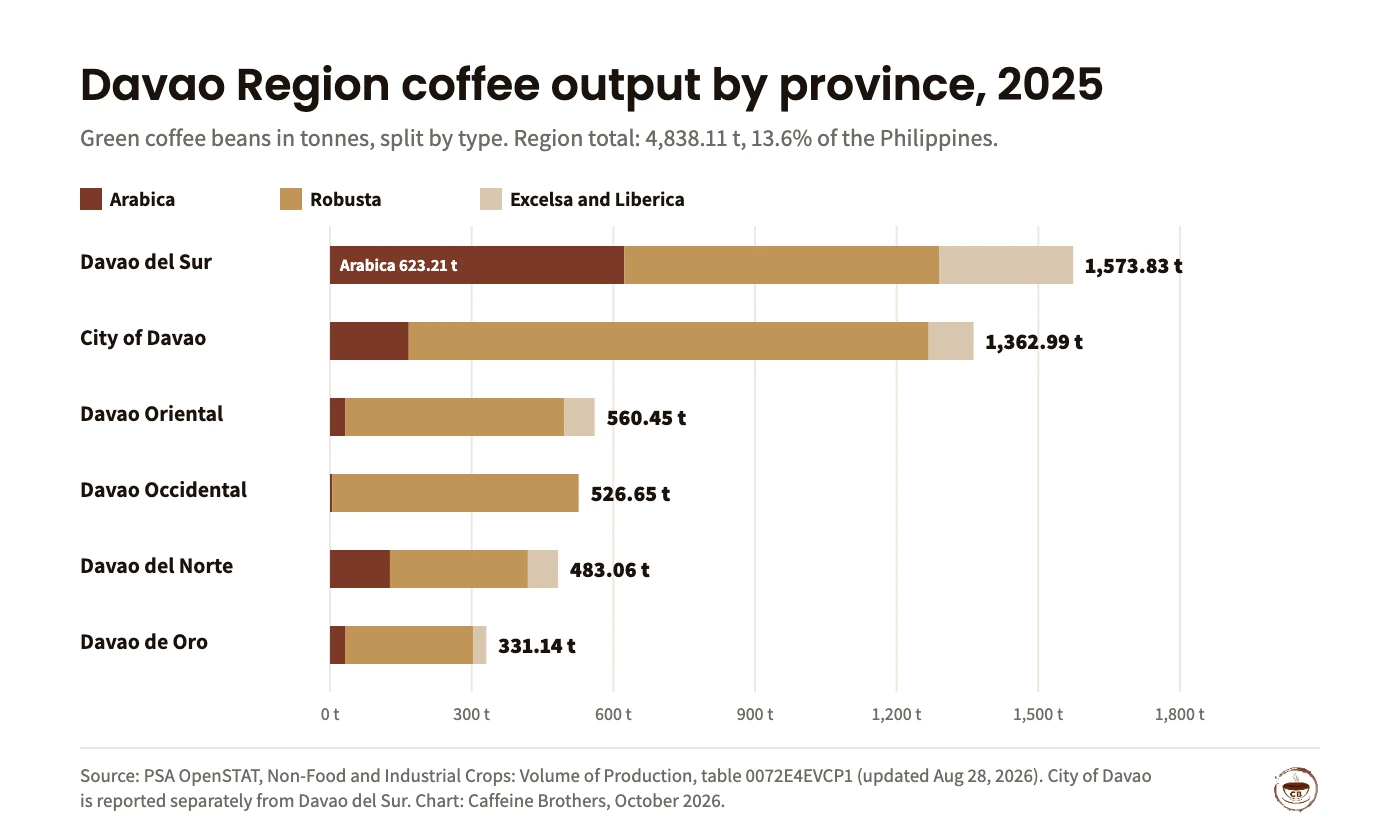
Davao del Sur leads, followed by the City of Davao, which PSA reports as its own line. The city’s coffee is mostly Robusta. Davao del Sur is the only part of the region with a large Arabica harvest.
| Province or city (2025) | Green beans | Arabica | Area | Bearing trees | Farmgate, Arabica | Farmgate, Robusta |
|---|---|---|---|---|---|---|
| Davao del Sur | 1,573.83 t | 623.21 t | 7,710.35 ha | 6,201,067 | ₱477.50/kg | ₱371.25/kg |
| City of Davao | 1,362.99 t | 166.71 t | 4,423.22 ha | 3,636,616 | not reported | not reported |
| Davao Oriental | 560.45 t | 32.40 t | 1,559 ha | 1,318,491 | ₱195.14/kg | ₱176.01/kg |
| Davao Occidental | 526.65 t | 5.06 t | 1,124 ha | 918,803 | ₱200.00/kg | ₱196.88/kg |
| Davao del Norte | 483.06 t | 126.96 t | 1,088.33 ha | 884,486 | ₱135.83/kg | ₱135.83/kg |
| Davao de Oro | 331.14 t | 31.80 t | 4,331 ha | 3,176,490 | ₱160.00/kg | ₱206.30/kg |
| Davao Region | 4,838.11 t | 986.14 t | 20,235.90 ha | 16,135,953 | ₱215.73/kg | ₱200.25/kg |
| Philippines | 35,645.64 t | 7,849.82 t | 124,982.58 ha | 84,839,827 | ₱264.65/kg | ₱228.67/kg |
One reporting quirk matters if you look at the series yourself. PSA shows no separate figure for the City of Davao in 2023 and 2024, and Davao del Sur’s total jumps to about 3,000 t in those two years. Davao del Sur plus the city came to 3,092.35 t in 2022 and 2,936.82 t in 2025, so the 2023 and 2024 Davao del Sur figures look like they include the city. The drop to 1,573.83 t in 2025 reflects a change in how the numbers are split between the province and the city.
Why is Davao del Sur Arabica so highly priced?
PSA’s 2025 farmgate data has Davao del Sur Arabica at ₱477.50 a kilo, up from ₱420.00 in 2024 and ₱419.78 in 2023. Only Sultan Kudarat (₱500) was higher among provinces, and Benguet was next at ₱417.67. Davao del Sur Robusta averaged ₱371.25, second to Ilocos Sur. Both are far above the regional averages of ₱215.73 and ₱200.25, which shows how much prices vary inside one region.
Quality competitions help explain the premium. Coffee scoring 80 points or more on a cupping sheet counts as specialty grade, and Bansalan’s Arabica keeps scoring above that line.
| Year | Place | Farmer | Location | Score |
|---|---|---|---|---|
| 2021 | 1st, Arabica | Marites Arellano | Balutakay, Brgy. Managa, Bansalan | 85.86 |
| 2021 | 2nd, Arabica | Lendilou Loon | Sitio Mahayahay, Brgy. Alegre, Bansalan | not given |
| 2021 | 3rd, Arabica | Jastine Mae Dubria | Balutakay, Bansalan | not given |
| 2026 | 2nd, Arabica | Roxanne Abegail Naya | Bansalan | 85.61 |
| 2026 | 6th, Arabica | Lendilou Loon-Morris | Bansalan | 84.25 |
| 2026 | 7th, Arabica | Janet Escalera | Bansalan | 84.07 |
MindaNews reported that 10 of the 12 Arabica winners in 2026 came from Mindanao. Our Bukidnon coffee guide covers the province that took first place.
Where on Mt. Apo is the coffee grown?
Most of the award-winning Davao coffee comes from Barangay Managa and nearby villages in Bansalan, on the Davao del Sur side of Mt. Apo. Reports give different elevations because they describe different farms. MindaNews put the 2021 winning farm in Balutakay at 1,560 m. Edge Davao in July 2026 said members of the Balutakay Coffee Farmers Association (BACOFA) farm at about 1,700 m, while a June 2025 Edge Davao feature put Purok Pluto at 1,200 m.
BACOFA was set up in May 2013 with 20 farmers and now has 68 members, according to Edge Davao. The same report describes one family farm, run by Luis and Janet Escalera on 4 hectares, that washes the cherries, ferments them for three days, pulps them, dries them in hanging dryers, hulls them and sorts the beans by hand. Neighbors are paid ₱20 per kilo for sorting, and harvesters get ₱250 a day plus snacks and lunch. Edge Davao also notes that Balutakay farmers once switched to vegetables when world coffee prices fell, then returned to coffee.
Support has followed. The Department of Science and Technology opened a ₱12 million Regional Coffee Innovation Center at Davao del Sur State College in Digos City on February 20, 2025, growing out of a small cupping lab first backed by ACDI/VOCA.
Why has Davao’s coffee output fallen?
The region produced 11,340.78 t in 2010 and 4,838.11 t in 2025, a 57% fall. National output fell 25% over the same years, from 47,268.01 t to 35,645.64 t. The region’s share of the national harvest went from 24.0% to 13.6%.
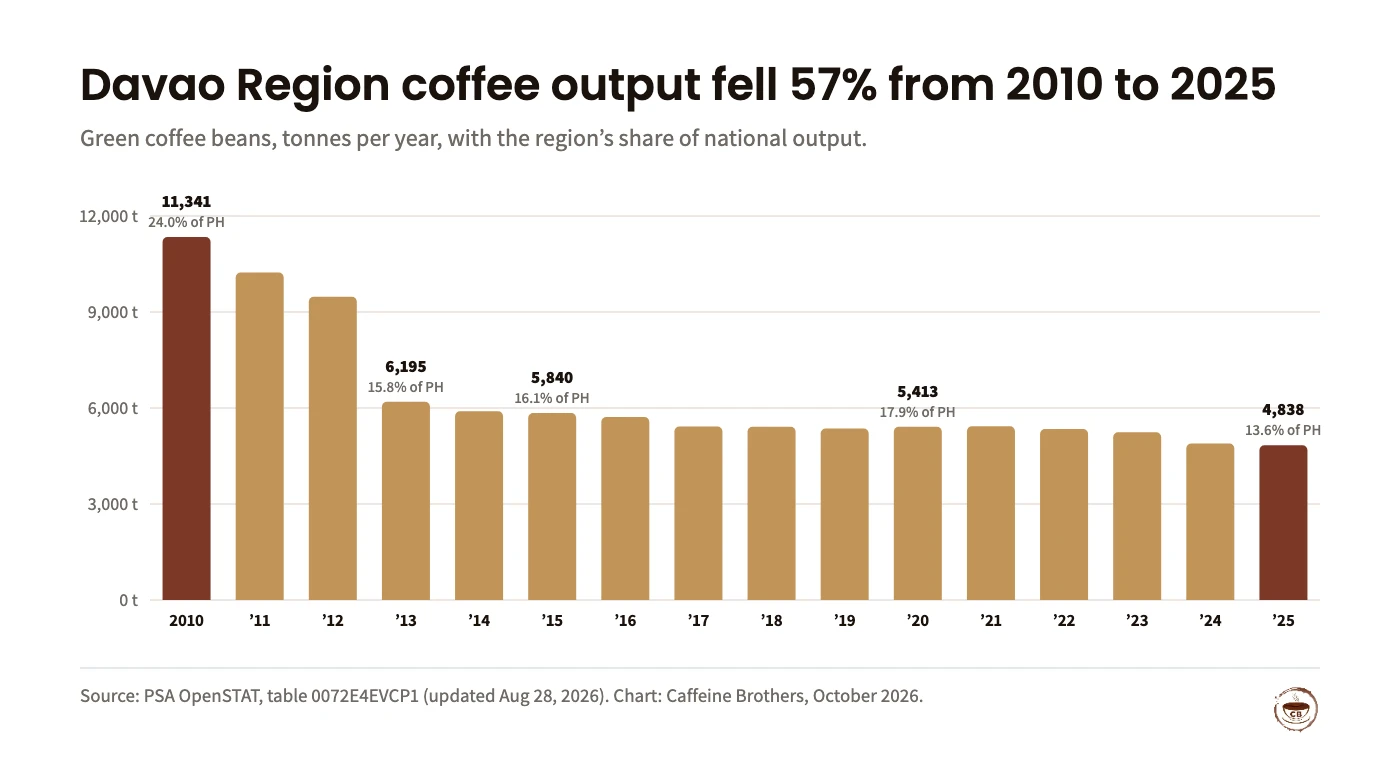
Almost all of the drop happened in Davao de Oro (formerly Compostela Valley). Its output went from 5,807.15 t in 2010 to 716.54 t in 2015 and 331.14 t in 2025. Its coffee area shrank from 11,026 ha to 4,331 ha and its bearing trees from 9.58 million to 3.18 million. PSA’s tables record the change without giving a cause.
Davao del Sur is moving the other way on land. Its coffee area rose from 3,517.35 ha in 2020 to 7,710.35 ha in 2025, and its Arabica area from 1,405 ha to 2,398 ha. Edge Davao notes that Arabica usually takes 4 to 5 years to bear fruit, so new plantings take time to show up in harvest figures.
How to buy and brew Davao coffee
- Look for the farm, association or barangay on the bag. “Davao” on its own could mean Robusta from any of six provinces.
- Ask for the roast date and buy amounts you can use within a few weeks.
- Check the processing method. Davao Arabica is sold washed and natural; the 2021 PCQC winner was a natural.
- Brew Arabica with a pour-over or French press to taste the origin. Robusta from the region suits strong black coffee or drinks with milk.
- Compare prices per kilo. Davao del Sur’s 2025 farmgate Arabica price of ₱477.50 for green beans is a useful floor when you look at roasted bag prices; our coffee prices guide explains how green and roasted prices relate.
If you are comparing Philippine Arabica origins, our Benguet coffee guide covers the Cordillera, where our own Arabica comes from. Caffeine Brothers Arabica costs ₱292 for 200 g and ₱1,068 for 1 kg, and our Batangas Robusta ₱231 and ₱813, as of October 23, 2026.
Frequently asked questions
What is Davao coffee known for?
Davao is best known for Arabica grown on the slopes of Mt. Apo, especially around Bansalan in Davao del Sur. Bansalan farmers took the top three Arabica places in the 2021 Philippine Coffee Quality Competition and three of the twelve Arabica places in 2026. By volume, though, most coffee grown in the Davao Region is Robusta: 3,317.03 of 4,838.11 tonnes in 2025, per PSA.
How much coffee does the Davao Region produce?
PSA recorded 4,838.11 tonnes of green coffee beans from the Davao Region in 2025, 13.6% of the national total of 35,645.64 tonnes. That made it the second-largest coffee region after SOCCSKSARGEN (16,675.73 tonnes). Output has fallen 57% since 2010, when the region produced 11,340.78 tonnes.
Which province in Davao grows the most coffee?
Davao del Sur, with 1,573.83 tonnes of green beans in 2025, including 623.21 tonnes of Arabica. The City of Davao, which PSA reports separately, produced 1,362.99 tonnes, mostly Robusta.
Does Caffeine Brothers sell Davao coffee?
No. Our Arabica comes from Benguet and our Robusta and Kapeng Barako from Batangas. If you want Mt. Apo coffee specifically, buy from Davao farmer groups or roasters that name the farm or association on the bag.
Sources
- Non-Food and Industrial Crops: Volume of Production, by Region, Province, Quarter, and Semester, 2010 to 2026. Philippine Statistics Authority (PSA) OpenSTAT, table 0072E4EVCP1, updated August 28, 2026. Used for green coffee bean output by region, province and type, 2010 to 2025.
- Area planted/harvested of non-food and industrial crops. PSA OpenSTAT, table 0092E4EAHM1, updated September 1, 2026. Used for coffee area by province and type, 2010, 2020 and 2025.
- Number of bearing trees of non-food and industrial crops. PSA OpenSTAT, table 0122E4EBTM1, updated August 28, 2026. Used for bearing coffee trees and output per tree.
- Commercial Crops: Farmgate Prices by Commodity, Region and Province, Monthly, 2010 to 2026. PSA OpenSTAT, table 0032M4AFN08, updated August 28, 2026. Used for 2023 to 2025 annual farmgate prices of green Arabica and Robusta by province.
- Mindanao farmers dominate coffee quality competition. MindaNews, June 8, 2026. Used for the PCQC 2026 Arabica rankings and scores, including the three Bansalan winners.
- Davao del Sur mountain coffees dominate PCQC 2021. Bobby Timonera, MindaNews, May 26, 2021. Used for the 2021 Bansalan winners, the 85.86 top score and the 1,560 m elevation of the winning farm.
- Why Mount Apo’s coffee is the best. Henrylito D. Tacio, Edge Davao, July 3, 2026. Used for BACOFA’s founding and membership, the 1,700 m farm elevation, the Escaleras’ processing steps and the sorting and harvest pay rates.
- Davao del Sur: The source of finest coffee in the Philippines. Henrylito D. Tacio, Edge Davao, June 13, 2025. Used for the DOST Regional Coffee Innovation Center (₱12 million, inaugurated February 20, 2025) and the Purok Pluto details.
- Caffeine Brothers shop prices. Checked October 23, 2026 through the store’s product feed. Used for our Arabica and Robusta prices.
Cite this article: Caffeine Brothers. “Davao Coffee: Mt. Apo Arabica and Region XI Output.” Caffeine Brothers Coffee Blog, October 2026. https://caffeinebrothers.co/davao-coffee/
You are welcome to reference the charts and frameworks in this article with a link back to this page.
Looking for Philippine Arabica you can order today? Try our Benguet Arabica or Batangas Robusta, roasted daily and delivered nationwide, or browse the full shop. Contact us with any questions.
 Previous Post