
Peaberry Coffee: What It Is and How Rare It Really Is
By Robin Salvador, co-founder, Caffeine Brothers
Last updated: October 31, 2026
Quick answer: Peaberry coffee comes from coffee cherries that grew one bean instead of the usual two. The single bean has nothing to flatten it, so it develops round or oval. Researchers at Colombia’s Cenicafé put peaberries at 5% to 7% of the Arabica and Robusta harvest, and a two-season study in Ethiopia measured 7.31% across pure-line Arabica varieties and 16.22% in a hybrid. Peaberries are sorted out as a separate lot in some origins, graded as their own type in Hawaii, and treated as a defect by many breeders.
Key takeaways
- A coffee cherry normally holds two seeds with flat faces pressed together; a peaberry forms when only one seed develops (Alemseged and Taye, 2020).
- Cenicafé (2023) puts peaberries at 5% to 7% of the total Arabica and Robusta harvest.
- At Jimma, Ethiopia, peaberry share ranged from 3.24% (Wush Wush) to 11.07% (variety 744) among pure lines, and reached 16.22% in the hybrid Gawe.
- Hawaii’s coffee rules, in the summary effective July 1, 2020, grade peaberry as type II beans on slotted screens: size 13 for Extra Fancy, 12 for Fancy and 10 for No. 1.
- If 5% to 7% applied to the Philippines’ 2025 Arabica crop of 7,849.82 tonnes (PSA), that would be roughly 392 to 549 tonnes of peaberry, though no Philippine source measures the share.
Customers sometimes ask us whether we have peaberry, usually after seeing it priced higher on a café menu or a Kona coffee bag. This guide explains what a peaberry is, how often it happens, how grading standards treat it and what the research says about roasting and taste. We do not sell a separate peaberry lot, and we say so below.
What is a peaberry coffee bean?
A coffee fruit, or cherry, usually holds two seeds. They grow facing each other, so each bean ends up flat on one side and curved on the other. In a peaberry, only one seed develops. Hawaii’s Department of Agriculture rules define this “type II bean” as one “produced one to a cherry” that is “generally oval in shape and round in diameter,” and say it is “also referred to as peaberry.”
Alemseged Yilma of the Ethiopian Institute of Agricultural Research and Taye Kufa of IITA, in a 2020 paper, give two main causes: one of the two ovules is not fertilized, or the endosperm of one seed fails to develop. They list the triggers as weather that causes flower abortion, poor pollination by insects or wind, incompatibility between parents (common in hybrids such as Arabusta), and possibly genetic defects. Because the remaining seed has the whole cherry to itself, it grows into a rounder shape.
How common are peaberries?
Two research groups give similar headline figures. Cenicafé, the Colombian coffee research center, says peaberries make up 5% to 7% of the total harvest of Coffea arabica and Coffea canephora (Robusta), in the abstract of a 2023 study by Eduardo Duque Dussán, Paula Figueroa Varela and Juan Rodrigo Sanz Uribe. Alemseged and Taye give the same 5% to 7% range in their introduction.
Their own field data, collected over two cropping seasons at the Jimma National Coffee Research Center in Ethiopia, show how much the share moves by variety. The mean across all pure-line varieties was 7.31%. The hybrid Gawe produced 16.22%, which the authors put down to poorer pollination and parental incompatibility in hybrids. The research center also reported that about 7% of the seed it distributed was sorted out as peaberry.
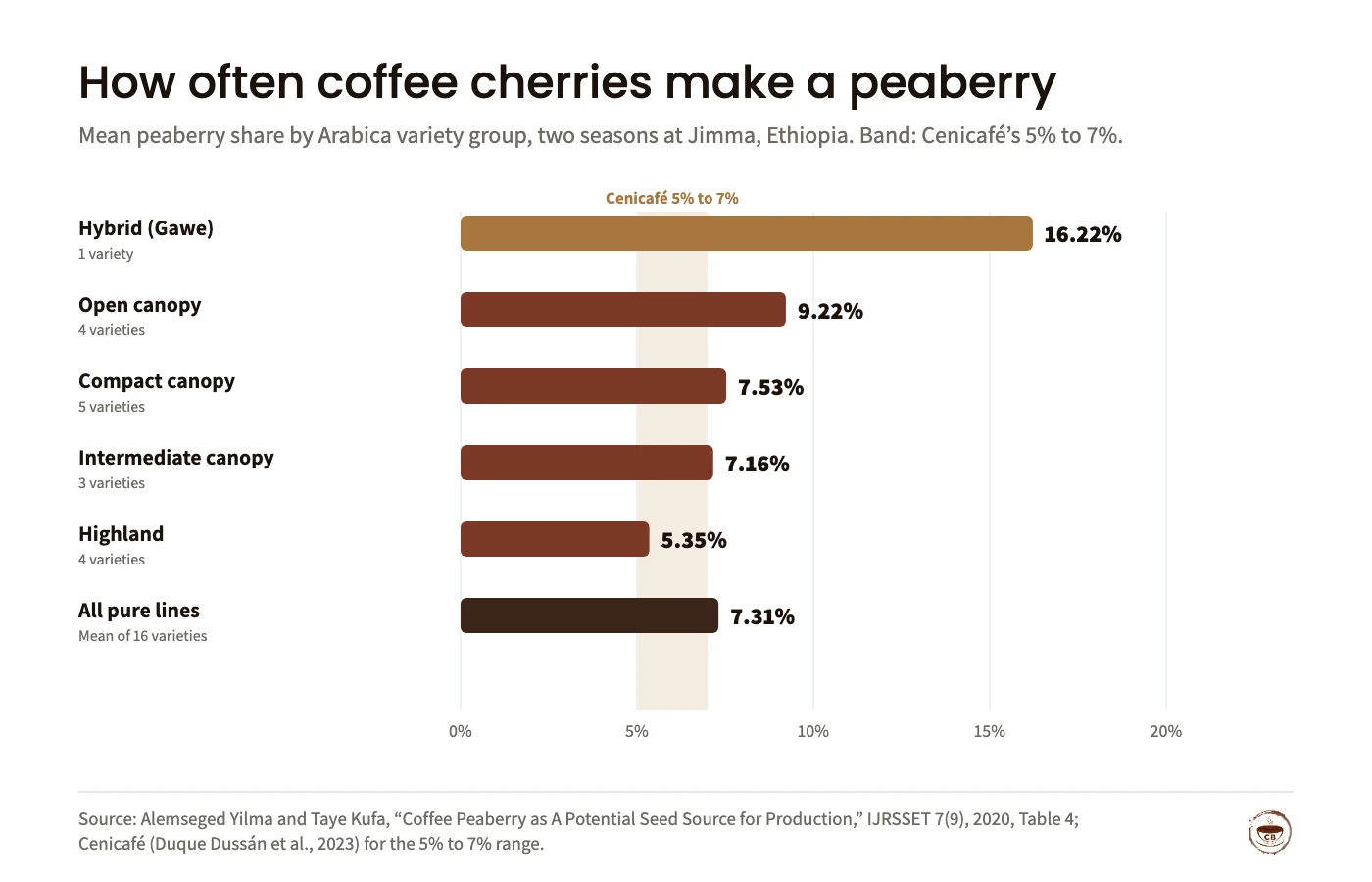
| Variety group | Variety | Peaberry share (%) |
|---|---|---|
| Compact canopy | 74110 | 10.15 |
| Compact canopy | 74112 | 6.43 |
| Compact canopy | 74140 | 5.32 |
| Compact canopy | 74158 | 7.10 |
| Compact canopy | 74165 | 8.67 |
| Intermediate canopy | 7487 | 6.85 |
| Intermediate canopy | Meoftu | 9.46 |
| Intermediate canopy | Dessu | 5.18 |
| Open canopy | 741 | 6.34 |
| Open canopy | 754 | 9.31 |
| Open canopy | 75227 | 10.17 |
| Open canopy | 744 | 11.07 |
| Highland | Yachi | 8.88 |
| Highland | Wush Wush | 3.24 |
| Highland | Buno Woshi | 3.50 |
| Highland | Merda Cheriko | 5.76 |
| Hybrid | Gawe | 16.22 |
These are Ethiopian varieties grown at one station, so the exact numbers will not carry over to Benguet, Bukidnon or any other Philippine farm. They do show that the variety matters: the highest pure line produced more than three times the share of the lowest.
How many peaberries could the Philippines produce?
No Philippine agency we could find reports a peaberry share. As a rough sense of scale only, the Philippine Statistics Authority’s OpenSTAT production table (updated August 28, 2026) gives 2025 output of 7,849.82 tonnes of Arabica green coffee beans and 25,731.07 tonnes of Robusta. If 5% to 7% of the Arabica crop were peaberry, that would be about 392.49 to 549.49 tonnes. This is our arithmetic, and the real share depends on the varieties, weather and pollination on each farm. For background on Philippine Arabica varieties, see our post on Catimor, and on one growing region, our guide to Benguet coffee.
Peaberries also come at a cost to yield. Alemseged and Taye cite Wintgens (2004): an increase of 1% in peaberry beans in a crop reduces production by 0.75%. That is one reason breeders treat a high peaberry rate as a fault.
How do grading standards treat peaberry?
The answer depends on the market. Hawaii grades peaberry as its own bean type with its own screen sizes. Hawaii measures type I (flat) beans on round-hole screens and peaberries on slotted screens. A screen size is the hole width in 64ths of an inch, so size 10 is 10/64 of an inch, about 3.97 mm.
| Hawaii grade | Flat bean (type I) minimum screen | Peaberry (type II) minimum screen | Defect allowance |
|---|---|---|---|
| Extra Fancy | Size 19 (7.54 mm round hole) | Size 13 (5.16 mm slot) | 8 full imperfections per 300 g |
| Fancy | Size 18 (7.14 mm round hole) | Size 12 (4.76 mm slot) | 12 full imperfections per 300 g |
| No. 1 | Size 16 (6.35 mm round hole) | Size 10 (3.97 mm slot) | 18 full imperfections per 300 g |
A Hawaii Department of Agriculture grading presentation from 2013 adds that peaberry “is not a grade” and not a defect; it is a bean type that can appear in any grade. The same rules also allow one type with no more than 3% of the other type by weight in the top grades, so flat beans and peaberries are kept apart in those grades.
| Source | How it treats peaberry |
|---|---|
| Hawaii Administrative Rules 4-143 | Type II bean with its own screen sizes; not a defect |
| ASEAN Standard for Coffee Bean (ASEAN Stan 31:2013) | Not listed; its six defect types are black, mouldy and infested, immature and broken beans, dried cherries and foreign matter |
| Wintgens (2004), cited by Alemseged and Taye | Considered a defect in production and used as a criterion in breeding |
| Jimma Agricultural Research Center seed practice | Sorted out of seed lots and not used for seedlings, although the 2020 study found peaberry seed grows as well as normal seed |
| Duque-Dussán et al., Tropentag 2024 | Long treated as a defect, with exports once banned in many producing countries |
For Philippine buyers the ASEAN standard is the most relevant. It sorts green beans into Extra, Class I and Class II with total defect limits of 7%, 15% and 25%, and it sizes beans by diameter in millimetres. It does not mention peaberry at all, so a peaberry lot sold in the region is a sorting choice by the seller and not a grade under that standard. Our post on how coffee beans are graded covers the wider system.
Does peaberry roast or taste differently?
This is where marketing runs ahead of the evidence. Two lines of research exist.
- The 2023 Cenicafé study used Arabica variety Cenicafé 1 and compared peaberries with standard beans through drying, roasting, milling and cupping. Its abstract says peaberries dried faster, roasted more evenly without burnt spots, broke under more uniform forces when ground, and matched the cup quality of standard beans. The abstract does not give the measured values.
- A 2024 Tropentag abstract by the same group roasted 120 g of standard beans, 120 g of peaberries and a 60 g plus 60 g mix at medium roast, then photographed 100 beans from each. Colour was less variable in the peaberry samples, and the standard beans showed internal air chambers that the authors linked to over-roasting.
The sources disagree on one basic point. Alemseged and Taye describe peaberries as tending to be “larger and denser,” while the Cenicafé abstract calls them smaller beans that the market sees as a defect because buyers want large standard beans. Neither source gives size or density measurements to settle it, so we do not take a side.
Alemseged and Taye also quote coffee writer Kenneth Davids (2003), who said the roasting effects of shape are minor and that the bigger benefit of a peaberry lot is the careful sorting behind it. That is a reasonable way to read a peaberry label: it tells you the beans were hand or machine sorted by shape, which tends to go with careful processing, but it does not guarantee a better cup on its own. For more on how roast level shapes flavour, see medium roast vs dark roast.
How to buy and brew peaberry
- Check the origin and variety on the bag, since these shape the flavour more than bean shape.
- Look for a roast date and buy only what you will use in a few weeks.
- Ask whether it was sorted by screen or by hand, and from which grade, if the seller makes a quality claim.
- Brew it like any other bean from the same origin and roast; no special ratio is needed.
- Compare side by side with a flat-bean lot from the same farm if you want to judge the difference yourself.
Caffeine Brothers does not sort or sell a separate peaberry lot. Our Benguet Arabica (medium roast), Batangas Robusta, Kapeng Barako and blends are roasted with whatever peaberries come in with the flat beans.
Frequently asked questions
What is peaberry coffee?
Peaberry coffee is made from beans that grew alone inside the coffee cherry instead of as a pair. With no partner bean to press against, the single seed grows round or oval instead of flat on one side. Hawaii’s coffee rules call it a type II bean.
How rare is peaberry coffee?
Cenicafé researchers put peaberries at 5% to 7% of the harvest for Arabica and Robusta. A two-season study at Jimma, Ethiopia measured 7.31% on average across 16 pure-line Arabica varieties and 16.22% for one hybrid.
Does peaberry coffee taste better?
There is no settled answer. A 2023 Cenicafé study found peaberries reached the same cup quality as standard beans, dried faster and roasted more evenly, and a 2024 image study found more even roast colour. Flavour differences between lots still depend mostly on variety, farm and processing.
Is peaberry a defect?
It depends on who is grading. Breeders and some producing countries have treated peaberry as a defect, while Hawaii grades it as its own bean type with its own screen sizes. The ASEAN standard for coffee beans does not list peaberry among its six defect types.
Does Caffeine Brothers sell peaberry coffee?
No. Our Arabica, Robusta, Kapeng Barako and blends are not sorted into separate peaberry lots, so any peaberries are roasted together with the flat beans.
Sources
- Coffee Peaberry as A Potential Seed Source for Production. Alemseged Yilma and Taye Kufa, International Journal of Research Studies in Science, Engineering and Technology 7(9):30 to 35, 2020, via IITA. Used for causes, the 5% to 7% range, Table 4 variety shares, the 7% seed sort-out, Wintgens’ 0.75% yield figure and the Davids quote.
- Peaberry shape and size influence on different coffee postharvest processes. Duque Dussán, Figueroa Varela and Sanz Uribe, Cenicafé, October 5, 2023 (Journal of Food Process Engineering, e14461). Used for the 5% to 7% share and the drying, roasting, milling and cupping findings.
- Peaberry coffee beans shape influence final cup quality. Duque-Dussán, Sanz-Uribe and Figueroa-Varela, Tropentag 2024 abstract, September 2024. Used for the roast image analysis and the note on export bans.
- Summary of Chapter 4-143, Hawaii Administrative Rules: Standards for Coffee. Hawaii Department of Agriculture, effective July 1, 2020. Used for grade screen sizes and defect allowances.
- Haw. Code R. § 4-143-6: Standards for grades of green coffee. Cornell Legal Information Institute. Used for round and slotted screen definitions and the 10% undersize tolerance.
- Amendments to Chapter 4-143 (Ramseyer format). Hawaii Department of Agriculture, 2013. Used for the definition of a type II bean as peaberry.
- HDOA green grading and defects. Hawaii Department of Agriculture presentation, 2013, via Hawaii Coffee Ed. Used for “peaberry is not a grade” and not a defect.
- ASEAN Standard for Coffee Bean (ASEAN Stan 31:2013). ASEAN. Used for the classes, defect list and size codes.
- Non-Food and Industrial Crops: Volume of Production (table 0072E4EVCP1). Philippine Statistics Authority OpenSTAT, updated August 28, 2026. Used for 2025 Arabica and Robusta production.
Cite this article: Caffeine Brothers. “Peaberry Coffee: What It Is and How Rare It Really Is.” Caffeine Brothers Coffee Blog, October 2026. https://caffeinebrothers.co/peaberry-coffee/
You are welcome to reference the charts and tables in this article with a link back to this page.
Want a Philippine Arabica roasted fresh for your home or café? Try our Benguet Arabica coffee beans or browse the full shop. For café and office supply, contact us.
 Previous Post