
Moka Pot vs French Press: Strength, Caffeine and Cost per Brew
By Robin Salvador, co-founder, Caffeine Brothers
Last updated: November 7, 2026
Quick answer: A moka pot makes a small, strong coffee by pushing hot water up through a fine bed of grounds with steam pressure. A French press steeps coarse grounds in hot water for about 4 minutes and makes a larger, lighter-bodied pot with more oils. In a 2013 Zurich University of Applied Sciences study, the moka pot brew had about 7.2 mg of caffeine per 10 ml and 2.13% dissolved solids, against 5.2 mg and 1.43% for the French press. Per batch, the French press gave more caffeine because it used more coffee and water.
Key takeaways
- The moka pot is stronger per sip: 7.20 mg of caffeine per 10 ml versus 5.2 mg for the French press in Gloess et al. (2013).
- The French press made the bigger batch: 27.5 g of coffee for 500 ml, against 7.5 g for 110 ml in a three-cup Bialetti.
- French press coffee had the most oil of the nine methods tested (0.157% by weight), because a metal mesh lets oils through where paper would hold them back.
- The National Coffee Association’s French press numbers are 1:10 to 1:16 coffee to water, 93 ± 3 °C and about 4 minutes, with a coarse grind.
- With Caffeine Brothers 1 kg prices on November 7, 2026, a three-cup moka batch costs ₱6.10 to ₱8.01 in beans and a 500 ml French press ₱22.36 to ₱29.37.
Both brewers are common in Filipino kitchens because neither needs electricity beyond a stove or kettle. This comparison uses measured data from one study that brewed the same coffee nine ways, plus the National Coffee Association (NCA) brewing guide and Bialetti’s Moka Express instructions. For the wider picture, see our brewing methods comparison, and for step-by-step guides, our moka pot and French press posts.
How do a moka pot and a French press work?
A moka pot has three parts: a lower chamber for water, a funnel basket for ground coffee and an upper chamber that collects the brew. As the stove heats the lower chamber, pressure builds and pushes water up through the coffee. Navarini and colleagues measured the thermodynamics of a moka in 2009 and described it as using “the steam pressure” in the kettle. They found that extraction starts at fairly low temperatures and depends on the dry air trapped in the kettle, and they called the common idea that water must reach its boiling point “the consolidated misbelieve.”
A French press is an immersion brewer. Coffee and hot water sit together in a carafe, then a metal mesh plunger pushes the grounds to the bottom. The NCA guide says to let the water rest about 30 seconds off the boil, stir the crust after one minute, steep about three more minutes, then press and serve right away, because coffee left in the press “will continue to brew and turn bitter.”
| Moka pot | French press | |
|---|---|---|
| Brewing principle | Steam pressure pushes water up through the grounds | Grounds steep in hot water, then a mesh filter separates them |
| Grind | Finer than drip; Bialetti’s guide warns that too fine tastes burnt | Coarse, “like rock salt” (NCA) |
| Ratio in the 2013 study | 7.5 g coffee for 110 ml of brew (three-cup Bialetti) | 27.5 g coffee for 500 ml (Bodum) |
| Recommended ratio | Fill the basket level without tamping; water just below the valve (Bialetti) | 1:10 to 1:16 by weight (NCA) |
| Water temperature | Heated on the stove in the pot | 93 ± 3 °C (NCA) |
| Brew time in the 2013 study | 224 seconds | 240 seconds |
| Filter | Metal funnel and filter plate | Metal mesh |
| Heat source | Gas or electric stove; the aluminium Moka Express is not induction compatible | Kettle; any heat source |
Which one makes stronger coffee?
The best data comes from Gloess et al., “Comparison of nine common coffee extraction methods,” published in European Food Research and Technology in 2013 by a team at the Zurich University of Applied Sciences. They brewed one coffee nine ways and measured each brew in the lab. Their moka pot was a three-cup Bialetti Moka Express, and their French press was a double-wall Bodum.
Per 10 ml, which the authors used as one sip, the moka brew had 2.13% total dissolved solids and 7.20 mg of caffeine. The French press had 1.43% solids and 5.2 mg of caffeine. Espresso from a semi-automatic machine was far stronger at 21.0 mg, and paper-filter coffee was the weakest at 4.7 mg.
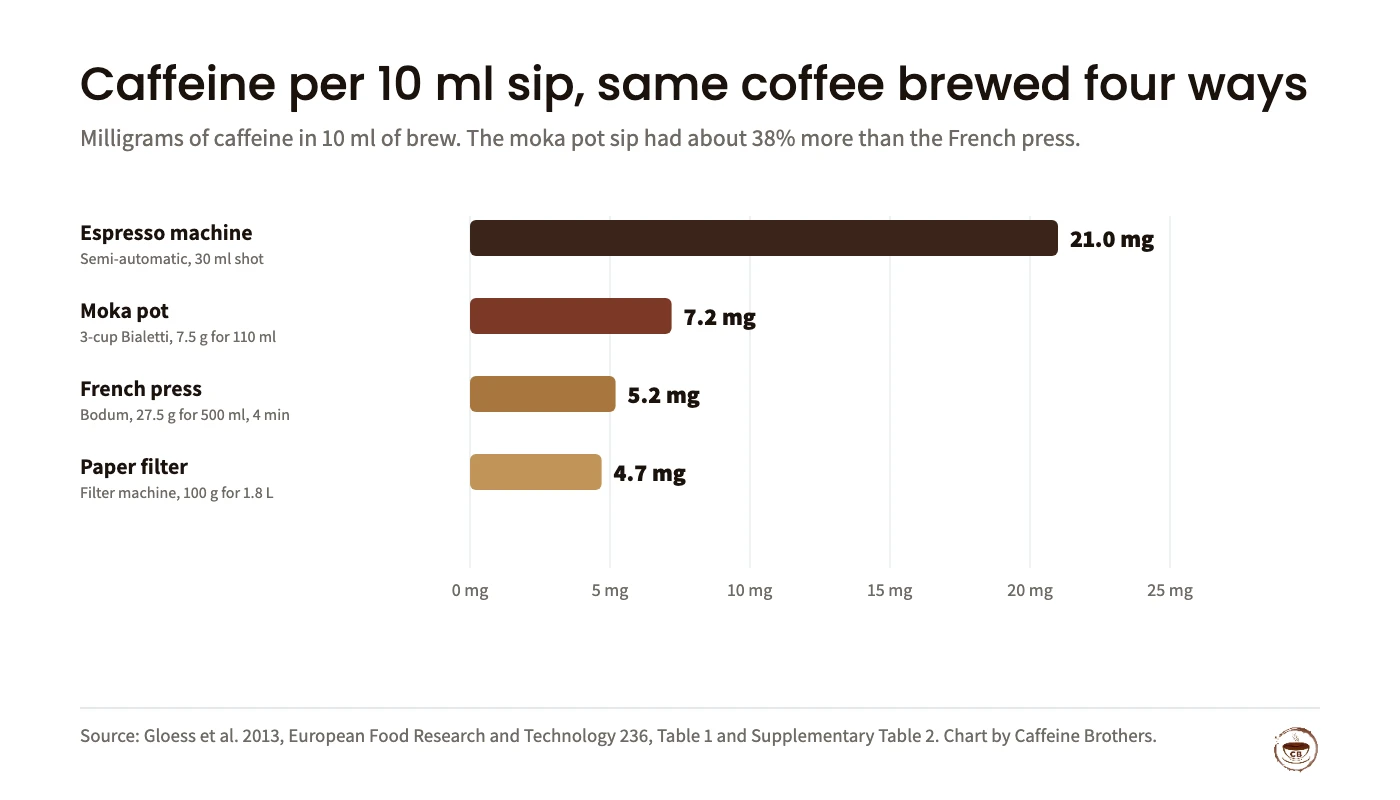
The authors point out that the moka is often called an espresso method, but its 2.13% solids is “strictly speaking, too low for an espresso,” because the water-to-coffee ratio of 110 ml to 7.5 g is closer to a long coffee. So a moka pot makes something stronger than a French press and weaker than true espresso.
| Measure (Gloess et al. 2013) | Moka pot (Bialetti) | French press (Bodum) |
|---|---|---|
| Ground coffee per brew | 7.5 g | 27.5 g |
| Brew volume | 110 ml | 500 ml |
| Total dissolved solids | 2.13% | 1.43% |
| Caffeine per 10 ml | 7.20 mg | 5.2 mg |
| Caffeine per serving (30 ml moka, 120 ml press) | 21.6 mg | 62 mg |
| Caffeine in the whole batch (calculated) | About 79 mg | About 260 mg |
| Fat (esterified fatty acids) in the brew | 0.05% by weight | 0.157% by weight |
| pH | 5.9 | 5.9 |
| Caffeine extracted per gram of ground coffee | 1.06% | 0.95% |
Which one has more caffeine?
It depends on whether you count per sip or per pot. Per 10 ml, the moka brew had about 38% more caffeine than the French press (7.20 mg against 5.2 mg). Per batch, the French press wins easily, since 500 ml at 5.2 mg per 10 ml is about 260 mg, while 110 ml of moka coffee at 7.20 mg per 10 ml is about 79 mg.
The study also measured how much caffeine came out of each gram of ground coffee: 1.06% for the moka pot and 0.95% for the French press. Those figures are close, which means the bigger difference in a cup comes from how much coffee and water you use. If you drink a 120 ml mug, a French press mug in the study had 62 mg of caffeine. A 30 ml moka serving had 21.6 mg, and a 60 ml pour would be about 43 mg.
The bean matters as much as the brewer. Robusta beans carry more caffeine than Arabica, as our Robusta vs Arabica caffeine guide shows.
How do they taste different?
The study’s instrumental results explain much of the texture. French press coffee had the highest fat content of all nine methods, which the authors saw as a film of fat on the walls of the glass jar. Paper-filter coffee had the lowest, as the paper held the oils back. That is why French press coffee feels fuller and leaves a little sediment, and why it can taste heavier with dark roasts.
The moka pot’s brew is more concentrated, so it reads as stronger and more bitter, and it works well cut with hot water or milk. Bialetti’s guide warns that too-fine coffee and too much heat both give a burnt taste. It suggests a flame no wider than the base of the pot, taking the pot off the stove once the upper chamber is full, and stirring the coffee before pouring so the layers mix.
Both brews had a pH of 5.9 in the study, among the least acidic of the nine methods, so neither brewer stood out as more sour in the lab.
How much does each brew cost?
Here is the bean cost per batch using the doses from the study and the Morning Ritual gift set’s French press card (23 g for 350 ml, a 1:15 ratio), at our 1 kg bag prices on November 7, 2026.
| Coffee (1 kg price) | Moka, 3-cup (7.5 g) | French press, 350 ml (23 g) | French press, 500 ml (27.5 g) |
|---|---|---|---|
| Robusta, Batangas (₱813) | ₱6.10 | ₱18.70 | ₱22.36 |
| Kapeng Barako, Batangas Liberica (₱858) | ₱6.43 | ₱19.73 | ₱23.59 |
| CB’s Finest blend (₱866) | ₱6.50 | ₱19.92 | ₱23.82 |
| Arabica-Robusta blend (₱991) | ₱7.43 | ₱22.79 | ₱27.25 |
| Arabica, Benguet (₱1,068) | ₱8.01 | ₱24.56 | ₱29.37 |
Per batch, the moka pot is cheaper because it makes much less coffee. Per milliliter they are close: about ₱0.06 per ml for a Robusta moka batch (₱6.10 for 110 ml) and about ₱0.04 per ml for a 500 ml Robusta French press (₱22.36). The French press is the better value for a family or a group, and the moka pot suits one or two people who want a short, strong cup.
Which should you buy?
- Choose a moka pot if you like strong coffee, drink it with milk or condensed milk, brew for one or two, and cook on gas or an electric coil. Check the base if you use induction; the guide we read lists the aluminium Moka Express as not induction compatible.
- Choose a French press if you brew for several people, like a fuller body, want to adjust strength by ratio, and already have a kettle. Coarse grind matters, so buy whole beans and a burr grinder or ask for a coarse grind.
- For beans, a dark roast such as our Batangas Robusta or Kapeng Barako gives a bold moka cup. For French press, a medium roast like our Benguet Arabica keeps more of the brighter notes.
These bean suggestions are our own roast notes, not test results. The study used one coffee, so different beans and roasts will change the numbers.
Moka pot sizes
Bialetti cup sizes are small, Italian-style servings. The Moka Express guide from Coffea, a Bialetti stockist, lists these capacities, and notes that some water stays in the boiler after brewing, so the final output is a little less.
| Moka Express size | Capacity |
|---|---|
| 1 cup | 60 ml |
| 2 cups | 120 ml |
| 3 cups | 180 ml |
| 4 cups | 220 ml |
| 6 cups | 340 ml |
| 9 cups | 540 ml |
| 12 cups | 720 ml |
| 18 cups | 1,000 ml |
The study’s three-cup pot produced 110 ml of brew per batch, less than the 180 ml listed capacity, which matches the guide’s note about water left behind.
Frequently asked questions
Is moka pot coffee stronger than French press?
Yes, per sip. In Gloess et al. (2013), moka pot coffee had 7.20 mg of caffeine and 2.13% dissolved solids per 10 ml, against 5.2 mg and 1.43% for the French press. A full French press batch still had more total caffeine because it used more coffee and water.
Is a moka pot the same as espresso?
No. A moka pot uses steam pressure from the stove and makes a brew with about 2.13% dissolved solids in the 2013 study, which the authors said is too low for an espresso. Machine espresso in the same study had more than 4%.
What grind should I use for a moka pot and a French press?
Use a coarse grind for a French press, as the National Coffee Association recommends. For a moka pot, use a grind finer than drip but not too fine; Bialetti’s guide warns that very fine coffee tastes burnt.
Can I use a moka pot on an induction stove?
Only if the pot is made for induction. The Moka Express guide we read lists the aluminium Moka Express as not induction compatible, so check the base of your pot before buying.
How much coffee do I use in a French press?
The National Coffee Association suggests 1 gram of coffee to 10 to 16 grams of water. For a 350 ml press, about 23 g of coarse coffee gives a 1:15 ratio.
Sources
- Gloess A.N. et al., Comparison of nine common coffee extraction methods: instrumental and sensory analysis. European Food Research and Technology 236, pp. 607 to 627, 2013 (ZHAW repository PDF). Table 1, solids, caffeine, fat, pH
- Gloess et al. 2013, Electronic Supplementary Material. Springer. Supplementary Tables 2 to 4 (per sip, per cup, per gram)
- Navarini L. et al., Experimental investigation of steam pressure coffee extraction in a stove-top coffee maker. Applied Thermal Engineering, 2009 (University of Trieste abstract)
- French press coffee. National Coffee Association, modified Feb 6, 2025. Ratio 1:10 to 1:16, 93 ± 3 °C, about 4 minutes, coarse grind
- Guide to Moka Express. Coffea (Bialetti stockist), PDF. Capacities, instructions, induction note
- The Morning Ritual Christmas Coffee Gift Set. Caffeine Brothers. French press card: 23 g for 350 ml, 93 °C, 4 minutes
Cite this article: Caffeine Brothers. “Moka Pot vs French Press: Strength, Caffeine and Cost per Brew.” Caffeine Brothers Coffee Blog, November 2026. https://caffeinebrothers.co/moka-pot-vs-french-press/
You are welcome to reference the charts and tables in this article with a link back to this page.
Brewing at home? Shop Philippine coffee beans roasted daily and ground free for moka pot or French press. Giving one this Christmas? The Morning Ritual gift set pairs a 350 ml French press with two coffees, and the rest are on our Christmas gift sets page. Contact us with any questions.
 Previous Post