
Vietnamese Coffee: How to Brew It With a Phin and Which Beans to Use
By Robin Salvador, co-founder, Caffeine Brothers
Last updated: November 9, 2026
Quick answer: Vietnamese coffee is strong coffee, usually Robusta, brewed one cup at a time through a phin, a small metal drip filter that sits on top of the glass. The best-known version is cà phê sữa đá: the coffee drips onto sweetened condensed milk and is poured over ice. Published recipes use 10 to 14 grams of fine to medium-fine coffee per cup, a short bloom, and about five minutes of dripping. You can make it in the Philippines with Batangas Robusta or Kapeng Barako ground fine.
Key takeaways
- Vietnam is forecast to produce a record 32.5 million 60-kg bags of coffee in 2026/27, and 96.6% of it is Robusta (USDA FAS, May 20, 2026).
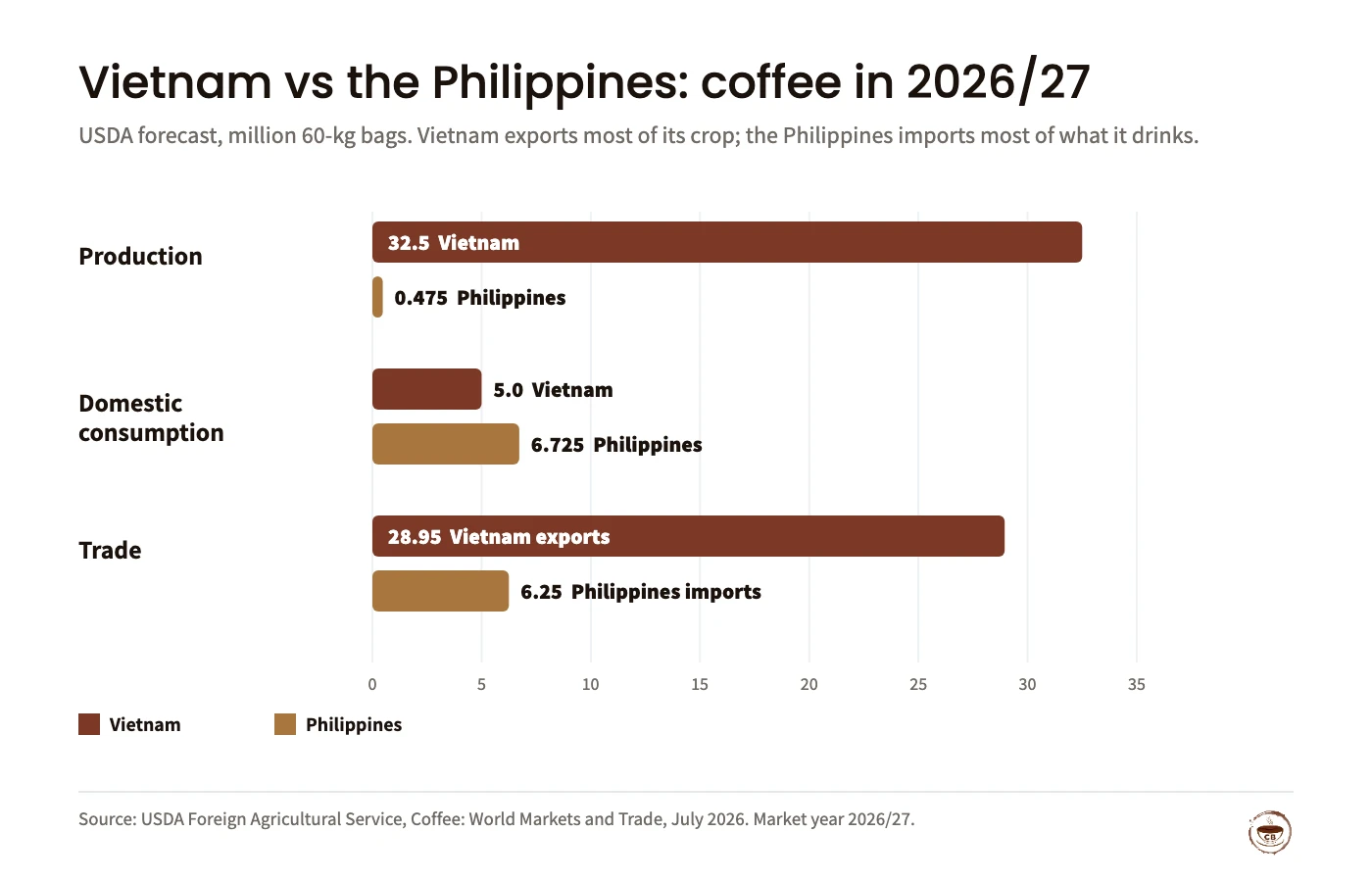
- Vietnam exports most of what it grows: 28.95 million bags forecast for 2026/27, against domestic consumption of 5.0 million.
- The Philippines drinks far more than it grows: consumption of 6.725 million bags against production of 475,000 in 2026/27 (USDA FAS, July 2026). Vietnam supplied about 66% of Philippine coffee imports by value in 2023, per UN Comtrade data compiled by TrendEconomy.
- Three published phin recipes agree on about five minutes of dripping but differ on dose (10 to 14 g), water temperature and bloom time.
- At November 9, 2026 prices, a 14 g phin dose of Caffeine Brothers Robusta costs ₱11.38, and 18 g of condensed creamer adds about ₱2.05.
What makes coffee “Vietnamese”?
Three things: the bean, the brewer and the milk. Most Vietnamese coffee is Robusta, which grows well in the Central Highlands. It is brewed in a phin, a small cup-shaped filter with a perforated base, a press insert and a lid. And it is often served with sweetened condensed milk, hot (cà phê sữa nóng) or over ice (cà phê sữa đá). Black coffee over ice is cà phê đá.
Coffee came to Vietnam with the French. A 2008 paper in the Journal of Commodity Science, Technology and Quality states that “coffee was first planted in Vietnam in 1857,” and that output stayed small until after reunification in 1975. Production then rose sharply after the Doi Moi reforms of 1986, with the first big expansion in and around Dak Lak province. The USDA’s 2026 report lists Dak Lak, Gia Lai, Kon Tum, Dak Nong and Lam Dong as the main Central Highlands growing provinces.
How big is Vietnam’s coffee industry?
Vietnam is the world’s main Robusta source. The USDA Foreign Agricultural Service’s Vietnam Coffee Annual, published May 20, 2026, puts total coffee area at about 730,000 hectares and counts more than 600,000 smallholder households growing coffee.
| Vietnam, thousand 60-kg bags | 2024/25 | 2025/26 | 2026/27 forecast |
|---|---|---|---|
| Total production | 29,000 | 31,700 | 32,500 |
| Robusta production | 28,000 | 30,500 | 31,400 |
| Arabica production | 1,000 | 1,200 | 1,100 |
| Total exports | 25,200 | 28,500 | 28,950 |
| Domestic consumption | 4,800 | 4,900 | 5,000 |
Robusta is 96.2% of the 2025/26 crop and 96.6% of the 2026/27 forecast. The July 2026 edition of the USDA’s Coffee: World Markets and Trade says Vietnam’s output “is forecast to increase 800,000 bags to a record 32.5 million due to expanding area and higher yields,” and puts domestic consumption at “a record 5.0 million bags.”
How does the Philippines compare?
The two countries sit at opposite ends of the coffee trade. Vietnam exports almost nine of every ten bags it grows. The Philippines grows about 7% of what it drinks and imports the rest, and most of those imports are soluble (instant) coffee.
| Philippines, thousand 60-kg bags | 2023/24 | 2024/25 | 2025/26 | 2026/27 forecast |
|---|---|---|---|---|
| Production | 450 | 450 | 450 | 475 |
| Total imports | 5,940 | 5,740 | 6,075 | 6,250 |
| of which soluble imports | 5,000 | 5,000 | 5,500 | 5,500 |
| Domestic consumption | 6,590 | 6,190 | 6,525 | 6,725 |
Much of what the Philippines imports comes from Vietnam. TrendEconomy, compiling UN Comtrade data, reports Philippine imports of coffee (HS 0901) of $153 million in 2023, with Vietnam supplying 66% ($101 million), ahead of Indonesia (14%) and Malaysia (11.8%). The USDA’s 2025 Vietnam report adds a detail from the Vietnam Coffee and Cocoa Association: among Vietnam’s top 10 export markets in the 2023 to 2024 crop year, “the Philippines paid the highest overall at $4,424 per ton.” For local farm figures, see our coffee price guide and Philippine coffee statistics.
How do you brew coffee with a phin?
There is no single official recipe. We compared three published ones. They agree on the method and on a drip time of about five minutes, and differ on dose, temperature and bloom.
| Step | Nguyen Coffee Supply | SAVEUR (updated Aug 31, 2026) | The Woks of Life |
|---|---|---|---|
| Coffee | 14 g (2 tbsp) per serving | 10 g (2 tbsp) | 3 tbsp |
| Grind | Fine, “like sand” | Medium-fine | Vietnamese ground coffee |
| Water temperature | 195 to 200 °F (about 90 to 93 °C) | Boiling or 205 °F (about 96 °C) | Close to boiling |
| Bloom | 1 oz water, 45 seconds | 2 tbsp water, 60 seconds | 2 tbsp water, 5 seconds |
| Total water | About 4 oz (113 ml) in the example | About 84 g | 6 to 8 oz |
| Drip time | First drop before 2 minutes, finish around 5 minutes | About 5 minutes | About 5 minutes |
| Condensed milk | Not specified | 1 tbsp (18 g) | 1 to 3 tbsp |
Our reading of these recipes, as a method you can follow:
- Put the condensed milk in the glass. Start with one tablespoon (18 g). Add more after tasting, not before.
- Add 10 to 14 g of fine coffee to the phin. Shake it level and set the press insert on top without packing hard.
- Bloom with a little hot water. Use about 30 ml of water just off the boil and wait 45 to 60 seconds.
- Fill the chamber and cover. Add hot water to the top, put the lid on and leave it.
- Check the drip. The first drops should fall within two minutes and the brew should finish in about five. If it runs much faster, grind finer; if it stalls, grind coarser or loosen the insert.
- Stir and serve. Mix the coffee into the milk. For cà phê sữa đá, pour it over a full glass of ice.
No phin? A moka pot gives a similarly strong, small cup. Our drip bags (10 g each) brewed with less water over condensed milk make a quick version, though the drip bag uses a paper filter and a coarser grind, so it is not the same cup. See also our brewing methods compared.
Which beans work best?
If you want to match the Robusta that makes up almost all Vietnamese coffee, use Robusta. Our Batangas Robusta is a dark roast, and we grind it fine on request for free. Kapeng Barako is Liberica, not Robusta, but it is also a dark roast and makes a strong cup that stands up to condensed milk. Arabica works too, with a lighter, more acidic cup. We have not run a side-by-side test of these beans in a phin, so treat this as a match by species and roast, not a taste ranking.
Robusta also carries more caffeine. A 2017 paper in Chemistry Central Journal (Weldegebreal and colleagues) states that green Arabica beans contain “between 0.7 and 1.6% caffeine” and Robusta “between 1.5 and 4.0%.” More detail is in our Robusta vs Arabica caffeine guide.
| Caffeine Brothers bean (1 kg price) | Roast | 10 g dose | 14 g dose | 14 g dose + 18 g condensed creamer |
|---|---|---|---|---|
| Robusta, Batangas (₱813) | Dark | ₱8.13 | ₱11.38 | ₱13.43 |
| Kapeng Barako, Batangas Liberica (₱858) | Dark | ₱8.58 | ₱12.01 | ₱14.06 |
| CB’s Finest blend (₱866) | Medium and dark | ₱8.66 | ₱12.12 | ₱14.17 |
| Arabica-Robusta blend (₱991) | Blend | ₱9.91 | ₱13.87 | ₱15.92 |
| Arabica, Benguet (₱1,068) | Medium | ₱10.68 | ₱14.95 | ₱17.00 |
Note that Jersey’s product is labelled a sweetened condensed creamer, which is a different product from sweetened condensed milk. We explain the difference in condensed milk vs evaporated milk.
How much sugar is in a glass?
Most of it comes from the condensed milk. USDA FoodData Central lists sweetened condensed milk at 321 kcal and 54.4 g of sugars per 100 g. One tablespoon (18 g), the amount in the SAVEUR recipe, works out to about 58 kcal and 9.8 g of sugar. Two tablespoons double that. WHO recommends keeping free sugars below 10% of energy intake and says that going below 5%, “roughly 25 grams (6 teaspoons) per day,” would bring further benefits. One tablespoon of condensed milk is about 39% of that 25 g. Brands differ, so read the label on the can you buy.
What other Vietnamese coffee drinks are there?
- Cà phê sữa đá: phin coffee over condensed milk, poured over ice.
- Cà phê sữa nóng: the same drink served hot.
- Cà phê đá: black phin coffee over ice, sweetened with sugar or not at all.
- Cà phê trứng (egg coffee): coffee topped with egg yolk whisked with sugar and condensed milk. Hanoi Times credits it to Nguyen Van Giang, who first made it in Hanoi in 1946. Mental Floss says he was a bartender at the Sofitel Legend Metropole hotel, used whisked egg in place of scarce milk, and later opened Café Giang.
Frequently asked questions
What is Vietnamese coffee?
It usually means strong, dark coffee brewed slowly through a small metal drip filter called a phin, often over sweetened condensed milk. Vietnam grows mostly Robusta: in the USDA’s May 2026 report, 31.4 million of the 32.5 million bags forecast for 2026/27 are Robusta.
How much coffee do I put in a phin?
Published recipes range from about 10 grams (SAVEUR) to 14 grams (Nguyen Coffee Supply) per cup, ground fine to medium-fine. Bloom with a little hot water for up to a minute, then fill the chamber and let it drip for about five minutes.
Can I make Vietnamese coffee with Philippine beans?
Yes. The phin method works with any coffee ground fine enough. Batangas Robusta is the closest match to the Robusta most Vietnamese coffee uses, and Kapeng Barako (Liberica) also brews well as a strong, dark cup.
Is Vietnamese iced coffee high in sugar?
It depends on the condensed milk. USDA data puts sweetened condensed milk at 54.4 g of sugars per 100 g, so one tablespoon (18 g) adds about 9.8 g of sugar. That is about 39% of the 25 g a day that WHO says gives extra health benefits.
What is egg coffee?
Egg coffee (cà phê trứng) is coffee topped with egg yolk whisked with sugar and condensed milk. Hanoi Times and Mental Floss credit Nguyen Van Giang, a bartender at Hanoi’s Metropole hotel, who created it in 1946 when milk was scarce.
Sources
- Vietnam: Coffee Annual (VM2026-0016). USDA Foreign Agricultural Service, May 20, 2026. Vietnam production, Robusta share, area, provinces, exports, consumption
- Vietnam: Coffee Annual (VM2025-0018). USDA Foreign Agricultural Service, May 19, 2025. VICOFA unit values by market, Philippines $4,424 per ton
- Coffee: World Markets and Trade. USDA Foreign Agricultural Service, July 2026. Vietnam and Philippines supply and demand tables
- Philippines imports and exports: coffee, coffee substitutes (HS 0901). TrendEconomy, compiling UN Comtrade data, page dated January 28, 2024. 2023 imports by origin
- Environmental and socio-economic effects of intensive agriculture: the Vietnam case. Giungato, Nardone and Notarnicola, Journal of Commodity Science, Technology and Quality, 2008. 1857 introduction, Doi Moi, Dak Lak
- Traditional Vietnamese Drip (Phin). Nguyen Coffee Supply brew guide, undated. Dose, grind, temperature, bloom and timing
- Vietnamese Iced Coffee (Ca Phe Sua Da). SAVEUR, updated August 31, 2026. 10 g coffee, 18 g condensed milk, 60-second bloom
- How to Make Vietnamese Coffee. The Woks of Life, undated. 3 tbsp coffee, 6 to 8 oz water, 1 to 3 tbsp condensed milk
- Development of new analytical methods for the determination of caffeine content in aqueous solution of green coffee beans. Weldegebreal, Redi-Abshiro and Chandravanshi, Chemistry Central Journal 11:126, December 5, 2017. Caffeine ranges
- Egg coffee feature. Hanoi Times, undated. Nguyen Van Giang, Hanoi, 1946
- A Brief History of Vietnamese Egg Coffee. Mental Floss, January 18, 2021. 1946 Metropole bartender, Café Giang
- SRP bulletin for basic necessities and prime commodities. DTI, effective May 11, 2026 (still the latest on November 9, 2026). Jersey Sweetened Condensed Creamer 390 g, ₱44.50
- Milk, canned, condensed, sweetened (SR Legacy 171275). USDA FoodData Central, published April 1, 2019. 321 kcal and 54.4 g sugars per 100 g
- WHO calls on countries to reduce sugars intake among adults and children. World Health Organization, March 4, 2015. Below 10%, and below 5% or about 25 g
Cite this article: Caffeine Brothers. “Vietnamese Coffee: How to Brew It With a Phin and Which Beans to Use.” Caffeine Brothers Coffee Blog, November 2026. https://caffeinebrothers.co/vietnamese-coffee/
You are welcome to reference the charts and tables in this article with a link back to this page.
Want to try Vietnamese-style coffee at home? Order our Batangas Robusta or Kapeng Barako ground fine, or browse the shop. Cafés can ask about wholesale 10 kg boxes or contact us for a quote.
 Previous Post
 Next Post