
Batangas Coffee: Robusta, Excelsa and Barako by the Numbers
By Robin Salvador, co-founder, Caffeine Brothers
Last updated: November 3, 2026
Quick answer: Batangas coffee today is mostly Robusta and Excelsa, with a small amount of Liberica, the bean sold as kapeng barako. PSA data show Batangas produced 236.48 tonnes of green coffee beans in 2025 from 3,650.34 hectares: 130.10 tonnes of Robusta (55%), 96.72 tonnes of Excelsa (41%) and 9.66 tonnes of Liberica (4%). That is 60.7% less than in 2010 and about 0.7% of Philippine output. In the 1800s, Lipa in Batangas was the center of a coffee boom that ended when pests and coffee rust killed the farms.
Key takeaways
- Batangas produced 236.48 tonnes of green coffee beans (GCB) in 2025, down from 601.44 tonnes in 2010, according to PSA OpenSTAT (updated August 28, 2026).
- The 2025 harvest was 130.10 tonnes of Robusta, 96.72 tonnes of Excelsa and 9.66 tonnes of Liberica. PSA records no Arabica in Batangas from 2010 to 2025.
- Batangas grew 11.5% of the country’s Liberica in 2025 (9.66 of 84.02 tonnes) on 50 of the country’s 1,327.11 hectares of Liberica.
- Batangas trees yielded about 0.12 kg of green coffee per bearing tree in 2025, against 0.42 kg nationally.
- Neighboring Cavite produced 1,229.74 tonnes in 2025, 5.2 times as much as Batangas.
We roast Robusta and Kapeng Barako (100% Liberica) from Batangas, so this province matters to us more than most. This guide looks at Batangas coffee as a farm crop: what is planted, how much is harvested, and how that has changed since the Lipa boom. Every figure comes from PSA, the Philippine Coffee Board, news reports or local history sources we read on November 3, 2026. If you want to know how barako tastes and how to brew it, our kapeng barako guide covers that.
What kind of coffee is grown in Batangas?
Three types. PSA’s provincial tables split Batangas coffee into Robusta, Excelsa and Liberica, and they record no Arabica at all. Robusta is the largest crop by output, area and tree count. Excelsa is a close second by output. Liberica, the bean most people link with Batangas, is a small slice of the harvest.
| Type (2025) | Output (t GCB) | Share of output | Area (ha) | Bearing trees |
|---|---|---|---|---|
| Robusta | 130.10 | 55.0% | 2,200 | 1,498,515 |
| Excelsa | 96.72 | 40.9% | 1,400.34 | 464,465 |
| Liberica (barako) | 9.66 | 4.1% | 50 | 24,501 |
| Arabica | none recorded | 0% | none recorded | none recorded |
| Total | 236.48 | 100% | 3,650.34 | 1,987,481 |
The mix matters when you shop. Farmers in Lipa interviewed by the Los Baños Times in 2022 said they grow Robusta and Excelsa alongside Liberica. Arnold Malbataan, who chairs the Samahan ng Magkakape sa Lipa, also told the paper that imported coffee is sometimes sold as kapeng barako. A bag labeled “Batangas coffee” can therefore hold any of the three local types, or a blend. If you want Liberica specifically, ask the seller which species is in the bag. Our guide to Excelsa coffee explains how Excelsa differs.
Batangas is a bigger player in Liberica than its tonnage suggests. Its 9.66 tonnes were 11.5% of the 84.02 tonnes of Liberica PSA recorded for the whole country in 2025. National Liberica output itself fell sharply that year, from 206.96 tonnes in 2024, while Batangas Liberica moved only from 10.35 to 9.66 tonnes.
How much coffee does Batangas produce?
Batangas produced 236.48 tonnes of green coffee beans in 2025, 3.7% less than the 245.62 tonnes of 2024. Output has been falling for most of the period PSA covers. It was 601.44 tonnes in 2010, dropped below 200 tonnes in 2018, and touched 173.38 tonnes in 2022 before a partial recovery to 260.43 tonnes in 2023.
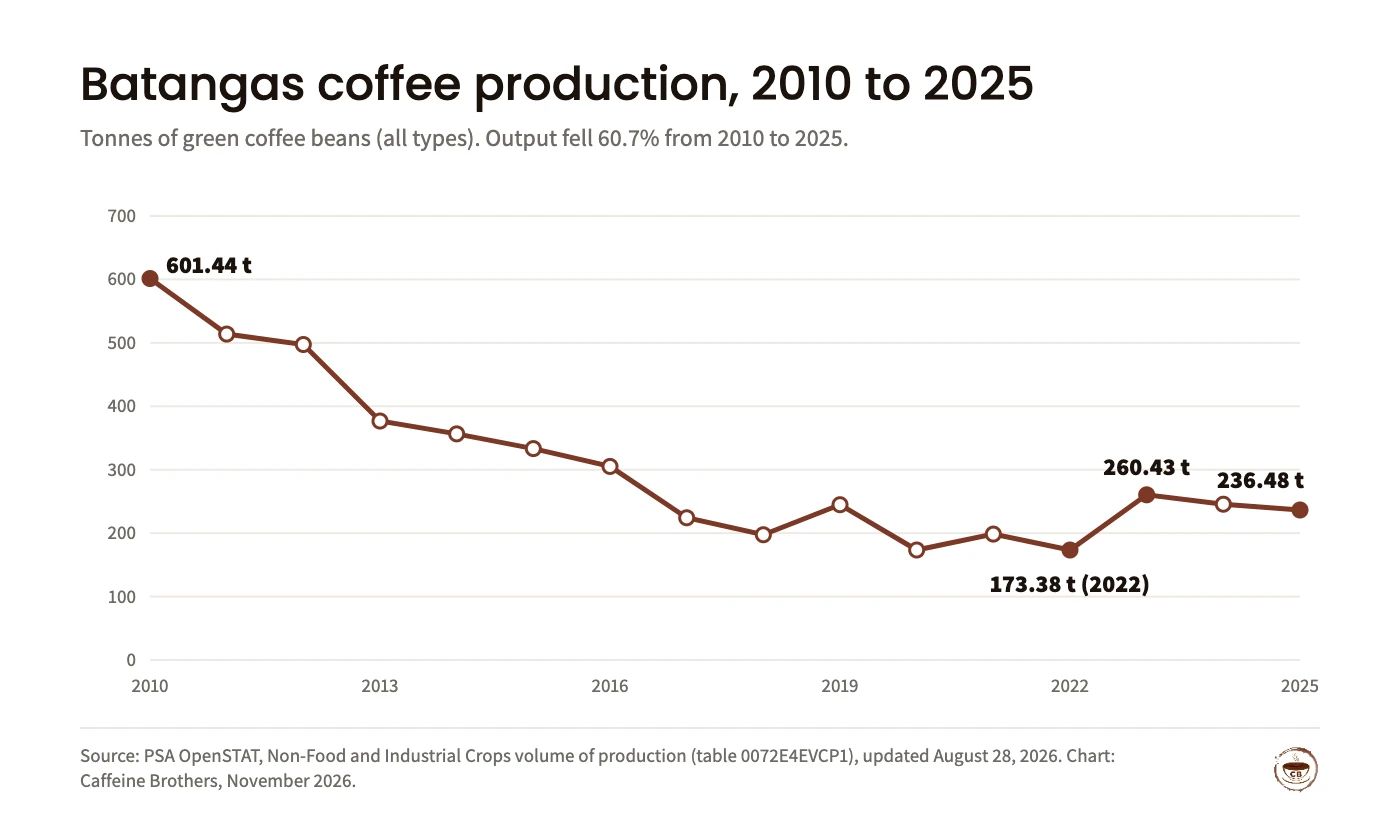
The fall from 2010 to 2025 was 60.7%, more than double the national decline of 24.6% (47,268.01 to 35,645.64 tonnes). Robusta dropped the most, from 420.50 to 130.10 tonnes (down 69.1%). Excelsa fell 42.1%, from 166.98 to 96.72 tonnes, and Liberica fell 30.9%, from 13.97 to 9.66 tonnes.
| Year | Batangas (t GCB) | Cavite (t GCB) | CALABARZON (t GCB) | Philippines (t GCB) | Batangas share of PH |
|---|---|---|---|---|---|
| 2010 | 601.44 | 3,500.11 | 4,382.06 | 47,268.01 | 1.27% |
| 2015 | 333.28 | 609.72 | 1,136.10 | 36,170.91 | 0.92% |
| 2020 | 173.42 | 331.20 | 636.06 | 30,320.48 | 0.57% |
| 2023 | 260.43 | 545.26 | 947.45 | 30,023.39 | 0.87% |
| 2024 | 245.62 | 457.88 | 827.37 | 31,979.26 | 0.77% |
| 2025 | 236.48 | 1,229.74 | 1,578.26 | 35,645.64 | 0.66% |
Cavite, next door, is the bigger producer by far. Its output jumped from 457.88 tonnes in 2024 to 1,229.74 tonnes in 2025, which is why Batangas’ share of the CALABARZON region fell from 29.7% to 15.0% in a single year. We looked at Cavite’s numbers in our post on the coffee capital of the Philippines.
Why are Batangas coffee yields so low?
On PSA’s figures, Batangas harvests far less coffee per tree than the national average. Across all types it produced about 0.12 kg of green coffee per bearing tree in 2025, against 0.42 kg nationally. Per hectare, the gap is similar: 0.06 tonnes in Batangas against 0.29 tonnes for the country.
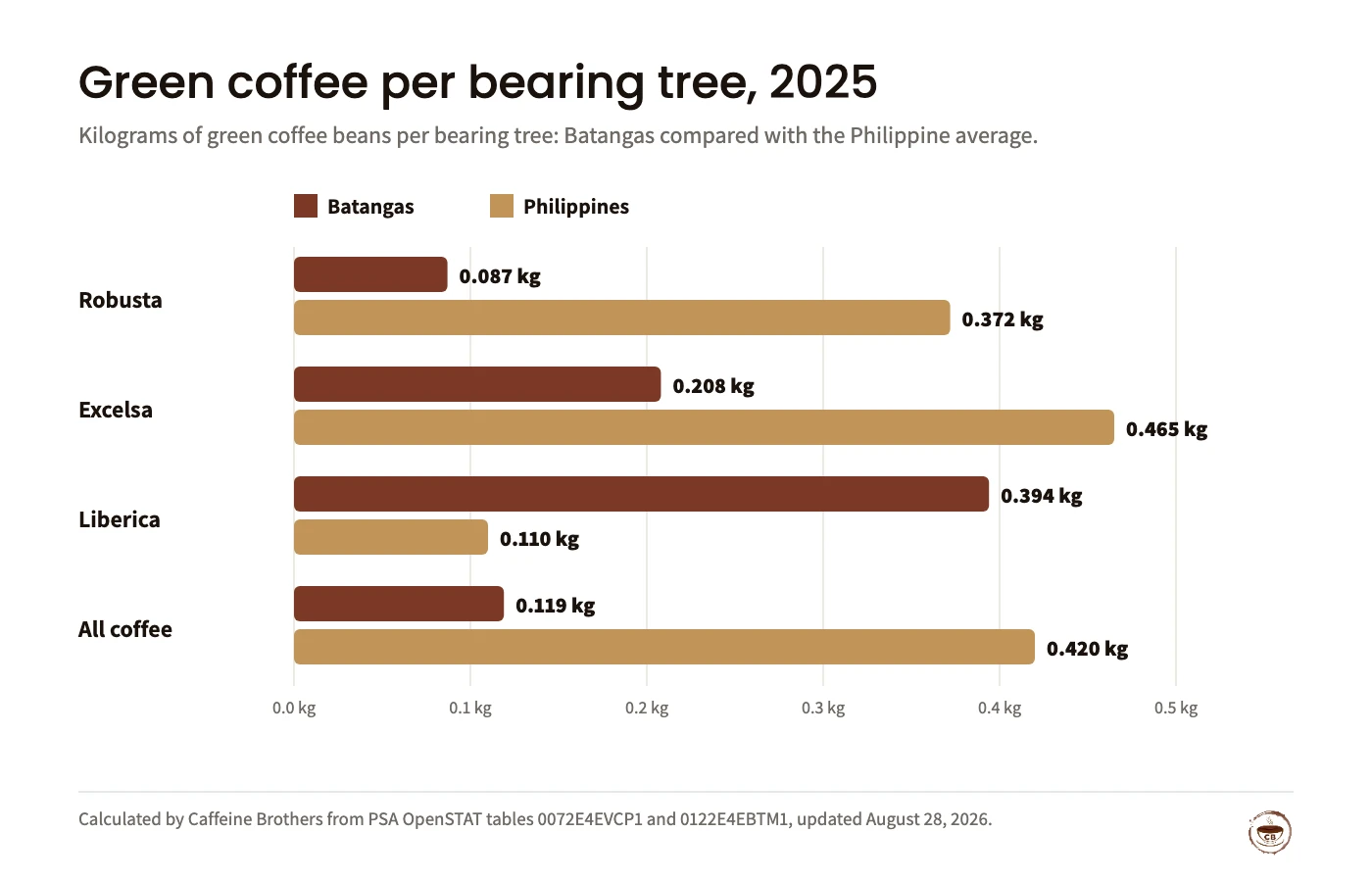
| Type (2025) | Batangas kg per tree | Philippines kg per tree | Batangas t per ha | Philippines t per ha |
|---|---|---|---|---|
| Robusta | 0.087 | 0.372 | 0.059 | 0.255 |
| Excelsa | 0.208 | 0.465 | 0.069 | 0.266 |
| Liberica | 0.394 | 0.110 | 0.193 | 0.063 |
| All coffee | 0.119 | 0.420 | 0.065 | 0.285 |
Liberica is the exception. Batangas Liberica trees yielded more than three times the national Liberica average per tree in 2025. Robusta is where the gap is widest: 0.087 kg per tree, less than a quarter of the national Robusta figure.
PSA does not explain the low yields, so treat any reason with care. One thing the tables do show is that the inputs barely move. Batangas area has been listed at 3,650 hectares every year since 2020, and the bearing-tree count was 1,987,481 in both 2024 and 2025, while output swung between 173 and 260 tonnes. If many listed trees are old, unpruned or no longer picked, the per-tree figure would look low. Farmers have also pointed to other problems. In the Los Baños Times report, Lipa growers named low farmgate income, irregular harvests linked to climate, ageing farmers and competition from imports. PSA publishes no farmgate price series for Batangas coffee, so we cannot compare local prices with the national averages.
What happened to the Lipa coffee boom?
Lipa was the center of Philippine coffee in the 1800s. The Philippine Coffee Board says coffee trees were already growing in Lipa by the 1800s, that Batangas was exporting coffee to America and Australia by the mid-1850s, and that by 1886 the Philippines was reputed to be the world’s fourth-largest coffee exporter. When coffee rust hit Brazil, Africa and Java, Lipa gained a price advantage.
The accounts of how the boom ended differ in their dates. The Philippine Coffee Board says the “glory days” lasted until 1889, when insects and disease pushed landowners to switch to sugarcane, and that coffee rust in 1891 finished the job, cutting production to one sixth of its former level in two years. The Batangas History, Culture and Folklore site cites Manuel Sastron’s 1895 book, which put peak production at 70,000 picos in 1877 and blamed a wood-boring worm locally called “bayongbong”. It also quotes Simeon Luz, an early American-era governor of Batangas, who described a province-wide infestation in 1899 followed by a leaf blight, after which planters turned to sugar, rice and corn. The two accounts agree on the causes and disagree on the years, which may reflect a decline that ran through the 1880s and 1890s.
Both sources say the coffee of the boom years was not the barako of today. The Philippine Coffee Board dates the first Liberica seedlings in the area to 1876, in Amadeo, Cavite. The Batangas history site says the Lipa boom ran on Arabica and that Liberica, which resisted the blight better, came in later and became the kapeng barako Batangas is now known for.
Who is working to revive Batangas coffee?
- The Samahan ng Magkakape sa Lipa had about 255 member farmers across 35 to 42 barangays of Lipa in 2022, according to its chair Arnold Malbataan (Los Baños Times, October 19, 2022).
- In February 2024 the group asked the Department of Agriculture to help farmers get better Liberica seeds, and Lipa Mayor Eric Africa proposed planting 100,000 coffee seedlings that year (Philippine News Agency, February 5, 2024).
- In May 2024 Batangas provincial agriculturist Dr. Rod Bautista said the province planned to rehabilitate old coffee trees and plant new ones (GMA Regional TV, May 27, 2024).
- The provincial agriculture office formed a technical working group in May 2024 to register Kapeng Barako as a collective mark with the Intellectual Property Office of the Philippines, working with the Batangas Coffee Farmers Federation, Batangas State University and De La Salle Lipa (Philippine News Agency, August 8, 2024).
- In September 2024 the office said it was still completing the IPOPHL requirements and aimed to finish preparations by December 2024 (Philippine News Agency, September 24, 2024). We found no report that the mark had been registered as of November 3, 2026.
How to buy Batangas coffee: five checks
- Ask for the species. Robusta, Excelsa and Liberica are all grown in Batangas. If the label says only “barako” or “Batangas coffee”, ask which one is inside.
- Look for a roast date. Whole beans keep their flavor longer than ground coffee, and a date lets you judge freshness.
- Match the grind to your brewer. Coarse suits a French press, normal suits drip and pour-over, and fine suits espresso and moka pots.
- Compare price per kilo. Small bags cost more per gram. Work out the cost per 10 g cup before you choose a size.
- Buy local when you can. Growers in Lipa say imports compete with their coffee. Buying from roasters who name their source helps keep Batangas farms in coffee.
Here is what our Batangas coffees cost on the day we wrote this. Prices come from our shop’s live product data.
| Caffeine Brothers coffee (Batangas) | Roast | 200 g | 1 kg | 10 kg wholesale box | Cost per 10 g cup (1 kg bag) |
|---|---|---|---|---|---|
| Robusta coffee beans | Dark | ₱231 | ₱813 | ₱7,730 | ₱8.13 |
| Kapeng Barako (100% Liberica) | Dark | ₱242 | ₱858 | ₱8,160 | ₱8.58 |
For a wider view of how farm prices feed into what you pay, see our breakdown of coffee prices in the Philippines.
Frequently asked questions
Is kapeng barako the same as Batangas coffee?
Not exactly. Kapeng barako is the local name for Liberica coffee, which the Philippine Coffee Board says is grown mainly in Batangas and Cavite. Batangas also grows Robusta and Excelsa, and in 2025 PSA counted only 9.66 of the province’s 236.48 tonnes of green coffee beans as Liberica.
How much coffee does Batangas produce?
PSA put Batangas output at 236.48 tonnes of green coffee beans in 2025, from 3,650.34 hectares and 1,987,481 bearing trees. That is about 0.7% of Philippine production and 60.7% less than the 601.44 tonnes recorded in 2010.
Does Batangas grow Arabica?
PSA OpenSTAT records no Arabica output, area or bearing trees for Batangas in any year from 2010 to 2025. The coffee that made Lipa rich in the 1800s was Arabica, according to the Batangas History, Culture and Folklore site, but it was largely lost to pests and disease.
Why did the Lipa coffee boom end?
The Philippine Coffee Board says pests and diseases from 1889, then coffee rust in 1891, cut production to one sixth within two years. A Batangas governor quoted in a 1906 book described a wood-boring worm destroying the plantations in 1899, followed by a leaf blight. Both accounts say planters switched to sugar and other crops.
Sources
- Non-Food and Industrial Crops: Volume of Production, by Region, Province, Quarter, and Semester, 2010-2026. Philippine Statistics Authority OpenSTAT, table 0072E4EVCP1, updated August 28, 2026. Used for Batangas, Cavite, CALABARZON and national output by type
- Non-Food and Industrial Crops: Area Planted/Harvested, by Region, Province, Quarter, and Semester, 2010-2026. Philippine Statistics Authority OpenSTAT, table 0092E4EAHM1, updated September 1, 2026. Used for area by type
- Non-Food and Industrial Crops: Number of Bearing Trees/Hills/Vines, by Region, Province, Quarter, and Semester, 2010-2026. Philippine Statistics Authority OpenSTAT, table 0122E4EBTM1, updated August 28, 2026. Used for bearing trees and per-tree yields
- Commercial Crops: Farmgate Prices by Commodity, Region and Province, Monthly, 2010-2026. Philippine Statistics Authority OpenSTAT, table 0032M4AFN08. Checked for Batangas coffee prices; none are published
- Our Coffee Heritage: Coffee’s Rich History in the Philippines. Philippine Coffee Board, undated, read November 3, 2026. Used for the Lipa history, 1876 Liberica, 1886, 1889 and 1891 dates and the barako definition
- What Ended Lipa’s 19th Century Coffee Boom. Batangas History, Culture and Folklore, April 2024. Used for Sastron (1895), Simeon Luz via Forbes-Lindsay (1906), the 1877 peak and the 1899 infestation
- Farmers’ hope on the struggling Kapeng Barako industry. Los Baños Times, October 19, 2022. Used for the Samahan ng Magkakape sa Lipa, the species grown in Lipa and farmers’ problems
- Batangas coffee farmers seek support for “kapeng barako”. Philippine News Agency, February 5, 2024. Used for the seed request and the 100,000-seedling proposal
- Batangas working on rejuvenating coffee industry. GMA Regional TV, May 27, 2024. Used for the provincial rehabilitation plan
- Batangas to register “kapeng barako” with Intellectual Property Office. Philippine News Agency, August 8, 2024. Used for the collective mark plan and working group
- Batangas to standardize “kapeng barako” production, promotion. Philippine News Agency, September 24, 2024. Used for the registration status and December 2024 target
- Caffeine Brothers shop. Prices read from the WooCommerce Store API on November 3, 2026
Cite this article: Caffeine Brothers. “Batangas Coffee: Robusta, Excelsa and Barako by the Numbers.” Caffeine Brothers Coffee Blog, November 2026. https://caffeinebrothers.co/batangas-coffee/
You are welcome to reference the tables and charts in this article with a link back to this page.
Want coffee grown in Batangas? Try our Robusta coffee beans or Kapeng Barako, roasted daily, or browse the full shop. Buying for a café or office? See wholesale or contact us.
 Previous Post
 Next Post