
Coffee in Tagalog: A Filipino Coffee Glossary
By Robin Salvador, co-founder, Caffeine Brothers
Last updated: November 2, 2026
Quick answer: Coffee in Tagalog is kape, pronounced ka-PÉ, from the Spanish café. The online dictionary Diksiyonaryo.ph gives it three meanings: the coffee plant, its bean, and the drink made from it. As an adjective, kape also means brown. The best-known Filipino coffee term is kapeng barako, which in Batangas means Liberica coffee. Below are 32 everyday coffee words with their dictionary meanings, read on November 2, 2026, plus how they map to grind sizes and the beans we sell.
Key takeaways
- Kape comes from Spanish café. Several common coffee words are also Spanish loans: tasa (taza), asukal (azúcar), tostado, krema and pino (fino).
- Barako means a brave man or a breeding male animal. Kapeng barako is kape + na + barako.
- The Batangas provincial agriculture office calls kapeng barako Liberica (PNA, August 8 and September 24, 2024). One dictionary entry labels it Coffea canephora, the Robusta species.
- Liberica is rare. PSA counted 84.02 tonnes of Liberica green beans in 2025, 0.24% of the 35,645.64 tonnes the country produced.
- Grind sizes in Tagalog: buo (whole), magaspang (coarse), pino (fine).
Most coffee glossaries in English cover espresso terms. We wrote one on essential coffee vocabulary before. This one is for the words Filipinos use at home, in the palengke and at the kapihan. Every meaning below comes from Diksiyonaryo.ph, an online dictionary of the Filipino language, unless we say otherwise. We give the dictionary’s own stress marks. The notes in the last column are ours.
What is coffee in Tagalog?
The word is kape. Diksiyonaryo.ph marks it ka•pé, with the stress on the last syllable, and traces it to the Spanish café. Its first meaning is the shrub of the genus Coffea, whose seeds are dried and ground to make a drink, native to tropical Africa and grown on plantations. It names four species: Coffea arabica, Coffea excelsa, Coffea liberica and Coffea canephora. The second meaning covers the bean and the drink. A separate adjective entry gives kape as kayumanggi, brown.
Wiktionary’s Tagalog entry agrees on the Spanish origin and compares the Tausug word kahawa (see our Sulu coffee guide). It also lists common derived words: magkape (to have coffee), kapihan, butil ng kape, and the saying “walang matigas na tinapay sa mainit na kape,” no bread is too hard for hot coffee.
Tagalog words for coffee, cups and taste
| Tagalog | Dictionary stress | Meaning (Diksiyonaryo.ph) | Our note |
|---|---|---|---|
| kape | ka•pé | Coffee: the plant, the bean, and the drink; as an adjective, brown | From Spanish café. Wiktionary compares Tausug kahawa. |
| kapeng barako | ka•péng ba•rá•ko | A broad-leafed coffee; also the usual name for a thick, bitter brew | kape + na + barako. In Batangas the name refers to Liberica. |
| barako | ba•rá•ko | A fearless man; a male animal kept for breeding; a boar raised for breeding | Root of the coffee name. |
| butil | bú•til | A small hard seed, as of corn, rice or wheat | Butil ng kape is a coffee bean. |
| bunga | bú•nga | The fruit or product of a plant | Coffee cherries are the bunga of the tree. |
| kapihan | ka•pí•han | Small coffee-and-bread restaurant; coffee plantation; coffee container; a gathering over coffee | kape + han. |
| tasa | tá•sa | A small bowl-like vessel, usually for coffee, chocolate or tea | From Spanish taza. Stress matters: tasá means to sharpen. |
| timpla | tim•plá | A mix of ingredients | Used for how a cup is mixed, as in “ang timpla mo.” |
| matapang | ma•tá•pang | Brave; also having a strong effect | Matapang na kape is strong coffee. |
| mapait | ma•pa•ít | Having a bitter taste | From pait, bitterness. |
| malapot | ma•lá•pot | Thick, viscous | Useful for describing a strong barako cup. |
| matamis | ma•ta•mís | Sweet | From tamis, sweetness. |
| gatas | gá•tas | Milk | Kapeng may gatas is coffee with milk. |
| asukal | a•sú•kal | Sugar, usually from sugarcane | From Spanish azúcar. |
| krema | kré•ma | Cream, the thick fatty part of milk; also cream-coloured | From Spanish crema. |
| tsokolate | tso•ko•lá•te | A drink made from tabliya; also chocolate brown | From Spanish chocolate. |
| tabliya | tab•lí•ya | Hardened cacao seeds that are roasted, ground, moulded and dried | Cacao, not coffee, but sold beside it. |
What does kapeng barako mean, and which bean is it?
Barako has three meanings in Diksiyonaryo.ph: a man who fears nothing, a brave man; any male animal kept for breeding; and a pig raised for breeding. Kapeng barako is built from kape + na + barako, so it reads as the barako’s coffee. The name fits a strong, heavy cup, and the dictionary’s second meaning for kapeng barako is exactly that: the common name for a thick and bitter brew of coffee.
The species is where sources disagree. The dictionary’s first meaning describes kapeng barako as a coffee with broad leaves and labels it Coffea carephora, which appears to be a misprint of canephora, the Robusta species. Its kape entry also says canephora is popularly called kapeng barako. Batangas growers use the name for Liberica. The Philippine News Agency reported on August 8, 2024 that the Batangas Office of the Provincial Agriculturist was registering kapeng barako with the Intellectual Property Office as a collective mark, describing it as the Liberica variety and planting DNA-tested Liberica seeds. A September 24, 2024 PNA report on the province’s code of practice used the same description.
So the word can point to a species or simply to a style of cup, the dictionary’s second meaning. When we say Kapeng Barako on our product page, we mean 100% Liberica from Batangas, dark roasted. If you want the full story of the bean, see our guide to kapeng barako.
How rare is Liberica in the Philippines?
Very rare by volume. The Philippine Statistics Authority’s OpenSTAT production table, updated August 28, 2026, puts total 2025 production at 35,645.64 tonnes of green coffee beans. Robusta was 25,731.07 tonnes (72.2%), Arabica 7,849.82 tonnes (22.0%), Excelsa 1,980.73 tonnes (5.6%) and Liberica 84.02 tonnes (0.24%). Liberica output was 316.70 tonnes in 2010 and 206.96 tonnes in 2024. Batangas itself recorded 9.66 tonnes of Liberica in 2025.
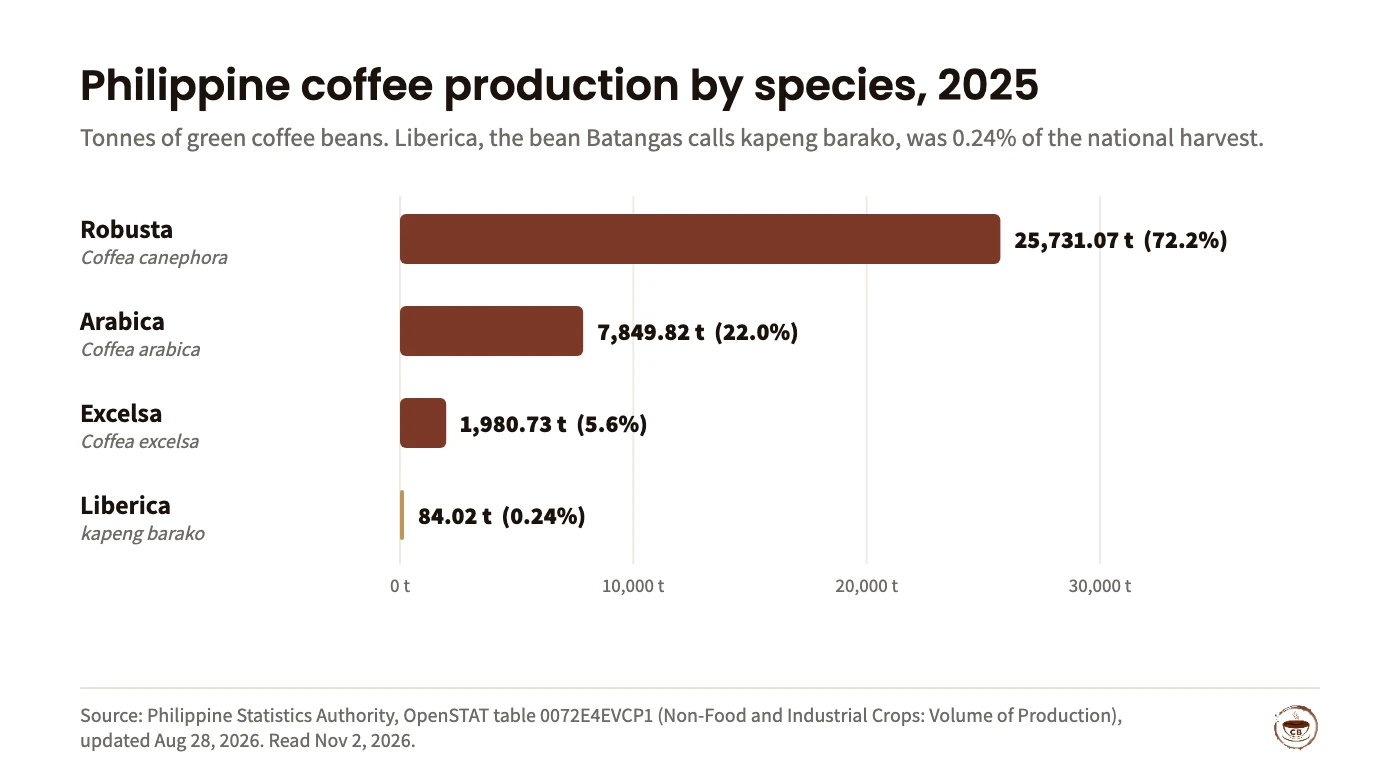
So a word that every Filipino knows names a bean that makes up about a quarter of one percent of the national harvest. That gap explains why “barako” on a label does not always mean Liberica, and why it is worth asking.
Tagalog words for making coffee
Many brewing words come from the rice kitchen. Gilingan is first a rice mill, giling is milling palay, and busa is toasting rice or corn.
| Tagalog | Dictionary stress | Meaning (Diksiyonaryo.ph) | Coffee use (our note) |
|---|---|---|---|
| gilingan | gi•lí•ngan | A machine for crushing or powdering corn, coffee and the like; also a pair of millstones | A coffee grinder. |
| giling | gí•ling | Milling grain; crushing or powdering grains such as rice and corn | Grind. |
| buo | bu•ô | Whole, complete; solid | Whole bean. |
| magaspang | ma•gas•páng | Coarse | Coarse grind, for French press and cold brew. |
| pino | pí•no | Very small, crushed almost to powder | From Spanish fino. Fine grind, for espresso and moka pot. |
| salaan | sa•la•án | A tool for straining | A coffee filter or strainer. From salà, separating fine from coarse with a cloth or sieve. |
| tostado | tos•tá•do | Cooked or heated until it turns the colour of coffee | From Spanish. Toasted or roasted. |
| sangag | sa•ngág | Cooking in a pan; also day-old rice fried with oil and garlic | Pan-roasting coffee at home. |
| busa | bu•sá | Roasting or toasting rice or corn | Toasting, as of rice or corn. |
| kulo | ku•lô | The bubbling of water when heated | Boil. |
| tubig | tú•big | Water | The main ingredient of every cup. |
| lusong | lu•sóng | A wooden mortar with a hollow, used for pounding palay | Can crush roasted beans when there is no grinder. |
| almires | al•mi•rés | A stone, wood or brass mortar for crushing spices such as pepper | From Spanish. |
| kaldero | kal•dé•ro | An aluminium or metal cooking pot | From Spanish caldero. Works for boiled coffee. |
| tsarera | tsa•ré•ra | A pot with a spout, handle and lid, used to make and pour tea | From Spanish. |
Two words are useful for the kitchen counter. tostado means cooked or heated until it turns the colour of coffee, which is also a fair description of roasting. And salaan is any tool for straining. A cloth salaan and a kaldero are enough to make coffee at home; for other methods, see our coffee brewing methods compared guide.
How do you order coffee beans in Tagalog?
Our grind options map neatly onto three dictionary words. Whole bean is buo. Coarse is magaspang. Fine is pino, which Diksiyonaryo.ph defines as very small, crushed almost to powder. Our fourth option, normal, sits between coarse and fine and suits drip machines and pour-over. Grinding is free on all bags.
| Bean on our site | Tagalog way to ask | Roast | 200 g | 1 kg |
|---|---|---|---|---|
| Kapeng Barako (100% Liberica, Batangas) | Kapeng barako, buo o giniling | Dark | ₱242 | ₱858 |
| Robusta (Batangas) | Robusta, magaspang o pino | Dark | ₱231 | ₱813 |
| Arabica (Benguet) | Arabica, buo | Medium | ₱292 | ₱1,068 |
| CB’s Finest Signature Blend | Timpla namin, CB’s Finest | Medium and dark | ₱244 | ₱866 |
| Arabica-Robusta Blend | Arabica at Robusta na halo | Medium to dark | ₱274 | ₱991 |
For taste words, matapang and mapait do most of the work. Our dark roasts, Robusta and Kapeng Barako, are the beans people usually mean by matapang na kape. Arabica, a medium roast from Benguet, is the one to choose if you want a cup that is less mapait. Taste is personal, so treat this as a starting point.
What about alamid and musang?
These two animal names come up because of civet coffee. Diksiyonaryo.ph defines alamid as a small black wild cat of the forest, Paradoxurus philippinensis, and musang as a grey wild cat with a strong smell, Viverra tangalunga. People often use both words for the animal behind kape alamid, but the dictionary gives them as two different species. We cover the coffee, its prices and the welfare concerns in our kape alamid guide. We do not sell civet coffee.
Five ways to use this glossary
- Ask what “barako” means on the label. If the seller means Liberica, they should say so; if not, it may be any strong local roast.
- Name the grind. Say buo for whole beans, magaspang for French press or cold brew, and pino for espresso or moka pot.
- Describe the cup with matapang, mapait and malapot. Strong, bitter and thick are different things, and a barista can adjust each one.
- Order timpla your way. Kapeng may gatas is coffee with milk; add asukal to taste.
- Keep tasa and tasá apart. Tá•sa is the cup; ta•sá means to sharpen, as with a pencil.
Frequently asked questions
What is coffee in Tagalog?
Coffee is kape, pronounced ka-PÉ with the stress on the last syllable. Diksiyonaryo.ph traces it to the Spanish café and gives three meanings: the coffee plant, the bean, and the drink. As an adjective, kape also means brown.
What does barako mean?
Barako means a fearless or brave man, and also a male animal kept for breeding, such as a boar. Kapeng barako joins kape and barako with the linker na, so it reads as the coffee of the barako.
Is kapeng barako Liberica or Robusta?
In Batangas it is Liberica. The Batangas provincial agriculture office, quoted by the Philippine News Agency in 2024, calls kapeng barako the Liberica variety and is registering it as a collective mark. One Filipino dictionary entry labels it Coffea canephora (Robusta), which does not match how Batangas growers use the name.
What is a coffee shop in Tagalog?
Kapihan. Diksiyonaryo.ph lists four meanings: a small restaurant that mainly serves coffee and bread, a coffee plantation, a container for coffee, and a gathering of people having coffee together.
How do you say strong coffee in Tagalog?
You can say matapang na kape. Matapang means brave, and also having a strong effect, the same sense used for strong liquor or vinegar. Mapait means bitter and malapot means thick.
Sources
- Diksiyonaryo.ph entries for kape, barako, kapihan, tasa, timpla, gilingan, salaan, tostado, alamid, musang and the other words in the tables. Diksiyonaryo.ph, read November 2, 2026. Used for every meaning, stress mark and Spanish origin in the tables
- kape, Tagalog entry. Wiktionary, read November 2, 2026. Used for the Spanish origin, the Tausug kahawa comparison, derived terms and the saying about hard bread
- Batangas to register ‘kapeng barako’ with Intellectual Property Office. Philippine News Agency, August 8, 2024. Used for the Liberica identification, collective mark and DNA-tested seeds
- Batangas to standardize ‘kapeng barako’ production, promotion. Philippine News Agency, September 24, 2024. Used for the code of practice and Liberica description
- Non-Food and Industrial Crops: Volume of Production, by Region, Province, Quarter, and Semester, 2010-2026 (table 0072E4EVCP1). Philippine Statistics Authority OpenSTAT, updated August 28, 2026. Used for 2025 production by species and Liberica output for 2010, 2024 and Batangas
- Caffeine Brothers shop. Prices read from the WooCommerce Store API on November 2, 2026
Cite this article: Caffeine Brothers. “Coffee in Tagalog: A Filipino Coffee Glossary.” Caffeine Brothers Coffee Blog, November 2026. https://caffeinebrothers.co/coffee-in-tagalog/
You are welcome to reference the tables and charts in this article with a link back to this page.
Want to try matapang na kape at home? Browse our coffee beans, start with Kapeng Barako or Robusta, or pick the medium-roast Arabica. Questions about grind or brewing? Contact us.
 Previous Post