
Maguindanao Coffee: Output in Del Norte and Del Sur (2025 Data)
By Robin Salvador, co-founder, Caffeine Brothers · Last updated: November 22, 2026
Quick answer: Maguindanao coffee is coffee grown in Maguindanao del Norte and Maguindanao del Sur, the two provinces created when Maguindanao was split in 2022. Together they produced 1,958.65 tonnes of green coffee beans in 2025, about 5.5% of Philippine output, according to the Philippine Statistics Authority (PSA). Most of it is Robusta, and the best known growing area is Upi, which sits on both sides of the new provincial line.
Key takeaways
- PSA counted 1,153.20 t of green coffee beans in Maguindanao del Norte and 805.45 t in Maguindanao del Sur in 2025 (table updated Aug 28, 2026).
- Combined, the two provinces would rank 4th in the country after Sultan Kudarat, Bukidnon and Sulu, and they make up 44.9% of BARMM output.
- Robusta is 71.5% of the combined harvest, Arabica 21.9% and Excelsa 6.6%.
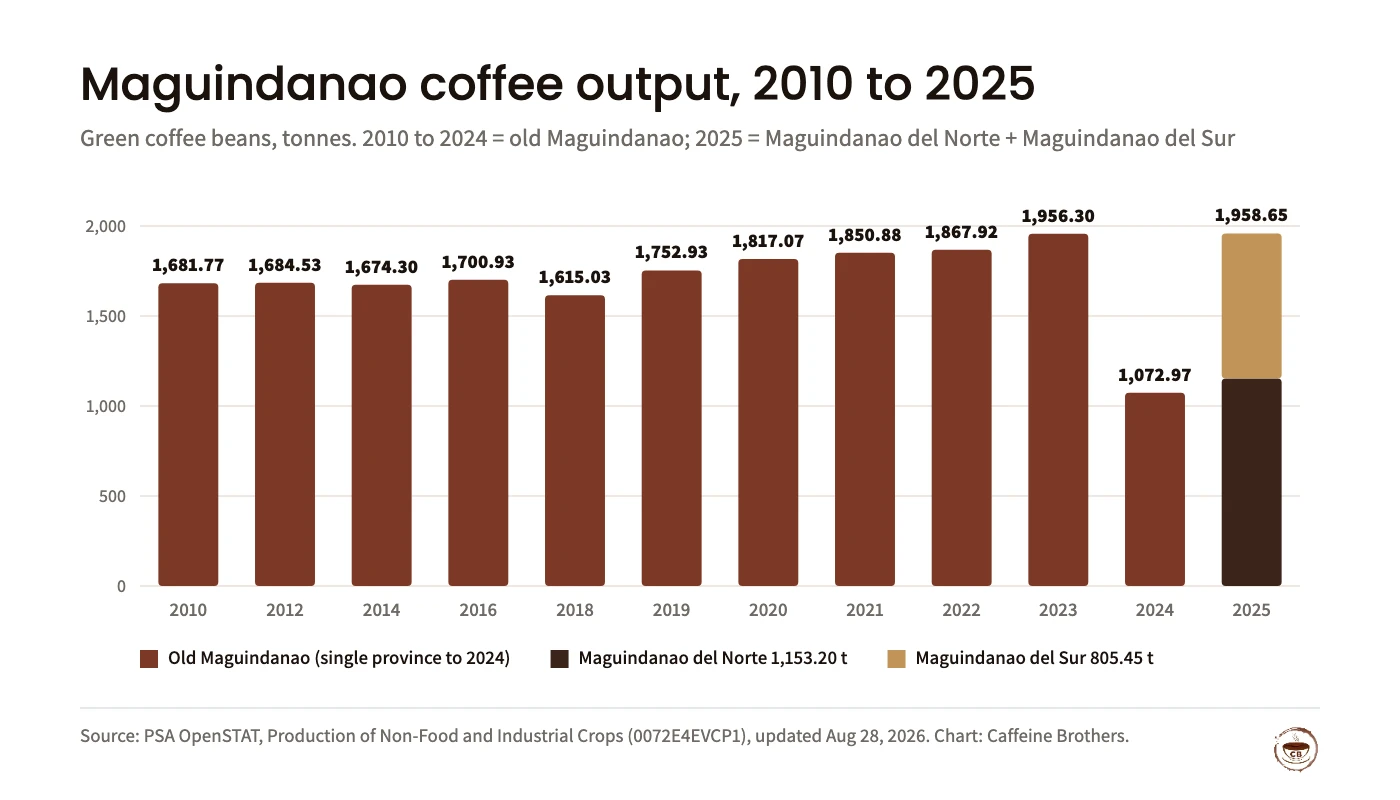
- Old Maguindanao output fell 45.2% in 2024 to 1,072.97 t, almost all of it in the fourth quarter, then recovered to 1,958.65 t in 2025.
- An Upi coffee from North and South Upi won a silver award at the AVPA roasted-at-origin contest in Paris in 2020.
Where is Maguindanao coffee grown?
Maguindanao sits in the Bangsamoro Autonomous Region in Muslim Mindanao (BARMM). Republic Act 11550, dated May 27, 2021, divided the province into Maguindanao del Norte and Maguindanao del Sur. Voters approved the split in a plebiscite on September 17, 2022, with 706,558 votes (99.27%) in favour and 5,209 against, according to Philstar’s report of the official canvass.
The law lists 12 municipalities for Maguindanao del Norte, including Barira, Datu Odin Sinsuat, Parang and North Upi. Maguindanao del Sur has 24, including Buluan, Pagalungan, Datu Saudi Ampatuan and South Upi. Before the split, PhilAtlas lists the old province at 9,968.31 km² with 1,342,179 people in the 2020 census.
Upi is the name most coffee people know. The Philippine Coffee Board described it in 2019 as a town “at 1,600 feet above sea level” and quoted farmer Jandatu Salik: “Upi has always been a coffee area.” Because the 2022 split put North Upi in del Norte and South Upi in del Sur, “Upi coffee” now comes from two provinces.
How much coffee does Maguindanao produce?
PSA’s crop production table (OpenSTAT 0072E4EVCP1, updated August 28, 2026) gives the 2025 figures below. The two provinces together produced 1,958.65 tonnes of green coffee beans, which is 5.5% of the national 35,645.64 tonnes.
| Coffee type | Maguindanao del Norte (t) | Maguindanao del Sur (t) | Combined (t) | Share of PH output for that type |
|---|---|---|---|---|
| Robusta | 830.00 | 571.00 | 1,401.00 | 5.4% of 25,731.07 t |
| Arabica | 252.20 | 175.80 | 428.00 | 5.5% of 7,849.82 t |
| Excelsa | 71.00 | 58.65 | 129.65 | 6.5% of 1,980.73 t |
| Liberica | none | none | none | PH total 84.02 t |
| All coffee | 1,153.20 | 805.45 | 1,958.65 | 5.5% of 35,645.64 t |
On its own, Maguindanao del Norte ranks 6th among provinces in 2025 and Maguindanao del Sur ranks 9th. Added together they would come 4th, behind Sultan Kudarat (15,689.08 t), Bukidnon (2,245.70 t) and Sulu (2,216.78 t), and ahead of Davao del Sur (1,573.83 t). We covered the top three in our posts on Sultan Kudarat coffee and Sulu coffee.
How has Maguindanao coffee output changed since 2010?
PSA reports the old province as one series from 2010 to 2024 and the two new provinces from 2025. Output was steady at around 1,600 to 1,960 tonnes a year for more than a decade, while national output fell. The 2024 figure is the outlier.
| Year | Maguindanao (t) | Philippines (t) | Maguindanao share |
|---|---|---|---|
| 2010 | 1,681.77 | 47,268.01 | 3.6% |
| 2015 | 1,715.98 | 36,170.91 | 4.7% |
| 2020 | 1,817.07 | 30,320.48 | 6.0% |
| 2023 | 1,956.30 | 30,023.39 | 6.5% |
| 2024 | 1,072.97 | 31,979.26 | 3.4% |
| 2025 (del Norte + del Sur) | 1,958.65 | 35,645.64 | 5.5% |
Between 2010 and 2023, old Maguindanao grew 16.3% while the Philippines as a whole fell 36.5%. Then 2024 dropped 45.2% to 1,072.97 tonnes. PSA’s quarterly data shows where: the fourth quarter of 2024 recorded 151.90 tonnes against 1,057.30 tonnes in the fourth quarter of 2023. The 2025 total of 1,958.65 tonnes is almost exactly the 2023 level.
We found no published explanation for the 2024 drop. PSA’s area and bearing-tree counts stayed flat (4,268 hectares and about 3.59 million trees), so the fall was not caused by fewer recorded farms. It may reflect a poor harvest, a reporting gap during the provincial transition, or both. We would treat the 2024 number with caution until PSA or the Ministry of Agriculture, Fisheries and Agrarian Reform (MAFAR) explains it.
How productive are Maguindanao coffee farms?
PSA’s area table (0092E4EAHM1, updated September 1, 2026) and bearing-tree table (0122E4EBTM1, updated August 28, 2026) let us work out yields. On these figures, Maguindanao harvests more coffee per hectare than the national average.
| Measure (2025) | Maguindanao del Norte | Maguindanao del Sur | Philippines |
|---|---|---|---|
| Area planted (ha) | 2,560.80 | 1,707.20 | 124,982.58 |
| Bearing trees | 2,152,317 | 1,434,878 | 84,839,827 |
| Tonnes per hectare | 0.45 | 0.47 | 0.29 |
| Kilograms per bearing tree | 0.54 | 0.56 | 0.42 |
| Robusta t/ha (combined vs PH) | 0.41 | 0.41 | 0.25 |
| Arabica t/ha (combined vs PH) | 0.60 | 0.60 | 0.52 |
One caution: the 2025 area and tree counts for the two provinces split old Maguindanao’s 2024 figures exactly 60:40. For example, 2,560.80 plus 1,707.20 hectares equals the 4,268 hectares PSA reported for 2024. That suggests the new provincial numbers were allocated from the old total, not counted farm by farm. The old totals have also barely moved since 2013. Yields built on them are estimates.
What do farmers get paid for Maguindanao coffee?
PSA’s farmgate price table (0032M4AFN08, updated August 28, 2026) lists ₱26 to ₱27 per kilogram for Maguindanao del Norte and del Sur in 2025, based on a single February 2025 reading. That is about one tenth of the BARMM averages for the same year (Robusta ₱129.97, Arabica ₱152.01, Excelsa ₱191.24 per kilogram) and the national averages (Robusta ₱228.67, Arabica ₱264.65). We think the provincial reading may be for dried berries or may be an error, so we do not use it as a green bean price. Our coffee price guide explains how farmgate prices compare with retail prices.
Who is working on Maguindanao coffee?
- In November 2020, MindaNews reported that a native coffee blend from North and South Upi won a silver award (Gourmet Argent) at the 6th Coffees Roasted at Origin contest run by AVPA in Paris, which drew 150 coffees from 25 countries. The coffee came from wild native trees 10 to 30 years old at 700 to 1,000 masl and was processed by Malibacao Agricultural Cooperative and North Star Upi Coffee.
- The Agricultural Training Institute (ATI-RTC XII) has run coconut-coffee intercropping trainings under the Coconut Farmers and Industry Development Plan, with MAFAR-Maguindanao staff taking part: 35 participants in Datu Odin Sinsuat (July 22 to 24, 2024), and 30 farmers each in Pagalungan and in Barira (May 14 to 16, 2025).
- The Ministry of Science and Technology of BARMM held a coffee roasting and grinding training on November 25 to 28, 2024, and turned over ₱800,000 in equipment to women’s groups from North and South Upi.
- In June 2020, the Bangsamoro Parliament reported that the Ministry of Indigenous Peoples’ Affairs and MAFAR gave 4,000 coffee seedlings to Indigenous Peoples farmers in Datu Saudi Ampatuan.
- In June 2025, BARMM’s trade ministry said it was forming a Regional Coffee Council to improve production standards, according to the Daily Tribune.
We did not find any Maguindanao entries among the top-ranked lots of the 2026 Philippine Coffee Quality Competition. The nearest BARMM success that year was Lanao del Sur, whose Arabica placed 3rd; see our Lanao del Sur coffee post.
How does Maguindanao compare with the rest of BARMM?
PSA put BARMM at 4,361.81 tonnes in 2025, or 12.2% of national output. Sulu led with 2,216.78 tonnes, then Maguindanao del Norte (1,153.20), Maguindanao del Sur (805.45), Tawi-Tawi (132.63), Lanao del Sur (50.99) and Basilan (2.76). The two Maguindanao provinces together supply 44.9% of the region. Note that PSA still counts Sulu inside BARMM for 2025, although PhilAtlas notes that Sulu was part of the region only until September 9, 2024.
How to check Maguindanao coffee figures yourself
- Open PSA OpenSTAT and go to Agriculture, then Crops, then Production of Non-Food and Industrial Crops (table 0072E4EVCP1).
- Pick both new provinces and the old one. Select Maguindanao, Maguindanao del Norte and Maguindanao del Sur, because the old series ends in 2024 and the new ones start in 2025.
- Choose green coffee beans by type (Arabica, Excelsa, Liberica, Robusta) and the annual period.
- Add the area and bearing-tree tables (0092E4EAHM1 and 0122E4EBTM1) if you want yields, and remember the 2025 split looks allocated.
- Check the farmgate table separately (0032M4AFN08) and compare it with BARMM and national prices before you quote it.
Can you buy Maguindanao coffee from Caffeine Brothers?
No. Caffeine Brothers roasts Benguet Arabica and Batangas Robusta and Kapeng Barako, and we do not sell Maguindanao coffee. If you like the strong, low-acid profile that Robusta is known for, our Batangas Robusta (₱231 for 200 g or ₱813 per kilogram on November 22, 2026) is the closest match from our range. For a medium-roast Arabica, see our Benguet Arabica (₱292 for 200 g).
Frequently asked questions
How much coffee does Maguindanao produce?
PSA counted 1,958.65 tonnes of green coffee beans in 2025 for the two Maguindanao provinces together: 1,153.20 tonnes in Maguindanao del Norte and 805.45 tonnes in Maguindanao del Sur. That is about 5.5% of the Philippine total of 35,645.64 tonnes.
What type of coffee grows in Maguindanao?
Mostly Robusta. In 2025 Robusta made up 1,401 tonnes, or 71.5% of combined output, followed by Arabica at 428 tonnes and Excelsa at 129.65 tonnes. PSA recorded no Liberica for either province in 2025.
Why does PSA show no Maguindanao del Norte or del Sur data before 2025?
Maguindanao was split into two provinces by RA 11550, ratified in the September 17, 2022 plebiscite. PSA kept reporting the old Maguindanao series until 2024 and started separate provincial series in 2025.
Does Caffeine Brothers sell Maguindanao coffee?
No. Our beans come from Benguet (Arabica) and Batangas (Robusta and Kapeng Barako). If you want a Philippine Robusta for strong black coffee or milk drinks, our Batangas Robusta is the closest match to what Maguindanao mostly grows.
Sources
- Production of Non-Food and Industrial Crops by Region and Province (0072E4EVCP1). Philippine Statistics Authority, updated Aug 28, 2026. Used for 2010 to 2025 production by type and quarter.
- Area Planted/Harvested of Non-Food and Industrial Crops (0092E4EAHM1). Philippine Statistics Authority, updated Sep 1, 2026. Used for area.
- Number of Bearing Trees of Non-Food and Industrial Crops (0122E4EBTM1). Philippine Statistics Authority, updated Aug 28, 2026. Used for bearing trees.
- Farmgate Prices of Commercial Crops (0032M4AFN08). Philippine Statistics Authority, updated Aug 28, 2026. Used for farmgate prices.
- Republic Act No. 11550. LawPhil, May 27, 2021. Used for the division of Maguindanao and the municipalities of each province.
- High turnout, no disruptions as Maguindanao votes to split province. Philstar, Sep 18, 2022. Used for plebiscite results.
- Maguindanao Profile. PhilAtlas. Used for land area and 2020 population.
- Bangsamoro (BARMM) Profile. PhilAtlas. Used for Sulu leaving BARMM on Sep 9, 2024.
- Coffee the Moro Way. Philippine Coffee Board, Jul 10, 2019. Used for Upi elevation and the farmer quote.
- Maguindanao’s Upi coffee wins silver award in Paris competition. MindaNews, Nov 21, 2020. Used for the AVPA award details.
- ATI-RTC XII completes first batch of farmer-level training on coconut-coffee. Agricultural Training Institute, Jul 25, 2024. Used for the Datu Odin Sinsuat training.
- CFIDP training on coconut-coffee system empowers second batch of farmers in Pagalungan. Agricultural Training Institute, May 16, 2025. Used for the Pagalungan training.
- ATI XII concludes 3rd batch of CFIDP coco-coffee training in Maguindanao del Norte. Agricultural Training Institute, May 19, 2025. Used for the Barira training.
- MOST-BARMM empowers women through coffee processing training and equipment turnover. Ministry of Science and Technology BARMM, undated. Used for the Nov 2024 training and ₱800,000 equipment turnover.
- MIPA distributes coffee seedlings to IP communities. Bangsamoro Parliament, Jun 26, 2020. Used for the 4,000 seedlings.
- BARMM to help boost coffee industry. Daily Tribune, Jun 19, 2025. Used for the coffee council plan.
- Mindanao farmers dominate coffee quality competition. MindaNews, Jun 8, 2026. Used for PCQC 2026 results.
- Caffeine Brothers product prices. Caffeine Brothers Store API, checked Nov 22, 2026.
Cite this article: Caffeine Brothers. “Maguindanao Coffee: Output in Del Norte and Del Sur (2025 Data).” Caffeine Brothers Coffee Blog, November 2026. https://caffeinebrothers.co/maguindanao-coffee/
You are welcome to reference the charts and tables in this article with a link back to this page.
Looking for Philippine-grown coffee for your home, office or café? Browse our beans in the shop, see wholesale pricing for 10 kg orders, or contact us with your questions.
 Previous Post
 Next Post