
Cuban Coffee: How to Make Cafecito With Espumita at Home
By Robin Salvador, co-founder, Caffeine Brothers · Last updated: November 22, 2026
Quick answer: Cuban coffee (café cubano or cafecito) is a short, strong coffee made from dark-roasted beans and sweetened while it brews. You beat the first drops of coffee into sugar until it turns into a pale foam called espumita, then stir in the rest of the coffee. At home you can make it in a stovetop moka pot with dark-roast Robusta or Barako and about 4 level teaspoons of sugar per 6-cup pot.
Key takeaways
- Britannica describes café cubano as espresso-style coffee sweetened during brewing, traditionally made in a stovetop cafetera (moka pot).
- Sugar per serving varies by recipe: about half a tablespoon (University of Miami, 2018) up to 4 heaping teaspoons for one pot (Starbucks at Home).
- A 60 ml cup holds about 80 mg of caffeine if it is espresso (EUFIC, updated Jul 31, 2024); a dilute moka brew measured 7.20 mg per 10 ml in a 2013 study.
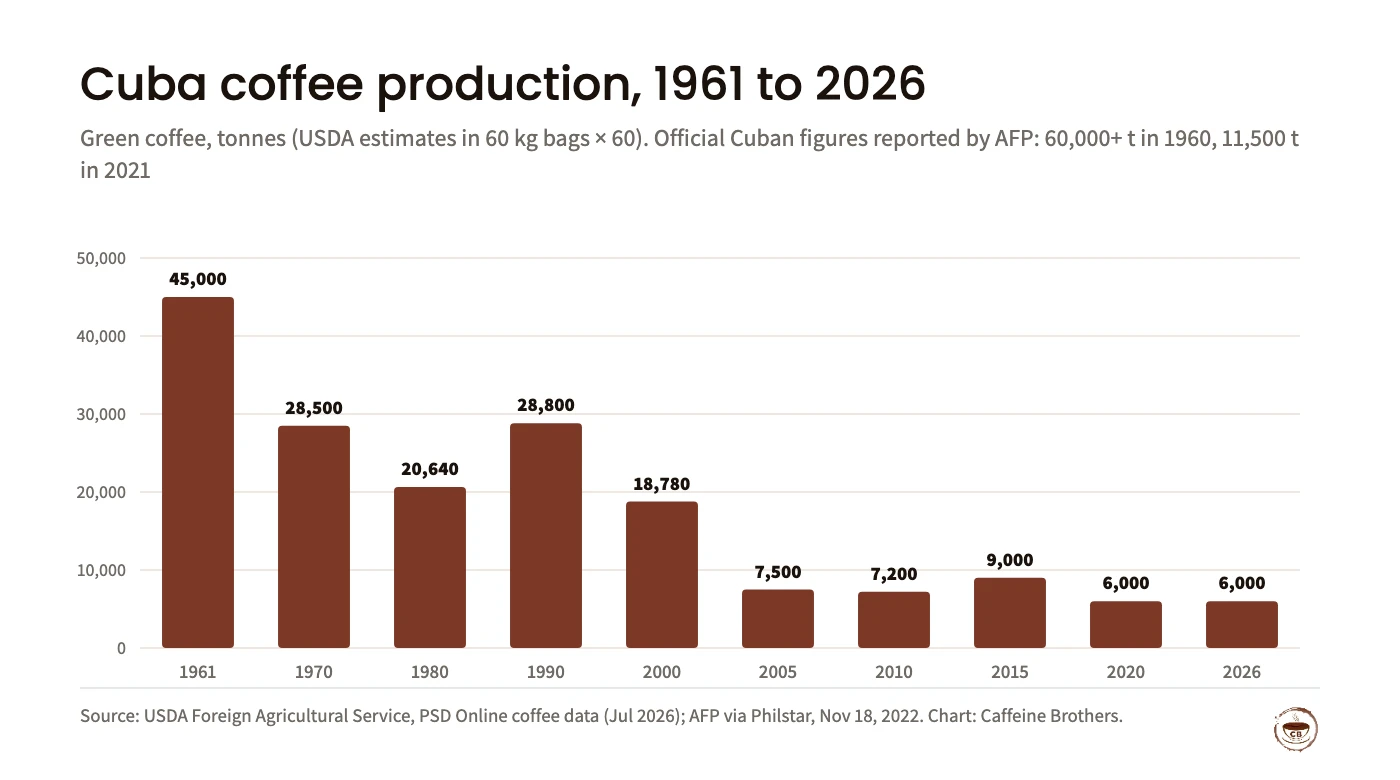
- Cuba produced more than 60,000 tonnes of coffee in 1960 but only 11,500 tonnes in 2021, according to official figures reported by AFP.
- With our November 22, 2026 prices, 10 g of dark-roast Robusta costs ₱8.13 and the sugar for a cup costs under ₱1.
What is Cuban coffee?
Cuban coffee is a way of preparing coffee more than a type of bean. Britannica describes café cubano as espresso from dark-roasted, finely ground coffee that is sweetened with sugar during brewing, usually in a stovetop moka pot that Cubans call a cafetera. The step that makes it Cuban is the espuma or espumita: the first drops of coffee are beaten into the sugar to make a thick, pale foam, and the rest of the coffee is poured over it.
The University of Miami’s “Cafecito 101” guide (September 27, 2018) describes the foam as the result of vigorously stirring, almost beating, the first teaspoon of brewed coffee into a small vessel of sugar. The result is sweet, strong and served in small cups, often about two to three fluid ounces each.
What are the different Cuban coffee drinks?
| Drink | What it is | Typical serving |
|---|---|---|
| Cafecito (café cubano) | Sweetened Cuban coffee with espumita | One small demitasse, about 2 to 3 fl oz (60 to 90 ml) |
| Colada | A larger batch meant for sharing | Three to six shots in one cup, with tiny plastic cups for pouring; Barista Magazine describes a 12-ounce cup with half a dozen small cups |
| Cortadito | Cafecito topped with steamed milk | Milk and coffee about 50/50 or 75/25; many use evaporated milk |
| Café con leche | Cuban coffee in a large mug of hot milk | Much more milk than coffee, close to a latte |
In Miami these drinks are sold from ventanitas, walk-up coffee windows. NBC News reported in 2021 that Versailles restaurant in Little Havana opened in 1971 with “a ventanita, a sandwich counter and some tables.” If you like the evaporated milk version of the cortadito, our post on condensed vs evaporated milk in coffee compares sugar and fat per serving.
How do you make Cuban coffee at home?
You do not need an espresso machine. A moka pot works, and it is the tool most Cuban homes use. The Starbucks at Home recipe uses a 6-cup moka pot, 6 tablespoons of ground coffee, 4 heaping teaspoons of granulated sugar, and about 60 seconds of beating to turn the sugar and first coffee into a paste. The guide to the Bialetti Moka Express says to fill the lower chamber “just below the valve,” not to tamp the coffee, and not to grind too fine or it will taste burnt.
Here is our starting recipe for a 6-cup moka pot, which holds about 340 ml of water according to that guide. It makes four or five small cups.
- Fill the bottom chamber with water to just below the safety valve.
- Fill the basket with ground coffee, level it with a finger and do not press it down. Screw the pot together.
- Measure 4 level teaspoons of sugar (16.8 g) into a small metal pitcher and put the pot on medium heat.
- Catch the first coffee. As soon as coffee appears, pour about one teaspoon onto the sugar and lift the pot off the heat for a moment.
- Beat the sugar hard with a spoon for about a minute until it turns pale and thick, like wet sand turning to cream.
- Finish the brew and combine. Put the pot back on the heat, then pour the rest of the coffee slowly over the paste and stir. The foam rises to the top.
- Serve straight away in small cups, or add steamed milk for a cortadito.
For a moka pot, choose our “normal” grind. Our “fine” grind suits an espresso machine, which needs a fine grind at about a 1:2 ratio over 20 to 30 seconds according to the National Coffee Association. Our moka pot guide covers heat and timing in more detail, and our espresso ratio lesson covers the machine method.
How much sugar and caffeine is in a cafecito?
Sugar is where recipes differ most. The table below converts each recipe’s measure into grams using the USDA figure of 4.2 g per level teaspoon of granulated sugar, and compares it with the World Health Organization’s suggested limit of about 25 g of free sugars a day (March 4, 2015).
| Recipe | Sugar as written | Approximate grams | Share of WHO 25 g |
|---|---|---|---|
| University of Miami (2018) | About ½ tablespoon per serving | 6.3 g per cup | 25% |
| Starbucks at Home | 4 heaping tsp, recipe serves 1 | At least 16.8 g per serving (heaping spoons hold more) | 67% or more |
| Barista Magazine (2022) | “A couple of tablespoons” for a batch | Not stated per cup | Varies |
| Caffeine Brothers starting recipe | 4 level tsp per 6-cup pot, 4 to 5 cups | 16.8 g per pot, 3.4 to 4.2 g per cup | 13% to 17% |
Caffeine depends on how strong you brew. EUFIC (updated July 31, 2024) puts espresso at about 80 mg per 60 ml, and the National Coffee Association says one 1-ounce shot has about 63 mg. A moka pot can be weaker: in Gloess and colleagues’ 2013 comparison of nine brewing methods, a 3-cup Bialetti brewed with 7.5 g of coffee and 110 ml of water measured 7.20 mg per 10 ml, or about 43 mg in a 60 ml cup. Cuban recipes usually pack the basket fuller, so expect a cup somewhere between those figures.
The European Food Safety Authority says single doses up to 200 mg and up to 400 mg a day are safe for healthy adults, other than during pregnancy, and that 100 mg close to bedtime may affect sleep. A shared colada spread across a group is a small dose per person; drinking a whole colada yourself is not.
Where does Cuban coffee come from?
Coffee reached Cuba in 1748. Barista Magazine credits José Antonio Gelabert with bringing the first plants. Britannica says commercial growing took off in the 1790s, when French planters fled the revolution in Saint-Domingue (today’s Haiti) for eastern Cuba. UNESCO’s World Heritage listing for the first coffee plantations of south-east Cuba covers 171 old cafetales across 81,475 hectares in Guantánamo and Santiago de Cuba.
Cuba’s harvest is much smaller today. AFP, in a report carried by Philstar on November 18, 2022, said Cuba produced more than 60,000 tonnes in 1960 and only 11,500 tonnes in 2021, with 1,365 tonnes exported. World Coffee Portal (April 19, 2024) reported that Cubans drink around 20,000 tonnes a year, “mostly imported from Vietnam and Brazil.” The USDA estimate is lower still, at 100,000 bags (6,000 tonnes) for 2026, a figure that has not changed since 2020. The sources differ, so treat any single number as an estimate.
So a cafecito in Miami or Manila is rarely made with Cuban-grown beans. What matters is a dark roast, a strong brew and the espumita. That is why Philippine Robusta and Barako work well for it, in the same way they suit Vietnamese coffee with condensed milk.
Which Philippine beans work for Cuban coffee?
Cuban coffee is traditionally made from dark roasts. From our range, these are the closest fits. Bean suggestions are based on roast level, not on a tasting test. Prices are from our shop on November 22, 2026, and cost per 10 g is calculated from each pack price.
| Bean | Roast | 200 g price | Cost per 10 g (200 g) | Cost per 10 g (1 kg) |
|---|---|---|---|---|
| Robusta (Batangas) | Dark | ₱231 | ₱11.55 | ₱8.13 |
| Kapeng Barako (Batangas Liberica) | Dark | ₱242 | ₱12.10 | ₱8.58 |
| CB’s Finest Signature Blend | Medium and dark | ₱244 | ₱12.20 | ₱8.66 |
| Arabica (Benguet) | Medium | ₱292 | ₱14.60 | ₱10.68 |
Robusta also carries more caffeine than Arabica, which we explain in Robusta vs Arabica caffeine. If you prefer a milder cup, use the medium-roast Arabica and keep the sugar on the low side.
Frequently asked questions
What is Cuban coffee?
Cuban coffee, or café cubano, is a short, strong coffee brewed from dark-roasted, finely ground beans and sweetened during brewing. The first drops of coffee are beaten with sugar into a pale foam called espuma or espumita, then the rest of the coffee is stirred in.
How much sugar goes into Cuban coffee?
Recipes vary. The University of Miami suggests about half a tablespoon per serving, roughly 6.3 g, while the Starbucks at Home recipe uses 4 heaping teaspoons for one moka pot. Our starting recipe uses 4 level teaspoons (16.8 g) for a 6-cup pot shared by four or five people.
What is the difference between a cafecito, a colada and a cortadito?
A cafecito is one small cup of sweetened Cuban coffee. A colada is a larger batch, often three to six shots, poured into a cup and shared in tiny plastic cups. A cortadito adds steamed milk, usually around equal parts, and many people use evaporated milk.
Can I make Cuban coffee without an espresso machine?
Yes. Many Cuban households use a stovetop moka pot, called a cafetera. Fill the bottom chamber with water up to the valve, fill the basket with coffee without tamping, and catch the first spoonful of coffee to whip into the sugar.
Sources
- café cubano. Encyclopaedia Britannica, undated. Used for the definition, the cafetera, drink names, 1748 and the 1790s.
- Cafecito 101. University of Miami News, Sep 27, 2018. Used for the espuma method, sugar per serving, cup size, colada and cortadito.
- Café Cubano. Starbucks at Home recipe. Used for quantities and the 60-second beating step.
- Misunderstood Drinks: Meet the Café Cubano. Barista Magazine, Sep 30, 2022. Used for colada serving and Gelabert in 1748.
- Guide to Moka Express. Coffea (Bialetti distributor), PDF. Used for water level, no tamping, grind and capacities.
- Espresso. National Coffee Association, modified Feb 5, 2026. Used for 63 mg per shot and the 1:2 ratio.
- Caffeine levels in different foods and drinks. EUFIC, updated Jul 31, 2024. Used for 80 mg per 60 ml espresso.
- Comparison of nine common coffee extraction methods. Gloess et al., European Food Research and Technology 236:607 to 627, 2013. Used for moka pot caffeine per 10 ml.
- Caffeine. European Food Safety Authority. Used for 200 mg and 400 mg guidance and sleep.
- WHO calls on countries to reduce sugars intake among adults and children. World Health Organization, Mar 4, 2015. Used for the 25 g figure.
- FoodData Central SR Legacy. USDA, Apr 2018 release. Used for 4.2 g per teaspoon of sugar.
- PSD Online coffee data. USDA Foreign Agricultural Service, file of Jul 2026. Used for Cuba production, 1961 to 2026.
- It’s the future: Cuba’s bet on specialty coffee. AFP via Philstar, Nov 18, 2022. Used for 1960 and 2021 production and exports.
- Inside the Lavazza project rebuilding Cuba’s coffee industry. World Coffee Portal, Apr 19, 2024. Used for consumption and imports.
- Archaeological Landscape of the First Coffee Plantations in the South-East of Cuba. UNESCO World Heritage Centre. Used for 171 cafetales and 81,475 ha.
- Cafecito and presidential sightings: Landmark Miami restaurant turns 50. NBC News, Nov 28, 2021. Used for Versailles and the ventanita.
- Weekly average prices, NCR, November 9 to 15, 2026. Department of Agriculture Bantay Presyo. Used for refined sugar at ₱81.23/kg.
- Caffeine Brothers product prices. Caffeine Brothers Store API, checked Nov 22, 2026.
Cite this article: Caffeine Brothers. “Cuban Coffee: How to Make Cafecito With Espumita at Home.” Caffeine Brothers Coffee Blog, November 2026. https://caffeinebrothers.co/cuban-coffee/
You are welcome to reference the charts and tables in this article with a link back to this page.
Want to try a cafecito with Philippine beans? Pick up dark-roast Robusta or Kapeng Barako in our shop, ground to order, or contact us and we will help you choose a grind for your moka pot.
 Previous Post