
Pangasinan Coffee: Region I’s Top Arabica Province in 2025
By Robin Salvador, co-founder, Caffeine Brothers
Last updated: November 12, 2026
Quick answer: Pangasinan grows only a little coffee, but most of it is Arabica. Philippine Statistics Authority (PSA) data show the province produced 34.12 tonnes of green coffee beans in 2025: 29.21 tonnes of Arabica and 4.91 tonnes of Robusta, from 90 hectares and 95,820 bearing trees. That makes Pangasinan the second-largest coffee province in Region I after Ilocos Sur and the region’s largest Arabica producer, with 79% of Ilocos Region Arabica. It is still less than 0.1% of Philippine output. Farmers were paid ₱200 per kilo for Arabica and ₱210 per kilo for Robusta green beans in the first half of 2026.
Key takeaways
- Pangasinan produced 34.12 t of green coffee beans in 2025, up 6.2% from 32.13 t in 2024 (PSA). Arabica was 85.6% of it.
- Its 29.21 t of Arabica is 79.4% of Region I Arabica (36.77 t) and 0.37% of Philippine Arabica (7,849.82 t). It ranks 18th among provinces for Arabica.
- Output jumped from 1.72 t in 2015 to 39.16 t in 2016, after reported coffee area rose from 4.85 ha in 2014 to 101 ha in 2015. PSA does not explain the change.
- PSA farmgate prices: Arabica ₱159.50/kg in 2025 against a national average of ₱264.65, and ₱200/kg every month from January to June 2026.
- Government reports show coffee planting in Natividad (10,000 Robusta seedlings from DA), San Quintin, Bani and Bugallon.
Pangasinan is known for rice, bangus and the beaches of the Lingayen Gulf, so it rarely comes up in talk about Philippine coffee. The numbers say it deserves a closer look, mainly because of its Arabica. This guide uses PSA OpenSTAT tables for output, area, trees and farmgate prices, plus reports from the Department of Agriculture (DA) Region I, the Provincial Government of Pangasinan and the Agricultural Training Institute. It is part of our origins series with La Union coffee, Ilocos Sur coffee and Benguet coffee.
Where is coffee grown in Pangasinan?
Pangasinan is the most populous province in Region I, with 3,163,190 people in the 2020 census and a land area of 5,450.59 square kilometers (PhilAtlas). Most of it is lowland. PSA does not publish coffee data by town, so the list below comes from government reports that mention coffee in specific places.
- Natividad, on the eastern edge of the province by the Caraballo Mountains. A DA Region I report from January 7, 2021 says beneficiaries of a convergence project launched in December 2019 had started planting “10,000 Robusta coffee seedlings from DA” alongside cacao, bamboo and rubber.
- San Quintin. Under the provincial Green Canopy project, the town planted 18,507 assorted seedlings, the most of any LGU, and coffee is listed among them (Provincial Government of Pangasinan, February 8, 2024).
- Bani and Bugallon. The Agricultural Training Institute held a coconut and coffee farming course for 25 members of a tribal farmers’ association in Bani on August 28 to 30, 2024, with a practicum on coffee nurseries and pruning at a farm in Bugallon. The report states a “commitment to developing Bani as coconut and coffee producing municipality.”
- Balungao. In July 2022 the town’s tourism office told the Philippine News Agency it was “eyeing a convergence project for a coffee plantation” at Mt. Balungao with the DENR. We found no later report on it.
We could not find a source that names where Pangasinan’s Arabica grows. The only variety named in the town reports is Robusta. The upland barangay of Malico in San Nicolas is often mentioned for its cool climate; the provincial government puts it at about 1,675 meters above sea level, while other reports give lower figures. The reports we read describe strawberries and vegetables there, not coffee.
How much coffee does Pangasinan produce?
In 2025 Pangasinan produced 34.12 tonnes of green coffee beans, or 41.4% of Region I output. PSA reports no Excelsa or Liberica for the province. The table compares the four Region I provinces.
| Province (2025) | Total (t) | Arabica (t) | Robusta (t) | Excelsa (t) | Share of Region I |
|---|---|---|---|---|---|
| Ilocos Sur | 38.47 | 2.35 | 31.35 | 4.77 | 46.6% |
| Pangasinan | 34.12 | 29.21 | 4.91 | none | 41.4% |
| La Union | 8.45 | 4.44 | 2.73 | 1.28 | 10.2% |
| Ilocos Norte | 1.43 | 0.77 | 0.60 | 0.02 | 1.7% |
| Region I total | 82.47 | 36.77 | 39.59 | 6.07 | 100% |
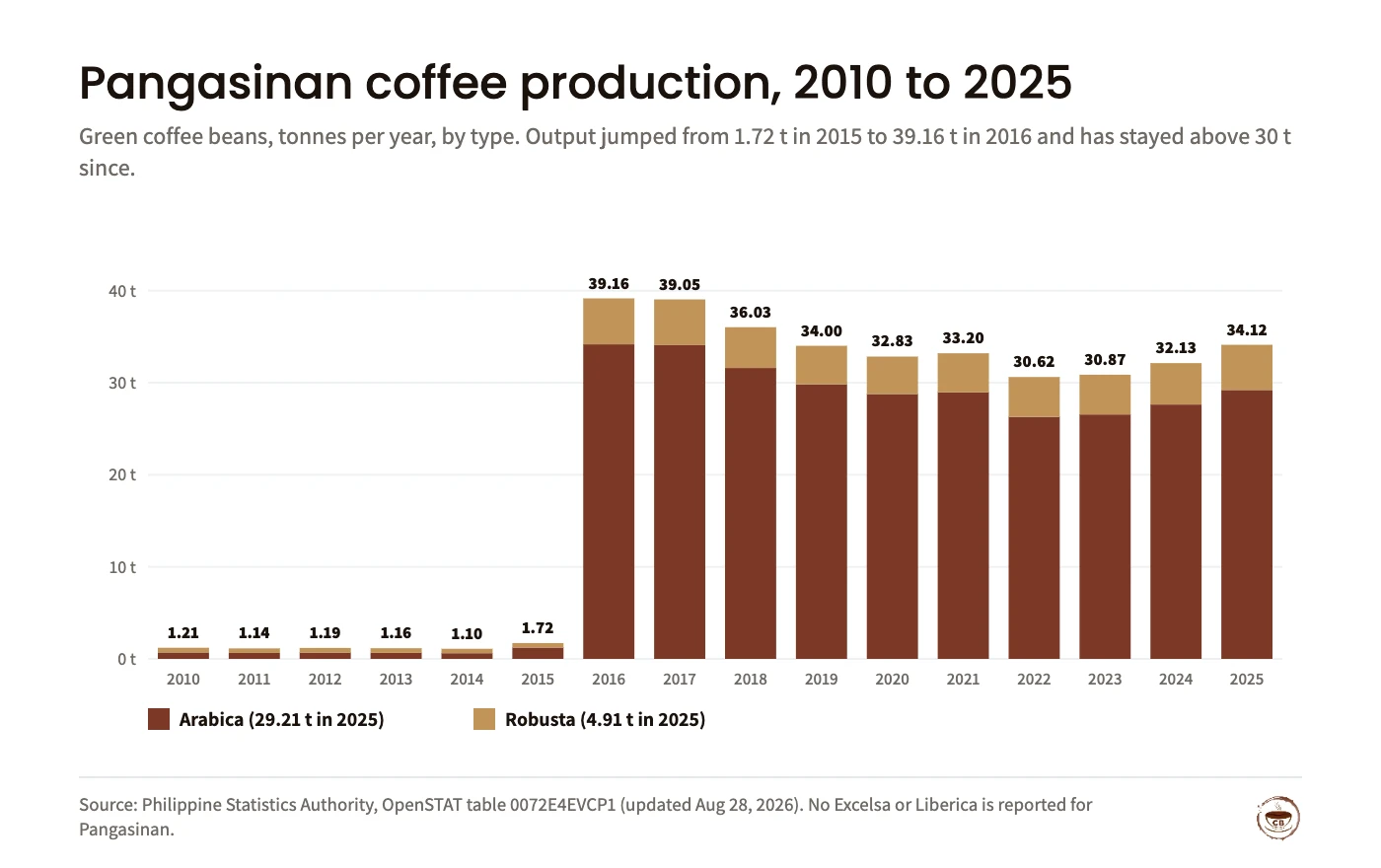
The series has a clear break. From 2010 to 2015 Pangasinan produced between 1.10 and 1.72 tonnes a year. Reported coffee area rose from 4.85 hectares in 2014 to 101 hectares in 2015, almost all of it Arabica (88 ha). Bearing trees went from 10,718 in 2015 to 107,666 in 2016, and output reached 39.16 tonnes that year. Since then it has stayed between 30.62 and 39.16 tonnes.
PSA does not say why. In March 2013 the Sunday Punch reported a provincial environment office plan to plant 400 hectares of coffee under the National Greening Program, with seedlings coming through an agreement between the DENR, DA and Nestlé Philippines. The timing fits the jump, but we found no source that links the two, so treat it as context only.
Sources also disagree on the regional mix. A 2023 Philippine News Agency report cited 2021 DTI data saying Region I coffee was 54% Robusta and 39% Arabica. PSA’s 2021 figures give 44% Robusta and 48% Arabica (34.22 t and 37.07 t of 77.68 t). In November 2026 a DA official put Region I at 13th nationally with a 0.25% share; PSA’s 2025 numbers give 0.23%. We use PSA throughout.
How productive are Pangasinan’s coffee farms?
Dividing PSA output by area and bearing trees gives a rough picture of yields. Some of the inputs have not changed for years (Robusta area has been 13 hectares every year since 2015), so read these as estimates.
| 2025 | Pangasinan Arabica | Philippines Arabica | Pangasinan Robusta | Philippines Robusta |
|---|---|---|---|---|
| Area (ha) | 77 | 15,102.97 | 13 | 101,098.49 |
| Bearing trees | 81,820 | 10,634,508 | 14,000 | 69,187,643 |
| Output (t green beans) | 29.21 | 7,849.82 | 4.91 | 25,731.07 |
| Tonnes per hectare | 0.38 | 0.52 | 0.38 | 0.25 |
| Kilos per bearing tree | 0.36 | 0.74 | 0.35 | 0.37 |
Pangasinan’s Arabica trees yield about half the national average per tree, while its Robusta yields more per hectare than the national figure. For the province as a whole, 2025 output works out to 0.36 kg per bearing tree against 0.42 kg nationally. None of the sources we read explains the difference.
What do Pangasinan coffee farmers get paid?
PSA has farmgate prices for Pangasinan coffee only from 2024. In 2024 both Arabica and Robusta averaged ₱168.75 per kilo of green beans. In 2025 Arabica averaged ₱159.50 and Robusta ₱180.00. From January to June 2026, the latest data, the price was ₱200 for Arabica and ₱210 for Robusta in every month.
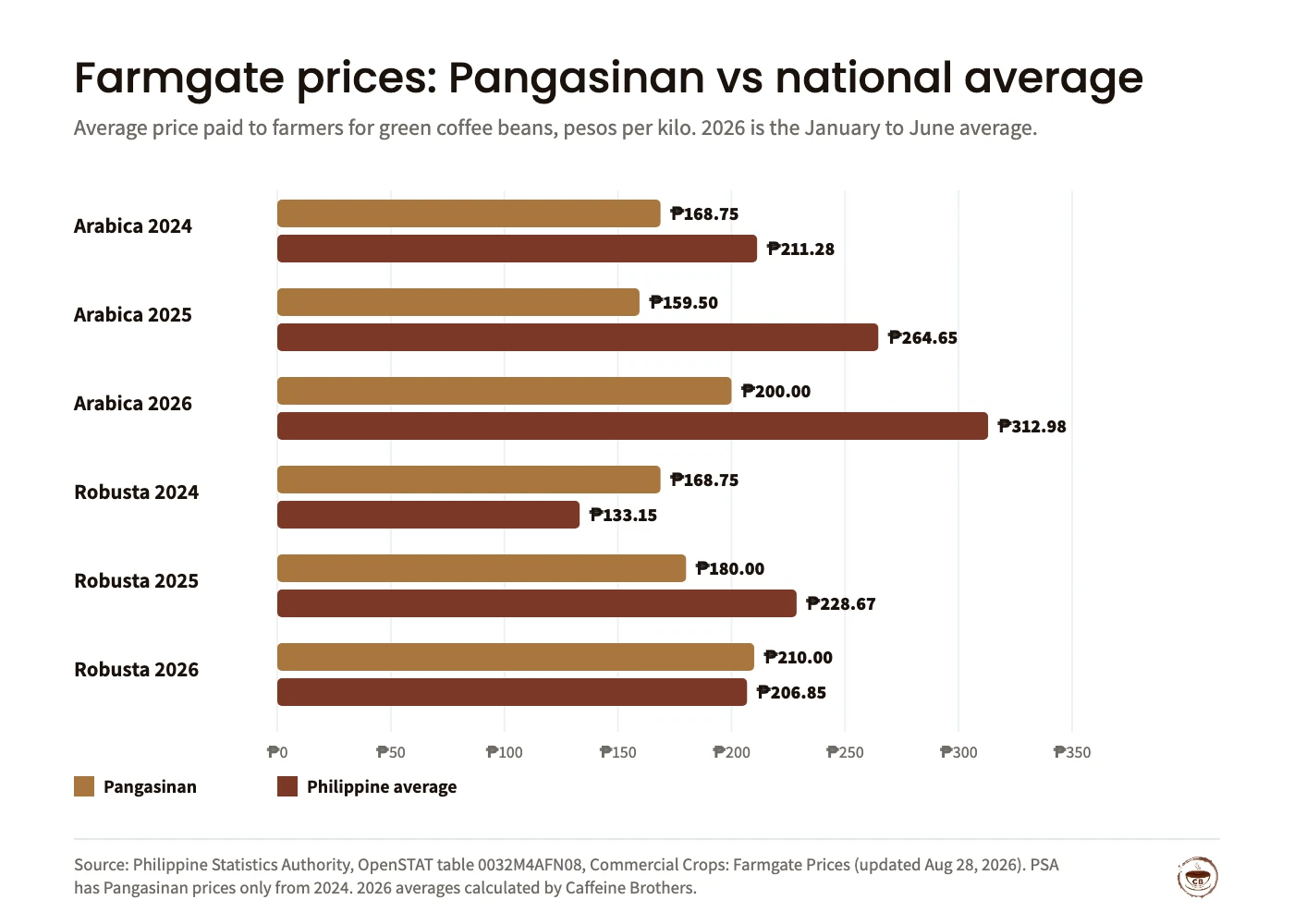
The gap is largest for Arabica. Pangasinan’s 2025 Arabica price was 60% of the national average of ₱264.65, and the Region I average was ₱206.36. In 2026 the national Arabica price ranged from ₱262.70 in January to ₱368.00 in February, while Pangasinan stayed at ₱200. Robusta is closer: Pangasinan’s ₱210 was slightly above the national January to June average of ₱206.85, which fell from ₱228.03 in January to ₱168.83 in June. For how farmgate prices compare with world and shelf prices, see our coffee price guide.
What programs support coffee in Pangasinan?
- National Greening Program (2013): the provincial environment office planned 400 hectares each of coffee and cacao, with seedlings under a DENR, DA and Nestlé Philippines agreement (Sunday Punch, March 3, 2013).
- Natividad convergence area (from December 2019): a DA and DENR project in the Caraballo foothills that supplied the 10,000 Robusta seedlings, set to run until 2022.
- Green Canopy Pangasinan (from 2023): the provincial government reported 24,342 seedlings planted by August 16, 2023, including coffee from the Provincial Agriculturist’s office, and 149,964 seedlings in 36 LGUs by February 2024. Coffee is not counted separately.
- Coffee and cacao enterprise program: on January 24, 2025, DA Region I gave coffee and cacao seedlings to representatives of four farmer groups at its Sta. Barbara, Pangasinan station. The report does not name their towns.
- Region I coffee roadmap: DA and DTI held the first Region I Coffee Industry Roadmap Localization Workshop in Bauang, La Union, on October 19 to 21, 2026. Problems named included low production, little scientific support, weak infrastructure and limited data.
We found no Pangasinan entry among published Philippine Coffee Quality Competition winners (see our PCQC guide), no cooperative selling Pangasinan-grown beans, and no published retail price for them.
How to check a Pangasinan coffee before you buy
- Ask for the town and barangay. Reports place coffee in Natividad, San Quintin, Bani and Bugallon. A seller who grows or buys locally should be able to name the farm area.
- Ask whether it is Arabica or Robusta. PSA counts both in Pangasinan, and the two taste and cost differently.
- Ask for the harvest and roast dates. A roast date tells you more about freshness than a “best before” date.
- Ask how it was processed. Washed, natural and honey processing change the cup, and small farms often use natural drying.
- Compare the price with farmgate. Green beans sold at ₱200 to ₱210 per kilo at the farm in 2026. Roasted coffee costs more because beans lose weight in roasting and need sorting and packing, but a very large markup is worth a question.
Does Caffeine Brothers sell Pangasinan coffee?
No. We do not sell Pangasinan coffee. Our Arabica comes from Benguet and is a medium roast: ₱292 for 200 g or ₱1,068 per kilo on November 12, 2026. Our Robusta and Kapeng Barako (Liberica) come from Batangas and are dark roasts: ₱231 and ₱242 for 200 g, ₱813 and ₱858 per kilo.
Frequently asked questions
Does Pangasinan grow coffee?
Yes. PSA data show Pangasinan produced 34.12 tonnes of green coffee beans in 2025 from 90 hectares and 95,820 bearing trees. That is the second-largest output in Region I after Ilocos Sur, but less than 0.1% of the Philippine total.
Is Pangasinan coffee Arabica or Robusta?
Mostly Arabica by PSA’s count: 29.21 tonnes of Arabica and 4.91 tonnes of Robusta in 2025, or about 86% Arabica. The only variety named in the town-level reports we found is Robusta, for seedlings planted in Natividad, so ask the seller which type you are buying.
Which towns in Pangasinan grow coffee?
PSA does not publish coffee data by town. Government reports mention coffee planting in Natividad, San Quintin, Bani and Bugallon, and a planned coffee plantation at Mt. Balungao. We found no report naming the towns where the Arabica grows.
How much do Pangasinan coffee farmers earn per kilo?
PSA farmgate prices for Pangasinan were ₱200 per kilo for Arabica and ₱210 per kilo for Robusta green beans in every month from January to June 2026. The national Arabica average over the same months was ₱312.98.
Sources
- Volume of Production of Non-Food and Industrial Crops (0072E4EVCP1). Philippine Statistics Authority OpenSTAT, updated Aug 28, 2026. Pangasinan, Region I and Philippine coffee output 2010 to 2025 and province ranks, via the PxWeb API
- Area Planted/Harvested (0092E4EAHM1). PSA OpenSTAT, updated Sep 1, 2026. Coffee area by type
- Number of Bearing Trees (0122E4EBTM1). PSA OpenSTAT, updated Aug 28, 2026. Coffee bearing trees by type
- Farmgate Prices of Commercial Crops (0032M4AFN08). PSA OpenSTAT, updated Aug 28, 2026. Green coffee bean farmgate prices by province and month
- Pangasinan Profile. PhilAtlas. Land area and 2020 population
- Of Protecting the Caraballo Mountains: LGU Natividad Continues Feat on Envi, Econ Dev’t through CADP. Department of Agriculture Regional Field Office 1, January 7, 2021. 10,000 Robusta seedlings, convergence area launched December 2019
- PGP gears up for a greener Pangasinan. Provincial Government of Pangasinan, February 8, 2024. San Quintin 18,507 seedlings incl. coffee; 149,964 seedlings in 36 LGUs
- Gov. Guico sets his sight in greening the province thru Green Canopy Pangasinan project. Provincial Government of Pangasinan, August 17, 2023. 24,342 seedlings incl. coffee
- BATIRI-Tribal Farmer Irrigators Association Learn Coconut-Coffee Farming System. Agricultural Training Institute RTC 1, September 5, 2024. Bani training, Bugallon practicum
- Pangasinan mountain-volcano resort now drawing tourists. Philippine News Agency report as carried by Canadian Inquirer, July 21, 2022. Planned coffee plantation at Mt. Balungao
- Coffee, cocoa bamboo added to Pangasinan’s NGP. Sunday Punch, March 3, 2013. 400 ha coffee planned under the National Greening Program
- Caffeine overload: FCAs granted coffee and cacao seedlings at ceremonial distribution. DA Regional Field Office 1, January 27, 2025
- Ilocos Coffee Roadmap Workshop Aligns Region 1 Industry Direction. DA Regional Field Office 1, November 10, 2026. Region I 13th, 0.25% share; October 19 to 21, 2026 workshop
- Ilocos Sur’s robusta coffee hailed as ‘best’ in PH. Philippine News Agency via SunStar, June 5, 2023. DTI 2021 regional mix (54% Robusta, 39% Arabica)
- Malico: Summer Capital of Pangasinan. Provincial Government of Pangasinan, July 5, 2024. Elevation about 1,675 m
Cite this article: Caffeine Brothers. “Pangasinan Coffee: Region I’s Top Arabica Province in 2025.” Caffeine Brothers Coffee Blog, November 2026. https://caffeinebrothers.co/pangasinan-coffee/
You are welcome to reference the charts and tables in this article with a link back to this page.
Looking for Philippine Arabica? Try our Benguet Arabica, or for something stronger our Batangas Robusta and Kapeng Barako. Browse the shop, with free grinding to whole bean, coarse, normal or fine. Cafés and offices can order 10 kg boxes through wholesale. Contact us with questions.
 Previous Post
 Next Post