
Cotabato Coffee: Mt. Apo Arabica, Excelsa and 2025 Output Data
By Robin Salvador, co-founder, Caffeine Brothers
Last updated: November 14, 2026
Quick answer: Cotabato coffee is grown mainly on the Cotabato side of Mt. Apo, in Kidapawan City and Makilala, and in upland towns such as Alamada. The Philippine Statistics Authority (PSA) counts 208.55 tonnes of green coffee beans for the province in 2025: 111.21 tonnes of Robusta, 58.85 tonnes of Excelsa and 38.45 tonnes of Arabica. Output is 84.4% lower than in 2010, but Makilala farmers still place in the national Arabica competition, most recently 5th in 2026 with 84.50 points.
Key takeaways
- Cotabato produced 208.55 t of green coffee beans in 2025, 0.59% of the Philippine total of 35,645.64 t (PSA OpenSTAT, updated Aug 28, 2026).
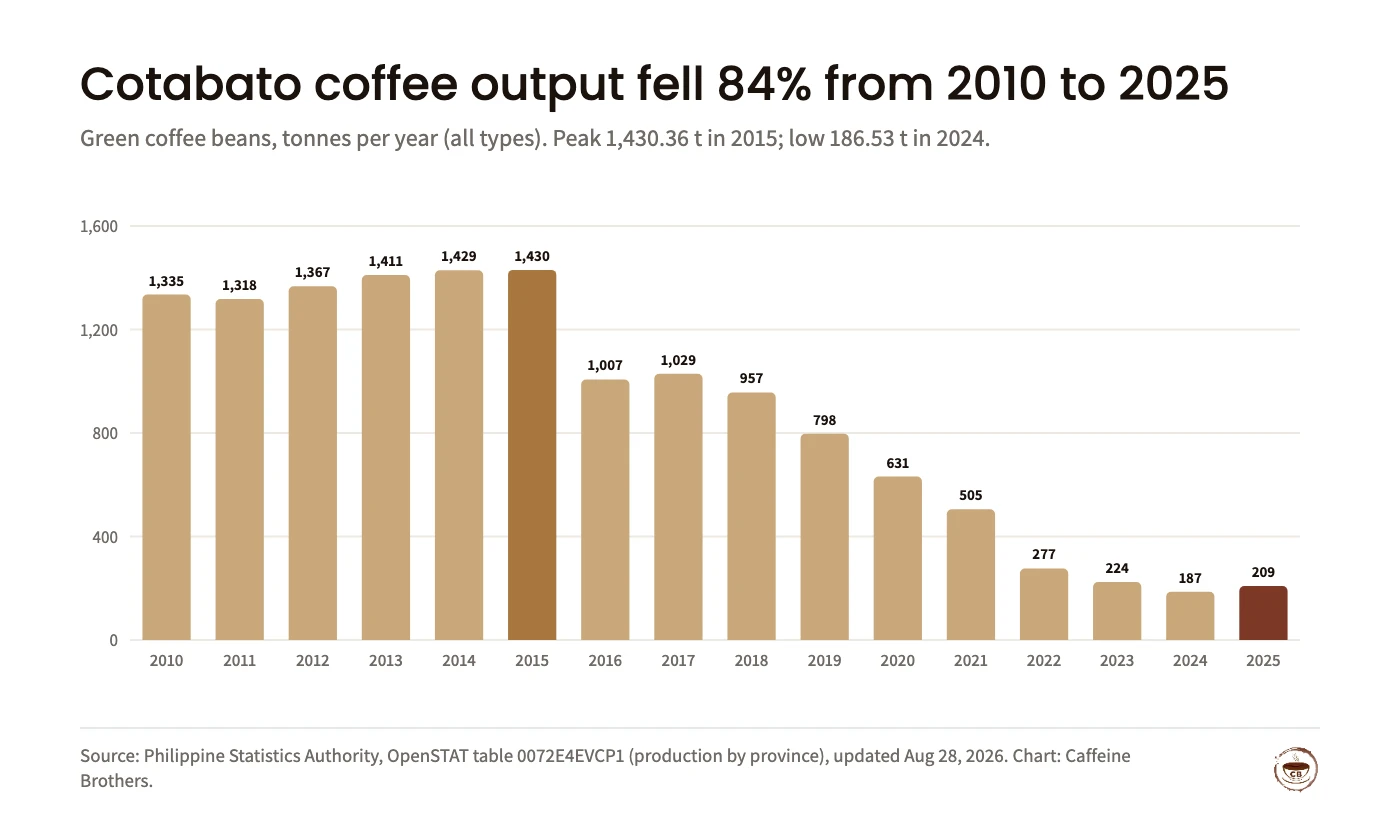
- Output peaked at 1,430.36 t in 2015 and fell to 186.53 t in 2024 before a small rise in 2025. Coffee area shrank from 3,111 ha in 2010 to 1,120.80 ha.
- Cotabato grows 82.6% of Region XII’s Excelsa (58.85 of 71.26 t) and ranks 11th nationally for that type.
- Ylaine Joyce Giangan of Makilala placed 6th (83.94) in the 2024 Philippine Coffee Quality Competition and 5th (84.50) in 2026.
- Farmgate Robusta in Cotabato averaged ₱224.30/kg in 2025, close to the national ₱228.67/kg.
Where is coffee grown in Cotabato?
Cotabato, still often called North Cotabato, is a landlocked province of Region XII (SOCCSKSARGEN) with its capital at Kidapawan City. PhilAtlas lists 1 city and 17 municipalities, a land area of 9,317.30 km² and a 2020 population of 1,490,618.
The coffee towns that show up in news and competition records sit on the slopes of Mt. Apo and in the uplands to the north:
- Kidapawan City. The Sondawa Coffee Farmer Association in Barangay Ilomavis says its farms are “at the foot of the Mt. Apo” at 700 to 1,000 meters above sea level.
- Makilala. The Inquirer (Sep 20, 2024) reported that the villages of Cabilao, Buhay and Malumpini are “the center of civet coffee production in Cotabato,” with some 200 hectares of Arabica farms. Read more in our kape alamid guide.
- Alamada. Coffee for Peace said in 2019 it planned to help expand Arabica there, and that “current arabica volume in Alamada remains small.”
- Arakan. The Department of Agrarian Reform turned over an all-weather dryer for coffee and cacao farmers in Lanao Kuran, Arakan (Manila Times, Aug 25, 2023).
The Davao del Sur side of the same mountain is covered in our Davao coffee guide.
How much coffee does Cotabato produce?
PSA’s OpenSTAT production table gives annual green coffee bean (GCB) output by province from 2010 to 2025. Cotabato’s total stayed between 1,318 and 1,431 tonnes from 2010 to 2015, then fell in steps: down 29.6% in 2016 and down 45% in 2022. The 2025 figure of 208.55 tonnes is 11.8% above 2024.
| Year | Total (t) | Robusta | Excelsa | Arabica | Liberica | Share of PH |
|---|---|---|---|---|---|---|
| 2010 | 1,334.84 | 867.83 | 267.42 | 198.62 | 0.98 | 2.82% |
| 2015 | 1,430.36 | 920.27 | 287.13 | 221.62 | 1.35 | 3.95% |
| 2016 | 1,007.09 | 626.29 | 202.68 | 177.01 | 1.11 | n/a |
| 2020 | 631.43 | 364.94 | 143.87 | 121.72 | 0.91 | 2.08% |
| 2022 | 276.66 | 154.92 | 70.37 | 51.13 | 0.25 | n/a |
| 2024 | 186.53 | 100.50 | 51.45 | 34.57 | 0.01 | 0.58% |
| 2025 | 208.55 | 111.21 | 58.85 | 38.45 | 0.04 | 0.59% |
The rest of Region XII moved the other way. Region XII grew from 10,987 tonnes in 2023 to 16,675.73 tonnes in 2025, almost all of it from Sultan Kudarat (9,889.30 to 15,689.08 tonnes; see our Sultan Kudarat coffee article). In 2025 Cotabato ranked 3rd of the region’s 4 provinces, behind Sultan Kudarat and South Cotabato (596.64 t) and ahead of Sarangani (181.47 t). Nationally it was 25th of 71 areas with data.
None of the sources we read explains the decline. Many PSA area and tree figures for Cotabato are round numbers that repeat for several years (for example 300 ha of Arabica from 2012 to 2015), so treat them as estimates.
Which coffee types does Cotabato grow?
Robusta made up 53.3% of the 2025 total, Excelsa 28.2% and Arabica 18.4%. Liberica is close to zero: 0.8 hectares, 400 trees and 0.04 tonnes. In 2010 the mix was 65.0% Robusta, 20.0% Excelsa and 14.9% Arabica, so Robusta lost the most ground.
Excelsa is where Cotabato stands out. It grew 58.85 of Region XII’s 71.26 tonnes in 2025 (82.6%) and 2.97% of the Philippine total of 1,980.73 tonnes, ranking 11th of 39 areas. Sulu leads the country at 610.54 tonnes. Our Excelsa coffee guide explains the bean.
How do Cotabato’s yields compare?
We divided PSA production by PSA area and bearing trees for 2025. Cotabato’s yields are below both the region and the country for every type. In 2010 the province was above the national average (0.429 vs 0.389 t/ha), so the gap is recent.
| Type (2025) | Cotabato t/ha | Cotabato kg/tree | Region XII t/ha | Philippines t/ha | Philippines kg/tree |
|---|---|---|---|---|---|
| All coffee | 0.186 | 0.272 | 0.492 | 0.285 | 0.420 |
| Arabica | 0.366 | 0.592 | 0.892 | 0.520 | 0.738 |
| Robusta | 0.193 | 0.278 | 0.426 | 0.255 | 0.372 |
| Excelsa | 0.134 | 0.196 | 0.143 | 0.266 | 0.465 |
What do Cotabato farmers get paid for coffee?
PSA’s farmgate price table has Cotabato data for Robusta and Excelsa green beans. Arabica has only one monthly figure (₱215/kg in January 2026), and Liberica has none.
| Green coffee, ₱/kg | 2023 | 2024 | 2025 | Jan to Jun 2026 average |
|---|---|---|---|---|
| Robusta, Cotabato | 96.22 | 145.00 | 224.30 | 208.33 |
| Robusta, Philippines | 90.31 | 133.15 | 228.67 | 206.85 |
| Excelsa, Cotabato | 125.05 | 161.00 | 240.12 | 255.00 |
| Excelsa, Philippines | 89.49 | 145.20 | 358.03 | 176.20 |
Cotabato Robusta more than doubled from 2023 to 2025 (+133%), in line with the national rise (+153%) covered in our coffee price guide. Monthly Cotabato Robusta prices in 2026 were ₱230 in January and ₱200 from March to June.
Has Cotabato coffee won awards?
Cotabato names appear in the Arabica results of the Philippine Coffee Quality Competition (PCQC) and DTI Region XII’s Kape Dose contest. We list only results we could read in published reports.
| Year | Competition | Farmer and place | Result |
|---|---|---|---|
| 2018 | 2nd PCQC, Arabica | Rogelio Giangan, Cabilao (Makilala) | 10th, 84.28 |
| 2023 | Kape Dose (Region XII), Arabica | Rogelio Giangan, Cotabato | 2nd, 80.75 |
| 2024 | PCQC, Arabica | Ylaine Joyce Giangan, Makilala | 6th, 83.94 |
| 2025 | Kape Dose (Region XII), Arabica | Ma. Fe Beatingo, Dado, Alamada | 3rd, 82.65 |
| 2026 | PCQC, Arabica | Ylaine Joyce Giangan, Makilala | 5th, 84.50 |
In 2025 Cotabato sent 4 entries to Kape Dose, all Arabica, according to SunStar. Our PCQC guide explains how the national contest is scored.
What programs support coffee in Cotabato?
- In May 2025 Nestlé Philippines and the SF Group of Companies signed an agreement to expand Robusta “in Northern Cotabato” through Sunfood Marketing’s Corporate Growership Program, which InsiderPH called the first partnership of its kind under the Nescafé Plan. No hectare or peso targets were published.
- In 2014 a DAR project worth ₱470,000 set out to produce 31,000 coffee seedlings for at least 50 hectares in Barangay Kawayanon, Makilala, with the Kawayanon Multi-Purpose Cooperative (Philstar, Nov 16, 2014).
- In 2014 DA Region XII said Kidapawan groups were making brewed coffee using mini processing facilities from the agency (MindaNews, Jul 11, 2014).
How to buy and brew Cotabato coffee
- Ask for the town and type. “Cotabato” can mean Robusta, Excelsa or Arabica. Mt. Apo Arabica usually comes from Kidapawan or Makilala.
- Buy from the farmer group or a roaster that names it. Sondawa in Kidapawan lists Arabica at ₱1,200 per kilo, ₱600 per 500 g and ₱40 per single drip bag on its undated product page.
- Check the roast date. Brew within a few weeks of roasting and grind just before brewing.
- Start with a standard recipe. Our brewing methods guide lists coffee-to-water ratios, grind and time for each method. Change one thing at a time.
- Compare with a known bean. Brew it side by side with a Benguet Arabica or Batangas Robusta to learn what you like.
Caffeine Brothers does not sell Cotabato coffee. For comparison, our Benguet Arabica is ₱292 for 200 g and ₱1,068 per kilo, and our Batangas Robusta is ₱231 for 200 g and ₱813 per kilo (live prices, November 14, 2026).
Frequently asked questions
Where is coffee grown in Cotabato?
Coffee is grown on the Mt. Apo side of the province, in Kidapawan City and Makilala, and in upland towns such as Alamada and Arakan. A Kidapawan farmers group places its farms at 700 to 1,000 meters, and Makilala’s Cabilao, Buhay and Malumpini villages have about 200 hectares of Arabica.
How much coffee does Cotabato produce?
PSA counts 208.55 tonnes of green coffee beans for Cotabato in 2025. That is 0.59% of the Philippine total and down 84.4% from 1,334.84 tonnes in 2010.
What kind of coffee comes from Cotabato?
Robusta is the largest type at 111.21 tonnes in 2025, followed by Excelsa at 58.85 tonnes and Arabica at 38.45 tonnes. Cotabato grows 82.6% of Region XII’s Excelsa.
Does Caffeine Brothers sell Cotabato coffee?
No. Our Arabica comes from Benguet, and our Robusta and Kapeng Barako come from Batangas. For Cotabato beans, look for farmer groups and roasters in Kidapawan and Makilala.
Sources
- Production of Non-Food and Industrial Crops by Province (0072E4EVCP1). Philippine Statistics Authority, OpenSTAT, updated August 28, 2026. Production 2010 to 2025, ranks and shares
- Area Planted/Harvested by Crop and Province (0092E4EAHM1). PSA OpenSTAT, updated September 1, 2026. Hectares by coffee type
- Number of Bearing Trees by Crop and Province (0122E4EBTM1). PSA OpenSTAT, updated August 28, 2026. Bearing trees by coffee type
- Farmgate Prices of Commercial Crops (0032M4AFN08). PSA OpenSTAT, updated August 28, 2026. Robusta and Excelsa farmgate prices
- Cotabato Profile. PhilAtlas. Area, 2020 population, capital and municipalities
- Mindanao farmers dominate coffee quality competition. MindaNews, June 8, 2026. PCQC 2026 Arabica result for Makilala
- Mindanao coffee farmers dominate in PCQC 2024. MindaNews, June 17, 2024. PCQC 2024 Arabica 6th place
- 3 Davao coffee growers feted. SunStar Davao, March 28, 2018. 2nd PCQC Arabica results
- First Kape Dose competition showcases quality of region’s coffee. Peace and Equity Foundation, March 13, 2023. Kape Dose 2023 results
- Sultan Kudarat farmers celebrate success at Kape Dose 2025. SunStar Davao, April 11, 2025. Cotabato entries and Alamada result
- Civet hunting threatens specialty coffee in Cotabato. Philippine Daily Inquirer, September 20, 2024. Makilala civet coffee villages and Arabica area
- Sondawa Coffee Farmer Association. Community product page, undated. Kidapawan elevation and retail prices
- Coffee for Peace to help expand Cotabato arabica production. BusinessWorld, July 29, 2019. Alamada Arabica
- Nestlé, SFGC forge deal to strengthen Mindanao’s Robusta coffee production. InsiderPH, May 2025. Northern Cotabato Robusta agreement
- Coffee production project benefits agrarian reform beneficiaries in Cotabato. Philstar, November 16, 2014. Makilala seedling project
- R-12 eyes doubling coffee production in 10 years. MindaNews, July 11, 2014. Kidapawan processing facilities
Cite this article: Caffeine Brothers. “Cotabato Coffee: Mt. Apo Arabica, Excelsa and 2025 Output Data.” Caffeine Brothers Coffee Blog, November 2026. https://caffeinebrothers.co/cotabato-coffee/
You are welcome to reference the charts and tables in this article with a link back to this page.
Cotabato beans are hard to find in Manila. For Philippine-grown coffee roasted daily, browse our shop or the Kapeng Barako page, and see wholesale 10 kg boxes for cafés. Contact us with questions.
 Previous Post
 Next Post