
Kalinga Coffee: Production, Prices and Where It Is Grown
By Robin Salvador, co-founder, Caffeine Brothers
Last updated: October 30, 2026
Quick answer: Kalinga coffee is mostly Robusta grown by smallholders in Tanudan, Tabuk City, Pinukpuk, Pasil, Lubuagan and other towns of Kalinga province in the Cordillera. PSA data show Kalinga produced 230.49 tonnes of green coffee beans in 2025 from 2,765 hectares, making it the Cordillera’s second-largest producer after Benguet (1,011.77 tonnes). Output has fallen 87.9% since 2010, when Kalinga produced 1,901.50 tonnes and two thirds of the region’s coffee.
Key takeaways
- In 2025 Kalinga produced 230.49 tonnes of green coffee beans (GCB), 99.8% of it Robusta, according to PSA OpenSTAT (updated August 28, 2026).
- Kalinga’s share of Cordillera coffee fell from 67.8% in 2010 to 16.8% in 2025; Benguet has been the region’s top producer every year since 2021.
- PSA counts 1,830,300 bearing trees on 2,765 hectares in Kalinga, but output per tree in 2025 was 0.13 kg against a national average of 0.42 kg.
- PSA’s average farmgate price for Kalinga Robusta was ₱88.33 per kg in 2025, against ₱228.67 nationally; DTI-Kalinga cited a usual farmgate price of ₱150 to ₱160 in 2024.
- The 2024 Kalinga Coffee Quality Competition was won by Pablo Dao-wan of Tanudan with a Robusta that scored 82 and sold for ₱230 per kg at auction.
Kalinga used to be the coffee province of the Cordillera. Most coffee drinkers know Benguet and Sagada Arabica, but for years the bigger volume came from the Robusta farms of Kalinga’s lower slopes. We roast Robusta from Batangas, not Kalinga, so we have no beans to sell you here. We wrote this guide because the official numbers tell an unusual story about Philippine Robusta, the coffee we roast every day. Every figure below comes from PSA, government agencies or news reports we read in October 2026.
Where is coffee grown in Kalinga?
A 2018 PTV report on a ₱130 million, 13-kilometre farm-to-market road from Banneng to Gombowoy in Tanudan, built under the DA’s Philippine Rural Development Project, called Tanudan the province’s biggest coffee producer. It said about 3,425 hectares of coffee plantations, plus corn and other crops, would benefit, and named 673 households in Lay-asan and Pangol villages. A 2016 Inquirer report, quoting DA figures, put 3,954 hectares of Robusta in Tanudan, about half of the province’s production area.
Other coffee towns named in recent government reports include Tabuk City, Pinukpuk and Pasil, where DA’s Special Area for Agricultural Development (SAAD) program trained growers in 2021, and Lubuagan and Balbalan, whose farmers have entered the provincial coffee competition. A DA-SAAD article from April 2022 notes that lowland areas of Kalinga suit Robusta, Excelsa and Liberica, while Arabica grows in the highlands. Robusta is harvested from January to April.
How much coffee does Kalinga produce?
PSA’s OpenSTAT tables give province-level coffee data from 2010 to 2025. In 2025, Kalinga produced 230.49 tonnes of green coffee beans: 230.00 tonnes of Robusta and 0.49 tonnes of Excelsa. That was 16.8% of the Cordillera’s 1,373.83 tonnes and 0.6% of the Philippines’ 35,645.64 tonnes. Within the region, Kalinga ranks second, behind Benguet (1,011.77 tonnes) and ahead of Ifugao (74.72), Mountain Province (41.90), Abra (8.12) and Apayao (6.84).
| Year | Kalinga (t GCB) | Benguet (t GCB) | Cordillera (t GCB) | Kalinga share of Cordillera |
|---|---|---|---|---|
| 2010 | 1,901.50 | 243.80 | 2,804.07 | 67.8% |
| 2013 | 1,849.25 | 250.50 | 2,732.41 | 67.7% |
| 2015 | 1,740.20 | 270.39 | 2,605.01 | 66.8% |
| 2016 | 1,040.00 | 261.63 | 1,867.93 | 55.7% |
| 2017 | 155.60 | 260.40 | 943.08 | 16.5% |
| 2018 | 400.60 | 257.52 | 1,099.49 | 36.4% |
| 2020 | 395.63 | 349.58 | 1,003.13 | 39.4% |
| 2021 | 371.53 | 525.36 | 1,114.59 | 33.3% |
| 2023 | 217.30 | 614.23 | 1,013.62 | 21.4% |
| 2024 | 210.77 | 590.08 | 983.43 | 21.4% |
| 2025 | 230.49 | 1,011.77 | 1,373.83 | 16.8% |
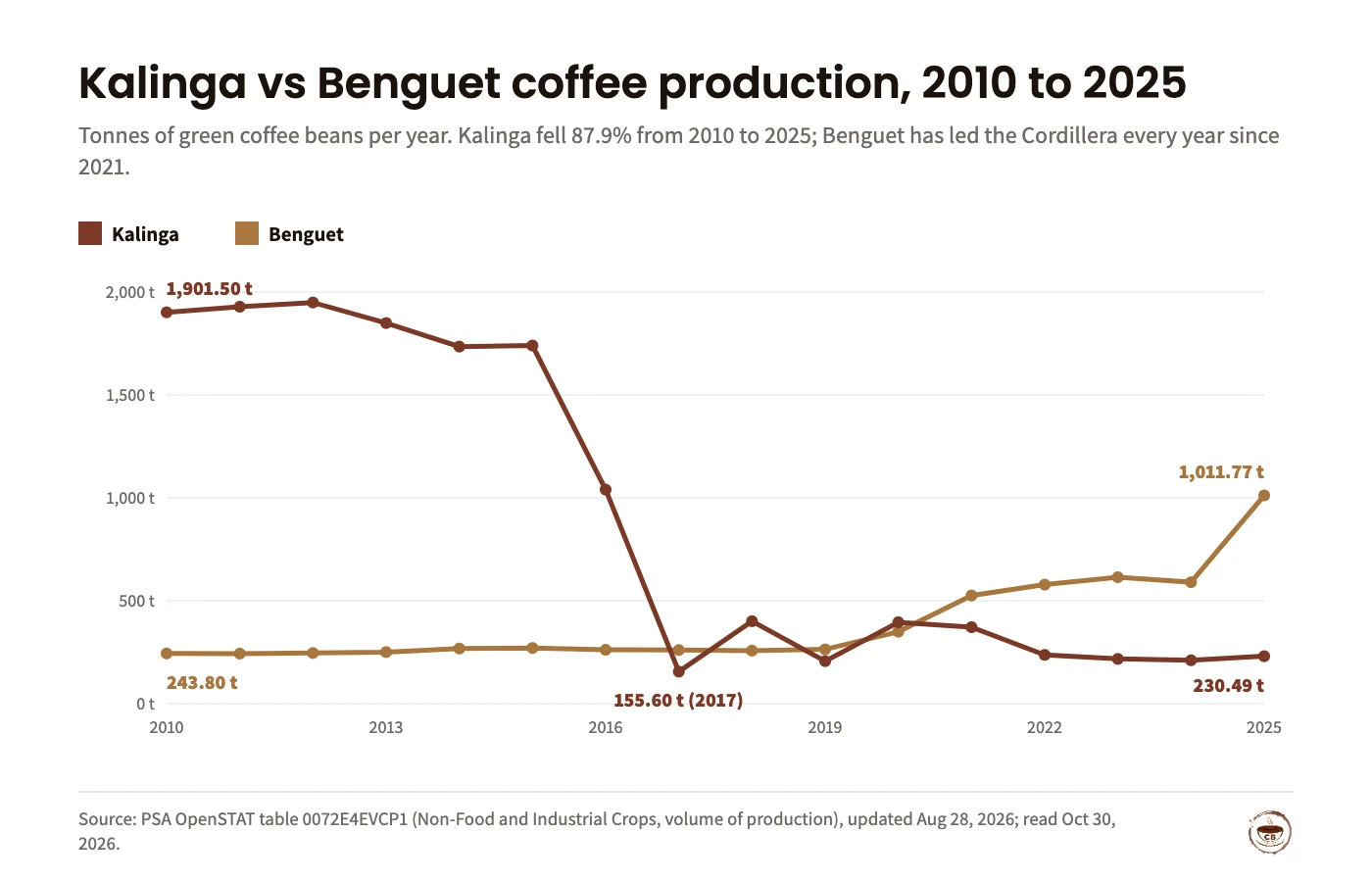
The fall was not gradual. Kalinga produced 1,040.00 tonnes in 2016 and 155.60 tonnes in 2017, a drop of 85.0% in one year, while PSA’s count of bearing trees barely moved (2,393,200 to 2,368,500). Output recovered to around 400 tonnes in 2018 and 2020, then slid again. Benguet, the home of most Cordillera Arabica, produced more than Kalinga in 2017 and 2019, less in 2018 and 2020, and has led every year since 2021. Our Benguet coffee guide covers that side of the story.
Older news reports quote bigger numbers, and the difference is mostly about units. A March 2016 Inquirer report cited DA data saying Kalinga produced 3,698.50 tonnes, 68% of the Cordillera total. PSA’s table shows exactly 3,698.50 tonnes for Kalinga in 2013, measured as dried berries with pulp, not green beans. Dried berries weigh roughly twice as much as the green beans inside them: PSA’s Kalinga figures for 2013 are 3,698.50 tonnes of dried berries and 1,849.25 tonnes of green coffee beans.
How productive are Kalinga’s coffee farms?
On paper, Kalinga has a lot of coffee. PSA counts 2,765 hectares and 1,830,300 bearing trees in 2025, which is 59.3% of all bearing coffee trees in the Cordillera. The yield is low. Each tree produced about 0.13 kg of green beans in 2025, less than a third of the national average of 0.42 kg. Note that PSA reports the same area (2,765 hectares) and tree count (1,830,300) for every year from 2020 to 2025, so these two series look like carried-forward estimates, while production changes each year.
| Measure, 2025 | Kalinga | Philippines |
|---|---|---|
| Green coffee beans produced | 230.49 t | 35,645.64 t |
| Robusta share of output | 99.8% | 72.2% |
| Area planted to coffee | 2,765 ha | 124,982.58 ha |
| Robusta area | 2,600 ha | 101,098.49 ha |
| Arabica area | 65 ha | 15,102.97 ha |
| Bearing trees | 1,830,300 | 84,839,827 |
| Output per hectare | 0.08 t | 0.29 t |
| Output per bearing tree | 0.13 kg | 0.42 kg |
| Robusta farmgate price, annual average | ₱88.33/kg | ₱228.67/kg |
Why did Kalinga coffee output fall?
No single official document explains the 2017 drop, but several reports describe the same pressures.
- Corn replaced coffee. An undated Inquirer report, citing PSA figures for 2005 and 2014, said Kalinga’s coffee area fell from 5,550 to 3,427 hectares while corn area rose from 9,516 to 14,459 hectares. It named southern and western Tabuk City, lower Tanudan and lower Pinukpuk as the areas of conversion, and quoted provincial agriculturist Domingo Bakilan: “Some farmers are cutting down coffee trees to plant corn because of the low production of coffee.”
- The trees are old. The same report said many trees were planted in the 1970s and 1980s. DA-SAAD’s 2022 rejuvenation project in Pasil, Pinukpuk and Tabuk City targeted about 10,800 century-old trees on 27 hectares.
- Supply for local processors shrank. In the 2016 Inquirer report, Antuza Refalda of Kalinga Brew said she bought 1,000 kg of local beans a day when she started in 2006, and “Today I’d be happy if I get 500 kg on a good day.”
- Imports compete on price. A February 2024 PIA report said the provincial competition aims to boost local production against imported Vietnamese coffee, and quoted DTI-Kalinga’s Jeffrey Pasikan: “the supply of Kalinga coffee is dwindling.”
What do Kalinga coffee farmers get paid?
PSA’s farmgate price survey has an unusual pattern for Kalinga Robusta. Until 2019, Kalinga farmers received more than the national average: ₱124.14 per kg against ₱79.53 in 2019. Since then the national price has more than doubled, from ₱72.60 in 2021 to ₱228.67 in 2025, while PSA’s Kalinga average stayed near ₱90. For January to March 2026, PSA records ₱90.00 for Kalinga each month and ₱208.80 to ₱228.03 nationally; there is no Kalinga figure after March.
| Year | Kalinga Robusta (₱/kg) | Philippines Robusta (₱/kg) |
|---|---|---|
| 2010 | 62.53 | 54.95 |
| 2015 | 93.07 | 70.95 |
| 2017 | 118.31 | 81.70 |
| 2019 | 124.14 | 79.53 |
| 2021 | 113.88 | 72.60 |
| 2023 | 86.32 | 90.31 |
| 2024 | 76.67 | 133.15 |
| 2025 | 88.33 | 228.67 |
| 2026 (Jan to Mar) | 90.00 each month | 228.03, 224.23, 208.80 |
Other sources give higher local prices. In the February 2024 PIA report, DTI-Kalinga said the usual farmgate price was ₱150 to ₱160 per kg, and the winning Robusta in that year’s competition sold for ₱230 per kg at auction. In 2016, Kalinga Brew said a large corporation paid ₱75 per kg while it offered ₱85. We could not find a source that explains why PSA’s Kalinga average sits so far below both the DTI figure and the national average, so treat the ₱88.33 as one survey estimate. Our coffee price guide explains how PSA collects farmgate prices and how they compare with world prices.
What does Kalinga coffee taste like?
We have not cupped Kalinga coffee ourselves, so we can only report what judges and producers have written. At the 2024 Kalinga Coffee Quality Competition, PIA reported these judges’ notes:
- Pablo Dao-wan, Lay-asan, Tanudan (Robusta, 82 points): dried berries, mangosteen, honey, tamarind, orange, pineapple and citrus.
- Crispin Gayagay, Tanudan (80.1 points): caramel, nutty, cinnamon, tangerine, citrus, prunes and tea-like.
- Jonathan Itong, Lubuagan (Robusta, 80 points): roasted peanuts, dark chocolate and caramel.
- Lioba Busway, Upper Uma, Lubuagan (Arabica, special citation, 83.5 points, the only Arabica entry): tangerine, tamarind, lemon, passion fruit, tea rose and honey. It sold for ₱700 per kg at the auction.
Tabuk City producer Sunshine Molinta, a Robusta Q Grader and the 2025 National Gawad Saka Outstanding Farmer for high-value crops (plantation category), told the Manila Bulletin in September 2025 that Kalinga coffee has “top notes of dark chocolate and muscovado.” She runs Kalinga Mountain Roasters in Bolanao, Tabuk City.
What is being done to revive Kalinga coffee?
The province and national agencies run several programs. The Kalinga coffee competition started in 2023 at Kalinga State University with 16 growers, using a score of 80 or higher on the Specialty Coffee Association scale as the quality benchmark, according to PIA. The provincial coffee council has been revived under Governor James Edduba, and the Baguio Midland Courier reported farm machinery and inputs given to 16 coffee farmers and a DTI investment forum in Tabuk City. DA-SAAD trained 450 farmers in Pasil, Pinukpuk and Tabuk City in late 2021, with ₱730,000 for training and another ₱730,000 for materials and equipment.
The DA-SAAD training taught rejuvenation of old trees, which brings a stand back into bearing faster than replanting. The steps, as DA-SAAD described them:
- Pick old, low-yielding trees in the block to be renewed; the 2021 project targeted about 80% of the program area.
- Cut the main stem at a slant, through at least 75% of its diameter, about two feet above the ground.
- Seal the cut with latex paint to protect the wound.
- Let new shoots grow and manage them; DA-SAAD says rejuvenated trees can bear berries within a year, against three to four years for new seedlings.
- Harvest only ripe cherries. The training discourages stripping branches, which damages trees and mixes unripe and overripe beans into the lot.
Kalinga is not the only Philippine Robusta region in transition. Volume has moved south: PSA shows Sultan Kudarat alone produced 15,689.08 tonnes in 2025, 44.0% of the national total.
Can you buy Kalinga coffee from Caffeine Brothers?
No. We do not sell Kalinga coffee and we do not claim any Kalinga origin. Our Robusta comes from Batangas and is roasted dark; our Kapeng Barako is Batangas Liberica; our Arabica is from Benguet. As of October 30, 2026, Robusta coffee beans cost ₱231 for 200 g and ₱813 for 1 kg, Kapeng Barako ₱242 and ₱858, and Benguet Arabica ₱292 and ₱1,068. If you want to try Kalinga beans, look for the provincial producers named above.
Frequently asked questions
What type of coffee is grown in Kalinga?
Almost all of it is Robusta. In 2025, PSA counted 230.00 of Kalinga’s 230.49 tonnes of green coffee beans as Robusta, with 0.49 tonnes of Excelsa. Kalinga also has about 65 hectares of Arabica, but PSA reports no Arabica output for the province since 2016.
How much coffee does Kalinga produce?
PSA put Kalinga’s 2025 output at 230.49 tonnes of green coffee beans, from 2,765 hectares and 1,830,300 bearing trees. That is 16.8% of the Cordillera’s 1,373.83 tonnes and 0.6% of the Philippine total of 35,645.64 tonnes.
Why has Kalinga coffee production declined?
Reports from the Inquirer, DA-SAAD and PIA point to farms converted to corn, aging trees planted decades ago, poor farm-to-market roads and low prices. PSA shows output falling from 1,901.50 tonnes in 2010 to 230.49 tonnes in 2025, with the biggest drop between 2016 and 2017.
Does Caffeine Brothers sell Kalinga coffee?
No. Our Robusta comes from Batangas and our Arabica from Benguet. If you want a strong Robusta for brewing or milk drinks, our Batangas Robusta and Kapeng Barako are the closest options in our range.
Sources
- Non-Food and Industrial Crops: Volume of Production, by Region, Province, Quarter, and Semester, 2010 to 2026 (table 0072E4EVCP1). Philippine Statistics Authority, OpenSTAT, updated August 28, 2026; queried October 30, 2026 via the PxWeb API. Used for green bean and dried berry output for Kalinga, Benguet, the other Cordillera provinces, the Cordillera and the Philippines
- Non-Food and Industrial Crops: Area Planted/Harvested (table 0092E4EAHM1). PSA OpenSTAT, updated September 1, 2026. Used for coffee area by type
- Non-Food and Industrial Crops: Number of Bearing Trees/Hills/Vines (table 0122E4EBTM1). PSA OpenSTAT, updated August 28, 2026. Used for bearing trees
- Commercial Crops: Farmgate Prices by Commodity, Region and Province, Monthly, 2010 to 2026 (table 0032M4AFN08). PSA OpenSTAT, updated August 28, 2026. Used for Kalinga and national Robusta farmgate prices
- P130-M farm-to-market road opens up global chance for Kalinga coffee. PTV News, February 23, 2018. Used for the Tanudan road, 3,425 hectares and 673 households
- In Kalinga, coffee growers seeking government help to boost production. Philippine Daily Inquirer, Kimberlie Quitasol, March 7, 2016. Used for Tanudan’s 3,954 hectares, the 3,698.50-tonne figure and Kalinga Brew’s supply and prices
- Corn farms eating up land devoted to coffee. Philippine Daily Inquirer, undated. Used for coffee and corn area in 2005 and 2014, conversion areas, tree age and the Bakilan quote
- Keeping the coffee industry alive in Kalinga. Department of Agriculture SAAD Program, April 18, 2022. Used for the rejuvenation training, budget, steps and harvest seasons
- Tanudan farmer tops 2024 Kalinga coffee quality competition. Philippine Information Agency, Larry Lopez, February 2024 (awarding February 15, 2024). Used for winners, scores, cupping notes, auction prices and the DTI farmgate price
- Kalinga Robusta coffee graded for quality. Philippine Information Agency, Peter Balocnit, February 10, 2023. Used for the first competition, 16 growers and the 80-point benchmark
- Stakeholders collaborate to improve Kalinga coffee trade. Baguio Midland Courier, undated. Used for the provincial coffee council, equipment for 16 farmers and the DTI forum
- Manila Bulletin Agriculture reader is a Kalinga coffee advocate. Manila Bulletin, September 5, 2025. Used for Sunshine Molinta, Kalinga Mountain Roasters and the flavor description
- Caffeine Brothers shop. Prices read from the WooCommerce Store API on October 30, 2026
Cite this article: Caffeine Brothers. “Kalinga Coffee: Production, Prices and Where It Is Grown.” Caffeine Brothers Coffee Blog, October 2026. https://caffeinebrothers.co/kalinga-coffee/
You are welcome to reference the charts and frameworks in this article with a link back to this page.
Looking for a strong, local Robusta for your café or kitchen? Try our Batangas Robusta coffee beans or Kapeng Barako, roasted daily, or browse the full shop. Buying for a café or office? See wholesale or contact us.
 Previous Post
 Next Post