Sales Invoice vs Official Receipt: What Cafés Must Issue in 2026
By Robin Salvador, co-founder, Caffeine Brothers
Last updated: November 19, 2026
Quick answer: Since January 22, 2024, the sales invoice is the main document a Philippine business must issue for every sale of goods and services, under Republic Act No. 11976, the Ease of Paying Taxes (EOPT) Act. The official receipt is now a supplementary document that only proves payment and cannot be used to claim input VAT. For a coffee shop, VAT-registered sellers issue an invoice for every sale, while non-VAT sellers issue one for each sale of ₱500 or more and an end-of-day invoice for smaller sales.
Key takeaways
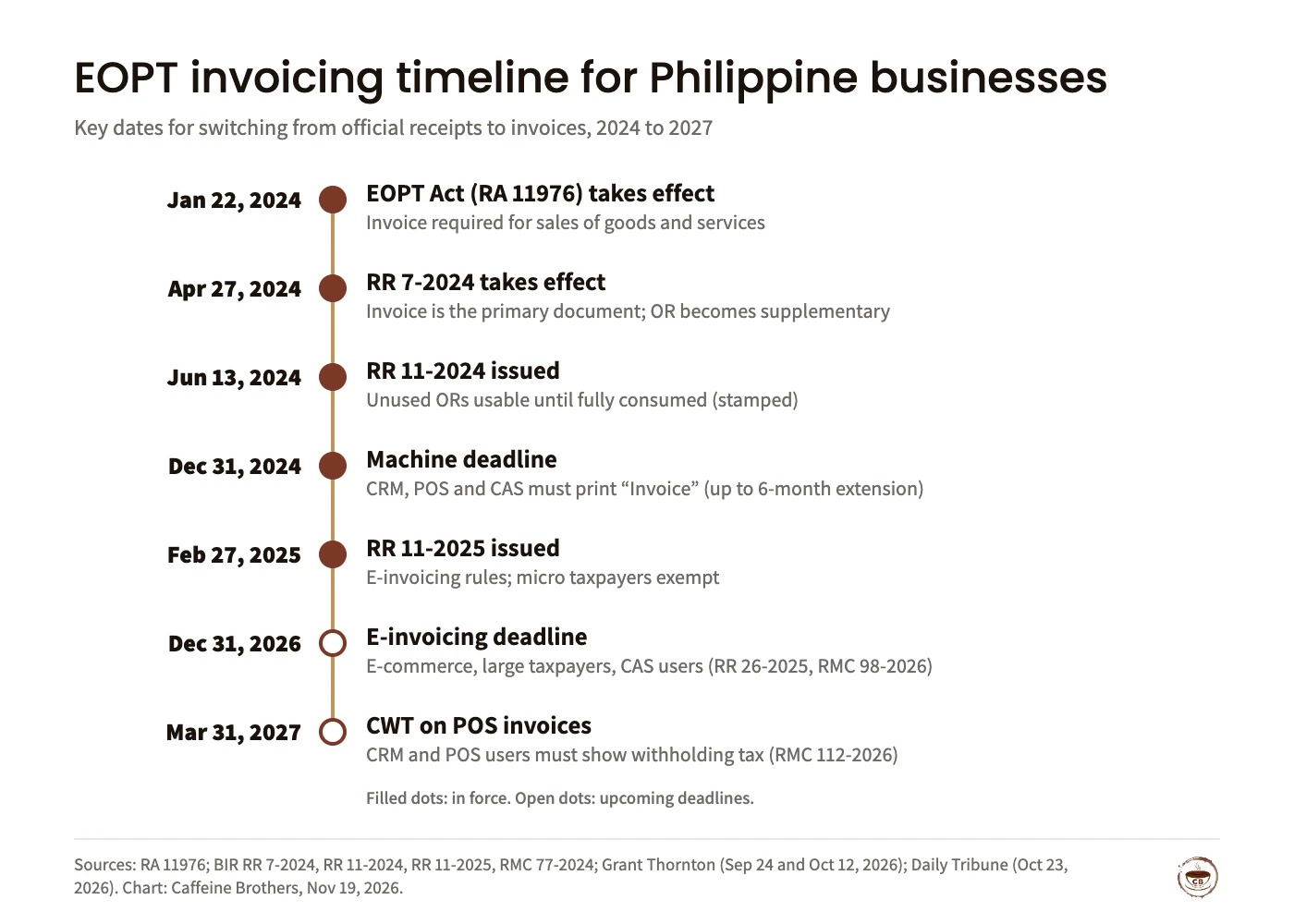
- RA 11976 was approved on January 5, 2024 and took effect on January 22, 2024; BIR Revenue Regulations No. 7-2024 took effect on April 27, 2024.
- Non-VAT sellers issue an invoice for sales of ₱500 or more, plus one end-of-day invoice once small sales reach ₱500. VAT-registered sellers invoice every sale.
- Unused official receipts can be used until fully consumed, as supplementary documents or stamped “Invoice” (RR 11-2024, June 13, 2024).
- Failing to issue an invoice carries a fine of ₱1,000 to ₱50,000 and 2 to 4 years in prison under NIRC Section 264(a); micro and small taxpayers get at least a 50% cut on compromise penalties.
- New for late 2026: invoices must show creditable withholding tax as a separate line (RR 6-2026), with POS and cash register users given until March 31, 2027 (RMC 112-2026).
What changed between the official receipt and the sales invoice?
Before 2024, Philippine businesses used two primary documents. Sellers of goods issued sales invoices, while sellers of services, including many cafés that treated food and drinks as a service, issued official receipts. The EOPT Act ended that split. The amended Section 237 of the National Internal Revenue Code now requires “duly registered sale or commercial invoices” for goods and for services alike.
BIR Revenue Regulations No. 3-2024 put it simply: the term “Invoice” is now used “instead of Sales/Commercial Invoices or Official Receipts.” RR 7-2024, issued April 11, 2024 and effective April 27, 2024, then wrote the details. It says the EOPT Act “no longer requires the issuance of Official Receipts,” although a business may still issue an official receipt, collection receipt or payment receipt as proof that money was received.
The practical difference comes down to two things. The invoice records the sale and is what the BIR counts as evidence of sales. A supplementary document such as an official receipt records payment, must carry the bold line “THIS DOCUMENT IS NOT VALID FOR CLAIM OF INPUT TAX,” and cannot replace the invoice. BIR RMC 77-2024 says an official receipt issued instead of an invoice is “tantamount to failure to issue” an invoice.
| Point | Sales invoice | Official receipt (since 2024) |
|---|---|---|
| Legal status | Primary document for sales of goods and services | Supplementary document only |
| When issued | At the time of sale (BIR: an invoice cannot be issued upon receipt of payment) | On later collection of payment, as proof of payment |
| Input VAT claim for the buyer | Yes, if it is a valid VAT invoice | No; must state it is not valid for claim of input tax |
| Evidence of sales for the BIR | Yes | No |
| Needs BIR authority to print or registration | Yes (new ATP for invoices) | Old ORs usable until consumed under RR 11-2024 |
| Penalty if used instead of the other | Not applicable | Treated as failure to issue an invoice, NIRC Sec 264(a) |
Coffee beans for your café
Caffeine Brothers supplies cafés, offices and restaurants with freshly roasted Philippine coffee in 10 kg wholesale boxes from ₱773/kg, with free Metro Manila delivery and a free sample before you commit.
See Wholesale Prices →When must a coffee shop issue an invoice?
It depends on whether the café is VAT-registered. The amended Section 237 says “VAT-registered persons shall issue duly registered sale or commercial invoices regardless of the amount of the sale.” Most small cafés with gross sales under the ₱3 million VAT threshold are non-VAT and pay the 3% percentage tax instead, which we explain in our guide to percentage tax for coffee shops.
Non-VAT sellers must issue an invoice for each sale “valued at Five hundred pesos (P500) or more.” For sales below ₱500, the law lets the seller issue one invoice for the aggregate amount at the end of the day, once that day’s small sales reach at least ₱500. Two rules apply to everyone: the seller must issue an invoice “when the buyer so requires regardless of the amount,” and the ₱500 threshold can be adjusted every three years using the consumer price index. We found no BIR issuance adjusting it as of November 19, 2026.
Here is how that works on a normal day at a small non-VAT café. Say the café sells 52 drinks and pastries under ₱500 each, totalling ₱6,240, plus one ₱650 group order. It issues one invoice for the ₱650 order at the time of sale and one end-of-day invoice for ₱6,240. If a customer buying a ₱120 latte asks for an invoice, that customer gets one too, and the café leaves that sale out of the end-of-day total. A VAT-registered café would instead issue a VAT invoice for all 53 sales.
| Café type | Sale | What to issue |
|---|---|---|
| Non-VAT (percentage tax or 8%) | ₱120 latte, no request | Include in one end-of-day invoice once the day’s small sales reach ₱500 |
| Non-VAT | ₱120 latte, customer asks | Invoice at the time of sale |
| Non-VAT | ₱650 group order | Invoice at the time of sale |
| VAT-registered | Any sale, any amount | VAT invoice for every sale |
| VAT-registered | ₱1,000 or more to a VAT-registered buyer | VAT invoice with the buyer’s registered name, address and TIN |
| Any | Payment collected later on a credit sale | Invoice at the sale; OR or collection receipt optional when paid |
What must a sales invoice show?
RR 7-2024 Section 6(B) lists the information every invoice must carry. Most of it will look familiar from old receipts, but a few items catch people out, such as the word “Invoice” itself and the VAT or non-VAT statement next to the TIN.
- The seller’s registered name, as shown on the BIR Certificate of Registration, and the registered business address where the invoice is used.
- A statement that the seller is VAT or non-VAT registered, followed by the TIN and branch code (for example “VAT Reg TIN” or “Non-VAT Reg TIN”).
- The word “Invoice,” such as Sales Invoice, Cash Invoice or Service Invoice.
- The date, quantity, unit cost and a description of the goods or service, and a serial number printed prominently.
- Space for the buyer’s name, address and TIN. For direct sales to consumers (B2C), the buyer’s address and TIN are not required.
- The total amount. A VAT seller includes VAT in the total and shows the VAT amount as a separate item; a non-VAT seller whose sales are not subject to VAT or percentage tax prints “EXEMPT.”
- Spaces for senior citizen, PWD and solo parent discount details, including the ID number, the discount breakdown and the customer’s signature. See our guide to the senior citizen and PWD discount at coffee shops.
For a VAT café, a ₱168 latte has ₱18.00 of VAT inside it (₱168 × 12 ÷ 112), so the invoice shows ₱150.00 as the VATable sale and ₱18.00 as VAT. BIR RMC 77-2024 adds that the business style of the buyer or seller no longer has to appear on the invoice.
Can I still use my old official receipts?
Yes. RR 7-2024 first set a December 31, 2024 cutoff, but RR 11-2024, issued June 13, 2024, removed it for manual receipts. Under RR 11-2024 you have two choices for unused official receipts. You can keep using them as supplementary documents “until fully consumed,” stamped “THIS DOCUMENT IS NOT VALID FOR CLAIM OF INPUT TAX.” Or you can strike through “Official Receipt,” stamp “Invoice,” and issue them as your primary invoice until they run out.
Two details matter. From April 27, 2024, a manual official receipt issued without the “Invoice” stamp counts only as a supplementary document. And cash register machines, POS systems and computerized accounting systems had to be reconfigured to print “Invoice” by December 31, 2024, with extensions of up to six months on request. When the old booklets run out, the BIR says businesses moving from receipts must apply for a new authority to print invoices.
What is the penalty for not issuing an invoice?
NIRC Section 264(a) punishes failure to issue invoices “by a fine of not less than One thousand pesos (P1,000) but not more than Fifty thousand pesos (P50,000) and suffer imprisonment of not less than two (2) years but not more than four (4) years.” RR 11-2024 applies the same section to anyone who keeps issuing official receipts after the transition dates, calling it “tantamount to failure to issue or non-issuance of Invoice.”
The EOPT Act softened this for smaller businesses. Its Section 45(e) gives micro and small taxpayers “a reduced compromise penalty rate of at least fifty percent (50%)” for violations of Sections 113, 237 and 238. RA 11976 defines micro taxpayers as those with gross sales of less than ₱3 million a year and small taxpayers as ₱3 million to under ₱20 million, which covers most independent cafés. The reduction applies to the compromise amount, so it is no excuse to skip invoices. If you are still setting up, our coffee shop permits guide covers BIR registration alongside the city permits.
Do cafés need electronic invoices by December 31, 2026?
Most small cafés do not, at least not yet. RA 12066 (CREATE MORE, November 8, 2024) rewrote Section 237 so the BIR will require electronic invoices “upon the establishment of a system capable of storing and processing the required data,” and lets other taxpayers issue them voluntarily. RR 11-2025, issued February 27, 2025, named the first group: e-commerce sellers, taxpayers under the Large Taxpayers Service and users of computerized accounting or other invoicing software. RR 26-2025 later moved their deadline to December 31, 2026.
Point-of-sale users are not in that first group. RR 11-2025 says POS users are covered only once the BIR has set up its system, and micro taxpayers are “exempted from the mandatory requirement to use and issue electronic invoice.” Grant Thornton’s September 24, 2026 summary of RMC 98-2026 adds that invoices typed in Word, Excel or Google Docs are not valid electronic invoices. A café that already runs accounting software, or sells mainly online, should check with its accountant whether it falls in the December 31, 2026 group.
One more 2026 change affects cafés that sell to companies. RR 6-2026, published on the BIR website on October 1, 2026, requires invoices to show creditable withholding tax as a separate item when it applies. RMC 112-2026, issued October 22, 2026, gave cash register and POS users until March 31, 2027 to comply, and said manual invoice users do not need a new authority to print just because their forms lack the new field.
A six-step invoicing checklist for coffee shops
- Confirm your registration type. Check your BIR Certificate of Registration for VAT or non-VAT status, since that decides whether every sale needs an invoice.
- Check your invoice layout. Make sure it shows the word “Invoice,” the VAT or non-VAT TIN statement, serial number and the senior citizen and PWD discount fields.
- Use up old receipts properly. Stamp “Invoice” on unused official receipts you want to use as invoices, or keep them as supplementary documents with the input tax disclaimer.
- Set an end-of-day routine. Non-VAT cafés should total sales under ₱500 at closing and issue one invoice once the total reaches ₱500, leaving out sales already invoiced on request.
- Keep invoices for corporate buyers. Office and event orders of ₱1,000 or more to VAT-registered buyers need the buyer’s name, address and TIN on a VAT invoice.
- Watch the 2026 and 2027 deadlines. Ask your accountant about e-invoicing coverage by December 31, 2026 and the withholding tax line on POS invoices by March 31, 2027.
For reference, Caffeine Brothers is VAT-exempt and issues a sales invoice, delivery receipt and collection receipt with wholesale orders, which is the kind of paperwork café owners should expect from any registered supplier. Our BMBE registration guide explains a separate income tax exemption that some small cafés can claim. This article is general information, not tax advice; check the rules for your business with a licensed accountant or your BIR revenue district office.
Frequently asked questions
Is an official receipt still valid in the Philippines?
An official receipt can still be issued, but only as a supplementary document that shows payment. Since the Ease of Paying Taxes Act took effect on January 22, 2024, the sales invoice is the primary document for sales of both goods and services, and an official receipt cannot support a claim for input VAT.
Does a coffee shop need to issue an invoice for a ₱120 drink?
A VAT-registered coffee shop must issue a VAT invoice for every sale, whatever the amount. A non-VAT café must issue an invoice for each sale of ₱500 or more, and may cover smaller sales with one invoice for the day’s total once that total reaches ₱500. Any customer who asks for an invoice must get one.
Can I still use my old official receipt booklets?
Yes, under RR 11-2024. Unused official receipts can be used as supplementary documents until they run out, or converted into invoices by striking out “Official Receipt” and stamping “Invoice” on them until they are fully consumed. Receipts issued without the “Invoice” stamp after April 27, 2024 count only as supplementary documents.
Do small coffee shops need electronic invoices by December 31, 2026?
Not as a rule. The December 31, 2026 e-invoicing deadline under RR 11-2025, RR 26-2025 and RMC 98-2026 covers e-commerce sellers, large taxpayers and users of computerized accounting or invoicing software. Micro taxpayers are exempt, and point-of-sale users follow later, once the BIR’s system is ready.
Sources
- Republic Act No. 11976, Ease of Paying Taxes Act. LawPhil, approved January 5, 2024. Sections 113, 237, 45(e) and taxpayer classification.
- Revenue Regulations No. 7-2024 (digest). Bureau of Internal Revenue, issued April 11, 2024. Invoicing rules under EOPT.
- RR 7-2024 full text (third-party copy). Uploaded May 2024. Section 6(B) invoice contents and OR status.
- Revenue Regulations No. 3-2024 (digest). Bureau of Internal Revenue, issued April 11, 2024. “Invoice” replaces “Official Receipt.”
- Revenue Regulations No. 11-2024 (digest). Bureau of Internal Revenue, issued June 13, 2024. Amended transitory rules for old receipts.
- Revenue Memorandum Circular No. 77-2024 (digest). Bureau of Internal Revenue, issued July 11, 2024. EOPT questions and answers.
- Amended transitory provisions on invoicing requirements under EOPT Act. P&A Grant Thornton, July 1, 2024.
- Republic Act No. 8424, National Internal Revenue Code. LawPhil. Section 264(a) penalties.
- Republic Act No. 12066, CREATE MORE Act. LawPhil, November 8, 2024. Electronic invoicing wording of Sections 237 and 237-A.
- Revenue Regulations No. 11-2025 (digest). Bureau of Internal Revenue, issued February 27, 2025. E-invoicing coverage; micro taxpayers exempt.
- Philippines: deadline for mandatory structured e-invoicing extended. Sovos, October 22, 2025. RR 26-2025, deadline December 31, 2026.
- BIR issues guidelines on electronic invoicing, retains 31 Dec 2026 deadline. P&A Grant Thornton, September 24, 2026. RMC 98-2026.
- Invoices must now disclose creditable withholding tax. P&A Grant Thornton, October 12, 2026. RR 6-2026.
- BIR extends deadlines for new CWT invoicing rules. Daily Tribune, October 23, 2026. RMC 112-2026; POS users until March 31, 2027.
Cite this article: Caffeine Brothers. “Sales Invoice vs Official Receipt: What Cafés Must Issue in 2026.” Caffeine Brothers Coffee Blog, November 2026. https://caffeinebrothers.co/sales-invoice-vs-official-receipt/
You are welcome to reference the charts and tables in this article with a link back to this page.
Buying coffee for your café? Our 10 kg wholesale boxes start at ₱7,730 with free Metro Manila delivery and come with a sales invoice, and the Coffee Lab calculators help you price each cup. For more on running the numbers, read our financial fundamentals for café owners, or contact us for a quote.
 Previous Post
 Next Post