
South Cotabato Coffee: Mt. Matutum Arabica, Tupi and Lake Sebu
By Robin Salvador, co-founder, Caffeine Brothers
Last updated: November 16, 2026
Quick answer: South Cotabato is a mid-sized coffee province in Region XII (SOCCSKSARGEN) that grows more Arabica than Robusta. The Philippine Statistics Authority (PSA) counted 596.64 tonnes of green coffee beans there in 2025, of which 369.77 tonnes (62%) were Arabica. That makes it the 5th largest Arabica province in the country. Most Arabica comes from the slopes of Mt. Matutum and the T’boli and Lake Sebu highlands, while Robusta grows in lower towns such as Tupi, Tampakan, Surallah, Banga and Polomolok.
Key takeaways
- PSA (OpenSTAT, updated August 28, 2026) reports 596.64 tonnes of green coffee in South Cotabato in 2025: 369.77 t Arabica, 226.65 t Robusta and 0.22 t Excelsa. That is 1.7% of the Philippine total and 12th among 69 producing provinces.
- In Arabica alone, South Cotabato ranks 5th nationwide, behind Sultan Kudarat, Benguet, Davao del Sur and Sulu, with 4.7% of the country’s 7,849.82 t.
- Output is 33.0% lower than in 2010 (890.52 t). Robusta fell by half, from 454.41 t to 226.65 t, while Arabica fell 15.2%.
- PSA farmgate prices for South Cotabato in 2025 were ₱133.00 per kg for Arabica green beans and ₱183.60 for Robusta, below the national averages of ₱264.65 and ₱228.67.
- The provincial government (July 22, 2026) wants South Cotabato to become Region XII’s coffee shop hub, focused on quality over quantity.
South Cotabato sits between Sultan Kudarat, the country’s biggest coffee province, and Davao del Sur. It is better known for pineapples, Lake Sebu and the T’boli people than for coffee, but its highlands grow a notable share of the country’s Arabica. This guide pulls together the PSA figures, the towns where coffee grows and the people and programs behind it. For the neighbouring provinces, see our guides to Cotabato coffee and Sultan Kudarat coffee.
How much coffee does South Cotabato produce?
PSA’s OpenSTAT production table (last updated August 28, 2026) gives South Cotabato 596.64 tonnes of green coffee beans in 2025. That is 3.6% of Region XII’s 16,675.73 t, a region where Sultan Kudarat alone produced 15,689.08 t. South Cotabato is the second largest coffee province in the region, ahead of Cotabato (208.55 t) and Sarangani (181.47 t).
| Measure (2025) | South Cotabato | Philippines | South Cotabato share |
|---|---|---|---|
| Green coffee beans, all types | 596.64 t | 35,645.64 t | 1.7% |
| Arabica | 369.77 t | 7,849.82 t | 4.7% |
| Robusta | 226.65 t | 25,731.07 t | 0.9% |
| Excelsa | 0.22 t | 1,980.73 t | 0.01% |
| Area planted to coffee | 2,633 ha | 124,982.58 ha | 2.1% |
| Bearing coffee trees | 1,342,212 | 84,839,827 | 1.6% |
The mix is unusual. Nationally, Robusta is about 72% of green coffee output. In South Cotabato, Arabica is 62%. Among the 47 provinces that report Arabica, South Cotabato ranks 5th after Sultan Kudarat (4,061.39 t), Benguet (938.78 t), Davao del Sur (623.21 t) and Sulu (436.66 t). In Robusta it ranks only 20th.
Has South Cotabato coffee output gone up or down?
Down over the long run, with a small recovery in 2025. Output peaked at 986.74 t in 2014, then dropped to 714.55 t in 2016 when Robusta fell 44.0% in a single year (511.16 t to 286.01 t). It drifted lower to 537.56 t in 2024 and rose 11.0% to 596.64 t in 2025. PSA does not explain the 2016 drop.
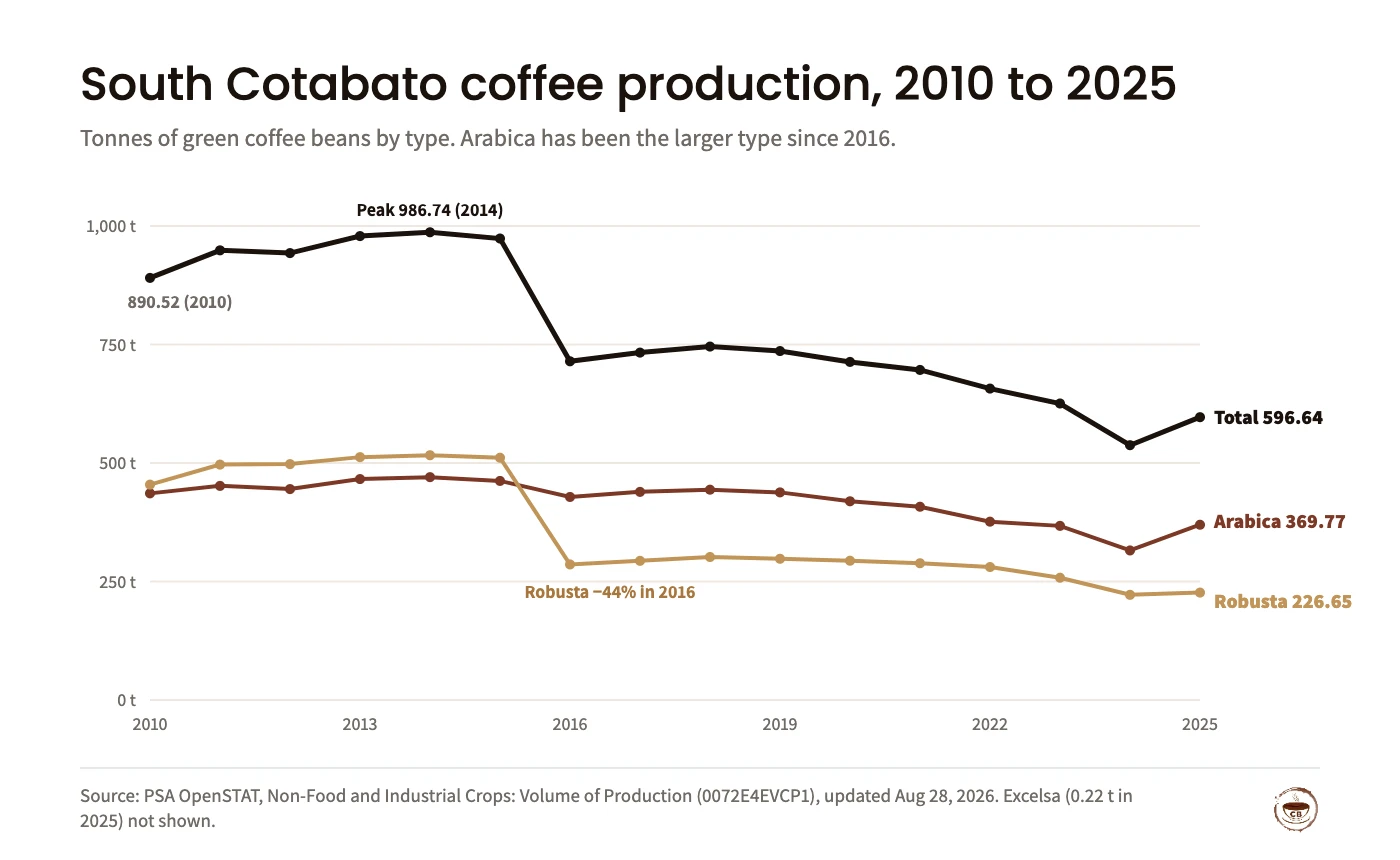
Area and tree counts barely moved while output fell. PSA lists 2,329 ha in 2010 and 2,633 ha from 2023 to 2025, and the same 1,342,212 bearing trees in each of 2023, 2024 and 2025. Repeated figures like these may be carried forward rather than re-counted, so read them as approximate.
The provincial government gives a different area. Its January 28, 2026 article says South Cotabato “accounted for a production area of 2,559.5 hectares of land planted with coffee for the year 2025,” which is 73.5 ha below PSA’s 2,633 ha. The two use different counts, so we show both.
Where is coffee grown in South Cotabato?
The provincial government’s July 22, 2026 article sums up the split: “Arabica coffee thrives in the highland areas of Mt. Matutum, T’boli, and Lake Sebu, while Robusta coffee is widely suited for Tupi, Tampakan, Surallah, Banga, and Polomolok.” It also notes the “growth of coffee enterprises and roasteries in Koronadal City, Polomolok, and Tupi.”
| Area | Coffee type named | What sources say |
|---|---|---|
| Mt. Matutum (Polomolok, Tupi) | Arabica | MindaNews (2011) reported about 300 ha of Arabica farms on Mt. Matutum; Bo’s Coffee sells a Tupi single origin listed at 800 to 1,000 m above sea level. |
| Kinilis, Polomolok | Catimor (Arabica) | World Coffee Research (Jan 3, 2024): a PhilCAFE nursery in Kinilis planted 1,300 Catimor seedlings. |
| T’boli | Arabica | Province (Nov 28, 2025): 45 farmers from Barangay Desawo trained in coffee production and nursery management. |
| Lake Sebu | Arabica | Province names it as an Arabica highland; MindaNews (2011) reported plans for up to 1,000 ha there. |
| Tupi, Tampakan, Surallah, Banga | Robusta | Province (Jul 22, 2026) lists these as Robusta areas. |
| Koronadal City | Roasteries, cafés | Province (Jan 28, 2026) says OPAg is validating coffee farm areas in Koronadal Proper and Polomolok. |
SilverKris describes Mt. Matutum as “a 13,947ha protected nature reserve.” PhilAtlas puts South Cotabato’s land area at 3,793.90 km², with 975,476 people in the 2020 census (General Santos City is counted separately), in 10 municipalities and 1 city.
How productive are South Cotabato coffee farms?
Dividing PSA output by area and trees gives a rough yield. In 2025 South Cotabato produced 0.23 tonnes of green coffee per hectare against a national 0.29. Arabica was 0.26 t/ha against 0.52 nationally, and 0.48 kg per tree against 0.74. Robusta was 0.18 t/ha against 0.25, though per tree it was slightly above the national figure (0.39 kg against 0.37). These are our calculations from PSA tables.
What do South Cotabato farmers get paid for coffee?
PSA’s farmgate price table (0032M4AFN08, updated August 28, 2026) has South Cotabato Robusta prices back to 2020 and Arabica only from 2025. South Cotabato prices sit below the national average for both types.
| Green coffee beans, ₱ per kg | 2023 | 2024 | 2025 | Jan to Jun 2026 |
|---|---|---|---|---|
| South Cotabato Robusta | 134.32 | 125.68 | 183.60 | 235.00 (Feb); 230.00 (Apr to Jun) |
| Philippines Robusta | 90.31 | 133.15 | 228.67 | 228.03 (Jan) to 168.83 (Jun) |
| South Cotabato Arabica | no data | no data | 133.00 | 133.00 (Apr to Jun) |
| Philippines Arabica | 228.76 | 211.28 | 264.65 | 262.70 (Jan) to 368.00 (Feb) |
| Region XII Arabica | no data | 322.77 | 224.75 | 215.00 (Jan); 145.95 (Apr to Jun) |
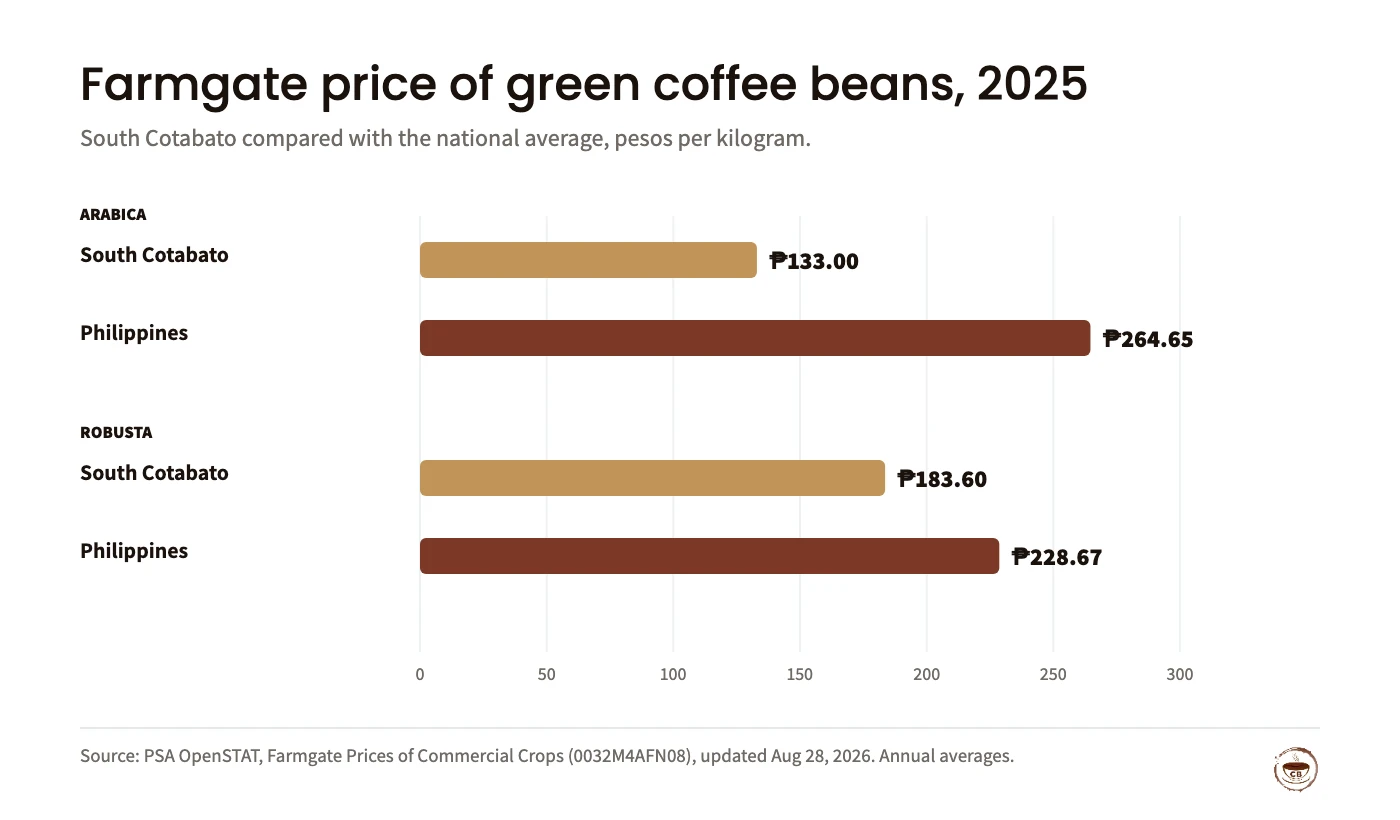
South Cotabato Arabica fetched about half the national average in 2025. PSA does not explain the gap, and South Cotabato has Arabica prices for only one year so far. Some growers sell above farmgate through direct trade: in 2011 MindaNews reported a Mt. Matutum group buying raw Arabica at ₱120 per kg when the commercial price was ₱80, and in 2024 the Philippine Information Agency said Kape Dose entries “have fetched 100 to 300 percent higher buying prices” than commercial coffee. For how farm prices turn into retail prices, see coffee prices in the Philippines.
Who grows and sells South Cotabato coffee?
Much of the highland coffee is grown by indigenous B’laan and T’boli communities. Named groups and brands in the sources include:
- Tupi Coffee Growers Association Inc. (TUCOGAI), which DTI Region 12 said in April 2018 “started as a client of CARP in DTI South Cotabato.”
- The Knoon Highland Farmers Association in T’boli, covering “some 200 farmers,” which signed a livelihood agreement with the Peace and Equity Foundation and partners in January 2020 (Mindanao Examiner).
- Greentropics, a civet coffee and Arabica processor working with B’laan households on Mt. Matutum (SilverKris, 2021; Malaya, 2025). Sources disagree on whether it is based in General Santos City or Polomolok.
- The Dream Coffee, a T’boli Arabica brand that the Inquirer reported in October 2022 working with 75 farmer families and selling roasted coffee at ₱325 per 200 g.
- K’fi, a T’boli native coffee sold at Lake Holon for ₱10 a cup, according to SunStar in 2017.
For background on civet coffee, which Mt. Matutum groups also produce, see our guide to kape alamid.
Has South Cotabato coffee won quality awards?
At regional level, yes. In the first Kape Dose competition for Region XII, Peace and Equity Foundation reported in March 2023 that “Mario Joey Tacan from Polomolok, South Cotabato won the first place with 83.13 rating” in the Arabica category, out of 48 entries. In Kape Dose 2024 the Tupi Coffee Growers’ Association placed 3rd in a Robusta category (PIA, April 2024). In Kape Dose 2025, SunStar reported that “South Cotabato submitted six Robusta entries and one Arabica entry”; none were among the named winners.
We found no South Cotabato winner in the national Philippine Coffee Quality Competition results for 2023, 2024 or 2026 reported by MindaNews. The 2026 Arabica winners came from Bukidnon, Davao del Sur, Lanao del Sur and Cotabato. See our PCQC guide for the full results.
What programs support coffee in South Cotabato?
- PhilCAFE (2019 to 2023). The USDA-funded project run by ACDI/VOCA worked with Sultan Kudarat State University and set up the Kinilis nursery in Polomolok (World Coffee Research, January 3, 2024).
- DAGYAW provincial program. The province’s January 28, 2026 article says “coffee and cacao are priority commodities,” with the Office of the Provincial Agriculturist (OPAg) validating farm areas.
- DA High Value Crops Development Program. Farm inputs and a farmers’ field school for T’boli growers in Barangay Desawo (province, November 28, 2025); DA-12 also met coffee and cacao growers in Tupi.
- Training. ATI Region 12 ran a coffee processing training in Tupi in April 2026, with a visit to a coffee farm in Barangay Linan.
- Coffee shop hub plan. The province, DTI, DA and the South Cotabato Barista Association are working to make the province Region XII’s café hub. Its focal person said, “We may not compete in quantity, but we will focus on quality” (July 22, 2026).
How does South Cotabato compare with our Benguet and Batangas beans?
Caffeine Brothers does not sell South Cotabato coffee. Our beans come from Benguet (Arabica, medium roast) and Batangas (Robusta and Kapeng Barako, dark roast). If you like highland Arabica, our Arabica coffee beans are the closest match in our range. Prices on November 16, 2026:
| Caffeine Brothers coffee | Origin and roast | 200 g | 1 kg | Per 10 g cup (1 kg) |
|---|---|---|---|---|
| Arabica | Benguet, medium | ₱292 | ₱1,068 | ₱10.68 |
| Robusta | Batangas, dark | ₱231 | ₱813 | ₱8.13 |
| Kapeng Barako (Liberica) | Batangas, dark | ₱242 | ₱858 | ₱8.58 |
| Arabica-Robusta Blend | Benguet + Batangas | ₱274 | ₱991 | ₱9.91 |
Frequently asked questions
Is South Cotabato coffee mostly Arabica or Robusta?
Mostly Arabica. PSA counted 369.77 tonnes of Arabica green coffee and 226.65 tonnes of Robusta in South Cotabato in 2025, so Arabica made up about 62% of the province’s 596.64 tonnes. Across the Philippines as a whole, Robusta is about 72% of output.
Where is coffee grown in South Cotabato?
The provincial government says Arabica grows in the highlands of Mt. Matutum, T’boli and Lake Sebu, and Robusta suits Tupi, Tampakan, Surallah, Banga and Polomolok. Older MindaNews reports also name the Mt. Matutum slopes of Polomolok and Tupi as the main coffee areas.
How much coffee does South Cotabato produce?
PSA reports 596.64 tonnes of green coffee beans in 2025, up 11.0% from 537.56 tonnes in 2024 but 33.0% below the 890.52 tonnes of 2010. That is 1.7% of national output and 12th among provinces.
Does Caffeine Brothers sell South Cotabato coffee?
No. Our coffee comes from Benguet (Arabica) and Batangas (Robusta and Kapeng Barako). This guide uses public data to describe South Cotabato coffee; for our own beans, see our Arabica and Robusta product pages.
Sources
- Non-Food and Industrial Crops: Volume of Production (0072E4EVCP1). Philippine Statistics Authority, OpenSTAT, updated August 28, 2026. Production by type, 2010 to 2025, read via the PxWeb API
- Non-Food and Industrial Crops: Area Planted/Harvested (0092E4EAHM1). PSA OpenSTAT, updated September 1, 2026. Coffee area by type
- Non-Food and Industrial Crops: Number of Bearing Trees (0122E4EBTM1). PSA OpenSTAT. Bearing coffee trees by type
- Farmgate Prices: Commercial Crops (0032M4AFN08). PSA OpenSTAT, updated August 28, 2026. Green coffee bean farmgate prices
- South Cotabato strengthens bid to become Region 12’s next Coffee Shop Hub. Provincial Government of South Cotabato, July 22, 2026. Arabica and Robusta towns, coffee hub plan
- South Cotabato drives stronger coffee industry. Provincial Government of South Cotabato, January 28, 2026. DAGYAW, 2,559.5 ha
- Organic coffee growers in T’boli receive farm inputs. Provincial Government of South Cotabato, November 28, 2025. Desawo farmers’ field school
- PhilCAFE project concludes. World Coffee Research, January 3, 2024. Kinilis nursery, 1,300 Catimor seedlings
- First Kape Dose competition showcases quality of region’s coffee. Peace and Equity Foundation, March 13, 2023. Mario Joey Tacan, 83.13
- SOCCSKSARGEN coffee quality improving, expert says. Philippine Information Agency, April 12, 2024. Kape Dose 2024, price premium
- Sultan Kudarat farmers celebrate success at Kape Dose 2025. SunStar Davao, April 11, 2025. South Cotabato entries
- Coffee industry in Region 12 eyes quality improvement. DTI Region 12, April 23, 2018. Tupi Coffee Growers Association
- Mindanao farmers dominate coffee quality competition. MindaNews, June 8, 2026. PCQC 2026 results
- R-12 eyes doubling coffee production in 10 years. MindaNews, July 11, 2014. Coffee areas, Nestlé as top buyer
- Moro group embarks on coffee venture. MindaNews, April 7, 2011. Mt. Matutum Arabica, ₱120 vs ₱80 per kg
- Livelihood program set for T’bolis in South Cotabato. Mindanao Examiner, January 24, 2020. Knoon Highland Farmers Association
- Meet the villagers whose livelihood depends on civet coffee. SilverKris, January 6, 2021. B’laan growers, Mt. Matutum
- The Dream Coffee (T’boli). Inquirer Lifestyle, October 27, 2022. 75 farmer families, ₱325 per 200 g
- K’fi: T’boli’s coffee. SunStar, November 12, 2017. ₱10 per cup at Lake Holon
- Mt. Matutum Beans. Bo’s Coffee product page, viewed November 2026. Tupi origin, 800 to 1,000 masl
- South Cotabato Profile. PhilAtlas. Land area, 2020 population, municipalities
Cite this article: Caffeine Brothers. “South Cotabato Coffee: Mt. Matutum Arabica, Tupi and Lake Sebu.” Caffeine Brothers Coffee Blog, November 2026. https://caffeinebrothers.co/south-cotabato-coffee/
You are welcome to reference the charts and tables in this article with a link back to this page.
Looking for Philippine highland Arabica? Try our Benguet Arabica or Batangas Robusta, browse the shop, see wholesale 10 kg boxes for cafés and offices, or contact us with questions.
 Previous Post
 Next Post