
Ifugao Coffee: Production, Prices and Where It Is Grown
By Robin Salvador, co-founder, Caffeine Brothers
Last updated: November 1, 2026
Quick answer: Ifugao coffee is mostly Robusta grown by smallholders in Asipulo, Kiangan, Lagawe and other towns of Ifugao province in the Cordillera. PSA data show Ifugao produced 74.72 tonnes of green coffee beans in 2025, 94% of it Robusta, from 1,020 hectares. That is 86.1% less than the 537.91 tonnes it produced in 2010, and 5.4% of Cordillera output. The best-known producer group is the Hojap Multi-Purpose Cooperative in Asipulo, whose farmers entered Robusta samples that scored above 80 points in a 2019 cupping competition.
Key takeaways
- Ifugao produced 74.72 tonnes of green coffee beans (GCB) in 2025: 70.27 tonnes of Robusta and 4.45 tonnes of Arabica, according to PSA OpenSTAT (updated August 28, 2026).
- Output fell from 537.91 tonnes in 2010 to 74.72 tonnes in 2025, and from 118.24 tonnes in 2024, a one-year drop of 36.8%.
- PSA counts 614,400 bearing trees on 1,020 hectares in 2025, down from 1,545,241 trees on 2,520 hectares in 2010.
- PSA’s average farmgate price for Ifugao Robusta was ₱137.44 per kg in 2025, about 60% of the ₱228.67 national average.
- In the first Asipulo cupping competition in April 2019, 17 of 21 Robusta samples scored above 80 points; the top score was 84.06.
Ifugao is known for its rice terraces, but coffee has been part of farm life in its upland towns for a long time. We roast Robusta from Batangas and Arabica from Benguet, not Ifugao coffee, so there is nothing to sell you here. We wrote this guide because the official numbers on Ifugao say a lot about where Philippine Robusta is heading. Every figure below comes from PSA, government agencies, development groups or news reports we read on November 1, 2026.
Where is coffee grown in Ifugao?
Asipulo is the coffee town most often named in reports. A 2019 report on the first Asipulo cupping competition, carried by the Baguio Herald Express and Wazzup Pilipinas, said Asipulo had about 1,394 hectares of coffee, or 55% of the province’s coffee area, and called it a major Robusta producer. The Hojap Multi-Purpose Cooperative is based in Barangay Haliap, Asipulo. In 2020 the Department of Agriculture’s Philippine Rural Development Project (DA-PRDP) opened two coffee buying stations for the cooperative in Barangays Pula and Camandag, whose farmers had needed one to four hours to reach the Haliap office.
Kiangan is the other coffee town in recent research. In February 2026 a team from UP Open University and Ifugao State University ran focus groups with coffee farmers in Kiangan and Asipulo for a coffee value chain project, and visited the Panubtuban Robusta Coffee Growing Village in Asipulo. Further south, a 2023 feature on the Ifugao Kape enterprise placed its growers in Lagawe, the provincial capital.
The 1,394-hectare figure for Asipulo does not fit PSA’s provincial numbers for 2019, when PSA put all of Ifugao at 1,551 hectares. A 55% share of about 2,535 hectares would match PSA’s figures for 2013 to 2015 (2,511 hectares) better. The report did not give the year of its area estimate, so treat it as an older local figure.
How much coffee does Ifugao produce?
PSA put Ifugao’s 2025 coffee output at 74.72 tonnes of green coffee beans. That made it the Cordillera’s third-largest producer, behind Benguet (1,011.77 tonnes) and Kalinga (230.49 tonnes). Nationally it is a small figure: 0.2% of the Philippines’ 35,645.64 tonnes.
The long-run trend is a steady decline. Ifugao produced 537.91 tonnes in 2010, about a fifth of all Cordillera coffee. Output slipped slowly to 2017, fell faster from 2018 to 2022, recovered slightly in 2023 and 2024, then dropped 36.8% in 2025. Over the same period Benguet, the Arabica province, quadrupled its output.
| Year | Ifugao (t GCB) | Benguet (t GCB) | Cordillera (t GCB) | Ifugao share of Cordillera |
|---|---|---|---|---|
| 2010 | 537.91 | 243.80 | 2,804.07 | 19.2% |
| 2013 | 526.20 | 250.50 | 2,732.41 | 19.3% |
| 2015 | 492.72 | 270.39 | 2,605.01 | 18.9% |
| 2016 | 471.70 | 261.63 | 1,867.93 | 25.3% |
| 2018 | 361.41 | 257.52 | 1,099.49 | 32.9% |
| 2019 | 253.79 | 263.74 | 797.94 | 31.8% |
| 2020 | 183.30 | 349.58 | 1,003.13 | 18.3% |
| 2021 | 143.46 | 525.36 | 1,114.59 | 12.9% |
| 2022 | 106.75 | 578.23 | 997.83 | 10.7% |
| 2023 | 110.76 | 614.23 | 1,013.62 | 10.9% |
| 2024 | 118.24 | 590.08 | 983.43 | 12.0% |
| 2025 | 74.72 | 1,011.77 | 1,373.83 | 5.4% |
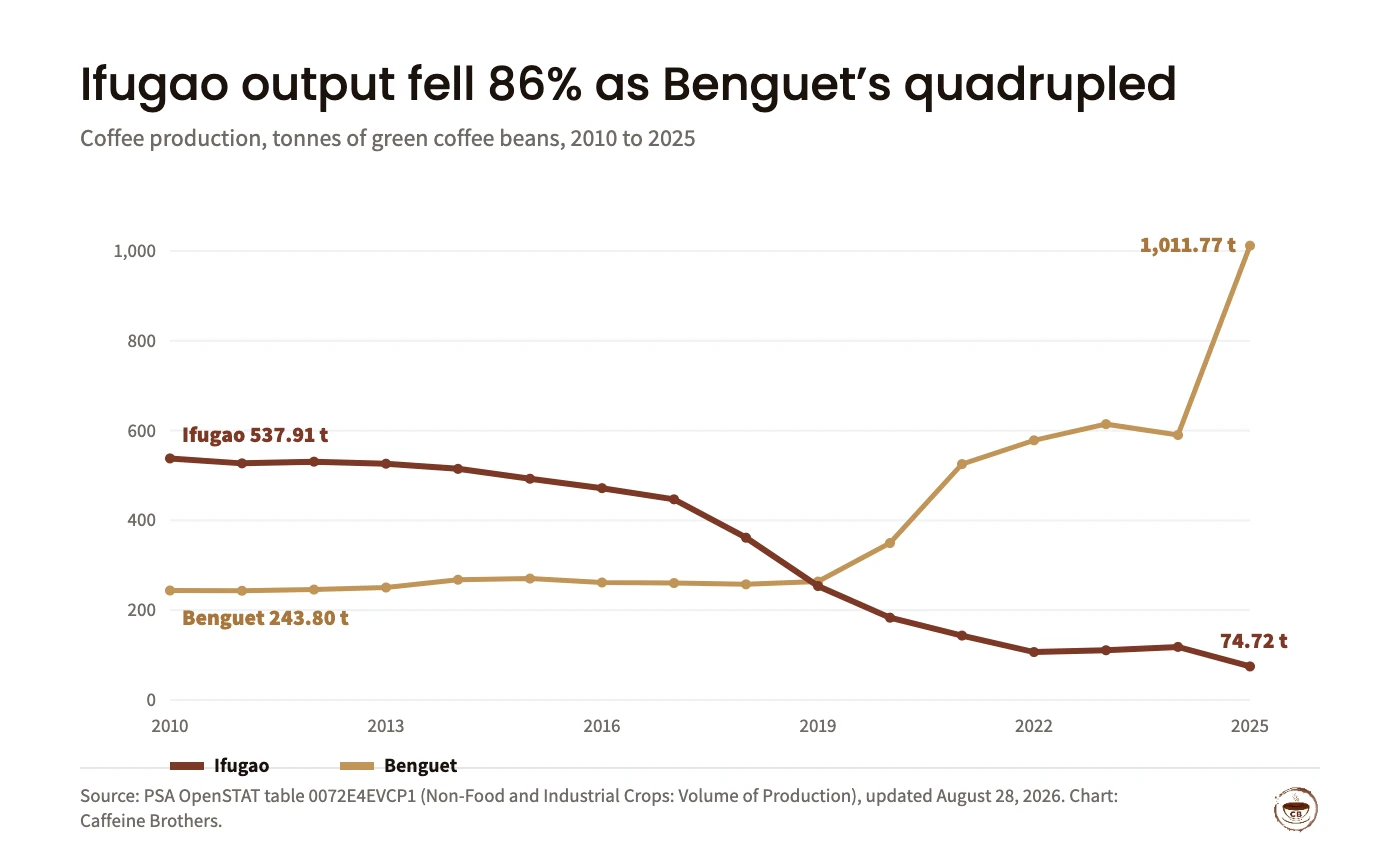
PSA does not explain the 2025 drop. Its area and tree counts for Ifugao (below) were cut by about a third in the same year, which points to a revised count of active farms rather than a single bad harvest. Typhoon Uwan also hit the Cordillera in November 2025: Manila Bulletin reported on November 12, 2025 that Ifugao was under a state of calamity, though it gave no crop loss figure for the province. The UP Open University team saw typhoon damage to coffee trees in Asipulo in February 2026.
What kind of coffee does Ifugao grow?
Almost all of it is Robusta. In 2025 PSA counted 70.27 of Ifugao’s 74.72 tonnes as Robusta (94.0%) and 4.45 tonnes as Arabica. PSA reports no Excelsa or Liberica output for the province. Arabica has stayed small for 15 years: 9.31 tonnes in 2010 and between 3.50 and 4.45 tonnes since 2019. Its area was listed as 51 hectares from 2013 to 2024 and 20 hectares in 2025. If you want to read about Cordillera Arabica, our Benguet coffee and Sagada coffee guides cover it.
That matches the national picture: Robusta (Coffea canephora) made up 25,731.07 of the Philippines’ 35,645.64 tonnes in 2025, or 72%. The Asipulo competition entries were all Robusta. The Ifugao Kape enterprise in Lagawe sells a blend of Arabica and Robusta; its 2023 feature said its first batch of planted Arabica failed to grow.
How many coffee trees does Ifugao have, and how productive are they?
| Measure | 2010 | 2019 | 2025 | Philippines 2025 |
|---|---|---|---|---|
| Area (hectares) | 2,520 | 1,551 | 1,020 | 124,982.58 |
| Robusta area (hectares) | 2,470 | 1,500 | 1,000 | 101,098.49 |
| Bearing trees | 1,545,241 | 953,840 | 614,400 | 84,839,827 |
| Output (t GCB) | 537.91 | 253.79 | 74.72 | 35,645.64 |
| Output per tree (kg GCB) | 0.35 | 0.27 | 0.12 | 0.42 |
| Output per hectare (t GCB) | 0.21 | 0.16 | 0.07 | 0.29 |
PSA’s area and tree counts for Ifugao move in steps: they stayed flat for several years, then fell in 2016, 2019 and 2025. That pattern suggests periodic recounts. Between recounts, output kept falling while the tree count stayed the same, so output per tree dropped from 0.35 kg in 2010 to 0.12 kg in 2025. The national average in 2025 was 0.42 kg.
Old trees are one likely reason. The Peace and Equity Foundation said in 2021 that Hojap farmer-members were starting to rejuvenate their trees, which it expected to raise yields, and the 2026 UP Open University visit compared rejuvenated trees with ones not yet rejuvenated in Panubtuban. Neither source gave yield figures.
What do Ifugao coffee farmers get paid?
PSA’s farmgate price series shows Ifugao farmers receive less than the national average for Robusta, and the gap has widened since prices jumped in 2024 and 2025. Our coffee price guide explains the national rise.
| Year | Ifugao Robusta (₱/kg GCB) | Philippines Robusta (₱/kg GCB) | Ifugao Arabica (₱/kg GCB) |
|---|---|---|---|
| 2010 | 61.47 | 54.95 | no data |
| 2015 | 51.24 | 70.95 | no data |
| 2020 | 85.00 | 72.92 | no data |
| 2022 | 188.71 | 84.58 | no data |
| 2023 | 127.09 | 90.31 | no data |
| 2024 | 130.00 | 133.15 | 150.00 |
| 2025 | 137.44 | 228.67 | 170.00 |
| Jan to Apr 2026 (monthly) | 150.00 to 127.50 | 228.03 to 220.19 | no data |
In 2025 Ifugao Robusta averaged ₱137.44 per kg, about 60% of the national average of ₱228.67. Ifugao was above the national average in most years from 2010 to 2023, then fell behind in 2024 and 2025 when national prices rose. PSA started reporting Ifugao Arabica prices only in 2024. We could not find a source that explains the gap; small volumes, buyers’ distance from the farms and the cost of hauling down mountain roads are all possible reasons, but none of the reports we read measured them.
Is Ifugao Robusta good enough to be specialty coffee?
Some of it is. The Philippine Coffee Board and the Peace and Equity Foundation ran the first Ifugao cupping competition in Asipulo in 2019. The rules were announced in November 2018, before harvest, and the board received 21 samples in March 2019. According to the Philippine Coffee Board, 17 of the 21 samples scored above 80 points, the usual line for specialty grade.
The winners were announced on April 16, 2019 during the Kulpi’d Asipulo Festival. All entries came from Hojap cooperative members and all were Robusta. Four judges named by the Philippine Coffee Board averaged their scores across ten attributes.
| Place | Farmer (age in 2019) | Average cupping score |
|---|---|---|
| 1st | Corazon Wangag (35) | 84.06 |
| 2nd | Leon Donato (61) | 83.13 |
| 3rd | Rosita Dumelod (47) | 82.83 |
A cupping score describes the sample sent to the judges. It does not tell you how every bag from the same farm or town will taste.
Who is working to grow Ifugao coffee?
The Hojap Multi-Purpose Cooperative is at the center of most projects. The 2019 competition report said Hojap had 962 members, began lending in 2002, entered coffee in 2009 and started regular coffee production in 2014, selling under the Kesi’melan brand. A 2021 report on the cooperative’s PRDP project gave 1,500 members and ₱131 million in total assets. In 2026 the UP Open University team interviewed a representative of Punkopehan by Hojap, one of the cafés using Ifugao coffee.
The PRDP subproject, the Ifugao Coffee Processing and Marketing Enterprise, was approved six years after it was proposed. Reports give two different totals because they count the cooperative’s own share differently:
- A March 2020 DA-PRDP report put the subproject cost at ₱18.22 million, including the cooperative’s equity, funded by the World Bank, DA and the provincial government.
- An August 2021 report on the inauguration put the cost at about ₱13.98 million excluding the cooperative’s additional equity, split 60% World Bank loan, 20% DA and 20% provincial government. It listed ₱4.49 million for an upgraded processing center, ₱3.55 million for the two buying stations and ₱5.88 million for two hauling trucks and equipment.
The Peace and Equity Foundation has worked with Hojap on quality and productivity since 2018. In Lagawe, the Ifugao Kape enterprise started in 2010 under a reforestation and livelihood project backed by AboitizPower, SN Aboitiz Power and the Social Action Development Center, which provided a roaster for the Ifugao Roasting Center (that 2023 article was sponsored content from AboitizPower). The 2026 university project found that Ifugao coffee has buyers, including for single-origin lots, but that production volume is limited.
How does Ifugao coffee compare with what we roast?
We do not sell Ifugao coffee. If you like a strong Philippine Robusta, our Batangas Robusta and Kapeng Barako are the closest options in our range. Prices below are from our shop on the day this article was updated.
| Caffeine Brothers coffee | Origin and roast | 200 g | 1 kg |
|---|---|---|---|
| Robusta | Batangas, dark roast | ₱231 | ₱813 |
| Kapeng Barako | Batangas Liberica, dark roast | ₱242 | ₱858 |
| Arabica | Benguet, medium roast | ₱292 | ₱1,068 |
Frequently asked questions
What type of coffee is grown in Ifugao?
Mostly Robusta. In 2025 PSA counted 70.27 of Ifugao’s 74.72 tonnes of green coffee beans as Robusta and 4.45 tonnes as Arabica. Ifugao has about 1,000 hectares of Robusta and 20 hectares of Arabica.
How much coffee does Ifugao produce?
PSA put Ifugao’s 2025 output at 74.72 tonnes of green coffee beans, down from 118.24 tonnes in 2024 and 537.91 tonnes in 2010. That is 5.4% of Cordillera output and 0.2% of national output.
Which town in Ifugao grows the most coffee?
Asipulo. A 2019 report said Asipulo had about 1,394 hectares of coffee, or 55% of the province’s coffee area, and it is home to the Hojap Multi-Purpose Cooperative. Kiangan and Lagawe also grow coffee.
How much do Ifugao coffee farmers earn per kilo?
PSA’s average farmgate price for Ifugao Robusta green beans was ₱137.44 per kg in 2025, against a national average of ₱228.67. Ifugao Arabica averaged ₱170 per kg in 2025.
Is Ifugao coffee specialty grade?
Some lots are. In the first Asipulo cupping competition in 2019, 17 of 21 Robusta samples scored above 80 points, and the winning sample from Corazon Wangag scored 84.06.
Does Caffeine Brothers sell Ifugao coffee?
No. We roast Robusta and Kapeng Barako from Batangas and Arabica from Benguet. This guide is for readers who want to know about Ifugao coffee.
Sources
- Non-Food and Industrial Crops: Volume of Production (table 0072E4EVCP1). PSA OpenSTAT, updated August 28, 2026. Used for Ifugao, Benguet, Cordillera and national output
- Non-Food and Industrial Crops: Area Planted/Harvested (table 0092E4EAHM1). PSA OpenSTAT, updated September 1, 2026. Used for coffee area by type
- Non-Food and Industrial Crops: Number of Bearing Trees/Hills/Vines (table 0122E4EBTM1). PSA OpenSTAT, updated August 28, 2026. Used for bearing trees
- Commercial Crops: Farmgate Prices by Commodity, Region and Province (table 0032M4AFN08). PSA OpenSTAT, updated August 28, 2026. Used for Ifugao and national farmgate prices
- Cupping competition highlights emerging Ifugao coffee industry. Baguio Herald Express, May 11, 2019. Used for Asipulo’s area share, winners, scores and Hojap’s history
- Cupping Competition Highlights Emerging Ifugao Coffee Industry. Wazzup Pilipinas, May 2, 2019. Used for the competition date, judges and scoring
- First Ifugao coffee cupping winners to be awarded this April. Philippine Coffee Board, April 7, 2019. Used for the 21 samples and 17 above 80 points
- Coffee satellite buying stations in Asipulo, Ifugao launched. Zigzag Weekly (DA-PRDP-CAR), March 2, 2020. Used for the buying stations and the ₱18.22 million cost
- Ifugao farmers’ cooperative gets P13.98-M DA-PRDP coffee project. North Philippine Times, August 8, 2021. Used for Hojap membership, assets and the cost breakdown
- Ifugao coop gets coffee processing center to boost production. Peace and Equity Foundation, August 19, 2021. Used for PEF’s work since 2018 and tree rejuvenation
- Coffee project team conducted site visit in Asipulo, Ifugao. UP Open University, April 15, 2026. Used for the Kiangan and Asipulo fieldwork, market findings and typhoon damage
- AboitizPower supports Ifugao coffee growers. PhilSTAR Life, May 17, 2023 (sponsored content). Used for Ifugao Kape in Lagawe
- Kalinga, Ifugao under state of calamity due to Uwan. Manila Bulletin, November 12, 2025. Used for the state of calamity
- Caffeine Brothers shop. Prices read from the WooCommerce Store API on November 1, 2026
Cite this article: Caffeine Brothers. “Ifugao Coffee: Production, Prices and Where It Is Grown.” Caffeine Brothers Coffee Blog, November 2026. https://caffeinebrothers.co/ifugao-coffee/
You are welcome to reference the tables and charts in this article with a link back to this page.
Looking for a strong, local Robusta for your café or kitchen? Try our Batangas Robusta coffee beans or Kapeng Barako, roasted daily, or browse the full shop. Buying for a café or office? See wholesale or contact us.
 Previous Post
 Next Post